



































































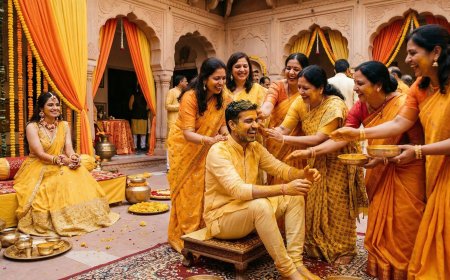




When Rice and Roses Rain Down: The Sacred Talambralu Ritual in Telugu Weddings
Talambralu is the breathtaking climax of every Telugu Hindu wedding — when bride, groom, and their entire gathered family shower each other with raw rice and rose petals, invoking abundance, fertility, and lifelong love. Rooted in Vedic tradition and documented as far back as the Kakatiya dynasty, this ritual is as spiritually profound as it is visually spectacular. For Telugu NRIs planning weddings across the US, UK, Canada, UAE, and Australia, this is your complete guide to performing Talambralu authentically, joyfully, and practically — wherever in the world you call home.


In the luminous arc of a Telugu wedding ceremony, Talambralu is the moment the entire gathering has been waiting for — when bride and groom shower each other with rice mixed with rose petals, blessing one another with abundance, fertility, and a love that is both ancient and achingly personal. For Telugu NRIs from Hyderabad to Houston, from Vizag to Vancouver, this ritual is the visual heartbeat of the wedding, the moment that fills every photograph and every memory. And it is the one ritual that, no matter which country you are standing in, makes the whole room feel like home.
You remember it from childhood weddings — that sudden shower of white and pink, the laughter that broke through the solemnity, the way your aunties leaned forward in their chairs as if pulled by something invisible. You were probably in the second row, wearing a silk pavadai that scratched at the collar, and you didn't understand the Sanskrit being chanted. But you understood that moment. Everyone did. Something shifted in the room when the rice began to fall.
Now you're planning your own wedding. You're in a flat in London's Wembley area, or in a suburb of Dallas, or in a townhouse in Brampton, and you've been on three calls this week with your mother in Hyderabad who keeps saying, "The Talambralu must be done properly — not just a handful of rice, not just a gesture." She means it. She has meant it since the day you told her you were getting married. Because she knows, as you are beginning to understand, that this ritual is not decoration. It is declaration.
It is two people saying, with open hands and open hearts: I pour everything I have over you. And I always will.
🌟 DID YOU KNOW?
- Talambralu derives from the Sanskrit root talambralu meaning "that which is showered with auspiciousness" — the mixture of raw rice and rose petals used in the ritual has been documented in Telugu wedding traditions dating back to the Kakatiya dynasty of the 12th and 13th centuries, when it appeared in inscriptions describing royal wedding ceremonies in the Deccan.
- The rice used in Talambralu is specifically akshata (unbroken, uncooked rice) — in Vedic symbolism, unbroken rice represents wholeness, continuity, and an uninterrupted life force. Broken or cooked rice is considered inauspicious for this ritual because it represents something already consumed or incomplete.
- A 2023 survey by the Telugu Association of North America found that Talambralu was ranked the most visually documented ritual at Telugu NRI weddings — more couples hired a dedicated second photographer specifically for this moment than for any other single ritual in the ceremony.
What Is Talambralu?
Talambralu — the word itself is Telugu, rooted in the act of sacred showering — is one of the most joyful and visually arresting rituals in the Telugu Hindu wedding sequence. It occurs after the Jeelakarra Bellam (the cumin and jaggery binding ritual) and typically just after or alongside the Mangalyadharanam (the tying of the sacred thread), placing it at the absolute emotional climax of the ceremony. By the time Talambralu happens, the couple is already spiritually married. This ritual is the universe's applause.
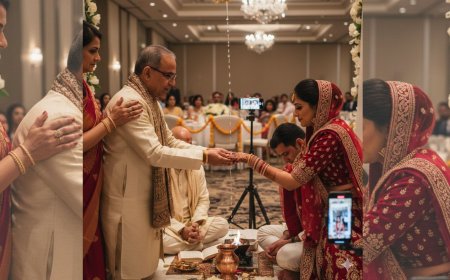
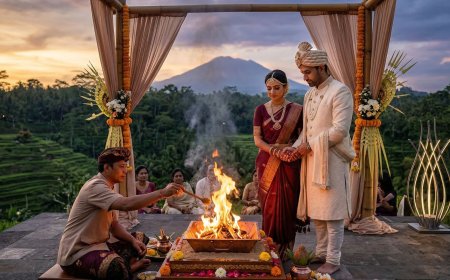
What physically unfolds is this: the bride and groom are seated or standing facing each other, close enough to feel each other's breath. A mixture of raw akshata (uncooked rice grains) and rose petals — sometimes also mixed with turmeric-dusted rice for additional auspiciousness — is placed in large, shallow plates or in the couple's own cupped hands. The groom showers the mixture over the bride's head. She showers it over his. Then they do it again, and again, often laughing by the third round, often moved to tears by the fourth.
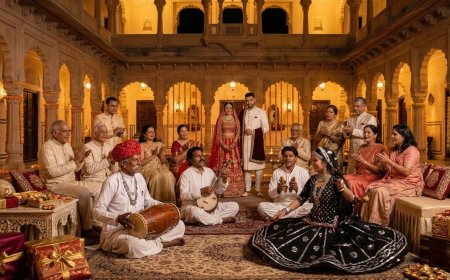
The families shower the couple simultaneously from their seats or from standing positions nearby. The priest chants Vedic shlokas (sacred hymns) invoking prosperity, longevity, and divine blessing upon the union. The entire hall participates — grandmothers throw rice with arthritic hands; small children fling fistfuls with wild enthusiasm; new in-laws stand side by side and shower the couple together for the first time as one family.
The symbolism is layered and deliberate. Rice in Indian civilization is not merely food — it is anna (sacred sustenance), the crop upon which an entire subcontinent's survival has depended for millennia. To shower someone in rice is to wish them a life of never going without. The rose petals bring sringara (the rasa of love and beauty) — they soften the abundance, they make it fragrant, they remind everyone present that a life well-lived is not only full but beautiful.
Together, rice and roses say what no wedding speech ever quite manages to say: may your life be both enough and exquisite.
Community Comparison Table
| Community / State | Local Name | Key Tradition | How NRIs Abroad Adapt It |
|---|---|---|---|
| Telugu (Andhra & Telangana) | Talambralu | Akshata and rose petals showered mutually by couple and family at ceremony's peak | Pre-mix rice and petals in zip-lock bags per guest; source fresh roses from florists 48 hrs before |
| Himachali | Akshata Varsha | Turmeric-dusted rice showered by elders over couple during key Saptapadi moment | Turmeric rice prepared by family night before; elder-led showering preserved fully |
| Garhwali | Chhitar | Grains of rice and barley scattered over couple as blessing by priest and family | Barley sourced from health food stores abroad; ritual maintained with local priest guidance |
| Kumaoni | Dhaan Chhitkaav | Rice grains scattered over couple by bride's maternal uncle at auspicious moment | Maama (maternal uncle) given ceremonial role; rice measured and set aside ritually |
| Ladakhi | Tashi Delek Offering | Barley flour and dried flowers sprinkled over couple as blessing; community joins | Tsampa flour sourced from Himalayan or Tibetan specialty stores in diaspora cities |
| Kashmiri Pandit | Laaj Hom | Puffed rice offered into sacred fire by bride; family showers akshata over couple | Puffed rice universally available; havan kund substitution discussed with pandit for indoor venues |
| Punjabi | Anand Karaj Lava | Showering of flower petals during circumambulation of Granth Sahib; rose petals by family | Gurudwara ceremony maintained; petals distributed to sangat (congregation) for communal showering |
| Marathi | Akshat Sopan | Akshata showered by priest and family at Antarpat removal; turmeric rice central | Antarpat (silk curtain) recreated with dupatta; akshata prepared with turmeric morning of ceremony |
| Tamil | Pori Vilayaadal | Puffed rice tossed by couple and guests; sisters of groom play central ceremonial role | Sisters assigned formal ritual role; puffed rice (pori) sourced from South Indian grocers |
| Bengali | Shidur Dan & Dhaan Durba | Rice and durba grass showered over couple; bride's vermillion applied at climactic moment | Durba grass sourced from Bengali grocery stores in Jackson Heights NY or Green Street London |
| Rajasthani | Jaimal & Pehraawa Akshata | Rose petals and rice showered during garland exchange (Jaimal) by family | Garland exchange moment preserved as photo focal point; akshata distributed in small pouches |
The Meaning Behind the Ritual
To understand why Talambralu moves people who have not cried at anything since childhood, you have to understand what rice means in the Telugu imagination — and it is not what a supermarket aisle suggests.
In the Rigveda (the oldest of the four sacred Vedic texts), anna (food, specifically grain) is described as Brahman — not metaphorically related to the divine, but literally identical to it. To have rice is to have life. To give rice is to give life. To shower rice over two people beginning their life together is therefore an act of tremendous theological weight — it is the gathered community saying, collectively: we pour our abundance over you. We wish you more than you can hold.
The rose petals are equally deliberate. In the Natyashastra (the ancient Indian treatise on art and aesthetics), sringara rasa — the aesthetic of romantic love — is considered the highest and most complex of all human emotional states. It encompasses not just desire but tenderness, longing, beauty, and the recognition of another soul as precious. The rose, in Telugu poetic tradition, has been associated with sringara for centuries. To mix roses with rice is to insist that a married life must be not only prosperous but beautiful — not only sufficient but loved.
The ritual also marks a transition in how the community sees the couple. Before Talambralu, they are individuals in ceremony. After it — rice in their hair, petals on their shoulders, laughing and blinking and finding each other's eyes — they are ours. They belong to each other and to all of us.
In the simplest words one could offer a non-Indian partner or family member: this is everyone in the room giving the couple everything they have, all at once, with open hands.
Doing Talambralu Abroad: The Practical Reality
Let's be honest about what this ritual looks like in a banquet hall in Mississauga or a hired function room in Southall: it looks, from a venue manager's perspective, like a considerable amount of rice and flower petals about to hit the carpet. This is your first logistical reality, and it is entirely manageable if you handle it in advance.
The single most important conversation you need to have — weeks before the wedding, not the morning of — is with your venue coordinator. Explain the ritual clearly: guests will be distributing small quantities of rice mixed with rose petals and showering them over the couple during a specific moment in the ceremony. Most venue managers, once they understand it is a brief, contained moment rather than a prolonged food fight, are accommodating. The key reassurances to offer are these: you will use a minimal quantity per guest (a small palmful, not a bowlful), you will provide a cleanup crew or add a cleaning fee willingly, and the rice will be raw rather than cooked (easier to sweep). Several NRI couples have successfully negotiated Talambralu in venues that initially hesitated by simply offering to pay a small additional cleaning deposit. It works almost every time.
For sourcing your Talambralu mixture abroad, the formula is simple: good quality raw rice (any long-grain variety works, though some families insist on sona masoori for authenticity), fresh rose petals ordered from a florist two days before the wedding, and optionally a small quantity of turmeric to dust the rice for colour and auspiciousness. In Houston, Patel Brothers on Hillcroft and the Indian stores along Harwin Drive stock everything you need. In Toronto and Mississauga, Gerrard Street East and the Brampton Indian grocery cluster are your destinations. In London, Southall Broadway has at least four stores that carry sona masoori rice in large bags. In Sydney, Harris Park in Parramatta is the address. In Dubai, the Indian grocery stores in Meena Bazaar and Karama carry everything. For the rose petals specifically, call a local florist rather than a grocery store — you want fresh petals, and ordering 72 hours in advance gives them time to source quantity. Ask for loose petals rather than whole roses; many florists will do this for a reasonable price.
Pre-packaging is the practical genius of NRI Talambralu. Rather than having large communal plates that require passing and pouring — unwieldy in a seated banquet hall setup — many NRI families prepare individual small pouches or envelopes of the rice-petal mixture for each guest. Small organza bags, sealed with a small safety pin or ribbon, can be placed on each guest's chair or table setting. This serves two purposes: it controls the quantity, and it transforms the ritual item into a beautiful keepsake that guests take home. The pouches can be labelled in Telugu and English, which non-Telugu guests particularly appreciate.
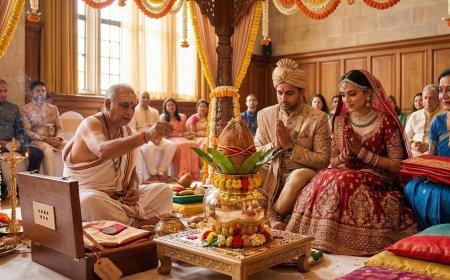
Finding a pandit familiar with the full Telugu Talambralu sequence follows the same guidance as for any Telugu ritual abroad. The Telugu Association of North America, the Telugu Association of UK, the Balaji Temple in Tividale in the West Midlands, and NRI.Wedding's own regional pandit directory are the best starting points. When interviewing a priest, ask specifically: "Are you familiar with the Talambralu sequence as practiced in Andhra and Telangana, including the accompanying Vedic shlokas?" A knowledgeable priest will immediately engage with this question and may ask about your family's community — Kamma, Reddy, Brahmin, Kapu — since the accompanying chants and the precise placement of Talambralu within the ceremony sequence can vary.
For families joining from India by video call, Talambralu is arguably the most rewarding ritual to stream because it is visually spectacular and emotionally immediate. Position your camera or tablet wide enough to capture both the couple and the guests showering them — the full panorama of rice in the air is what will make your grandmother in Vijayawada press her palms together. Set up the stream at least fifteen minutes early. If your wedding is at 6pm in Toronto (EST), your family in Hyderabad will be watching at 4:30am the following morning — confirm this timing the night before and make sure they've set an alarm. Some families send a small packet of akshata to the senior-most relative watching in India, so that at the exact moment of Talambralu, that elder showers their own handful as a simultaneous blessing across time zones. This gesture, costing almost nothing, is remembered forever.
Doing Talambralu as a Destination Wedding in India
Coming home to get married — to do Talambralu in a mandapam in Hyderabad or on the banks of the Krishna river in Vijayawada or in an open courtyard in a heritage haveli in Rajampet — is a choice that rewards you in ways that are impossible to fully anticipate until you are standing there with rice in your hair and jasmine in the air and the faces of three generations around you.
For a full traditional Telugu wedding with an authentic Talambralu sequence, the best venues are the grand kalyana mandapams (wedding halls) of Hyderabad's Jubilee Hills and Banjara Hills, the riverside ceremony venues along the Krishna and Godavari, and the increasingly popular heritage farmhouse resorts on the outskirts of Visakhapatnam that specialise in multi-day traditional ceremonies. Tirupati and its surrounding areas are also deeply meaningful locations for families with strong Vaishnava traditions, where the proximity to the sacred hills adds a layer of blessing that no foreign venue can replicate.
When briefing local pandits in India on your requirements as an NRI couple, bring a written brief that specifies your family's community, the regional variant of the ceremony you want, and any specific shlokas or sequences your family has traditionally used. If your parents or grandparents remember the priest who officiated your parents' wedding, try to find them or a priest trained in the same tradition — this continuity is deeply meaningful.
For non-Indian guests — partners, friends, colleagues — a beautifully designed bilingual ceremony booklet explaining each ritual in English and Telugu is invaluable. Include a page specifically about Talambralu: what the rice means, what the roses mean, what the guests are being invited to participate in. International guests who understand the meaning of what they are doing shower the rice with a reverence and joy that sometimes moves the Telugu family more than they expect.
What You Need: The Talambralu Ritual Checklist
Ritual Items Raw akshata (uncooked rice, preferably sona masoori — approximately 2 to 3 kilograms for a mid-sized wedding), fresh rose petals (ordered from florist 48 hours prior — at least 500 grams for generous distribution), turmeric powder for dusting the rice (optional but traditional), large shallow plates or trays for presenting the mixture to the couple, small organza pouches or paper envelopes for distributing portions to guests, banana leaf lining for the ceremonial tray, and a clean white or red cloth for the couple to sit upon.
People Required The officiant pandit familiar with Telugu tradition, the bride and groom, both sets of parents (who lead the family showering), sisters and brothers of both bride and groom (who often shower most enthusiastically), all assembled guests, a designated family member to distribute guest pouches before the ritual begins, and your wedding photographer and videographer — ideally briefed in advance that this is a priority moment requiring wide-angle coverage.
Preparation Steps Order rose petals from florist three days before the wedding and confirm quantity. Source rice and turmeric from Indian grocery stores at least one week prior. Prepare the Talambralu mixture the morning of the wedding — mix rice, petals, and turmeric gently by hand in a large bowl. Divide into guest pouches if using, and set aside the couple's ceremonial portions in the tray. Brief your pandit the evening before on sequencing and timing. Notify venue coordinator of the ritual and confirm cleanup arrangement. Set up video call with India family and confirm timing.
NRI.Wedding connects Telugu couples abroad with verified regional pandits, ritual item suppliers, wedding photographers experienced in Telugu ceremonies, and complete planning checklists tailored to your community. Find your team at NRI.Wedding.
5 Questions NRI Couples Always Ask
Our venue has a strict no-confetti, no-rice policy. What can we do?
This is more common than it used to be, and there are solutions. First, have a direct conversation with the venue manager specifically about this ritual — many blanket "no confetti" policies were written with paper confetti in mind, not raw rice, and venue managers are often more flexible once they understand what is actually happening. If the policy is truly immovable, there are two alternatives that many NRI couples have used successfully. The first is rose petals only — removing the rice and using only fresh petals, which most venues will accept, preserves the visual beauty and much of the emotional weight of the ritual. The second is to do the full Talambralu outdoors in a garden or terrace area of the venue, even briefly, before returning inside for the remainder of the ceremony. Neither solution is perfect, but both honour the spirit of the ritual.
My partner grew up in Australia and has never been to a Telugu wedding. How do we make Talambralu meaningful for them rather than confusing?
Preparation is everything, and it is simpler than you might think. Sit with your partner in the week before the wedding and walk them through the ritual in full — what the rice means, what the roses mean, what they will feel in their hands and on their head, what the priest will be saying and why. Show them a video of the ritual from a previous Telugu wedding if you can find one. On the day itself, if your pandit is willing, ask them to give a brief bilingual explanation of the ritual in English before beginning. Most importantly, tell your partner: you are not a passive recipient in this moment. You are showering me too. Your hands matter as much as mine. When a partner from outside the tradition understands this, they invariably participate with a seriousness and tenderness that becomes one of the most talked-about moments of the entire wedding.
How do I find a Telugu pandit in Canada who knows the specific Talambralu sequence rather than a generic Vedic ceremony?
Begin with the Hindu temples in your city that have specific Telugu congregations — in Toronto, the Saptha Rishis Hindu Temple and several temples in Brampton and Scarborough have Telugu community networks. The Telugu Association of North America maintains a list of priests and can often make referrals. When speaking to a potential pandit, ask specifically about the Talambralu sequence, the accompanying shlokas, and whether they have performed it for families from your specific community — Kamma, Reddy, Brahmin, Kapu. A priest who knows the ritual well will ask you these questions before you have to ask them. NRI.Wedding's Canada pandit directory filters by regional tradition and community, which significantly shortens your search.
We want to stream the Talambralu live for family in Hyderabad. What setup actually works?
A tablet on a stable stand — not a phone held by someone's grandmother — is your baseline requirement. Position it wide enough to capture both the couple and the surrounding guests, not just a close-up of the couple's faces. Designate one person whose only job during the ceremony is managing the video call: adjusting the angle, confirming audio, and relaying any technical issues. Brief your India-side family the night before on timing, and ask them to nominate one family member as their coordinator — so you are not receiving twelve separate calls at the moment the priest begins. Most importantly, begin the stream at least ten minutes before the Talambralu moment, so any technical problems surface early. The ritual itself lasts only a few minutes, but those are the minutes your family in India will watch on loop for years.
We have a civil ceremony on Saturday and the Telugu wedding on Sunday. Does the order affect the Talambralu?
Not in the eyes of the tradition. The religious ceremony carries its own complete and self-contained significance in Telugu Hindu culture — it is not defined by or dependent on what civil paperwork preceded it. Your pandit will regard Sunday's ceremony as the whole and sacred event. What matters is that the Talambralu and the surrounding rituals are performed with proper preparation, the right items, and the right priest, in the right sequence. Many NRI couples find that separating the civil and religious ceremonies actually gives each its own full, unhurried space — the civil registration on Saturday, intimate and practical; the Telugu wedding on Sunday, complete and sacred. The rice and roses on Sunday do not know or care about Saturday's paperwork. They know only that two people are beginning.
The Emotional Angle
There is something that happens to a Telugu mother when the rice begins to fall at her child's wedding abroad. It is not something she planned to feel, and it is not something she can easily describe afterward. She has been managing the logistics for months — the pandit's flight, the silk sarees packed in tissue, the akshata measured into containers and carried in her hand luggage because she did not trust the checked bag. She has been practical and capable and exhausting to be around, and everyone has let her be all of those things because they know it is the only way she knows to love across distance.
But when the rice rises into the air — when it catches the light of the wrong chandeliers in the wrong country and for one suspended second looks exactly like it did at her own wedding in Rajahmundry or Nellore or Warangal thirty years ago — she stops being practical. She becomes the girl who remembers. She showers her handful with hands that are shaking not from age but from the specific grief and gratitude of a parent who made a life in a foreign country so that this child could have everything, and then watched that child choose to carry the old things anyway.
The rice falls. The roses catch in the bride's hair. The priest chants the same words that were chanted over this woman's own head decades ago. And she understands, for the first time in a long time, that she did not lose anything by leaving. She carried it.
She always carried it.
A Moment to Smile
At a Telugu wedding in Houston in the spring of 2021, the Talambralu was going beautifully — the rice gleaming, the roses fragrant, the priest in full voice — when the groom's seven-year-old nephew, seated in the front row with his carefully prepared organza pouch of akshata, decided that the moment called for maximum effort. He stood up on his chair. He wound up like a baseball pitcher. He released with complete commitment.
The entire pouch — rice, petals, turmeric and all — landed directly in the priest's lap.
There was a silence of approximately one second. Then the priest looked down at his dhoti, looked up at the child, and began to laugh. He laughed so hard he had to pause the chanting. The bride and groom, who had been holding their composure admirably up to that point, lost it completely. The hall erupted.
The nephew sat back down with the satisfied expression of someone who had done exactly what the moment required.
He was not wrong.
Quotes from the Diaspora
"I was not going to cry at my own wedding. I had decided this. I had been very clear with myself. Then the rice hit my face and I smelled the roses and I heard my naana's voice — she was on the laptop, in Guntur — and she was saying my name the way only she says it. I cried. Obviously I cried. There was never any question." — Priyanka Yellamanchili, Kamma community, Dallas, Texas
"My daughter-in-law is from Kerala. She had never done Talambralu before. I showed her how to hold the rice, how to shower it gently, not just throw it. She practiced with me the night before in the hotel room. At the wedding, she did it perfectly — better than perfectly, with so much love in her face. I thought, this is how traditions travel. Not because we force them. Because someone new decides they are worth learning." — Saradha Venkataraman, Brahmin (Vaidiki) community, mother of the groom, Melbourne, Australia
"The venue in Wembley was not what I imagined for my wedding. It was a function hall that also hosted corporate events on Tuesdays. But when the Talambralu happened — when the rice was in the air and my husband was laughing and my mum was crying and my best friend from university, who is from Manchester and had never been to an Indian wedding, was showering rice with this enormous smile — I looked around and thought: this is exactly what I imagined. This is exactly it." — Deepika Gudipati, Reddy community, London, UK
Your Roots Travel With You
You carried the akshata in a container in your hand luggage because you did not trust the checked bag. You ordered the rose petals from a florist in Brampton who had to look up what loose petals even meant. You briefed your pandit on a video call at midnight, his face lit by a phone screen in Hyderabad, your face lit by a laptop screen in your living room in Toronto. You pre-packaged sixty organza pouches on the kitchen table while your mother talked and your father pretended to help and the TV played in the background.
And then the morning came. And the rice rose into the air. And for a moment — just a moment — you were not in Canada or the UK or the UAE. You were simply at your wedding, surrounded by the people who love you most, doing something your grandmother's grandmother also did, in a saree not unlike yours, with rice not unlike this rice, and a heart full of exactly the same hope.
NRI.Wedding is here for every moment of that journey — from finding your pandit to sourcing your vendors, from planning your ritual checklist to connecting you with photographers who understand what this moment means and how to capture it before the rice falls and the tears begin.
Your roots traveled with you. This is where they bloom.
This article explores Talambralu, the sacred rice and rose petal ritual at the heart of Telugu Hindu weddings, and its practice among Telugu NRI communities in Houston, Toronto, London, Melbourne, and Dubai — offering cultural depth, practical planning guidance, and emotional resonance for diaspora couples celebrating heritage across oceans.
What's Your Reaction?
 Like
0
Like
0
 Dislike
0
Dislike
0
 Love
0
Love
0
 Funny
0
Funny
0
 Angry
0
Angry
0
 Sad
0
Sad
0
 Wow
0
Wow
0