





































































Why the UP Brahmin Tilak Is the Most Important Ceremony Before the Wedding — And How to Do It Right Abroad
The Tilak ceremony in UP Brahmin weddings is one of Indian matrimonial culture's most spiritually significant pre-wedding rituals — a formal, witnessed acceptance of the groom by the bride's family, rooted in the ancient tradition of worshipping the groom as Lord Vishnu. This guide covers the ceremony's Vedic origins, regional sweet exchange traditions, and practical advice for Kanyakubja, Saryuparin, and Maithil-influenced NRI families recreating the Tilak in cities like Edison, Leicester, Mississauga, and Sydney — including pandit sourcing, sweet selection, gotra recitation, and coordinating with relatives in Lucknow and Allahabad.


In Uttar Pradesh Brahmin tradition, the Tilak ceremony is the moment a wedding truly begins — not with vows or fire, but with a vermillion mark, a plate of sweets, and the quiet, irreversible declaration that two families have chosen each other. For NRI families carrying this tradition from the lanes of Varanasi, Allahabad, Lucknow, and Kanpur to living rooms in New Jersey, Middlesex, and Mississauga, the Tilak is the ceremony that makes everything that follows feel real.
You grew up watching the men in your family get serious in a particular way at Tilak ceremonies. Not solemn — serious. The way your grandfather straightened his dhoti. The way your father checked the thali three times before carrying it into the room. The way even the loudest uncle went quiet when the pandit began. Nobody explained to you why a ceremony involving sweets and a forehead mark carried the weight of a courtroom oath. Nobody needed to.
Now you are in Edison or Harrow or Oakville, planning a UP Brahmin wedding for your son, and you are trying to hold the Tilak ceremony with the same gravity your grandfather gave it in his courtyard in Allahabad — in a house where the drawing room doubles as the ceremony space and your caterer needs the room back by seven. You are Googling pandit availability. You are calling your mausi in Lucknow to confirm which sweets go on the thali. You are doing what UP Brahmin families have always done: refusing to let the occasion be anything less than what it deserves to be.
This guide is for you.
🌟 DID YOU KNOW?
- The Tilak ceremony in UP Brahmin tradition is rooted in the ancient practice of Var Puja — the formal worship of the groom as a manifestation of Lord Vishnu — a custom documented in Sanskrit texts including the Grihyasutras (household ritual manuals) dating back over 2,500 years, making it one of the oldest continuously practised pre-wedding rituals in the world.
- The specific sweets exchanged during a UP Brahmin Tilak are not interchangeable — Peda from Mathura, Khoya Barfi, and Launglata (a deep-fried sweet pastry filled with khoya and spices) carry specific regional and seasonal significance, and families from different districts of UP maintain distinct sweet traditions that can identify their origin as precisely as a surname.
- According to community data from UP Brahmin cultural associations in the UK and North America, the Tilak ceremony has the highest preservation rate of any pre-wedding ritual among UP Brahmin NRI families — over 81% of families report conducting a full formal Tilak even when other ceremonies are simplified, citing it as the ritual they feel most strongly about maintaining in its complete form.
What Is the Tilak Ceremony?
The Tilak ceremony — also known in UP Brahmin tradition as Var Tilak or Tilakotasav — is the formal pre-wedding ritual in which the bride's family travels to the groom's home to officially accept him as the intended husband. It is the ceremony that converts an informal understanding between families into a public, witnessed, spiritually sanctioned commitment. Nothing before the Tilak is binding. Everything after it is.
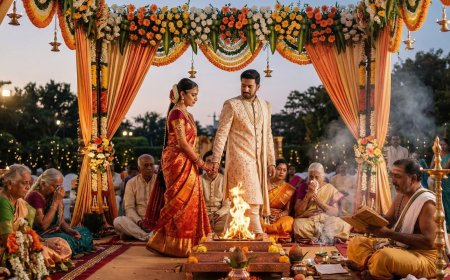
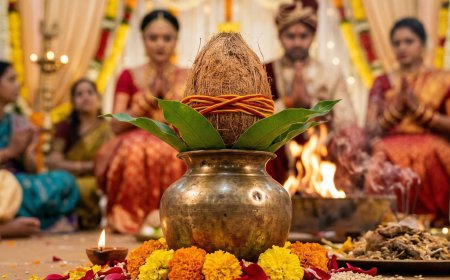
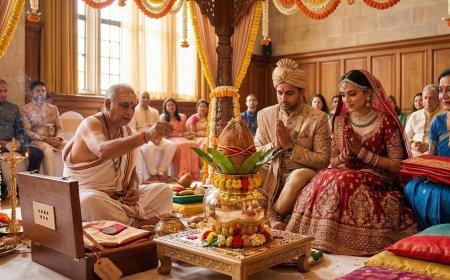
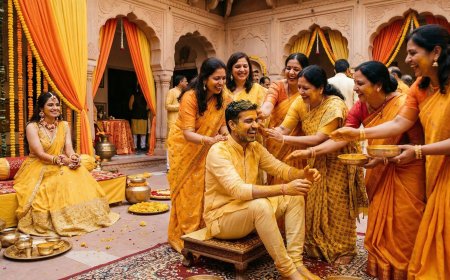
The ceremony begins with the arrival of the bride's party — her father, brothers, maternal uncle, and senior male relatives — at the groom's home, carrying decorated thalis (ceremonial trays) laden with specific offerings. The central thali holds kumkum (vermillion powder), akshat (unbroken rice grains), chandan (sandalwood paste), fresh flowers, a lit diya (oil lamp), and the sweets that are specific to the family's regional tradition. A cash shagun (auspicious gift) is also presented, its amount traditionally an odd number — never even — because odd numbers in Hindu numerology signify incompleteness that seeks completion, appropriate for a ceremony that is itself the beginning of something.
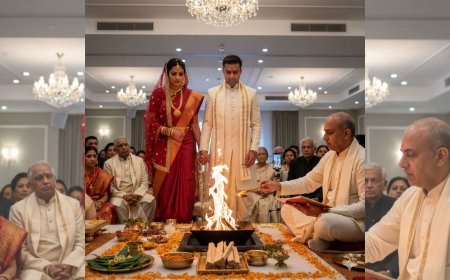
The groom is seated facing east, dressed formally, and the bride's father or eldest brother applies the Tilak to his forehead — a single vertical or circular mark of kumkum and chandan, placed precisely at the ajna chakra (the spiritual centre between the eyebrows). The groom's family simultaneously presents their own thali of sweets and gifts to the bride's party. The pandit recites Sanskrit shlokas specific to the Var Puja tradition, invoking Lord Vishnu's blessings on the groom and formally acknowledging the alliance between the two gotras (lineage groups).
The sweets exchange that follows is not a formality. In UP Brahmin tradition, the specific sweets on the thali communicate the family's identity, their district of origin, and the level of regard in which they hold the occasion. This is why your mausi in Lucknow has opinions about your sweet selection that she is not shy about sharing.
The Tilak typically happens days or weeks before the main wedding ceremony — allowing both families time to complete remaining preparations with the security of knowing that the alliance is formally sealed.
Community Comparison Table
| Community / State | Local Name | Key Tradition | How NRIs Abroad Adapt It |
|---|---|---|---|
| UP Brahmin (Kanyakubja) | Var Tilak / Tilakotasav | Groom worshipped as Vishnu; elaborate sweet exchange; bride's brother applies Tilak; gotra recitation by pandit | Ceremony held at family home or hired hall; sweets ordered from Indian sweet shops in Wembley or Devon Ave Chicago |
| UP Brahmin (Saryuparin) | Tilak with Panchamrit | Groom bathed ceremonially in Panchamrit (five sacred liquids) before Tilak; emphasis on purity rites | Panchamrit prepared at home; ceremony condensed to single afternoon; pandit sourced via UP Brahmin community networks |
| UP Brahmin (Maithil influence) | Tilak and Madhuparka | Madhuparka (honey and curd mixture) offered to groom as part of welcome; distinct from mainstream UP practice | Madhuparka prepared fresh; community elder guides preparation if pandit unfamiliar with Maithil customs |
| Rajasthani (Rajput) | Tilak / Sagan | Tilak applied by bride's brother; sword presented to groom; more martial ceremony aesthetic | Sword carried ceremonially; Rajasthani sweets including Ghevar and Mawa Kachori on thali |
| Punjabi (Hindu) | Sagan / Tilak | Less formal; Tilak combined with ring exchange; sweets and dry fruits exchanged; Bollywood songs played | Combined with engagement party format; held at banquet hall; professional photographer standard |
| Himachali Brahmin | Shagun Tilak | Tilak applied with local herbal paste; Himachali sweets including Mittha (sweet rice) offered | Local herb paste replaced with standard chandan; Himachali community gathers for folk blessing songs |
| Garhwali Brahmin | Tilak with Mandua sweets | Regional grain-based sweets specific to Garhwal offered alongside standard sweets; elder-led ceremony | Mandua sweets made at home by family; ceremony held morning-of with community presence |
| Kashmiri Pandit | Livun / Tilak equivalent | Purification ceremony central; walnuts, rice, and saffron featured on offering tray; distinct ritual sequence | Saffron brought from Kashmir; walnuts sourced locally; Kashmiri pandit essential for correct sequence |
| Marathi Brahmin | Sakhar Puda / Tilak | Green saree gifted alongside Tilak; Maharashtrian sweets including Puran Poli and Modak on thali | Modak ordered from Marathi sweet shops; green saree sourced online from Pune suppliers |
| Tamil Brahmin (Iyer) | Nichayathartham | Formal betrothal with horoscope exchange, garland ceremony, and elder blessings; sweets include Mysore Pak and Ladoo | Tamil pandit essential; Mysore Pak ordered from South Indian sweet shops in Markham or Harrow |
| Bengali Brahmin | Aashirbaad | Elder blessings with sandal paste; mishti (sweets) including Sandesh and Rosogolla exchanged; intimate family gathering | Sandesh ordered from Bengali sweet shops; ceremony held at family home with video call for Kolkata relatives |
| Bihari Brahmin | Tilak with Maithili customs | Similar UP structure with Bihari regional sweets; Thekua (wheat and jaggery sweet) specifically featured | Thekua made at home by family women; ceremony sequence closely follows UP Brahmin format |
The Meaning Behind the Ritual
In the UP Brahmin understanding of marriage, the groom on his wedding day is not simply a man — he is Vishnu Swaroop, a living embodiment of the preserver god. The Tilak ceremony is therefore not a social event. It is an act of worship. The bride's family approaching the groom's home with decorated thalis and lit diyas are approaching a deity. The mark they place on his forehead is not a social gesture. It is abhishek — the anointing of the divine.
This theology has profound practical consequences for how the ceremony is conducted. The groom must be bathed, purified, and dressed before the bride's party arrives — he must be ready to receive worship. The bride's father, in applying the Tilak, performs an act of simultaneous humility and sovereignty: he acknowledges the groom's worth while also declaring his own family's honour in having chosen him.
The sweets exchanged carry a symbolism rooted in Annapurna worship — the goddess of food and nourishment, whose domain is abundance, hospitality, and the sustaining of life. To offer sweets is to say: we come with abundance. We come in the spirit of nourishment. What passes between our families will be sweet.
The shagun amount — always odd, often ending in the auspicious digit one — encodes the mathematical philosophy of Advaita (non-duality): one is the number that precedes all pairs, the reminder that beneath the duality of two families, two gotras, two individuals, there is a single unifying principle. The number says: we are already, in some essential way, one.
For a non-Indian partner or guest: the Tilak ceremony is the moment one family looks at another family's son and says, in front of witnesses and god — yes. Him. We choose him completely.
Doing the Tilak Ceremony Abroad: The Practical Reality
The UP Brahmin Tilak abroad presents a specific challenge that families rarely anticipate until they are in the middle of it: the ceremony requires both families to be equally prepared, equally informed, and operating from the same understanding of the ritual sequence. When one family is in New Jersey and the other has flown in from Lucknow forty-eight hours ago and is operating on a nine-and-a-half-hour time zone difference, alignment requires active effort.
The sweets are your most emotionally loaded logistical challenge. UP Brahmin families are particular about their Tilak sweets in a way that deserves to be taken seriously rather than simplified. Peda — ideally from a trusted Indian sweet shop — Khoya Barfi, Launglata, Imarti, and Motichoor Ladoo are the traditional UP Tilak thali sweets. In London, Wembley High Road and Southall Broadway have multiple Indian sweet shops that carry UP-style mithai, though calling ahead to confirm specific varieties is advisable. In New Jersey, Oak Tree Road in Edison is the definitive destination — the concentration of Indian sweet shops there makes it possible to source an authentic UP Tilak thali entirely locally. In Toronto, Gerrard Street East and the Mississauga corridor have reliable options. In Houston, Hillcroft Avenue carries a wide range. In Sydney, the Parramatta area has Indian sweet shops that can accommodate advance orders.
The pandit for a UP Brahmin Tilak must be familiar with Var Puja specifically — the formal worship of the groom as Vishnu — and with gotra pravachan (the recitation of both families' lineage groups). A general Hindu pandit may be able to conduct a simplified Tilak but will not have the specific UP Brahmin sankalpa (ritual declaration) formulations. NRI.Wedding's pandit directory includes priests with documented UP Brahmin tradition experience. UP Brahmin community associations in Leicester, Harrow, Edison, and Mississauga maintain networks of visiting priests from Varanasi and Allahabad who travel during wedding season — contact them five to six months ahead for peak season dates.
The ceremony space for a Tilak requires less infrastructure than most Indian wedding rituals. A cleared living room, a family home dining room, or a private function room works perfectly. You need a mat or aasan for the groom to sit on, a low table for the thali, adequate lighting for photography, and enough seating for both families. The ceremony itself takes between forty-five minutes and two hours depending on the level of pandit recitation the family wants.
Coordinating with India is particularly important for the UP Brahmin Tilak because the bride's family is often the travelling party in the traditional structure — and for NRI families, that may mean coordinating the arrival of relatives from India with venue booking, accommodation, and a ceremony timing that works across time zones. If key members of the bride's family cannot travel, the ceremony can be restructured with resident family members applying the Tilak while India-based relatives witness via video call and offer blessings live. If your family is in Lucknow or Allahabad (IST), a mid-morning ceremony in the UK (10:00 AM GMT) falls at 3:30 PM IST, while a morning ceremony in New Jersey (11:00 AM EST) falls at 9:30 PM IST — workable for evening viewing in India with advance arrangement.
Doing the Tilak Ceremony as a Destination Wedding in India
If your wedding is taking place in Uttar Pradesh or a nearby destination, the Tilak ceremony finds its fullest expression in the landscape and culture that created it.
Varanasi remains the spiritual heartland of UP Brahmin tradition, and a Tilak conducted in a Varanasi haveli with a Kashi-trained pandit carries a resonance that is genuinely difficult to replicate elsewhere. The city's ancient ghats and the particular quality of its ritual life — where ceremony and daily existence are entirely continuous — make every wedding moment feel embedded in something permanent. Lucknow offers a more refined, nawabi-inflected aesthetic — its heritage properties and the city's legendary hospitality make it a superb destination for UP Brahmin families who want cultural authenticity with contemporary comfort. Allahabad (Prayagraj), at the confluence of sacred rivers, carries deep spiritual significance for Brahmin families and offers heritage venues in a city whose association with learned Brahmin tradition runs through centuries of history.
Brief local pandits on your specific regional sub-tradition — Kanyakubja, Saryuparin, or Maithil-influenced customs are distinct, and a pandit from a different UP tradition may need written guidance on your specific sequence, sweets order, and gotra formulations.
For non-Indian guests attending a destination Tilak in India, the ceremony's intimacy and the beauty of its setting make it one of the most accessible Indian rituals for international observers. A brief written explanation of the Var Puja theology — the groom as Vishnu, the forehead mark as anointing — transforms the experience from exotic to profound.
What You Need: Ritual Checklist
Ritual Items Decorated thali containing: kumkum, akshat, chandan paste, fresh marigold flowers, a lit diya, and a small Vishnu image or coin. UP Brahmin Tilak sweets — Peda, Khoya Barfi, Launglata, Motichoor Ladoo, and Imarti as minimum. Shagun envelope with an auspicious odd-number cash amount. Panchamrit ingredients if the family observes the pre-Tilak purification rite — milk, curd, honey, ghee, and sugar. Fresh dhoti or kurta-pyjama for the groom in white or cream. Incense and dhoop for the ceremony space. A clean aasan for the groom to sit on.
People Required The bride's father as the primary Tilak applicant, or eldest brother if the father is unable. Senior male relatives from the bride's family as witnesses. The groom seated and prepared to receive the ceremony. A UP Brahmin experienced pandit for Var Puja recitation and gotra pravachan. A designated photographer — the moment of Tilak application is among the most photographed instants in the UP Brahmin wedding sequence.
Preparation Steps Confirm pandit and brief on gotra and regional tradition eight to twelve weeks ahead. Order or plan sweets sourcing six weeks ahead. Prepare ceremony space and aasan the morning of. Confirm India video call link and time with relatives one week before. Brief all attending family members on the sequence and their specific roles two days before. Prepare shagun envelope the evening before.
NRI.Wedding connects UP Brahmin families with pandits experienced in Var Puja tradition, sweet vendors across diaspora cities, and photographers who understand the quiet power of this ceremony — find them all in our vendor directory.
5 Questions NRI Couples Always Ask
Can the Tilak be conducted at a wedding venue rather than the groom's home?
Yes — and many NRI families do this for practical reasons, particularly when the groom's family is also travelling from abroad and has no local home to host the ceremony. A private function room at a hotel, a hired community hall, or even a large family friend's home all work well. The important thing is that the space feels like it belongs to the groom's family for the duration of the ceremony — it should be set up before the bride's party arrives, with the groom seated and ready to receive them, replicating the domestic arrival dynamic of the traditional structure.
What if our gotras are unknown or incomplete? Can we still do the Tilak properly?
This is more common in NRI families than people acknowledge, and a good pandit will have a solution. Most UP Brahmin pandits carry reference texts for gotra identification and can guide families through the process of establishing the correct gotra before the ceremony. If the gotra genuinely cannot be determined, there are accepted Vedic substitutions that maintain the ritual's integrity. Raise this with your pandit at your first meeting — well before the ceremony day — so there is no uncertainty on the morning.
How do we handle the sweet exchange when our family is in the UK and the sweets we need are very specifically from UP?
For the most specific regional sweets — Launglata in particular — advance ordering from Indian sweet shops in Leicester, Wembley, or Southall with several days' notice usually produces good results. For families who want sweets as close to the Lucknow or Allahabad original as possible, some NRI families ask a travelling relative to bring vacuum-packed mithai in their luggage — this is entirely feasible for dry sweets and barfis. The emotional value of sweets that came directly from the family's home city is not nothing, and families who make this effort consistently report that it transforms the ceremony.
My partner's family is not Hindu and is unfamiliar with the gotra system. How do we explain the gotra recitation during the ceremony?
The gotra system is actually one of the easier elements of Indian wedding tradition to explain to non-Indian guests because it has a clear structural parallel to Western family genealogy. Prepare a simple one-paragraph explanation for your wedding programme: the gotra identifies which ancient sage's lineage a family descends from, ensuring that the two families being united come from different ancestral lines — a system that has functioned as both spiritual identity and genetic wisdom for over three thousand years. Most non-Indian guests find this genuinely fascinating rather than confusing.
We did our civil ceremony six months ago. Does the Tilak still carry its full meaning?
Entirely and completely. The Tilak belongs to your religious and cultural wedding, not your civil registration. The ceremony's meaning — the formal, witnessed, spiritually sanctioned acceptance of the groom by the bride's family — is in no way diminished by a prior civil marriage. Many NRI couples separate their civil and religious ceremonies by months or even years for practical reasons, and the Tilak retains every ounce of its significance regardless. If anything, having had time to settle into the relationship before the religious ceremonies makes the Tilak feel more intentional, not less.
The Emotional Angle
There is a particular kind of UP Brahmin father who does not make speeches. Who expresses love through preparation — through checking the thali contents three times, through calling the pandit a week before to confirm the gotra spelling, through driving forty minutes to the only sweet shop in the city that makes Launglata properly. He does not say: I love my daughter and I want her wedding to be perfect. He says it by arriving at the groom's door with a thali that has been prepared with the attention other people give to contracts.
For NRI families, the Tilak ceremony carries an additional layer of meaning that the ceremony's ancient architects could not have anticipated. When a family in Mississauga or Milton Keynes assembles the same thali their grandfather assembled in a Lucknow courtyard three decades ago — the same sweets, the same kumkum, the same odd-numbered shagun — they are doing something that goes beyond ritual preservation. They are insisting, quietly and completely, that geography is not biography. That where you live does not determine what you carry. That the mark on the groom's forehead means exactly what it always meant, regardless of what city the house is in.
The Tilak survives in the diaspora because UP Brahmin families understand, in their bones, that some promises are not diminished by distance. They are clarified by it.
A Moment to Smile
At a Tilak ceremony in Edison, New Jersey, two springs ago, everything was proceeding beautifully until the bride's eldest brother — assigned the honour of applying the Tilak — discovered mid-ceremony that he had, in his nervousness, picked up the wrong pot from the thali and applied a generous mark of pure sandalwood paste without any kumkum. The groom's forehead was a dignified, pale cream colour. The pandit paused. The room went very quiet.
The bride's mother, without missing a beat, leaned across, corrected the thali, handed her son the right pot, and said in a carrying whisper: "This is why we practise." The room erupted. The groom, who had been sitting with the gravity of a man receiving a state honour, lost his composure entirely and laughed so hard the aasan moved.
The re-applied Tilak was, by general agreement, the most enthusiastically kumkum-coloured mark anyone had ever seen. The brother has not lived it down. He is not expected to.
Quotes from the Diaspora
"My father flew in from Allahabad specifically for the Tilak. He didn't come for the main wedding — he had a heart procedure two weeks later and the doctors said long-haul twice was too much. So he came for the Tilak, applied the mark himself, ate the Peda, and flew home. He said: the rest I can watch on video. This I had to do with my own hands." — Rohini Mishra, Kanyakubja Brahmin family, Leicester
"I spent three weeks finding the right Launglata in Mississauga. Three weeks. My daughter thought I had lost perspective. But when I placed that thali in front of my son-in-law and he recognised it — his family is from Kanpur, they know Launglata — he looked at me in a way that told me he understood exactly what I was saying with those sweets. We didn't need words after that." — Sunita Pandey, UP Brahmin community, Mississauga
"I am the bride and I watched the Tilak from a distance the way you're supposed to. But I could see my father's hands shaking as he applied the mark. My father, who is the most composed man I have ever known, who has never once in my memory been visibly nervous about anything. I understood then that this ceremony was not for me or for my husband. It was for him. His last act as my father before becoming my father-in-law. I think about those shaking hands all the time."— Aditi Shukla, Saryuparin Brahmin family, New Jersey
Your Roots Travel With You
The UP Brahmin Tilak ceremony is proof that the most powerful rituals do not require spectacle. A thali, a forehead, a pot of kumkum, and the right people in the room — this is all it takes to make a promise that has the weight of centuries behind it. NRI families who preserve this ceremony in its complete form, with the right pandit and the right sweets and the same odd-numbered shagun their grandfathers gave, are not being sentimental. They are being precise. They understand that the details are the meaning.
NRI.Wedding is here to make sure every detail is possible, wherever you are. From UP Brahmin pandits experienced in Var Puja and gotra pravachan, to sweet vendors in Edison, Leicester, Mississauga, and Sydney who know what Launglata is supposed to taste like, to photographers who understand the particular stillness of a father's hand at the moment of Tilak — we are with you for every element of this extraordinary ceremony.
Your roots travel with you. Let them mark everything you touch.
What's Your Reaction?
 Like
0
Like
0
 Dislike
0
Dislike
0
 Love
0
Love
0
 Funny
0
Funny
0
 Angry
0
Angry
0
 Sad
0
Sad
0
 Wow
0
Wow
0