







































































Nath and Nose Ring Shopping in Jalandhar — Styles for NRI Brides Who Don’t Wear Them Daily
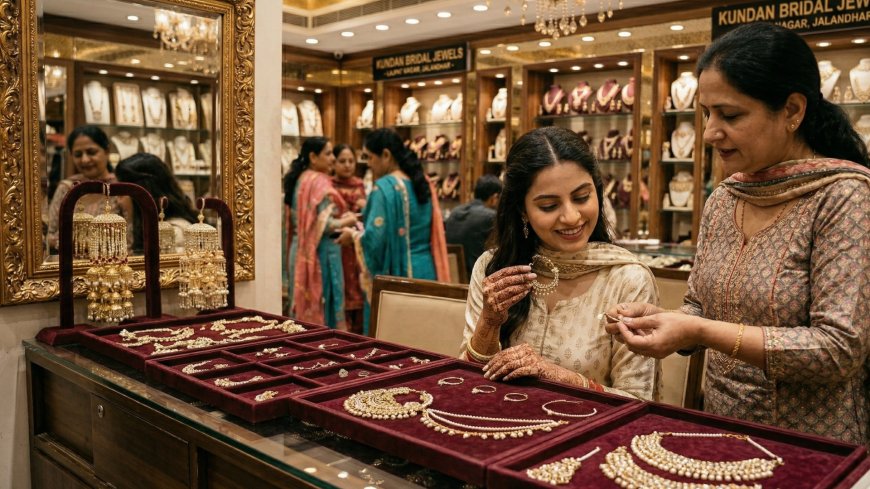
The bridal nath is one of the most distinctive elements of a Punjabi bridal look. In wedding photographs, it frames the face and connects the bridal jewellery with the hairstyle and dupatta. However, many NRI brides who grew up outside India rarely wear nose jewellery, which makes the bridal nath a more complicated decision than most wedding guides suggest. Fortunately, the bridal jewellery markets of Jalandhar offer a wide range of options, from traditional large Punjabi nath styles with pearl chains to subtle minimalist nose rings and modern non-piercing designs. This guide explains the different bridal nath styles available in Jalandhar, where to shop for them, and how brides who do not normally wear nose jewellery can still include this traditional accessory comfortably in their wedding look.

Nath and Nose Ring Shopping in Jalandhar: Styles That Work for NRI Brides Who Don't Wear Them Daily
The Conversation Nobody Prepares You For
It is a Tuesday evening in your flat in Melbourne.
You are three months into wedding planning and approximately six weeks into the specific planning spiral that every NRI bride eventually enters — the one where every decision that seemed individual and self-contained gradually reveals itself to be connected to four other decisions, each of which is connected to four more, and the entire structure of choices begins to feel less like a planning process and more like a living ecosystem that grows faster than you can tend it.
Tonight's spiral started with a photograph.
A wedding photograph from your cousin's Jalandhar wedding last year. Your cousin is radiant in it — the lehenga is extraordinary, the jewelry is perfect, the overall composition of the bridal look is everything a bridal look should be. And in the centre of the photograph, catching the light in a way that no other element of the image quite manages, is the nath.
It is a large piece. A traditional Punjabi nath — the ring that passes through the left nostril, with a decorative face of kundan and pearls that extends across the cheek, connected by a fine gold chain to the hair. It is magnificent. It is completely, unambiguously, recognizably Punjabi in its visual language. And it is, for your cousin who has worn a small nose stud since her early twenties, an entirely natural extension of her bridal look.
For you, it presents a specific and significant challenge.
You have never had your nose pierced. The Melbourne life you have built over the last nine years has involved precisely zero occasions on which a nose piercing felt necessary or relevant. Your relationship with facial jewelry ends at earrings, which you wear daily, and occasionally a decorative hairpin. The idea of a nose ring at your wedding — which you want, genuinely want, because the nath is such a central element of the Punjabi bridal aesthetic and because the photographs without it will look, to your family's eye, noticeably incomplete — requires navigating a set of practical and aesthetic challenges that your cousin, who had the advantage of an existing piercing, did not face.
You have three questions. Can you wear a nath without a permanent nose piercing? What styles work for NRI brides who are not accustomed to wearing nose jewelry and who will be managing an unfamiliar accessory across a long and physically demanding wedding day? And where in Jalandhar do you find the right piece — the nath that is beautiful, manageable, and genuinely appropriate for your bridal look — without wading through a market that is as overwhelming as it is extensive?
This guide answers all three questions. Completely, practically, and with the specific cultural and aesthetic intelligence that NRI brides navigating this decision from Melbourne or Toronto or Birmingham actually need.
The Cultural Significance of the Nath: Understanding What You Are Choosing to Wear
Before the style guide and the market assessment, the cultural context — because the nath is not simply an accessory in the decorative sense. It is one of the most culturally loaded elements of the Punjabi bridal vocabulary, and understanding what it means within the tradition is the foundation of making a meaningful and informed choice about it.
The nath — from the Sanskrit word for nose ring — has been a significant element of Indian bridal adornment across multiple regional traditions for centuries. Within the Punjabi bridal context specifically, the nath is one of the solah shringar — the sixteen adornments that together constitute the complete traditional bridal look. Its inclusion in this canon places it alongside the sindoor, the mangalsutra, and the choora as an element of the bridal look that carries significance beyond the aesthetic.
The traditional Punjabi bridal nath is worn in the left nostril — a convention rooted in the Ayurvedic understanding that the left nostril is connected to the female reproductive system and that adornment of this nostril has significance related to fertility and marital prosperity. The chain that connects the nath's decorative face to the hair — typically attached to a small hook above the left ear — is both functional, providing support for a heavy ornament, and symbolic, linking the adornment to the bride's hair in a single connected composition that extends across the left side of the face.
The decorative vocabulary of the traditional Punjabi nath draws on the same craft traditions that define the region's jewelry more broadly — kundan setting, polki diamonds, pearl work, meenakari enamel, and gold wire work all appear in the nath's decorative face in combinations whose visual richness is calibrated to the significance of the occasion. A bridal nath is not a small or restrained piece — it is a statement, worn on the most expressive surface of the human body, that announces the wearer as a bride with all the cultural weight that announcement carries.
For NRI brides who have grown up understanding the nath's significance through family weddings and cultural exposure but who have not maintained the nose piercing tradition in their daily international life, the wedding nath represents a specific kind of cultural return — a choice to wear, in the context of the occasion that most demands it, an element of the tradition that daily international life has made unfamiliar. This choice is itself meaningful — it is an act of cultural connection that the photographs will document and the family will receive as an expression of belonging that matters.
The Practical Reality: To Pierce or Not to Pierce
This is the question that most NRI brides without existing nose piercings confront first, and it deserves a direct and detailed answer.
The Case for Getting Pierced
A fresh nose piercing, healed properly before the wedding date, allows the bride to wear the full range of traditional Punjabi bridal naths — including the larger, heavier pieces that most completely represent the traditional aesthetic — with comfort, security, and the confidence that the piece will not move, slip, or require management during the wedding day.
The healing timeline:
A nose piercing requires a minimum of four to six months of healing before it is sufficiently established to comfortably support the weight and movement of a substantial bridal nath. The recommendation from experienced jewelry specialists and piercing professionals for NRI brides planning a Jalandhar wedding is to pierce at the eight-to-ten-month mark before the wedding — early enough to allow full healing with contingency time, but not so early that the bride is managing a healing piercing through the majority of the planning period.
The piercing gauge consideration:
Standard nose piercings in Western piercing studios are typically done at 20 gauge — a fine piercing appropriate for small studs and delicate rings. A substantial Punjabi bridal nath may require a slightly wider gauge — typically 18 or occasionally 16 gauge — to accommodate the ring's wire properly. If piercing specifically for a bridal nath, discuss the intended jewelry with the piercing professional and ensure the gauge is appropriate for the piece you plan to wear.
Piercing in Jalandhar versus abroad:
Many NRI brides choose to get pierced in Jalandhar during a planning visit rather than in their country of residence. The advantages of piercing in Jalandhar include immediate access to the traditional piercing knowledge of jewelers who have been piercing for bridal purposes for generations, the ability to try the intended nath at the jewelry visit rather than waiting for a healed piercing at the wedding, and the cultural context of beginning the bridal preparation process in the city where the wedding will happen. The disadvantage is that a Jalandhar piercing on a planning visit eight to ten months before the wedding requires the bride to manage the healing process at home without access to the original piercing professional for follow-up questions.
The Case for Non-Piercing Alternatives
For NRI brides who decide against a permanent piercing — whether because the healing timeline does not accommodate the wedding date, because the desire for a permanent nose piercing does not extend beyond the wedding, or because the individual's practical circumstances make piercing management difficult — the Jalandhar market offers a genuine range of non-piercing nath alternatives that have developed significantly in quality and sophistication in response to NRI demand.
The quality of non-piercing alternatives has improved substantially:
A decade ago, the non-piercing nath market in Jalandhar was limited to low-quality clip-on adaptations that were visually obvious in their mechanism, physically uncomfortable across extended wearing, and incapable of supporting the weight of a substantial decorative face. The market has evolved significantly. Several specialist jewelers and bridal accessory studios in Jalandhar now produce genuinely high-quality non-piercing naths that are designed with the specific requirements of NRI brides in mind — pieces that sit securely, remain comfortable across a full wedding day, and are not visually distinguishable from pierced alternatives in photographs.
The improvement has been driven by NRI demand — a generation of Punjabi diaspora brides who want the aesthetic of the traditional nath without the permanence of the piercing — and by the technical innovation of specialist craftspeople who have developed attachment mechanisms that go beyond the crude clip-on adaptations of earlier iterations.
Understanding Nath Styles: The Complete Taxonomy
The Punjabi nath market spans a range of styles whose differences — in size, construction, decorative vocabulary, and practical wearability — are significant and consequential for the NRI bride making her selection. Understanding the complete taxonomy before entering any shop is the knowledge that makes the selection process productive rather than overwhelming.
By Size
| Size Category | Diameter Range | Best For | Chain Required | NRI Wearability |
|---|---|---|---|---|
| Petite | 2–3 cm | Contemporary fusion looks, minimalist aesthetic | No | Excellent — most manageable for first-time wearers |
| Medium | 3–5 cm | Most traditional Punjabi bridal looks | Optional | Good — comfortable for most brides with proper fitting |
| Large | 5–8 cm | Grand traditional weddings, maximum visual impact | Yes — essential | Moderate — requires piercing for security |
| Statement | 8+ cm | Heritage or palace-style weddings | Yes — essential | Challenging — typically for experienced wearers only |
By Construction and Attachment
| Type | Construction | Piercing Required | Comfort Level | Price Range (INR) | Best For |
|---|---|---|---|---|---|
| Traditional pierced ring | Gold or silver wire through nostril | Yes | Excellent when healed | 5,000–80,000+ | Brides with healed piercings |
| Clip-on basic | Spring clip mechanism | No | Fair — limited duration | 500–3,000 | Short ceremony, backup piece |
| Magnetic attachment | Magnetic disc inside nostril | No | Good — up to 4–5 hours | 2,000–8,000 | Medium-length events |
| Adhesive hook | Medical adhesive pad attachment | No | Good — up to 6 hours | 3,000–12,000 | Full ceremony |
| Wire wrap | Fine wire wraps inside nostril | No | Very good — natural fit | 4,000–15,000 | Full wedding day |
| Chain-only support | Weight carried by chain, minimal nostril contact | Minimal | Excellent | 6,000–25,000 | Heavy decorative pieces |
| Stretch wire | Flexible internal wire fits nostril shape | No | Excellent | 5,000–20,000 | Recommended for most NRI brides |
By Decorative Style
| Style | Decorative Technique | Visual Character | Lehenga Pairing | Cultural Register |
|---|---|---|---|---|
| Kundan | Uncut stones in refined gold foil | Rich, luminous, traditional | Red, pink, ivory, gold | Most traditional |
| Polki | Uncut diamonds in gold | Brilliant, prestigious, timeless | All traditional colors | Highest prestige |
| Meenakari | Colored enamel on metal | Vibrant, colorful, festive | Bright colored lehengas | Traditional festive |
| Pearl work | Pearl clusters with gold | Soft, romantic, bridal | Ivory, blush, pastels | Traditional romantic |
| Mirror work | Mirror glass with thread | Dramatic, folk-inspired | All colors | Contemporary traditional |
| Temple jewelry style | South Indian craft motifs | Architectural, distinctive | Traditional colors | Fusion traditional |
| Minimalist gold | Clean metal work, minimal stones | Contemporary, refined | Pastel, white, contemporary | Contemporary NRI |
| Diamond and gold | Modern setting with diamonds | Glamorous, contemporary | Contemporary bridal | Modern prestige |
By Occasion and Function Count
| Function | Recommended Nath Size | Recommended Style | Attachment Type for Non-Pierced |
|---|---|---|---|
| Haldi | None or very small stud | Simple gold or floral | N/A |
| Mehendi | Small to medium | Oxidised silver or pearl | Wire wrap or magnetic |
| Sangeet | Medium | Contemporary designer | Stretch wire or wire wrap |
| Wedding ceremony | Medium to large | Full traditional kundan or polki | Pierced or chain-support |
| Reception | Medium | Coordinated with reception outfit | Stretch wire or adhesive |
| Post-wedding functions | Small to medium | Simplified traditional | Wire wrap or magnetic |
Styles That Work Specifically for NRI Brides Who Don't Wear Nose Jewelry Daily
This is the section that most guides do not provide — the specific, honest, practically-oriented guidance for NRI brides whose relationship with nose jewelry begins with the wedding and who need to know not just what is available but what is genuinely manageable for someone wearing a nath for the first time across a full and demanding wedding day.
The First-Timer's Priority Matrix
Before any style selection, NRI brides without nose jewelry experience should understand the priority matrix that should govern their choice — the hierarchy of considerations that determines which piece is genuinely right for their specific circumstances.
Priority 1 — Security of attachment: A nath that moves, slips, or feels insecure during the ceremony is a nath that requires active management — conscious attention to a piece of jewelry during moments when all of the bride's attention should be on the ceremony itself. Security of attachment is the non-negotiable first requirement for any NRI bride without nose jewelry experience.
Priority 2 — Physical comfort across extended wearing: A nath that is comfortable during a twenty-minute shop trial may become uncomfortable across six hours of wearing during a wedding ceremony and reception. The piece must be comfortable not just at point of purchase but across the duration of its intended wearing — and this requires assessment that goes beyond the standard shop fitting.
Priority 3 — Aesthetic appropriateness: Within the constraints that security and comfort impose, the nath should be as beautiful and as aesthetically complete as possible. But aesthetic ambition that compromises security or comfort is not a worthwhile trade for the NRI bride wearing nose jewelry for the first time.
Priority 4 — Manageability throughout the day: The nath must be manageable in the practical sense — the bride must be able to eat, drink, smile widely for photographs, and move through the physical demands of the wedding day without the nath requiring constant conscious management.
Style Recommendations by Bride Profile
Profile 1: The bride who wants maximum traditional authenticity
This bride wants the full Punjabi bridal nath experience — the traditional large-face kundan piece with chain, the piece that is fully legible within the traditional aesthetic vocabulary, and that photographs as unmistakably, completely traditional. Her priority is cultural completeness even at the cost of some wearability challenge.
Recommended approach: Get pierced eight to ten months before the wedding. Allow full healing. Commission or purchase a traditional medium-to-large kundan nath with chain support. The chain eliminates the weight burden from the nostril and distributes it to the hair attachment point, making the piece more manageable than its size suggests. Practice wearing across multiple sessions in the weeks before the wedding.
If piercing is not possible: Choose a specialist Jalandhar jeweler who produces chain-support non-piercing naths specifically designed for large decorative faces. The chain-support mechanism transfers the weight of the decorative face away from the nostril attachment point, making a larger piece genuinely manageable without a piercing. The attachment at the nostril is minimal — primarily positional rather than weight-bearing — and can be achieved through a high-quality stretch wire or adhesive mechanism.
Profile 2: The bride who wants traditional aesthetics with practical manageability
This bride wants to look completely bridal in the Punjabi tradition but is realistic about the wearability challenges of a very large or very heavy piece across a full wedding day. She wants beauty and cultural completeness without physical discomfort or security anxiety.
Recommended approach: A medium-sized kundan or pearl nath — three to four centimetres in diameter — with a chain that provides decorative connection to the hair without necessarily functioning as weight support. This size range is the sweet spot for NRI brides who want the traditional aesthetic without the management demands of the larger pieces. A stretch wire attachment mechanism for non-pierced brides provides excellent security at this size range.
The pearl nath variation: Pearl work naths in the medium size range are particularly well suited to the practical-traditional compromise. The pearl surface reflects light beautifully in photographs, the weight of pearl-set pieces is typically lower than equivalent kundan work, and the aesthetic is fully within the traditional bridal vocabulary while being slightly softer and more accessible than the full kundan statement.
Profile 3: The bride with a contemporary or fusion bridal look
This bride's lehenga and overall aesthetic is contemporary or fusion — a pastel color, minimal embellishment, a modern silhouette. A large traditional kundan nath would create a visual dissonance with her bridal look. She wants a nath-adjacent piece that acknowledges the tradition without imposing the full traditional aesthetic onto a contemporary look.
Recommended approach: A small to medium contemporary nath in the minimalist gold or diamond direction — a clean circular ring with minimal but high-quality stone setting, in a size that sits comfortably within the nostril without extending significantly across the cheek. Alternatively, a designer nath in pearl or mirror work that bridges the traditional and contemporary vocabularies without fully committing to either.
The no-nath conversation: For some contemporary NRI brides, the honest conclusion of the aesthetic assessment is that a traditional nath does not work within their chosen bridal look and that the cultural acknowledgment of the nose jewelry tradition can be made through a smaller, more contemporary nose stud rather than a full nath. This is a legitimate aesthetic conclusion — not every Punjabi bridal look requires every element of the traditional vocabulary, and forcing a traditional nath onto a fully contemporary bridal look can create visual dissonance that serves neither the tradition nor the contemporary aesthetic.
Profile 4: The bride who has never worn any nose jewelry and is genuinely anxious about the experience
This bride wants to wear a nath because of its cultural significance and its place in the bridal look, but she is genuinely anxious about the physical experience — the wearing, the management, the unfamiliarity. Her anxiety is legitimate and deserves practical, honest guidance rather than reassurance that minimizes a genuine concern.
Recommended approach: Begin with a trial experience several months before the wedding. Purchase or borrow a non-piercing nath in a small to medium size — not the actual wedding piece, but a comparable weight and attachment type — and wear it for increasingly extended periods across several weeks. The first wearing session might be twenty minutes. The next, forty-five. Working up to a three-hour wearing session several weeks before the wedding builds both the physical familiarity and the psychological comfort that transform an unfamiliar experience into a manageable one.
The practical reassurance: the vast majority of NRI brides who approach the first wearing of a nath with anxiety find that the physical experience is significantly more comfortable than they anticipated. The weight of a well-made medium-sized nath — supported by a chain — is genuinely minimal. The attachment mechanism of a quality non-piercing nath — a stretch wire or adhesive type — is not uncomfortable in normal wearing conditions. The management of the piece during eating requires a brief period of learning — a slightly different approach to fork-to-mouth movement — that most brides master within the first hour of wearing.
The Jalandhar Market: Shop by Shop
The Traditional Jewelry Lanes
Guru Nanak Mission Chowk and Adjacent Lanes
This is the heart of Jalandhar's traditional bridal jewelry market and the location with the highest concentration of nath specialists. The shops in these lanes have been producing and selling traditional Punjabi bridal naths for multiple generations, and their knowledge of the craft — the kundan setting, the gold wire work, the meenakari techniques — is deep and authoritative.
What to find here:
| Product Category | Availability | Price Range (INR) | Quality Range |
|---|---|---|---|
| Traditional kundan nath | Excellent | 8,000–1,50,000+ | Good to excellent |
| Polki nath | Good | 25,000–3,00,000+ | Excellent |
| Pearl work nath | Good | 6,000–80,000 | Good to excellent |
| Meenakari nath | Good | 5,000–60,000 | Good |
| Non-piercing adaptations | Limited | 3,000–20,000 | Variable |
| Custom commission capability | Good | Varies by design | Excellent |
The NRI shopping experience: English language capability varies significantly between shops in these lanes. The shops that have adapted most specifically to NRI bridal clients — those who have invested in English-speaking staff and who are familiar with international aesthetic references — are identifiable by the organization of their portfolio documentation and their willingness to show you photographs of recent NRI bridal clients alongside their standard inventory. Ask for this specifically.
Negotiation environment: The traditional lanes are a negotiating market. Prices are not fixed. The NRI family arriving with a clear brief, making a multiple-piece purchase across the bridal and family jewelry budget, and engaging the negotiation with respectful confidence can expect twenty to thirty percent improvement on the initial quoted price for significant purchase values.
The Old City Silver Market
A secondary zone within the old city that specialises in silver and white metal traditional jewelry — including silver naths in traditional forms that are significantly more accessible in price than the gold-based alternatives and that carry their own authentic craft tradition.
What to find here:
| Product Category | Availability | Price Range (INR) | Quality Range |
|---|---|---|---|
| Silver traditional nath | Excellent | 800–8,000 | Good |
| Oxidised silver contemporary nath | Good | 1,200–6,000 | Good |
| Silver with semi-precious stones | Good | 2,000–15,000 | Good |
| Silver non-piercing adaptations | Moderate | 1,500–6,000 | Variable |
Silver naths are not typically used for the primary Punjabi bridal look — gold is the traditional bridal metal. However, silver naths in oxidised or antique finish have become popular for the mehendi function, for bridesmaids, and for brides whose overall bridal aesthetic uses silver or white metal as its primary jewelry vocabulary.
Model Town Bridal Boutiques
Contemporary Designer Studios
The Model Town commercial area has developed a cluster of contemporary bridal jewelry and accessory boutiques that approach the nath as a design object — creating pieces that blend the traditional Punjabi nath form with contemporary aesthetic vocabulary in response to NRI demand.
What to find here:
| Product Category | Availability | Price Range (INR) | Quality Range |
|---|---|---|---|
| Contemporary fusion nath | Excellent | 3,000–30,000 | Good to excellent |
| Minimalist gold nath | Good | 4,000–25,000 | Good |
| Pearl and contemporary stone nath | Excellent | 2,500–20,000 | Good |
| Non-piercing specialist pieces | Good | 3,500–18,000 | Good to excellent |
| Mirror work and thread nath | Good | 1,500–8,000 | Good |
| Floral nath | Good | 1,000–5,000 | Variable |
| Custom commission | Excellent | Varies | Good to excellent |
These studios are the most NRI-adapted in the Jalandhar market — they are familiar with international aesthetic references, they communicate comfortably in English, they understand the specific needs of brides who do not wear nose jewelry daily, and they have invested in non-piercing alternative development specifically for the NRI bride market. For NRI brides whose primary requirement is manageability combined with contemporary aesthetic quality, the Model Town contemporary studios are the most productive starting point.
The Appointment-Based Specialists
A small number of the most sophisticated Model Town studios operate on an appointment basis rather than open walk-in retail — a format that allows for genuine consultation rather than browsing-based selection. These studios will typically request the bride's brief, lehenga details, and overall bridal aesthetic before the appointment, allowing them to prepare a curated selection that serves the specific brief rather than presenting the full general inventory.
For NRI brides whose time in Jalandhar is limited, the appointment-based format is significantly more efficient than the general market visit — the session begins with a curated selection rather than an overwhelming inventory, and the consultation produces a genuinely guided assessment rather than a self-directed exploration. Request appointments at these studios at least two to three days in advance of the planned shopping session.
GT Road Corridor
Large Format Jewelry Retailers
The GT Road corridor's large format jewelry retailers carry extensive nath inventory across the full style and price range — traditional kundan pieces, contemporary designer options, non-piercing alternatives, and everything between. Their strengths are breadth of inventory, organized retail presentation, and English-language service capability.
What to find here:
| Product Category | Availability | Price Range (INR) | Quality Range | Notes |
|---|---|---|---|---|
| Full style range traditional nath | Excellent | 3,000–1,00,000+ | Variable | Quality varies significantly between pieces |
| Contemporary nath | Good | 2,000–25,000 | Good | Better represented than in old city |
| Non-piercing range | Good | 2,000–15,000 | Variable | Quality varies — assess carefully |
| Bridal sets including nath | Excellent | 15,000–2,00,000+ | Good to excellent | Good value for complete set purchase |
The GT Road retailers' primary limitation for NRI brides with specific or sophisticated requirements is the mass-market orientation of their inventory — pieces selected for broad appeal rather than the specific requirements of a curated bridal look. For standard requirements and accessible price points, the GT Road offers excellent value. For distinctive or custom requirements, the specialist studios of Model Town and the old city craftspeople are more productive sources.
Specialist NRI-Oriented Studios
A small but important category of studios has emerged specifically in response to the NRI bride's particular requirements — studios that have invested in understanding the specific challenges of NRI brides, in developing non-piercing technology to a genuinely high standard, and in building communication and service infrastructure that serves clients planning from abroad.
These studios typically do not have high-street locations or walk-in retail formats. They are found through NRI community referrals, through platforms like NRIWedding.com whose vendor curation is specifically oriented to the NRI bridal market, and through recent NRI brides' recommendations in diaspora wedding planning communities.
Their value proposition for the NRI bride is specific and significant: they understand the problem she is trying to solve — wearing a traditional Punjabi bridal nath beautifully and comfortably without the advantage of an existing piercing or years of nose jewelry experience — and they have developed their product specifically to solve it. The non-piercing mechanisms they have developed are substantially more sophisticated than the general market's clip-on adaptations, their sizing and fitting process is designed around the specific anatomical considerations of nose jewelry novices, and their customer service infrastructure accommodates remote clients with the communication systems that international client relationships require.
The Non-Piercing Nath: A Technical Deep Dive
Because the non-piercing nath is the primary solution for the majority of NRI brides navigating the first-time wearing challenge, its technology deserves a thorough technical examination — the kind of detail that allows NRI brides to evaluate what they are being offered and to distinguish genuinely superior solutions from the general market's less sophisticated alternatives.
Mechanism Comparison
Spring Clip Mechanism
The most basic non-piercing attachment — a spring-loaded clip that pinches the nostril between an inner pad and the outer decorative face.
| Aspect | Assessment |
|---|---|
| Security | Poor — clips can spring open during movement |
| Comfort | Poor — spring pressure causes discomfort within 30–60 minutes |
| Visual | Moderate — clip mechanism may be visible at nostril |
| Weight capacity | Low — suitable only for very light decorative faces |
| Duration suitability | Maximum 1–2 hours |
| Recommendation | Not recommended for wedding day wear |
Stretch Wire Mechanism
A flexible internal wire is shaped to fit the individual nostril, providing a custom-fit hold through gentle elastic pressure.
| Aspect | Assessment |
|---|---|
| Security | Excellent — custom fit provides consistent hold |
| Comfort | Excellent — gentle pressure, adapts to individual nostril shape |
| Visual | Excellent — minimal visibility |
| Weight capacity | Good — suitable for medium to large pieces with chain support |
| Duration suitability | Full wedding day — 8–12 hours |
| Recommendation | The recommended standard for NRI brides' wedding day nath |
Sizing and Fitting: Getting It Right From Abroad
Nostril Measurement for Remote Commission
For NRI brides commissioning a nath remotely — whether through a Jalandhar-based studio or a specialist NRI jeweler — accurate nostril measurements are the foundation of a correctly fitted non-piercing piece.
| Measurement | What to Measure | How to Measure | Why It Matters |
|---|---|---|---|
| Nostril width | Widest internal width of the left nostril | Flexible measuring tape or string, measured at widest point | Determines internal wire diameter |
| Nostril depth | Distance from nostril opening to septum curve | Measured with a small flexible ruler in profile | Determines wire wrap depth |
| Nostril thickness | Thickness of the nostril tissue at the piercing point | Measured by gentle compression with calipers or thin ruler | Determines magnetic gap or clip span |
| Face measurement | Distance from nostril to left ear hairline | Measured across the face surface | Determines chain length |
| Decorative face preference | Diameter and weight of decorative face | Based on reference photographs | Determines overall piece specification |
The Shopping Visit: Practical Intelligence for the Jalandhar Market
Preparing Before You Arrive
The pre-visit research checklist:
Before entering any nath shop in Jalandhar, completing the following preparation maximises the productivity of the shopping session.
| Preparation Task | Why It Matters | How to Complete |
|---|---|---|
| Lehenga swatch preparation | Color matching requires physical reference | Cut a small swatch or photograph in natural light |
| Reference photograph collection | Communicates aesthetic direction precisely | Prepare 10–15 photographs organised by style direction |
| Measurement completion | Remote or in-shop fitting assessment | Complete nostril measurements with assistance |
| Budget determination | Prevents time wasted on irrelevant price ranges | Establish minimum and maximum per piece |
| Attachment type decision | Guides shop selection and piece assessment | Decide between pierced and non-piercing before visiting |
| Style direction clarity | Prevents overwhelming general market browsing | Narrow to two or three style directions before entering |
Common Mistakes NRI Brides Make With the Nath Decision
Mistake 1: Leaving the Decision and Purchase Too Late The nath requires more planning than most other bridal accessories because the non-piercing fit needs to be established, worn-in, and confirmed as comfortable before the wedding day. Purchasing at the planning visit — eight to ten months before the wedding — allows for remote wearing practice, any required adjustments, and the confidence of familiarity before the actual event. Brides who leave the nath purchase to the final weeks before the wedding are buying without the opportunity to practice wearing and without contingency time for adjustments.
Mistake 2: Choosing Size Before Confirming Comfort Duration The most common nath-related disappointment for first-time wearers is discovering that a piece that feels entirely manageable during a twenty-minute shop assessment becomes uncomfortable after two hours of continuous wearing. Always plan an extended wearing test — ideally across a full morning or afternoon at home — before confirming any nath purchase as the wedding day piece.
Mistake 3: Not Considering the Eating and Drinking Dimension A nath that extends significantly across the cheek may require modified approach to eating — a slight turn of the head or a modified fork approach — that becomes natural quickly but that benefits from practice before the wedding day. Brides who have not worn their nath while eating before the wedding reception find themselves self-conscious about this during the dinner, which is an entirely avoidable distraction from the evening's celebration.
Mistake 4: Assuming All Non-Piercing Mechanisms Are Equivalent The quality range between non-piercing nath mechanisms is enormous. A low-quality clip-on mechanism and a high-quality stretch wire mechanism are not equivalent products despite both being described as non-piercing alternatives. Assess the specific mechanism quality rather than accepting the general category description.
Mistake 5: Buying Without Wearing Against the Complete Bridal Look A nath assessed in isolation — without the choora, without the earrings, without the maang tikka, without the full face of bridal makeup and the hair styling — may look and feel different in the complete bridal composition. Before confirming the wedding day nath, wear it as part of the complete bridal look — either during a bridal trial or at home with the jewelry assembled — to assess how it integrates with the total composition rather than how it appears in isolation.
Mistake 6: Not Briefing the Photographer Specifically The nath is one of the most photographically significant elements of the Punjabi bridal look, and the detail photographs of the nath — close-up images of the decorative face, the chain, and the nath's relationship to the surrounding face — are among the most important bridal portraits the photographer will take. Brief the photographer specifically on the nath photography you want — the detail shots, the profile shots that show the full nath and chain composition, and the ritual moments during which the nath is being placed for the first time.
The Emotional Dimension: Wearing the Tradition
There is a moment in the bridal preparation — it happens at different points for different brides, but it happens — when the nath is placed and the chain is clipped to the hair and the bride sees herself in the mirror with the complete Punjabi bridal composition assembled for the first time.
And something shifts.
It is not a dramatic shift. It is not the movie-version of the bridal transformation, complete with swelling music and the gasps of assembled family members. It is quieter than that, and more significant. It is the moment when the bride who has spent nine years in Melbourne or eleven years in Birmingham looks at her reflection and sees, clearly and without any of the identity ambivalence that daily international life can produce, a Punjabi bride.
The nath is part of what makes that moment possible. Its presence on the left side of the face — the chain catching the light, the decorative face sitting exactly as it should against the cheek — is part of the visual composition that makes the reflection recognizable as belonging to a specific tradition, a specific culture, a specific way of celebrating the most significant day of a woman's life.
For the NRI bride who has never worn nose jewelry before, this moment is more surprising and more powerful than she expects. Because the nath that she was anxious about — the piece whose wearability she researched and whose attachment mechanism she tested and whose weight she worried about — turns out to be the element of the bridal look that most completely connects her to the thing she came home to Jalandhar to find.
Herself. In the tradition. At home.
Choose it with care. Wear it with confidence. And let it do what it has always done — tell everyone in the room, without a single word, that the woman wearing it is a Punjabi bride, completely and joyfully and entirely herself.
Complete Nath Shopping Checklist for NRI Brides
Decision Foundation
- Decide between piercing and non-piercing minimum eight months before wedding
- If piercing: arrange at eight to ten months at appropriate gauge for intended nath
- If non-piercing: research specialist studios with stretch wire or chain support capability
- Establish style direction from two to three aesthetic references
- Confirm budget range per piece before market entry
Preparation
- Complete nostril measurements with assistance
- Prepare lehenga swatch — physical fabric, not photograph
- Compile fifteen reference photographs organised by style direction
- Research shops and book appointments at specialist studios minimum three days in advance
- Confirm attachment mechanism preference based on this guide's assessment
In-Shop Assessment
- Assess stone setting security — zero movement standard
- Request weight specification for any piece under consideration
- Conduct minimum twenty-minute wearing test for attachment mechanism assessment
- Assess in natural light against lehenga swatch
- Photograph against lehenga for camera assessment
- Confirm chain length adjustability and adjustment service
Purchase and Commission
- For purchase: confirm exchange policy in writing for remote clients
- For custom commission: provide complete written brief with measurements and references
- Allow minimum six to eight weeks production time for custom pieces
- Arrange proxy assessment for remote purchases of significant value
Pre-Wedding Practice
- Begin wearing practice minimum eight weeks before wedding
- Practice wearing while eating and drinking at six weeks before
- Conduct full-day wearing test at four weeks before
- Wear as part of complete bridal look at bridal trial
- Brief photographer on nath photography requirements
Wedding Day Management
- Prepare backup attachment mechanism — spare adhesive pads or wire
- Carry small mirror for any required adjustment during the day
- Brief one trusted person — bridesmaid or family member — on nath adjustment assistance
- Apply nath after hair and makeup is complete, as the final accessory addition
The Piece That Completes the Picture
The nath that sits on the left side of your face on your wedding day in Jalandhar is not simply an ornament. It is the element of the bridal composition that has been placed in that specific position, on that specific side of the face, in that specific cultural tradition, for longer than any living person can personally remember.
It connects you to every Punjabi bride who wore a nath before you. To your mother's generation, and your grandmother's, and the generations before them whose weddings happened in the same city, under the same sky, with the same ornament chiming softly as it caught the light.
For the NRI bride who spent nine years in Melbourne not wearing nose jewelry — for the bride who researched attachment mechanisms and nostril measurements and style compatibility and photographer briefing protocols — this connection is not diminished by the research. It is made more complete by the intention.
You chose it. You learned how to wear it. You found the piece that was right — for your face, for your look, for your wedding, for your return to the tradition that was always yours even when daily life made it temporarily unfamiliar.
And when the chain is clipped to your hair and the decorative face settles against your cheek and you look in the mirror at the Punjabi bride looking back at you — you will know that all of it was worth it.
Every measuring session. Every reference photograph. Every shop visit. Every wearing practice.
The nath is the piece that completes the picture.
Go find yours.
What's Your Reaction?
 Like
0
Like
0
 Dislike
0
Dislike
0
 Love
0
Love
0
 Funny
0
Funny
0
 Angry
0
Angry
0
 Sad
0
Sad
0
 Wow
0
Wow
0