





































































Getting Jewellery Custom-Made in Jalandhar — Timeline, Costs and What to Bring
For many NRI brides planning weddings in Punjab, the perfect bridal jewellery set does not exist in a display case — it must be created. Jalandhar has long been a centre of traditional jewellery craftsmanship, where kundan, polki and meenakari pieces are still produced using techniques passed down through generations of goldsmiths. Commissioning custom jewellery allows brides to recreate family heirlooms, translate old photographs into modern pieces, or design completely original bridal sets. But the process requires planning. From design consultations and gemstone selection to crafting timelines and making charges, understanding how custom jewellery commissions work is essential for NRI buyers. This guide explains how NRI brides can commission bridal jewellery in Jalandhar, including the preparation required, realistic timelines, production stages, and the costs involved in working with master craftsmen.

Getting Jewellery Custom-Made in Jalandhar — Timeline, Costs and What to Bring
The sketch had been on her phone for eleven months.
Harleen had drawn it herself — not the trained draughtsman's precision drawing, but the specific, this-is-what-I-mean sketch that the person who cannot draw produces when the idea in the mind is clear enough to demand the imperfect expression rather than the continued silence. The sketch showed a necklace. The central pendant was the specific teardrop form that her grandmother's 1971 necklace had used — the form that Harleen had studied in the single surviving photograph of her grandmother at her own wedding, the black and white image whose limited resolution had not prevented Harleen from understanding the pendant's proportions after she had enlarged the photograph to the point where each pixel was the size of a thumbnail.
Around the teardrop pendant, the sketch showed the Kundan stone placement in the specific arrangement that the traditional form required — the stones decreasing in size from the centre outward, the gold foil's surface between them the surface that the kari work produced. The chain was the specific, flat-link chain whose weight the pendant required rather than the delicate chain whose inadequacy for the pendant's mass was the inadequacy that the boutique's standard chain would produce.
She had shown the sketch to three jewellers in the two years since she had drawn it.
The first had been the Indian jeweller in Southall, London, whose display case had the closest existing piece to the sketch's intention and who had looked at the sketch for forty seconds and said: We can make something like this. The price would be between four thousand and six thousand pounds. The timeline would be twelve to sixteen weeks. The something like this had been the specific phrase that had made Harleen say she would think about it.
The second had been the Toronto jeweller whose cousin's recommendation had preceded the visit and whose consultation had been warm and thorough and whose final number — seven thousand Canadian dollars, fourteen weeks — had produced the same, this-is-too-far-from-the-sketch feeling that the Southall visit had produced.
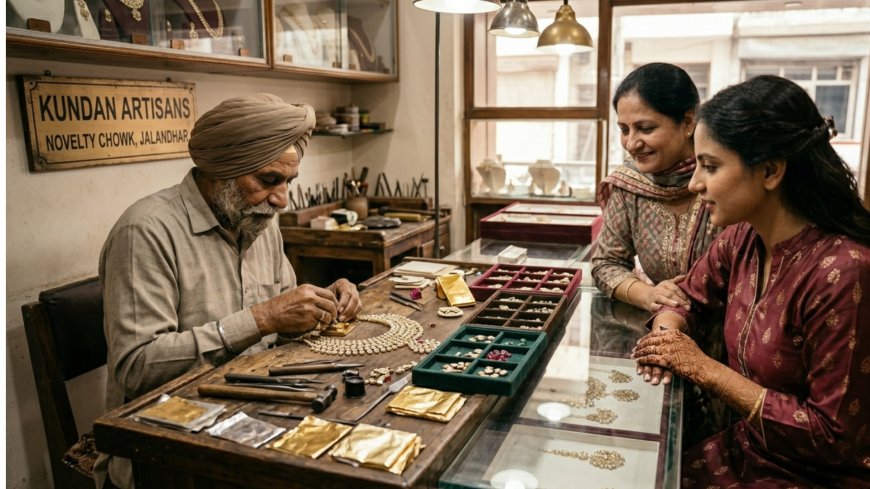
The third had been the Novelty Chowk jeweller in Jalandhar who had been her mother's jeweller for twenty-two years and who had looked at the sketch for four minutes without speaking. Then he had taken out the loupe — the jeweller's magnifying glass — and had looked at the photograph of the 1971 necklace that Harleen had printed and brought specifically because she had learned, by this third visit, that the physical photograph communicated better than the phone screen.
He had said, still looking through the loupe at the photograph: Your grandmother's necklace is the work of the Amritsar style. The teardrop pendant's proportion is the Amritsar proportion — longer than the Jaipur form, the stone placement denser at the top than at the base. The craftsman who made this was trained in the Amritsar tradition.
Harleen had said: Can you reproduce it?
He had put down the loupe.
He had said: I cannot reproduce it. The craftsman who made it is not here. I can make the piece whose design is informed by it. Whether the result is what you are looking for depends on the brief we agree and the craftsman we use. I know the right craftsman. He is in Amritsar. He trained in the same tradition. Come back tomorrow with the measurements you need and the budget you have. We will discuss what is possible.
Harleen had come back the next morning.
What had followed — the discussion, the brief, the commission, the fourteen weeks, the finished piece — had been the process that this guide describes in complete detail, so that the NRI bride who has the sketch on her phone and the grandmother's photograph in her bag arrives at the Jalandhar jeweller's counter prepared for every conversation the commission requires.
This guide is for Harleen, and for every NRI bride who has the specific idea that the boutique's stock cannot provide and who deserves the complete, step-by-step framework for getting that idea made in Jalandhar — from the first conversation through the finished piece in the velvet pouch.
Understanding What Custom Jewellery Commission in Jalandhar Actually Means
The word custom in the jewellery context covers a range of services whose distinction matters for the NRI buyer's timeline, budget, and outcome expectations. Before the commission process begins, the NRI buyer needs to understand which type of custom commission the brief requires — because the different types involve different craftsmen, different timelines, and different price structures.
Type One: The Design Modification
The design modification is the commission in which an existing design — a piece from the jeweller's stock catalogue or the standard production repertoire — is modified for the specific brief's requirements. The colour of the stones changed, the size of the pendant adjusted, the chain length extended, the earring drop reduced. This is the most common form of the custom commission and the one that the most jewellers in Jalandhar can execute because it does not require the pattern drafting from scratch — it requires the application of the specific modification to the existing design.
The design modification's timeline: four to eight weeks for the standard modification at the Jalandhar quality retail level. The price: the stock piece's price plus the modification's additional making charge — typically ten to thirty percent above the stock piece's price depending on the modification's complexity.
Type Two: The Design from Reference
The design from reference is the commission in which the jeweller produces a new piece whose design is informed by a reference that the client provides — the grandmother's photograph, the magazine image, the sketch on the phone. The jeweller and the craftsman study the reference, develop the production brief, and produce the piece whose design relationship to the reference is the design relationship that the brief has specified.
This is Harleen's commission type — the commission that requires the right craftsman rather than any competent craftsman, because the brief's reference is the specific traditional form whose execution requires the craftsman trained in that tradition's specific technique. The design from reference's timeline: eight to sixteen weeks depending on the complexity and the craftsman's current commission load. The price: the material cost (gold weight at the current rate, stone cost at the quality specified) plus the making charge that the specific design's complexity and the specific craftsman's skill level determine.
Type Three: The Entirely Original Design
The entirely original design is the commission in which the client brings the design concept — the idea, the sketch, the mood board, the written description — and the jeweller and the craftsman develop the design from the beginning, with no existing piece as the reference. This is the most demanding commission type for all parties: the client must communicate the concept with sufficient clarity for the craftsman to interpret it, the jeweller must translate the communication into the production brief, and the craftsman must execute the brief in a technique and a material whose constraints the concept may or may not have anticipated.
The entirely original design's timeline: ten to twenty weeks depending on the design's complexity and the production's technical demands. The price: the most variable of the three types because the design development's labour cost is the cost that the production brief's complexity determines and that the pre-commission estimate can only approximate.
The Preparation: What to Bring to the First Conversation
The custom commission's outcome is proportional to the preparation the client brings to the first conversation. The craftsman cannot produce the piece the client imagines from the description the client cannot give. The preparation converts the vague aspiration into the specific brief that the craftsman can execute.
The Reference Material — Physical and Digital
Bring the references in the physical format where possible — the printed photograph, the printed sketch, the actual piece of jewellery whose design element is the reference. The physical reference communicates the proportion, the weight, and the texture in ways that the phone screen's two-dimensional digital image does not.
The 1971 grandmother's photograph in the physical print — the A4 printed sheet rather than the phone screen — is the reference that the jeweller holds at arm's length, brings close, holds under the loupe, and passes to the craftsman for the independent assessment. The phone screen is the reference that the jeweller scrolls through on a surface whose brightness and whose scale the jeweller does not control and that the craftsman cannot hold under the loupe.
Where the physical reference does not exist — the design from the mood board, the concept from the Pinterest board — print the key references before the Jalandhar visit. The twelve printed images whose selection represents the design direction is the reference collection that the jeweller and the craftsman can spread on the counter and assess together. The phone's scrolled gallery is the reference whose assessment requires the jeweller to look where the client directs rather than the jeweller's own eye to find the relevant detail.
The reference material categories to bring:
The design reference — the piece or the image that most closely represents the design intent. Not the complete vision, but the closest existing expression of the vision's key elements.
The detail references — the specific design elements whose presence in the final piece is the requirement. The pendant's specific teardrop proportion from one image. The stone arrangement's specific density from another. The chain's specific link style from a third. The detail references together constitute the composite brief that the single design reference cannot always contain.
The negative references — the pieces or the images that represent what the brief does not want. The necklace that is too delicate for the pendant's weight. The stone arrangement that is too sparse for the traditional vocabulary the brief requires. The negative reference prevents the craftsman's interpretation of the brief in the direction the client has not specified and does not want.
The Measurements
The custom jewellery commission requires the specific measurements whose accuracy the finished piece's wearability depends on — and the measurements that the individual buyer brings to the commission are typically less complete than the commission requires.
The necklace measurement: the preferred wearing length in centimetres from the back of the neck around the front. Not the chain length in inches from the standard catalogue. The actual circumference of the path the necklace will take around the neck plus the clearance below the chin and the clearance above the collarbone. The jeweller can determine the chain length from this measurement. The client who brings the chain length alone may or may not have measured from the same reference point the jeweller uses.
The pendant's size specification: the client's preferred pendant width and height in centimetres. Not the reference photograph's pendant dimensions — the reference photograph's pendant is the proportion reference, not the size reference. The client's body's proportion relative to the pendant is the variable that the photograph's pendant dimensions do not capture. The pendant that looks correct on the grandmother's 1971 frame may require the size adjustment for the client's 2025 frame.
The earring's drop length: the preferred distance from the earlobe to the earring's lowest point in centimetres. The earring that is the correct length for the grandmother's sitting posture at the ceremony may be the earring that catches the shoulder pad at the client's height and the client's shoulder's breadth. Measure the preferred drop length on the body — the tape measure from the lobe to the preferred lowest point — before the commission consultation.
The tikka's chain length: the distance from the hairline's centre parting to the forehead's centre, at the specific position where the tikka's pendant should sit. This measurement is the tikka chain length, and it is the measurement whose specificity the hairstyle determines. The tikka chain whose length is the Jalandhar standard may position the pendant at the correct point for the standard hairstyle and the incorrect point for the specific bridal hairstyle that the NRI bride's stylist has planned. Bring the hairstyle reference alongside the tikka measurement.
The Outfit and the Jewellery System Reference
The custom jewellery piece does not exist in isolation — it exists in relationship to the outfit it will be worn with, the other jewellery pieces it will accompany, and the ceremony's specific function. The commission brief that does not account for these relationships produces the finished piece that is correct in itself and potentially wrong in context.
Bring the lehenga or the saree photograph to the commission consultation. The necklace whose neckline clearance is correct for the plain choli's high neck may be the necklace that disappears below the lehenga's heavily embroidered neckline. The pendant whose scale is correct for the lightweight chanderi may be the pendant that competes with the Bagh Phulkari's surface density. The outfit context changes the jewellery brief in specific ways, and the commission that begins with the outfit photograph produces the piece whose context relationship the design has accounted for.
Bring the other jewellery pieces that the custom piece will accompany — the chooda, the existing earrings, the family's mangalsutra — or bring the photographs of these pieces. The custom necklace whose gold tone is the warm 22 karat yellow gold must be commissioned alongside the awareness that the other pieces in the programme are the same gold tone. The custom necklace commissioned without this awareness may be the piece whose gold tone — the slightly cooler 18 karat setting the craftsman has used for structural reasons — does not match the family's traditional pieces.
The Commission Process: Step by Step
Step One — The First Consultation
The first consultation is the conversation in which the brief is developed — the jeweller, the client, and the reference material together producing the specific commission document that the craftsman will work from. This conversation requires time — a minimum of one hour for the simple modification commission and two to three hours for the design from reference or the original design. The NRI bride who has booked the first consultation as the twenty-minute appointment has not given the consultation the time it requires.
The first consultation's structure: the reference material review (the jeweller and the craftsman examining the references, asking the clarifying questions, identifying the design elements), the measurement confirmation (the measurements verified against the jeweller's standard and adjusted if necessary), the material specification (the gold karat, the stone quality, the stone selection from the jeweller's stock or the sourced requirement), the design discussion (the jeweller's interpretation of the brief communicated to the client, the client's confirmation or correction of the interpretation), and the estimate (the approximate price and timeline based on the brief as understood).
The first consultation does not conclude with the commission. It concludes with the estimate and the NRI bride's decision of whether the estimate's price and timeline are consistent with the wedding programme's requirements. The commission is confirmed at the second meeting — after the NRI bride has reviewed the estimate, confirmed the budget alignment, and returned with any clarifications the overnight consideration has produced.
Step Two — The Design Drawing and the Approval
For the design from reference and the original design commissions, the second meeting includes the design drawing — the craftsman's or the jeweller's interpretation of the brief in the drawn form that the client reviews and approves before the production begins.
The design drawing is the commission's most important approval step. The design drawing in the two-dimensional form is the form that the production will follow — the stone placement, the pendant's proportion, the chain's style, the surface treatment's pattern. The client who approves the design drawing without examining it carefully has approved the production brief without the examination that the finished piece will be measured against.
The design drawing review: every element of the drawing against every element of the brief. The pendant's proportion against the measurements specified. The stone arrangement against the detail reference's density. The chain style against the reference image's link form. The surface treatment against the traditional vocabulary's specific pattern. The correction made to the drawing is the correction made before the production. The correction attempted on the finished piece is the reconstruction whose possibility and whose cost the craftsman will honestly describe.
For the NRI bride who has returned to the UK or Canada between the first consultation and the design drawing's completion, the drawing review can be conducted remotely — the high-resolution photograph of the drawing reviewed on the video call with the jeweller and the craftsman. The remote review's limitation is the scale — the drawing photograph whose proportions the screen distorts requires the client to ask the jeweller to confirm the specific measurements rather than relying on the visual assessment of the photographed drawing.
Step Three — The Material Sourcing
After the design drawing's approval, the jeweller sources the materials — the gold of the specified karat and weight, the stones of the specified quality and size. For the standard materials whose stock the Jalandhar jeweller maintains, this step is the same day's exercise. For the specific materials whose quality or whose size the standard stock does not carry — the specific large polki stone for the central pendant, the specific meenakari colour combination for the reverse's treatment — the material sourcing is the step whose duration adds the first variable timeline element to the commission.
The NRI bride whose commission requires the specific material that the Jalandhar market's standard stock does not carry should ask the jeweller at the first consultation: what is the sourcing timeline for this specific material? The answer is the answer that the timeline's honest assessment requires. The sourcing timeline that adds four weeks to the production schedule is the sourcing timeline that the wedding programme's deadline must accommodate.
Step Four — The Production
The production is the craftsman's work — the gold's working, the stone setting, the meenakari application, the chain making, the finish and the polishing — whose duration is the duration that the piece's complexity and the craftsman's current commission load together determine.
The production timeline for the specific commission types at the Jalandhar quality retail level:
The design modification: three to five weeks for the production after the material sourcing.
The design from reference (the Harleen commission type): six to ten weeks for the production after the material sourcing and the design drawing's approval.
The entirely original design: eight to fourteen weeks for the production after the material sourcing and the design drawing's approval.
The NRI bride whose wedding timeline is fourteen weeks from the first consultation has the timeline that the design from reference commission can accommodate — if the first consultation, the design drawing, the approval, and the material sourcing together take no more than four weeks before the production begins. The NRI bride whose wedding timeline is eight weeks from the first consultation has the timeline that the design modification commission can accommodate and that the design from reference commission cannot.
Step Five — The Progress Communication
The commission's progress communication — the jeweller's update to the NRI client on the production's status during the production period — is the communication whose frequency and format the commission agreement should specify. The NRI bride in Birmingham or Toronto or Sydney who has commissioned the piece in Jalandhar and returned to her home city needs the production status update at the specific intervals that the commission timeline's management requires.
The update format that works for the remote NRI client: the photographic update at the key production milestones. The wax model or the initial metalwork photograph after the first two weeks, showing the piece's structure before the stone setting. The stone setting photograph at the midpoint, showing the stones in position before the meenakari and the finish. The finished piece photograph before the polishing, allowing the client to confirm the design at the last adjustment point before the final finish.
The photographs sent on the WhatsApp are the photographs that the NRI client reviews with the brief's reference alongside — the comparison of the production milestone's photograph against the reference photograph whose design the commission is translating. The divergence that the comparison reveals at the midpoint photograph is the divergence that the craftsman can correct before the finish. The divergence discovered in the finished piece's photograph is the divergence that the correction attempt will partially but not always fully address.
Ask for the milestone photographs. Review them against the reference. Communicate the correction before the next stage rather than after the final photograph.
Step Six — The Finished Piece and the Collection or the Courier
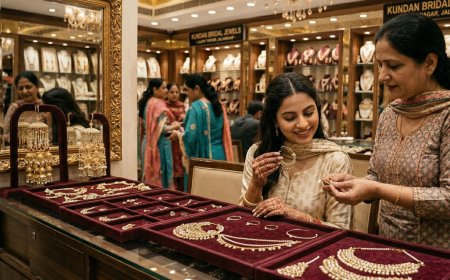
The finished piece collection — the moment at which the NRI bride sees the completed commission for the first time in the velvet pouch on the Novelty Chowk counter — is the moment whose preparation the entire process has been building toward. The collection visit is the fitting appointment of the jewellery commission — the moment of the physical encounter that the photographs have approached and that the hand-held piece in the natural light confirms or revises.
The collection visit's assessment: the piece in the natural light at the window, not in the shop's fluorescent. The measurements confirmed against the specifications — the chain length against the measurement, the pendant size against the proportion reference. The stone quality in the natural light against the stone specification agreed at the commission. The meenakari reverse examined for the quality indicators established in the previous guides — the colour depth, the boundary precision, the design's completeness.
The correction at the collection visit: the small corrections — the chain length adjustment of one centimetre, the finish's additional polishing at the specific point — are the corrections that the skilled craftsman accommodates at the collection without the additional charge and without the additional significant time. The significant correction — the stone replacement, the structural redesign — is the correction that the commission agreement's terms govern and that the discussion with the jeweller must resolve according to the agreement's specific provisions for the non-conforming delivery.
The Costs: What Custom Commission Actually Costs in Jalandhar
The Material Cost
The material cost is the cost whose calculation is the most transparent component of the commission's total price — the gold weight at the current rate plus the stone cost at the specified quality.
The gold weight for the typical bridal commission pieces at the Jalandhar quality retail level:
The Kundan ceremony necklace in the traditional form: typically twenty to forty-five grams of gold in the 22 karat purity. At the January 2025 rate of approximately six thousand two hundred rupees per gram, the gold cost alone for this piece is one lakh twenty-four thousand to two lakh seventy-nine thousand rupees.
The tikka in the traditional form: typically eight to fifteen grams. The gold cost: forty-nine thousand to ninety-three thousand rupees.
The passa pair: typically ten to twenty grams. The gold cost: sixty-two thousand to one lakh twenty-four thousand rupees.
The jhumka earrings in the traditional form: typically twelve to twenty-five grams. The gold cost: seventy-four thousand to one lakh fifty-five thousand rupees.
The Making Charge
The making charge is the craftsman's fee for the production — the labour, the skill, and the time whose combination produces the finished piece from the raw material. The making charge for the custom commission is the making charge whose calculation reflects the design's complexity and the craftsman's skill level — both of which the custom commission maximises relative to the stock piece.
The making charge range for the custom commission at the Jalandhar quality retail level:
The design modification commission: twelve to twenty percent of the gold value. The design modification's making charge reflects the adaptation of the existing design — the moderate skill requirement and the moderate time investment.
The design from reference commission: twenty to thirty-five percent of the gold value. The design from reference requires the craftsman's interpretation of the brief, the pattern development, and the specific traditional technique's application — a higher skill requirement and a longer time investment.
The entirely original design commission: twenty-five to forty-five percent of the gold value. The original design's making charge reflects the design development, the prototype, and the specific production whose technique the design's original requirements determine.
The master craftsman premium: the commission that requires the master craftsman — the craftsman trained in the specific regional tradition whose technique the brief requires — attracts the making charge premium that the master craftsman's scarcity and skill command. The Amritsar tradition craftsman who made the grandmother's 1971 piece's equivalent is the craftsman whose making charge premium the Novelty Chowk owner communicates honestly at the first consultation. The premium is typically twenty to forty percent above the standard craftsman's making charge.
The Stone Cost
The stone cost for the custom commission depends on the stone type, the quality specification, and the size — the variables whose combination produces the price range from the modest to the significant.
The Kundan stones — the semi-precious stones in the ruby, the emerald, the sapphire, the coral, the turquoise categories — are priced per piece at the quality level the commission specifies. The quality levels at the Jalandhar jeweller: the standard commercial grade, the mid-quality grade, and the premium grade. The premium grade stone in the large size can contribute more to the total commission cost than the gold in the same piece.
The polki stones — the uncut diamonds in the sawai grading — are priced per carat at the quality level the sawai grade specifies. The significant Polki commission whose central pendant requires the high sawai grade polki in the large size is the commission whose stone cost the making charge may not exceed.
The Total Commission Budget Framework
The complete budget calculation for the custom commission in Jalandhar:
Gold material cost (weight × current rate) + stone material cost + making charge (percentage of gold cost) + courier or carrying cost + destination country import duty and tax = total landed cost.
The NRI bride who builds the complete budget calculation before the first consultation is the bride whose commission's financial outcome matches the budget. The bride who builds the budget from the gold material cost alone — the intuitive approach for the buyer familiar with the gold price but not the making charge — is the bride whose final quote exceeds the budget by the making charge's amount.
Common Mistakes NRI Brides Make When Commissioning Custom Jewellery in Jalandhar
The first mistake is bringing only the digital reference without the physical print. The phone screen is the reference that the jeweller looks at and the craftsman cannot hold under the loupe. The physical print is the reference that the craftsman takes to the workshop, places on the bench beside the work in progress, and measures against the production at every stage. Print the references before the Jalandhar visit. The printing cost is negligible. The commission brief's precision improvement is not.
The second mistake is not specifying the negative references. The commission brief that specifies only what the piece should be produces the piece that is the craftsman's interpretation of the positive brief — an interpretation whose direction the craftsman's aesthetic preferences and the traditional repertoire's familiar patterns shape. The negative references — the pieces that are too delicate, too ornate, too contemporary, too traditional — constrain the interpretation in the direction the brief requires. Bring three to five negative references alongside the positive references.
The third mistake is not building the making charge into the budget before the first consultation. The making charge for the design from reference commission at twenty to thirty-five percent of the gold value is the making charge that the NRI bride whose budget calculation is the gold value plus the ten percent she has heard at the boutique has not anticipated. The first consultation's estimate reveals the making charge in full — but the NRI bride whose budget cannot accommodate it has had the consultation before having the budget. Calculate the making charge range before the consultation. Arrive knowing whether the estimate's range is the range the budget accommodates.
The fourth mistake is not arranging the milestone photograph updates before returning to the home country. The NRI bride who commissions in Jalandhar, returns to Birmingham, and waits for the finished piece's photograph without the midpoint updates is the bride who discovers the divergence from the brief at the point where the correction is most difficult. The milestone photographs — the wax model, the midpoint stone setting, the pre-polish finish — are the checkpoints whose agreement at the commission converts the production's monitoring from the hoped-for to the specified. Agree the milestone photographs before the departure. The jeweller who agrees to provide them has agreed to the oversight whose value the NRI client's remote position makes essential.
The fifth mistake is not confirming the correction and the refund terms in the written commission agreement before the production begins. The custom commission whose finished piece does not match the approved design drawing is the commission whose resolution the written agreement governs. The written agreement that specifies the correction process (the correction at no additional charge for the non-conformance with the approved design), the timeline's consequence (the partial refund for the significant delay beyond the agreed delivery), and the dispute resolution mechanism (the specific, this-is-how-we-will-resolve-it provision rather than the assumption of goodwill) is the written agreement that protects the NRI bride's investment. The verbal agreement in the warm atmosphere of the Novelty Chowk consultation is not the agreement that governs the dispute. The written agreement is.
The Reference Table: Custom Jewellery Commission in Jalandhar
| Commission Type | Brief Requirement | Timeline | Making Charge Range | Best For | Key Preparation | Remote Management |
|---|---|---|---|---|---|---|
| Design modification | Existing design + specific changes | 4–8 weeks | 12–20% of gold value | Simple personalisation; colour change; size adjustment | Reference of existing piece + modification specification | Single milestone photograph at completion |
| Design from reference | Grandmother's photograph; magazine reference; sketch | 8–16 weeks | 20–35% of gold value | Heirloom reproduction; traditional form translation | Physical print of reference; detail references; negative references | Wax/metal model photo; midpoint photo; pre-polish photo |
| Entirely original design | Concept; mood board; sketch | 10–20 weeks | 25–45% of gold value | Unique brief; no existing reference | Complete mood board printed; measurements; outfit reference | Multiple milestone photographs; video call design reviews |
| Master craftsman commission | Regional tradition technique required | Add 4–6 weeks to above | Add 20–40% premium to above making charge | Amritsar; Jaipur; Varanasi traditional techniques | Regional tradition reference; traditional technique examples | Confirm craftsman availability at first consultation |
| Stone upgrade within existing design | Same design; better stone quality | 2–4 weeks | Same as modification | Quality improvement on existing form | Stone quality reference (GIA/IGI for diamonds; sawai grade for polki) | Final photograph in natural light essential |
The Resolution
Harleen had collected the necklace on the fourteenth week.
She had flown into Jalandhar specifically for the collection — the three-day visit whose single fixed appointment was the Novelty Chowk morning. The Amritsar craftsman had traveled to Jalandhar for the handover — the specific, the craftsman presents the work to the client in the presence of the commissioning jeweller formality that the significant commission's completion deserved.
The necklace had been placed on the velvet display tray on the Novelty Chowk counter.
Harleen had looked at it for a long time.
Then she had picked it up and had walked to the window.
In the window's natural light, the Kundan setting's ruby stones had been the warm red of the traditional form — not the boutique's bright red, not the magazine's saturated red, but the specific, depth-with-warmth red of the stone in the gold foil that the grandmother's 1971 photograph had shown at one-third scale in the black and white image whose resolution Harleen had enlarged to the pixel.
The teardrop pendant's proportion had been the Amritsar proportion. The longer form, the stone placement denser at the top than at the base, the gold surface between the stones the surface that the kari work produced.
She had turned it over.
The meenakari reverse had been the crimson and the gold — the miniature painting precision applied to the surface that no guest at the ceremony would see and that the craftsman had applied because the craftsman's practice did not distinguish between the visible and the invisible.
The Novelty Chowk owner had said: Is it what you came for?
Harleen had said: It is what I sketched eleven months ago.
He had said: The craftsman saw the sketch. He said the sketch was trying to remember the grandmother's necklace.
Harleen had said: Yes. That is exactly what it was.
The craftsman — the man from Amritsar who had trained in the tradition that had produced the 1971 piece — had said nothing. He had simply looked at the necklace in the window's natural light with the specific, this-is-the-assessment quality of the craftsman who is evaluating the finished work against the standard that the standard has always been.
Then he had nodded.
It was the nod of the craftsman who has made what the brief required.
Bring the physical print of every reference — not the phone screen. Specify the negative references alongside the positive. Calculate the making charge range before the first consultation and build it into the budget. Agree the milestone photograph schedule before returning to the home country. Confirm the correction and the refund terms in the written agreement before the production begins.
The piece in the imagination has been waiting for the craftsman who can make it.
The craftsman is in Jalandhar.
The brief is what gets you there.
Bring the brief.
Published by NRIWedding.com — The Premium Global Platform for Non-Resident Indians Planning Indian Weddings From Abroad.
What's Your Reaction?
 Like
0
Like
0
 Dislike
0
Dislike
0
 Love
0
Love
0
 Funny
0
Funny
0
 Angry
0
Angry
0
 Sad
0
Sad
0
 Wow
0
Wow
0