





































































Creating a Guest Hospitality Desk — What Services to Offer: The Complete NRI Wedding Planning Guide
The guest hospitality desk is the specific human infrastructure that sits between the hotel's general service and the wedding planner's production management — dedicated entirely to the guest experience, equipped with the specific knowledge and the specific mandate to answer questions, solve problems, and create the conditions for every international guest to navigate a multi-day NRI destination wedding with confidence and ease. This complete guide gives NRI couples the full framework for creating a hospitality desk that genuinely works — covering what the hospitality desk actually is and why the NRI wedding specifically needs it, the physical infrastructure including location principles and setup essentials, operating hours and the WhatsApp channel extension, the three sourcing options for staffing including dedicated coordinator, wedding planner team member and bilingual family volunteer, and the six core services in detail: information and navigation, practical problem resolution, the complete practical supplies kit including the hundred safety pins reality, experience enhancement including local recommendations and booking assistance, family communication support, and accessibility support for mobility, dietary, language and medical needs, plus the pre-wedding staff briefing framework, the budget breakdown, and the five common mistakes that produce a desk that cannot answer the questions guests actually ask.

Creating a Guest Hospitality Desk: What Services to Offer
The Question That Should Have Had an Answer
He had a simple question.
The groom's cousin — forty-three, had traveled from Toronto, had attended enough Indian weddings to know how they worked but had never attended one in Udaipur — wanted to know whether there was a doctor on call if he needed one. Not because he was unwell. Because he was a person who thought about contingencies, who liked to know in advance where the emergency exit was, and who had woken up on the second morning of the four-day wedding with a headache that felt like the beginning of something and wanted to know what his options were.
He asked the hotel front desk. They gave him a number for the hotel doctor, which he wrote down. He asked whether the doctor spoke English. The front desk was not certain. He asked whether the doctor could come to the hotel or whether he would need to go to a clinic. The front desk was also not certain about this.
He asked the groom's father, who was standing nearby. The groom's father was warm and helpful and genuinely wanted to assist but was managing the morning's ceremony preparation and the arrival of forty relatives from Mumbai and the specific crisis of a missing garland that was supposed to have arrived an hour earlier, and could not give the question the attention it deserved.
He eventually found the answer through the bride's cousin, who happened to know a doctor in Udaipur, who happened to be available, and who happened to speak excellent English. The headache turned out to be dehydration and resolved by lunchtime with no medical intervention required.
But the experience of finding the answer had taken forty-five minutes and had involved five conversations and had required him to navigate the specific anxiety of being unwell in an unfamiliar country while the people best positioned to help him were managing the competing demands of a large wedding.
None of this needed to happen. The question he had — the simple, legitimate question of a guest who wanted to know what the medical options were — should have had a single, immediate answer from a single point of contact who was specifically designated to have exactly this kind of information and to provide it without the questioner needing to find the right person through a process of elimination.
That single point of contact is the hospitality desk.
The Core Reality: What the Hospitality Desk Actually Is
The Definition
The guest hospitality desk is a dedicated service point — staffed by a specific person or small team, located in a specific accessible place, operating during specific hours — whose sole function is to serve the needs of the wedding guests throughout the wedding programme.
It is not the hotel front desk. The hotel front desk serves the hotel's full guest population and manages the hotel's operational requirements. The wedding's hospitality desk serves the wedding guests specifically — with knowledge of the wedding programme, the guest list, the specific needs of the specific gathering, and the specific resources of the specific wedding destination.
It is not the wedding planner. The wedding planner is managing the production of the wedding — the vendors, the timeline, the ceremonies, the crises that arise in the execution of a complex multi-day event. The wedding planner who is simultaneously fielding guest questions about local restaurant recommendations, guest questions about the shuttle timing, and the catering team's questions about the reception setup is a wedding planner whose attention is divided in ways that serve none of these demands well.
The hospitality desk is the specific human infrastructure that sits between the hotel's general service and the wedding planner's production management — dedicated entirely to the guest experience, staffed with the specific knowledge and the specific mandate to answer questions, solve problems, and create the conditions for every guest to navigate the wedding occasion with confidence and ease.
Why the NRI Wedding Specifically Needs It
Every large wedding benefits from a dedicated guest service function. The NRI wedding needs it more acutely than most — for specific reasons that are particular to the international destination wedding context.
The guest diversity: The NRI wedding's international guest list includes people managing unfamiliar currency, unfamiliar transport, unfamiliar cultural conventions, unfamiliar food, and potentially unfamiliar medical systems. The number and variety of questions that this guest population generates is significantly greater than the questions generated by a guest population that is locally familiar with the destination and the cultural context.
The multi-day duration: A four-day wedding programme generates four times the logistical complexity and four times the guest service demand of a single-day event. The guest who needs help with something on day one will potentially need help with something different on days two, three, and four. The hospitality desk that is available across the full programme is the infrastructure that makes this sustained service possible.
The couple's unavailability: At a single-day wedding, the couple is theoretically accessible for a portion of the day for the specific guests who need to speak with them. At a four-day destination wedding, the couple is effectively unavailable for guest service across the entire programme — they are managing ceremony preparation, family obligations, photograph sessions, and the sustained demands of being the central figures in a major occasion. The hospitality desk is the couple's guest service proxy — the specific resource that serves guests in the couple's name while the couple is otherwise engaged.
The family's unavailability: The immediate family members who would naturally serve the guest service function at a smaller, domestic wedding are similarly occupied at a large destination wedding — managing their own ceremonial roles, managing out-of-town relatives, managing the specific emotional demands of the occasion. The hospitality desk frees the family to be present to the occasion rather than to be the operational support function for two hundred and fifty guests.
The Physical Infrastructure
Location
The hospitality desk's location determines its accessibility and its utilisation. The desk that is tucked into a corner of the hotel lobby that guests pass only if they are specifically looking for it will be found by fewer guests than the desk that is positioned at the natural convergence point of the guest flow — the corridor between the accommodation lifts and the event spaces, the lobby area where guests gather before shuttle departures, the breakfast area where guests convene in the mornings.
The location principles:
Visible from the primary guest circulation routes — the paths that guests walk between accommodation and events, between the hotel entrance and the lift lobby, between the breakfast area and the ceremony venue.
Accessible without requiring a specific search — the guest who needs help should be able to find the desk within two minutes of deciding to look for it, without needing to ask someone where it is.
Distinct enough from the hotel's own front desk that guests understand it as a wedding-specific resource rather than a general hotel service — a different visual identity, a different staff member, a clearly labelled sign.
Not so prominent that it creates a visual intrusion in spaces where the wedding's aesthetic is carefully managed — the hospitality desk in the middle of the ceremony mandap courtyard is in the wrong location.
The Physical Setup
The hospitality desk's physical setup should communicate its function clearly and should equip the staff to do their job effectively.
The essential physical elements:
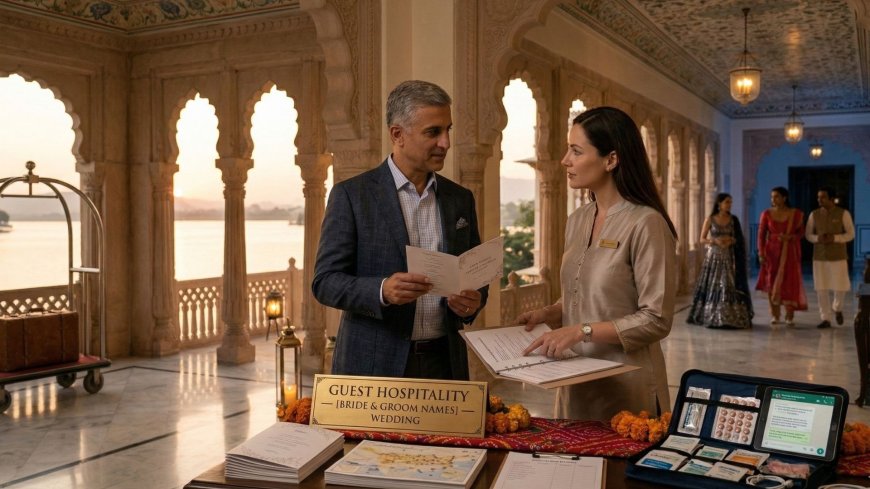
A clearly labelled sign — in the wedding's visual language, with the words "Wedding Hospitality" or "Guest Services" in large, readable type. The couple's names and a brief description of the desk's function — "For all your questions and assistance during the wedding" — removes any ambiguity about what the desk is for.
A contact list — the complete list of all relevant contacts for the wedding programme, the destination, the accommodation properties, the vendors, and the emergency services, in a form that the staff member can reference immediately when a question is asked.
The wedding programme materials — copies of the event itinerary, the venue maps, the shuttle schedule, the dress code information — for distribution to guests who need them.
A small practical supplies kit — addressed in the services section below — for the immediate resolution of minor guest needs.
A system for recording guest requests, questions, and unresolved issues — so that the desk functions as an information management system rather than a series of isolated interactions, and so that recurring questions can be addressed proactively.
The Operating Hours
The hospitality desk should operate during the hours when guests are most likely to need it — which for a multi-day wedding typically means the morning hours when guests are preparing for the day's events and the evening hours when guests are returning from events and managing the following day's logistics.
The operating hours framework:
Morning session: Two hours before the day's first event. This is the period when guests are managing outfit preparation, transport logistics, last-minute practical questions, and the specific anxiety of the first day of a complex occasion.
Pre-event session: One hour before each major event, at or near the event venue. Guests arriving at the ceremony venue with questions about where to sit, what to expect, and whether their outfit is appropriate need answers at the venue rather than at the hotel.
Evening session: One to two hours after the day's last event returns. This is the period when guests have questions about the following day, when logistical issues that arose during the event need resolution, and when the guest who had a problem during the day is in a position to address it.
A staffed WhatsApp or phone contact for the hours when the physical desk is not operating — so that guests who have an urgent question outside operating hours have a channel for reaching the hospitality desk function.
The Staff: Who Should Run the Desk
The Essential Qualities
The hospitality desk's effectiveness is entirely determined by the person staffing it. The physical setup, the materials, the location — all of these are supporting infrastructure for the human capability at the centre of the function.
The essential qualities of the hospitality desk staff member:
Genuine knowledge of the wedding programme and the destination — not approximate familiarity but specific, detailed knowledge of every event, every venue, every transport arrangement, every accommodation property, and every service resource available in the destination.
Calm competence under the specific pressure of managing multiple guest needs simultaneously — the ability to hold a conversation with one guest while being aware of the two guests waiting and managing the WhatsApp message from a fourth guest without any of these interactions feeling rushed or inadequate.
Warmth — the specific human quality that makes the interaction with the hospitality desk feel like a genuine service rather than a bureaucratic function. The guest who asks a question and receives a warm, personal, specific response has a different experience from the guest who asks the same question and receives a correct but impersonal answer.
Cultural fluency — sufficient familiarity with both the Indian wedding tradition and the international guest's perspective to bridge the gap between them confidently, explaining the ceremony's requirements to the non-Indian guest and explaining the international guest's specific need to the Indian family member who is trying to help.
Discretion — the ability to manage sensitive guest situations — the guest who is unwell, the guest who has had too much to drink, the family dispute that surfaces during the wedding week — without making these situations public or adding to the couple's stress.
The Sourcing Options
Option One — The Dedicated Wedding Planner Team Member:
The wedding planner's team typically includes multiple coordinators managing different aspects of the wedding production. Designating one of these coordinators specifically to the guest hospitality function — while the others manage the production — is the most integrated sourcing option and produces the hospitality desk staff member with the deepest knowledge of the wedding's specific details.
The challenge with this option: the wedding planner's team members are often pulled into production management during the most complex event periods — the times when the hospitality desk demand is also highest. The production crisis and the guest service need do not necessarily align with different team members being available for each.
Option Two — A Dedicated Hospitality Coordinator:
Engaging a person specifically for the guest hospitality function — someone who is not part of the production team and whose sole responsibility is the guest experience — produces a cleaner separation of functions and ensures that the hospitality desk is not depleted by production demands.
This option requires either a hospitality professional with wedding experience, a trusted family friend or extended family member with the relevant qualities, or a professional from a hospitality management background with India destination experience.
Option Three — The Bilingual Family Volunteer:
For weddings where the dedicated coordinator option is not in the budget, a bilingual family volunteer — a cousin or family friend who has the qualities described above, who knows the wedding programme thoroughly, and who is not in a ceremonial role that requires their presence elsewhere — can run an effective hospitality desk with thorough briefing and clear documentation.
The challenge with this option: the family volunteer is simultaneously a wedding guest with their own emotional investment in the occasion, and the boundary between their hospitality function and their family participation can be genuinely difficult to manage. The family volunteer who is pulled into a family emotional situation during the period they are supposed to be staffing the desk is not in a position to serve either function well.
The Services: What the Hospitality Desk Actually Provides
Service One: Information and Navigation
The primary service of the hospitality desk is the provision of accurate, specific, immediately available information — the answer to the question that the guest has come to ask.
The information categories the desk should be equipped to address:
Event logistics: What time does tomorrow's ceremony start? Where is the sangeet venue? What time does the shuttle leave? Is there parking at the ceremony venue for guests who have hired their own car?
Dress code clarification: Is my outfit appropriate for the baraat? Should I bring a dupatta to the temple? Is Western formal acceptable for the reception or is Indian attire specifically requested?
Destination navigation: Where is the nearest pharmacy? Which restaurant near the hotel is suitable for vegetarians? Is the market within walking distance or should I take an auto-rickshaw?
Cultural guidance: When should I remove my shoes? What should I do when the pandit offers something during the ceremony? Is it appropriate to take photographs?
Wedding programme specifics: Who is the pandit conducting the ceremony? What does the Antarpat ceremony involve? How long does the ceremony typically run?
The hospitality desk staff member must know — or know where to immediately find — the answer to every question in these categories. The desk that has to say "I don't know" to a reasonable guest question is a desk that is not adequately prepared.
Service Two: Practical Problem Resolution
The practical problem resolution service addresses the specific situations where a guest has encountered a problem that requires more than information — where the problem requires action.
The practical problems the hospitality desk should be equipped to resolve:
Transport problems: The guest whose taxi did not arrive, the guest who missed the shuttle, the guest who needs transport to a medical appointment. The hospitality desk should have a direct relationship with a reliable local transport provider — a specific driver or taxi service with confirmed availability — so that transport problems can be resolved within fifteen minutes rather than through a cold booking process.
Accommodation issues: The guest whose room has a problem — a malfunctioning air conditioning unit, an inaccessible location for a guest with mobility requirements, a room that was booked in the wrong category. The hospitality desk should have a direct relationship with the accommodation coordinator at each property so that room issues can be escalated and resolved through a specific channel rather than left to the guest to manage through the general hotel front desk.
Lost or forgotten items: The guest who has left their outfit at the airport, the guest who has lost their wallet, the guest who forgot to bring the specific medication they need. The hospitality desk's problem resolution function includes identifying the available options — the nearest shopping area for emergency outfit purchases, the process for replacing a lost international card from India, the nearest pharmacy for specific medications — and supporting the guest in accessing them.
Health situations: The guest who is unwell, the guest who needs a doctor, the guest who requires specific medical assistance. The hospitality desk should have the contact information for a specific, English-speaking doctor who is available during the wedding week — not a general hospital referral but a named doctor whose availability has been confirmed in advance.
Service Three: The Practical Supplies Kit
The hospitality desk's practical supplies kit is a small collection of immediately useful items that resolve the minor but genuinely disruptive problems that guests encounter during a multi-day wedding.
The essential practical supplies:
Safety pins — the single most universally requested item at Indian weddings, required for emergency outfit repairs, securing dupattas, managing garment malfunctions. The hospitality desk should have a hundred safety pins in assorted sizes. This is not an exaggeration.
Double-sided fashion tape — for securing saree pleats, managing necklines, fixing the specific garment emergencies that safety pins cannot address.
Blister plasters and pain relief — for guests whose formal footwear has produced the specific injuries that formal footwear reliably produces across multi-day wearing.
Stain remover wipes — for the guest whose outfit has encountered the specific hazards of a wedding dinner.
Sewing kit — for minor repairs that safety pins cannot manage.
Antacids and digestive tablets — for guests whose digestive systems are adjusting to Indian cuisine.
Paracetamol or equivalent pain relief — for headaches, jet lag, and the specific physical demands of a multi-day celebration.
Small packets of electrolyte powder — because the Rajasthan heat or the Gujarat summer or the Chennai humidity will claim at least a few guests who have not maintained adequate hydration.
Spare dupatta pins — because the guest who has lost or forgotten their dupatta pin is in a specific predicament that this small item resolves immediately.
Spare hair pins and elastic bands — because the elaborate hairstyles of formal Indian wedding dressing are not always as structurally stable as they appear at the beginning of the evening.
Phone charging cables — in the most common connector formats — for the guest whose phone is dying and whose charger is in the room.
A small amount of local currency in small denominations — for the specific situation where a guest needs immediate cash for a tip or a small purchase and the ATM is not accessible at that moment. This is a service loan rather than a gift — managed with a simple receipt.
Service Four: Experience Enhancement
Beyond the reactive problem-solving function, the hospitality desk's experience enhancement service proactively enriches the guest's experience of the wedding destination and the wedding occasion.
The experience enhancement services:
Local experience recommendations: The hospitality desk should be the authoritative source of recommendations for local experiences — the specific restaurant that best represents the local cuisine, the specific market that is most interesting for shopping, the specific heritage site that is most worth visiting in the time available between events. These recommendations should be specific and vetted — not generic tourist guide suggestions but the informed recommendations of someone who knows the destination and has thought about what would be most valuable for the specific guest.
Booking assistance: Many guests want to visit local attractions, restaurants, or experiences but are deterred by the logistics of booking from a foreign country with a language barrier and without local knowledge. The hospitality desk that can make the booking on the guest's behalf — calling the restaurant, arranging the tour, booking the heritage site visit — removes this barrier and enables experiences that the guest would not have had otherwise.
Local orientation: For guests who are visiting the destination for the first time, a brief orientation — where things are relative to the hotel, what the neighbourhood is like, what to expect in various local environments — delivered at the hospitality desk in the first morning gives the guest the confidence to navigate the destination independently.
Photography assistance: The guest who wants a specific photograph in a specific location — a portrait in front of the Amber Fort, a photograph in traditional Indian attire in the old city — benefits from the hospitality desk's knowledge of where to go, what time of day produces the best light, and which local photographer can be engaged for a brief session.
Service Five: Family Communication Support
The family communication support service addresses the specific need that arises at destination weddings where international guests are separated from their regular support networks and are managing communication across significant time zone differences.
The family communication support services:
WhatsApp communication management: Some guests — particularly older guests who are less comfortable with technology — need assistance managing their communication with family members who are not at the wedding. The hospitality desk that can help a guest send a photograph to their family in London, or help them make a video call to their grandchildren in Sydney, is providing a service that is out of proportion to its technical complexity in its impact on the guest's wellbeing.
Emergency family communication: In the event that a guest receives distressing news from home during the wedding week — a family illness, an emergency, a situation that requires the guest to consider leaving early — the hospitality desk is the appropriate first point of contact for the logistical support the guest needs, from rebooking flights to communicating with the couple's family about the situation.
Service Six: Accessibility Support
The accessibility support service ensures that guests with specific physical or logistical needs are proactively served rather than managed reactively when problems arise.
The accessibility services:
Mobility assistance: The guest with limited mobility who needs to navigate between accommodation and event venues, who needs specific seating arrangements at ceremony and reception events, who cannot manage the temple's stone steps — all of these need proactive support that begins with identifying the need at check-in and managing the logistics in advance of each event.
Dietary management: The guest with specific dietary requirements — the vegan, the guest with a nut allergy, the guest who requires halal food — needs the hospitality desk to communicate their requirements to the catering team for each event and to confirm that appropriate food will be available before the event rather than managing the situation at the buffet.
Language support: The guest who does not speak English or the local language needs the hospitality desk to serve as a translation and communication resource for practical interactions — hotel check-in, restaurant ordering, transport communication — where the language barrier creates a specific access barrier.
Medical need management: The guest with a specific medical condition who needs to know the location of the nearest appropriate medical facility, who needs refrigerated storage for medication, who needs a ground floor room or specific accessibility provision — all of these need the hospitality desk's proactive coordination.
The WhatsApp Broadcast as Hospitality Desk Extension
The Digital Hospitality Channel
The WhatsApp broadcast group — a group in which the hospitality desk can send one-way messages to all international guests simultaneously — is the digital extension of the physical hospitality desk function and is among the most practical guest management tools available for the NRI destination wedding.
The WhatsApp broadcast serves specific functions:
The daily briefing: A morning message — sent at a consistent time each day — that confirms the day's schedule, provides the shuttle departure times, notes any changes from the planned programme, and includes a practical tip for the day. Good morning. Today's mehendi begins at 6pm at the courtyard venue. The shuttle leaves from the hotel lobby at 5.30pm and again at 5.45pm. The temperature will reach 38 degrees today — please hydrate well before leaving the hotel.
The event reminder: A message sent one to two hours before each event confirming the departure time, the dress code, and any specific practical information. The ceremony begins in 90 minutes. The shuttle leaves at 9.45am. Remember to wear comfortable shoes that can be easily removed as you will be in a shoeless space for most of the ceremony. See you there.
The reactive communication: The message that goes to all guests when a programme change has occurred — a delayed start, a venue change, a schedule adjustment — ensuring that every guest has the information simultaneously rather than through an unreliable chain of person-to-person communication.
The management of the WhatsApp broadcast:
The broadcast should be operated by the hospitality desk staff member — not by the couple, not by the family — with a consistent voice and a consistent level of practical information. The guest who receives a WhatsApp broadcast from the hospitality desk coordinator knows immediately what the message is for and what kind of information it contains.
The Pre-Wedding Briefing
The Staff Preparation
The hospitality desk staff member should receive a comprehensive briefing before the wedding programme begins — typically the day before the first event, in a two to three hour session with the wedding planner and any relevant family members.
The briefing content:
Complete event programme: Every event, its location, its timing, its dress code, its access requirements, its specific logistical features.
Guest list overview: Not every guest's personal details but the categories of guest represented — how many international guests, which nationalities, any guests with specific needs that have been identified in advance.
Vendor contact list: Every relevant vendor's name, phone number, and specific function — the transport provider, the medical contact, the accommodation coordinators, the catering lead, the florist, the photographers.
Problem protocols: The specific process for escalating specific categories of problem — the medical emergency, the accommodation complaint, the transport failure, the missing guest — so that when these situations arise the staff member knows exactly what to do and who to contact.
The couple's specific wishes: Any specific hospitality priorities that the couple has — specific guests who need particular attention, specific experiences they want to ensure their guests have, specific concerns about specific logistics.
The Budget Framework
What the Hospitality Desk Costs
The hospitality desk is a genuine wedding expenditure and should be budgeted as such. The cost components are:
Staff: The dedicated hospitality coordinator costs between fifteen thousand and forty thousand Rupees per day depending on their experience and the scope of their function. For a four-day wedding, this is a sixty to one hundred and sixty thousand Rupee investment — a meaningful number that should be assessed against the value it produces.
Practical supplies kit: The initial assembly of the practical supplies kit costs between three thousand and eight thousand Rupees depending on the quantity and quality of items included.
The desk setup: Signage, furniture if the hotel is not providing it, printed materials — typically five thousand to fifteen thousand Rupees.
WhatsApp management: No direct cost beyond the staff time included in the coordinator's fee.
The return on this investment:
The hospitality desk is not a line item that produces a visible return in the wedding photographs or in the catering quality or in the ceremony's beauty. Its return is in the guest experience — specifically in the reduction of guest stress, the resolution of problems before they become crises, the specific human connections that are enabled when guests are not managing logistical anxiety, and the specific quality of the couple's own experience when they are not being approached throughout the wedding programme by guests who need help with things the hospitality desk should be handling.
Common Mistakes NRI Couples Make With Guest Hospitality
The first mistake is assuming the hotel front desk serves this function. The hotel front desk serves the hotel's full guest population with the hotel's general capabilities. It does not know the wedding programme, the specific dress code for each event, the medical contact that the wedding planner has arranged, or the answer to the specific cultural questions that the international guest is asking. The hotel front desk and the wedding hospitality desk serve different functions and one cannot substitute for the other.
The second mistake is giving the function to the wedding planner without separating it from the production management. The wedding planner who is simultaneously managing the florist's setup crisis, the caterer's timing issue, and a guest's question about tomorrow's shuttle schedule is not serving any of these demands well. The separation of the production function and the guest hospitality function produces better outcomes for both.
The third mistake is not briefing the staff member adequately. The hospitality desk staff member who does not know the answer to the question being asked is not providing hospitality — they are providing a polite version of uncertainty. The thorough pre-wedding briefing, the complete contact list, the clear problem protocols — these are what equip the staff member to provide the service the function requires.
The fourth mistake is not stocking the practical supplies kit. The hospitality desk without safety pins, without blister plasters, without digestive tablets, without the small practical items that guests need in the moments between events is a desk that fails at the exact moments when its value is most immediately apparent. The practical supplies kit costs a few thousand Rupees. Its absence is felt at every event by every guest who needed something it did not have.
The fifth mistake is closing the desk too early. The hospitality desk that operates only during the day's scheduled hours and is not available in the evening when guests are returning from events, when tomorrow's logistics need to be confirmed, and when the guest who had a problem during the day is finally in a position to address it, is a desk that is absent for a significant portion of its most valuable operating hours. The WhatsApp channel that extends the function beyond the desk's physical operating hours addresses this gap at minimal additional cost.
The Desk That Nobody Notices When It Works
The measure of a successful hospitality desk is its invisibility.
The guest who navigates four days of a large destination NRI wedding without encountering a single logistics problem they could not solve, without having a question they could not get answered, without experiencing the specific anxiety of being in an unfamiliar place without a clear resource for help — this guest will not necessarily remember the hospitality desk. They will remember the wedding as an experience of seamless warmth and generous hospitality, without being able to identify the specific mechanism that produced this experience.
This is the correct outcome. The hospitality desk is not an attraction. It is infrastructure — the specific, human infrastructure that makes the guest's experience of the wedding what the couple intended it to be rather than what the accumulated friction of an unmanaged logistics environment produces.
The cousin from Toronto who needed to know about the doctor should have walked to the hospitality desk, asked the question, received a specific answer with the doctor's name and phone number and a note that English was spoken, and returned to the wedding occasion within three minutes. The question should have been a two-minute interaction rather than a forty-five-minute search. The headache should have remained a minor inconvenience rather than a source of compounded anxiety.
The hospitality desk is how that interaction becomes two minutes instead of forty-five. Not through a technology solution, not through a printed guide, not through the couple's personal attention — but through the specific human presence of a well-briefed, warmly capable person whose entire function is to make sure that every guest, at every moment of the wedding programme, has exactly what they need.
Build the desk. Staff it well. Brief it thoroughly.
And then watch it disappear into the wedding's seamless warmth — doing its work invisibly, the way the best hospitality always does.
Published by NRIWedding.com — The Premium Global Platform for Non-Resident Indians Planning Indian Weddings From Abroad.
What's Your Reaction?
 Like
0
Like
0
 Dislike
0
Dislike
0
 Love
0
Love
0
 Funny
0
Funny
0
 Angry
0
Angry
0
 Sad
0
Sad
0
 Wow
0
Wow
0