





























































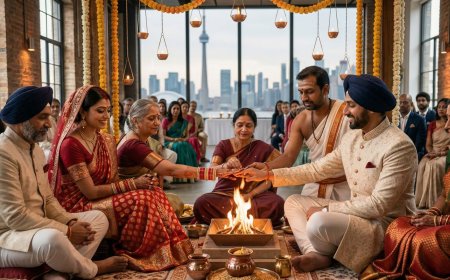



Before the Seventh Step, There Is a Whole Philosophy of How to Live: The Sacred World of Jain Wedding Rituals
Jain weddings are among India's most philosophically profound ceremonies — a multi-day ritual sequence rooted in ahimsa, dharmic duty, and the sacred Saat Phere, where seven vows extend beyond the couple to all living beings. From Vivah Panchami to gotra matching across Gujarati, Rajasthani, and Marwari communities, these traditions carry 2,500 years of spiritual integrity. For NRI Jain families in London, Toronto, Houston, Melbourne, and Dubai, this guide covers every ritual, pandit-sourcing strategy, fire restriction workaround, and diaspora adaptation needed for a fully authentic Jain wedding abroad.


The Jain wedding is perhaps the most philosophically demanding ceremony in all of Indian tradition — a ritual sequence that asks two people, at the very moment of their greatest worldly joy, to contemplate the nature of non-attachment, dharmic duty, and spiritual liberation. For NRI Jain families from Gujarat, Rajasthan, and Maharashtra now living in London, Toronto, Houston, Melbourne, and Dubai, preserving these ceremonies in their full form is not merely a cultural preference — it is an act of profound religious integrity.
You grew up knowing that your wedding would be different. Not louder or more elaborate — different in a quieter, more serious way. You knew there would be no animal sacrifice, no meat at the feast, no shortcuts taken with the sacred. You grew up hearing the word ahimsa [non-violence] applied not just to food but to the way your family conducted every ritual — with care, with intention, and with a consciousness that every action in a Jain wedding carries spiritual weight that extends far beyond the wedding day itself.
Now you're in London or Houston, and you're trying to explain to your non-Jain partner why the gotra matching [clan lineage compatibility check] matters, why the Vivah Panchami date is non-negotiable, and why the pandit you found on a general wedding website simply will not do. You're trying to source sthapana [ritual installation] items in a city where the nearest Jain temple is forty minutes away and the community WhatsApp group is the most reliable source of any information.
This is the guide that was missing. Written for you, with the seriousness your tradition deserves and the practicality your diaspora life demands.
🌟 DID YOU KNOW?
Jain wedding ceremonies are rooted in a tradition that is over 2,500 years old, predating many of the Hindu wedding customs they superficially resemble. The philosophical framework of Jain marriage is grounded in the Agamic texts — ancient scriptures that define marriage as a dharmic contractbetween two souls on their respective paths toward moksha [spiritual liberation], not merely a social or familial union.
The global Jain diaspora is estimated at approximately 150,000 in the United Kingdom, 100,000 in North America, and over 200,000 in East Africa and the Gulf combined — making it one of the most geographically dispersed minority religious communities in the world relative to its total population. Despite this dispersion, Jain wedding customs have been preserved with remarkable fidelity across generations.
Gotra matching in the Jain tradition is not merely a social custom — it is a genetic and spiritual safeguard rooted in ancient understanding of lineage, karma [the cosmic law of action and consequence], and community health. Jain gotras number in the hundreds and vary significantly between Digambara [sky-clad, the stricter sect] and Shvetambara [white-clad, the more common sect among diaspora communities] families.
WHAT IS A JAIN WEDDING?
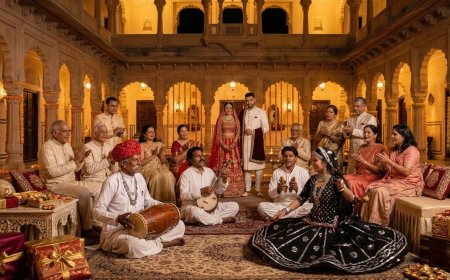
A Jain wedding — formally called Jain Vivah Sanskar [the sacred rite of Jain marriage] — is a multi-day ceremonial sequence governed by the twin principles of ahimsa [non-violence] and dharma [righteous duty]. It differs from a Hindu wedding in several foundational ways: there is no blood sacrifice of any kind, the floral decorations traditionally use only flowers that have naturally fallen rather than cut stems in orthodox families, and every element of the ceremony is designed to remind the couple that their union, while joyful, exists within a larger spiritual framework.
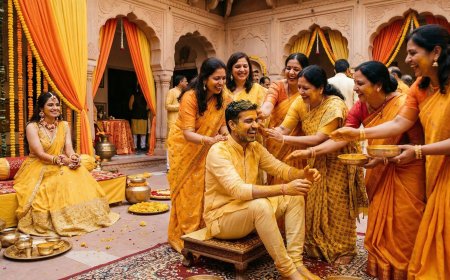
The sequence typically begins with the Sagai or Mangni [formal engagement], during which the families exchange tika[a sacred mark on the forehead] and gifts, and the gotra compatibility is formally confirmed. This is followed in the days leading to the wedding by the Pithi or Haldi [turmeric ceremony], the Mehendi [henna application], and the Tel Baan[an oil and grain anointing ritual unique to Jain tradition].
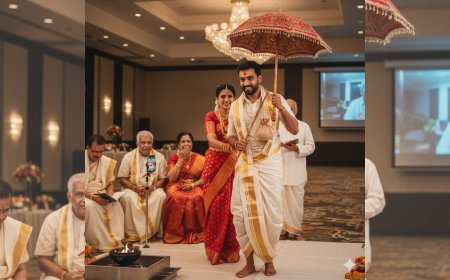
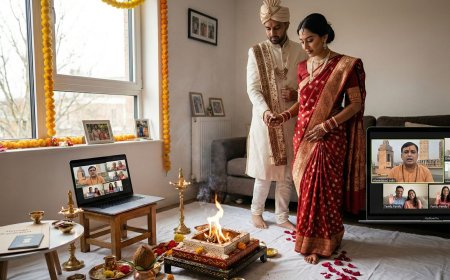
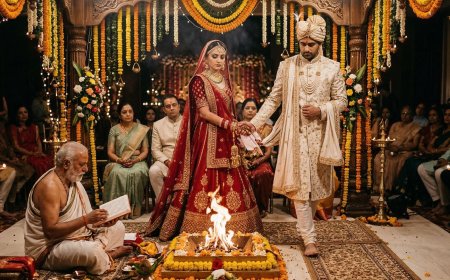
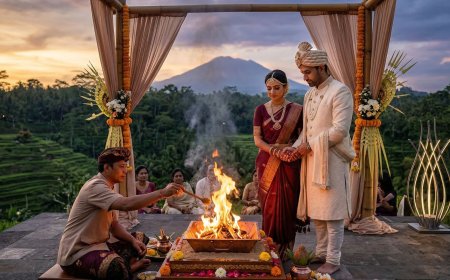
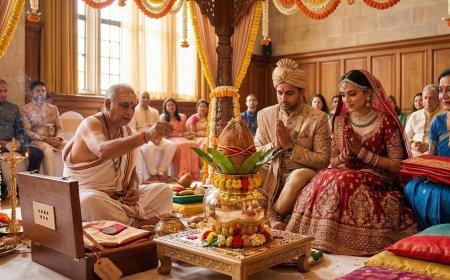
On the wedding day, the ceremony opens with the Sthapana [the ritual installation of sacred vessels and deities on the wedding altar], followed by the Ganesh Puja [worship of the auspicious deity, though in strictly Jain households this is replaced by worship of the Tirthankaras — the twenty-four enlightened beings of Jain cosmology]. The central ceremony, the Vivah Panchami [the five sacred steps of the Jain marriage rite], involves the couple circling the agni[sacred fire] while the pandit recites Sanskrit mantras [sacred verses] and the families bear witness. This culminates in the Saat Phere [seven circumambulations of the sacred fire], each step corresponding to a specific vow — of food, strength, prosperity, wisdom, children, health, and lifelong friendship.
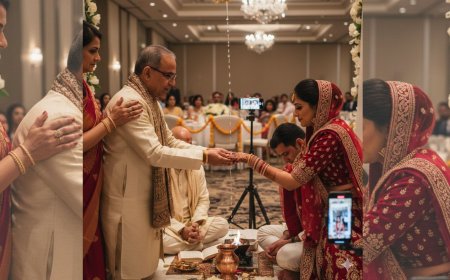
The Kanyadaan [the gift of the daughter by her father] and the Hastamilap [the joining of hands] are performed with the bride's hand placed in the groom's by her father — one of the most emotionally charged moments in the entire ceremony. The mangalsutra is tied, sindoor is applied, and the couple is formally pronounced married in the eyes of the community, the Tirthankaras, and the cosmos.
COMMUNITY COMPARISON TABLE
| Community / State | Local Name for Wedding Ceremony | Key Tradition | How NRIs Abroad Adapt It |
|---|---|---|---|
| Gujarati Jain (Shvetambara) | Jain Vivah Sanskar | Full Saat Phere, Vivah Panchami, elaborate Pithi ceremony | Jain centre or temple hall hired; Gujarati Jain pandit sourced via temple network |
| Rajasthani Jain (Oswal/Maheshwari) | Vivah | Gotra matching strictly observed, Oswal-specific rituals, band and procession | Rajasthani Jain community associations in Leicester/Toronto assist |
| Marwari Jain | Shadi | Highly elaborate multi-day celebration, significant dowry traditions being modernised | Marwari associations in London and Houston active; pandits available |
| Digambara Jain (Karnataka/Maharashtra) | Vivah Sanskar | Stricter ahimsa observance, no flowers cut, Tirthankara worship replaces Ganesh | Very specific pandit required; Digambara community networks essential |
| Jain (Maharashtra – Mumbaikar) | Lagna | Urban simplified version, often single-day ceremony | Most adaptable format for abroad; community temples in most diaspora cities |
| Punjabi Hindu (for comparison) | Anand Karaj / Shaadi | Seven pheras, similar fire ritual, less gotra strictness | Widely available pandits; easier to adapt |
| Gujarati Hindu (for comparison) | Lagna | Similar structure but different mantras; Ganesh puja central | Overlaps with Jain but not interchangeable |
| Rajasthani Hindu (for comparison) | Vivah | Similar gotra system but different lineage rules | Pandit overlap possible but Jain-specific mantras differ |
| Bengali Hindu (for comparison) | Biye | Seven pheras, Sampradaan replaces Kanyadaan | Entirely different liturgy; no overlap with Jain |
| Tamil Brahmin (for comparison) | Kalyanam | No pheras; different fire ritual; no gotra matching equivalent | Completely distinct tradition |
THE MEANING BEHIND THE RITUAL
The Saat Phere are not, in the Jain understanding, seven steps around a fire. They are seven conscious vows made before the agni — which in Jain cosmology represents not just purification but the Panch Parameshti [the five supreme beings: the Tirthankaras, the liberated souls, the ascetic leaders, the teachers, and the monks] who witness every act of dharmic significance.
Each phere corresponds to a dimension of shared life: the first to anna [food and sustenance], the second to bala [physical and moral strength], the third to dhan [prosperity used righteously], the fourth to vidya [knowledge and wisdom], the fifth to santaan [progeny and continuation], the sixth to swasthya [health and longevity], and the seventh — the most sacred — to maitri [friendship, the Jain concept of universal friendship that extends beyond the couple to all living beings].
That seventh step is what makes a Jain wedding philosophically radical. It asks a couple, at the height of their personal joy, to extend their goodwill beyond themselves — to all souls, to all creatures, to the cosmos. It is the moment when a private ceremony becomes a public spiritual act.
For a non-Indian partner or family member trying to understand: think of the seven steps not as a wedding ritual but as a seven-point philosophy of how two people intend to live — not just with each other, but in the world.
DOING A JAIN WEDDING ABROAD: THE PRACTICAL REALITY
The central challenge for Jain NRI couples planning a wedding abroad is finding a pandit who genuinely knows the Jain Vivah Sanskar mantras — not a Hindu pandit who will approximate them, but someone trained specifically in Jain liturgy. This distinction matters deeply to Jain families, and the difference in ceremony quality is significant. The Jain Centre of London in Potters Bar, the Jain Society of Toronto, the Jain Center of Houston, and the Federation of Jain Associations in North America (JAINA) all maintain pandit referral networks. These are your first calls. Make them early — twelve months ahead for a full ceremony is not excessive.
For sourcing ritual items, the requirements are specific. Sapta dhanya [seven sacred grains used in the Sthapana], supari[areca nut], paan ke patte [betel leaves], laung [cloves], elaichi [cardamom], akshata [unbroken rice mixed with turmeric], and ghee [clarified butter for the sacred fire] are all available at Indian grocery stores in diaspora cities. On Ealing Road in Wembley, London, Gujarati grocery stores stock all Jain ritual items and many owners are Jain themselves — they will understand precisely what you need. In Toronto, the Gerrard Street India Bazaar and Gujarati-owned stores on Ellesmere Road in Scarborough carry full ritual supplies. In Houston, Hillcroft Avenue's Gujarati and Jain-owned grocery stores are exceptionally well-stocked. In Dubai, the Meena Bazaar area and the Bur Dubai Indian grocery cluster carry everything. In Melbourne, the Dandenong market area has Gujarati vendors who stock Jain ritual items reliably.
The sacred fire — the agni — is the element that most often creates tension with venues abroad. Hotel ballrooms, community halls, and many event spaces have strict no-open-flame policies. The practical solutions that diaspora Jain families have developed include using a copper havan kund [sacred fire vessel] with a controlled bioethanol flame that produces minimal smoke, or working with venues that have outdoor terrace spaces where a proper fire is permitted. Some UK Jain temples have indoor havan facilities specifically designed for wedding ceremonies — this is worth exploring before booking an external venue.
For gotra verification and matching across borders, the Jain community association networks maintain gotra databases. If your families are from different states — one Gujarati Jain, one Rajasthani Jain — the gotra systems may use different naming conventions for the same lineages. A senior community elder or your pandit can cross-reference these. Do not skip this step; it is taken seriously across all Jain sects and its omission can create family tension that outlasts the wedding itself.
For coordinating with India via video call: Gujarat is IST (UTC+5:30). A 10:00 AM ceremony in London is 3:30 PM in Ahmedabad — excellent timing. In Toronto, a 10:00 AM ceremony is 8:30 PM in Ahmedabad, which is workable. In Dubai, the 1.5-hour difference makes real-time participation by Indian relatives almost seamless.
DOING A JAIN WEDDING AS A DESTINATION IN INDIA
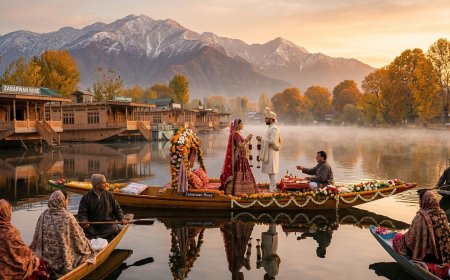
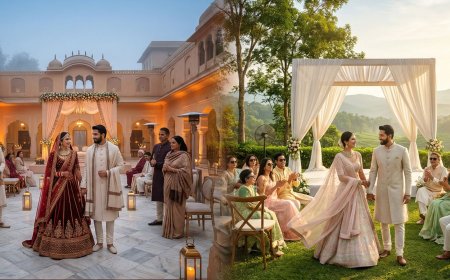
For Jain NRI families, Palitana in Gujarat — the site of the sacred Shatrunjaya hill with its 863 Jain temples — is the most spiritually significant destination wedding location in the world for this community. A wedding held in the vicinity of Palitana, or in Ahmedabad with its extraordinary Hutheesing Jain Temple as a ceremony backdrop, carries a weight that no overseas venue can replicate.
Jaisalmer and Bikaner in Rajasthan — with their magnificent Jain havelis and ancient temples — offer extraordinary settings for Rajasthani Jain families. Ranakpur, home to the spectacular marble Chaumukha temple, is another destination that diaspora Jain couples increasingly choose for its spiritual and aesthetic power.
When briefing local pandits for a destination Jain wedding in India, specify your sect — Shvetambara or Digambara — and your regional community clearly. A pandit trained in Gujarati Shvetambara customs will not automatically know Rajasthani Oswal variations. Request a pre-ceremony consultation to walk through the specific mantra sequence your family expects. For non-Indian or non-Jain guests, arrange a printed bilingual order of service and brief your wedding coordinator to provide quiet contextual explanations at each stage of the ceremony.
WHAT YOU NEED: RITUAL CHECKLIST
Ritual Items: Havan kund [sacred fire vessel] and fuel, sapta dhanya [seven sacred grains], akshata [turmeric rice], ghee, paan ke patte [betel leaves], supari [areca nut], fresh marigold and rose garlands, the mangalsutra [prepared in advance], sindoor [vermillion powder], the varmaala [wedding garland exchange], a chunri [red dupatta for the bride], oil lamps and wicks, kalash [sacred water pots for the Sthapana], a copy of the Jain wedding mantras for the pandit's reference, and a printed order of service for guests.
People Required: A Jain-trained pandit who knows the Vivah Panchami sequence, the bride's father for the Kanyadaan, a senior female elder to lead the Pithi and Mehendi, the best man [saali and sadu in Jain tradition for bride's sister and groom's brother-in-law roles], and ideally a community elder who can confirm gotra compatibility formally at the ceremony opening.
Preparation Steps: Complete gotra matching minimum six months before the wedding. Book your Jain pandit through your nearest Jain temple or JAINA network twelve months ahead. Confirm venue fire permissions early and arrange havan kund specifications in writing with the venue. Source all ritual items two to three months ahead. Hold Pithi and Tel Baan ceremonies at home the day before. Prepare bilingual order of service. Arrange live stream for India relatives.
NRI.Wedding connects Jain couples with verified Jain pandits, Gujarati and Rajasthani vendors, and photographers who understand the significance of the Saat Phere and the Kanyadaan moment. Browse our Jain wedding planning directory today.
5 QUESTIONS NRI COUPLES ALWAYS ASK
Can we do the Saat Phere without a real fire if the venue doesn't allow open flames?
Yes — and this is one of the most common adaptations made by Jain NRI couples worldwide. A bioethanol flame in a traditional copper havan kund produces a clean, nearly smokeless flame that satisfies both the ceremonial requirement and most venue fire safety regulations. Discuss this with your pandit in advance, as the mantra sequence for the agni installation [Sthapana] will need slight adaptation. Many experienced diaspora Jain pandits have performed this hundreds of times and will guide you confidently.
My partner is Hindu, not Jain. Will the ceremony be valid and will both families accept it?
This is genuinely one of the most common situations in modern Jain diaspora weddings. The short answer is yes — the ceremony can be conducted as a full Jain Vivah Sanskar with a non-Jain partner participating. The philosophical vows of the Saat Phere are universal enough that a Hindu partner will find deep resonance in them. The gotra check will apply only to the Jain partner's lineage. Speak openly with both families early, and brief your pandit so he can frame the ceremony inclusively without diluting its Jain character.
How do I find a pandit in Toronto who specifically knows Rajasthani Oswal Jain wedding customs, not just generic Jain mantras?
The Jain Society of Greater Toronto and the Rajasthani associations in Mississauga and Brampton are your starting points. The JAINA network — the Federation of Jain Associations in North America — maintains a pandit directory searchable by regional tradition. If no Rajasthani Oswal-specific pandit is available locally, it is entirely accepted to fly one in from New Jersey, Chicago, or even from Jaipur for the ceremony. Budget for travel and accommodation and book at least nine months ahead.
My parents want to do the gotra matching but we live in different countries and have never formally documented our gotras. How do we start?
Begin by asking the eldest member of each family to recall the gotra — this information is almost always held by grandparents and great-aunts. In many Jain families, the gotra is recorded in the Vahi [the traditional family genealogy book] maintained by the family's ancestral village pandit in Gujarat or Rajasthan. Your family's home village pandit can retrieve this. If the records are lost, the Jain community association in your ancestral region can often cross-reference community databases. Start this process at least eight months before the wedding.
We want to do a civil ceremony for legal purposes in Canada first and then the Jain ceremony. Does the order matter to the community?
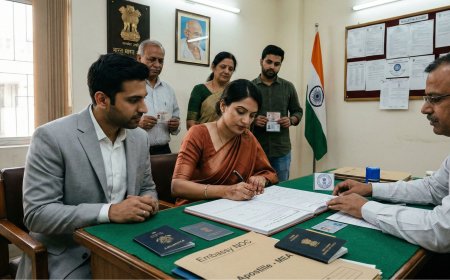
The Jain community, like most traditional Indian religious communities, considers the religious ceremony the true marriage. Civil registration for legal purposes is entirely standard for NRI couples and raises no concerns. Inform your pandit of the civil ceremony date at your first consultation — experienced diaspora pandits handle this routinely. The full Jain Vivah Sanskar proceeds with complete integrity regardless of prior civil registration.
THE EMOTIONAL ANGLE
There is a moment in the Jain Saat Phere that no one prepares you for. It is not the first step or the fire or even the mangalsutra. It is the seventh step — the one dedicated to maitri, to universal friendship, to the Jain understanding that love, to be complete, must extend beyond the two people making the vow.
For NRI Jain families doing this in a community hall in Leicester or a temple space in Houston, that seventh step lands differently than it does back in Ahmedabad or Jaisalmer. Because you have spent years — maybe your whole adult life — being the community that explains itself, that carries its own ingredients to the venue, that flies its pandit from three states away, that does the work nobody sees so that the ceremony looks effortless on the day.
And when you take that seventh step, and the mantra fills the room, and your mother is somewhere behind you holding herself very still because she refuses to cry in public, and your partner — who has learned the Jain concept of ahimsa and has eaten your grandmother's thepla and has sat through three hours of community deliberation about gotra compatibility with patient grace — takes your hand for the last time before you are officially married, something shifts.
You understand, for the first time fully, what the seventh step actually means. That all the effort — the sourcing, the flying in, the explaining, the adapting — was itself the vow. You were practicing maitri long before you reached the fire.
A MOMENT TO SMILE
At a Gujarati Jain wedding in Leicester in 2022, the family had arranged everything impeccably — the havan kund, the sapta dhanya, the pandit flown in from Ahmedabad, the pure vegetarian catering from a Jain caterer in Wembley who had driven up that morning. What nobody had anticipated was the venue's smoke detector, which was apparently sensitive enough to respond to the bioethanol flame in the havan kund at a distance of approximately twelve metres.
The alarm went off at the exact moment of the third phere. The pandit, a man of remarkable composure who had been conducting weddings for forty years, simply continued chanting at a slightly elevated volume. The groom's youngest uncle, who had appointed himself unofficial fire marshal for the occasion, began fanning the smoke detector with a paper plate with the focused intensity of a man whose nephew's wedding would not be interrupted. The bride, to her eternal credit, did not break her expression once.
The alarm stopped after ninety seconds. The third phere continued. The wedding photographer, who had been covering Jain weddings in the UK for fifteen years, later said it was the most composed ceremony he had ever witnessed under pressure. The paper plate now lives in a frame in the uncle's living room. He considers it a trophy.
QUOTES FROM THE DIASPORA
"We did the full gotra matching even though we were in Toronto and my family's records were in a Vahi in a village near Surat. It took three months and four phone calls to a pandit in Gujarat who had kept the records since 1971. When we finally confirmed compatibility, my father sat down and was quiet for a long time. He said: 'Now it is real.' That stayed with me." — Priya Shah, Gujarati Shvetambara Jain, Toronto
"My daughter-in-law is not Jain. She is from a Hindu Punjabi family. But she learned the significance of each phere before the wedding — she researched it herself, without being asked. When she took the seventh step and the pandit explained maitri, she looked at my son like she understood something new about who she was marrying. I have never loved a moment more." — Hemlata Mehta, Marwari Jain community, London
"People kept telling us to simplify. Do a shorter ceremony, skip the Tel Baan, use a Hindu pandit who knows most of the mantras. And I kept saying no. Because my grandparents brought the full ceremony from Rajasthan to Nairobi in 1962 and did it properly there. If they could do it in Nairobi, I could do it in Houston." — Kavita Jain, Rajasthani Oswal Jain community, Houston
YOUR ROOTS TRAVEL WITH YOU
The Jain wedding is the most philosophically demanding ceremony in all of Indian tradition — and it has survived 2,500 years precisely because the community that carries it has never been willing to simplify what matters. It has crossed oceans, survived dispersal, adapted to bioethanol flames and smoke detectors and twelve-hour time differences, and it arrives in every diaspora city still carrying its full spiritual weight.
NRI.Wedding is here for exactly this. Our directory of verified Jain pandits trained in both Shvetambara and Digambara traditions, our Gujarati and Rajasthani vendor networks, our destination wedding specialists in Ahmedabad, Palitana, and Jaisalmer, and our NRI wedding planning checklists exist because your ceremony deserves every one of its seven steps performed with full integrity.
Find your pandit. Confirm your gotra. Source your sapta dhanya. Take all seven steps.
Your roots travel with you. Let them be sacred.
This article covers Jain wedding rituals including Vivah Panchami, Saat Phere, gotra matching, Kanyadaan, and Sthapana ceremonies across Gujarati, Rajasthani, and Marwari Jain communities, with complete diaspora guidance for NRI couples in London, Toronto, Houston, Melbourne, and Dubai.
What's Your Reaction?
 Like
0
Like
0
 Dislike
0
Dislike
0
 Love
0
Love
0
 Funny
0
Funny
0
 Angry
0
Angry
0
 Sad
0
Sad
0
 Wow
0
Wow
0