


















































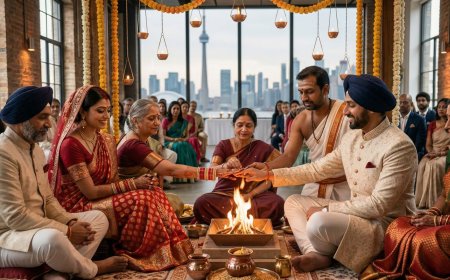



They Place a Feather on His Turban and He Becomes, for One Day, a King
The Kalgi — the jewelled plume placed on the Punjabi groom's turban — is not decoration. It is coronation. For NRI Punjabi families across London, Toronto, Dubai, Sydney, and Houston, the Kalgi ceremony is the most emotionally charged moment of the groom's wedding morning — the instant a family tells their son he is ready. This complete guide covers the royal origins of the Kalgi tradition, groom adornment customs across ten Indian communities, and practical guidance for sourcing Kalgis, booking turban-tiers, and performing this magnificent ceremony authentically abroad or as a destination wedding in India.


The Kalgi — the ornamental plume placed on the groom's turban at a Punjabi wedding — is one of the most visually magnificent and emotionally layered traditions in all of Indian wedding culture. It is not decoration. It is coronation. For NRI Punjabi families across London, Toronto, Dubai, Sydney, and Houston, the Kalgi ceremony is the moment the boy their family raised becomes the man they are sending forward — adorned, blessed, and ready. This is the tradition that makes grown men cry while pretending to adjust their turbans.
You have seen it in every Punjabi wedding photograph you have ever looked at. The groom in his sherwani, the turban perfectly tied, and there — at the front, catching the light — the Kalgi. That single plume of jewelled ornament that transforms a well-dressed man into something that looks, undeniably, like royalty. You noticed it as a child without knowing its name. You noticed it the way you notice something that belongs to a world larger and older than the one you currently inhabit.
Now it is your wedding. Or your son's wedding. Or your brother's. And the Kalgi is being discussed — where to source it, who places it, what the ceremony looks like, whether it can be done properly in the banquet hall of a hotel in Brampton or whether something essential will be lost in the translation.
Nothing will be lost. This article will make sure of it.
🌟 DID YOU KNOW?
The Kalgi [the jewelled plume or aigrette worn on the groom's turban] has its origins in the Mughal imperial court, where the jigha [the turban ornament worn by emperors and princes] was one of the most coveted symbols of royal authority in all of South Asian history. Akbar the Great's court records describe the jigha as a gift bestowed exclusively upon those the Emperor wished to honour above all others — making the Kalgi's placement on a Punjabi groom's turban a direct inheritance of the tradition of crowning a man as royalty on his wedding day.
The specific use of egret feathers in the traditional Kalgi is connected to ancient Indian beliefs about the egret's qualities — its white plumage represented purity, its stillness in water represented patience, and its sudden, precise movement represented decisive courage. These were considered the three essential qualities of a husband and a leader. Modern Kalgis use jewelled and feathered ornaments that preserve this symbolism without using protected bird species.
Among NRI Punjabi families surveyed in the UK and Canada, the Kalgi placing ceremony — often performed by the groom's maternal uncle [mama] or father — is ranked as the most emotionally significant moment of the groom's pre-wedding preparations, consistently described by grooms themselves as the moment the wedding became real, and by fathers as the moment they understood their son was ready.
What Is the Kalgi Wearing Ceremony?
Kalgi [from Persian/Urdu: the jewelled plume or aigrette attached to the front of the groom's turban, also spelled Kalgi or Kalghi] is the ornamental centrepiece of the Punjabi groom's wedding turban — and the ceremony of its placement is one of the most intimate, charged, and culturally significant moments of the entire Punjabi wedding sequence. It occurs on the morning of the wedding, during the groom's preparation, and it is the act that transforms the dressed groom into the dulha[bridegroom, the celebrated one] in the fullest ceremonial sense.
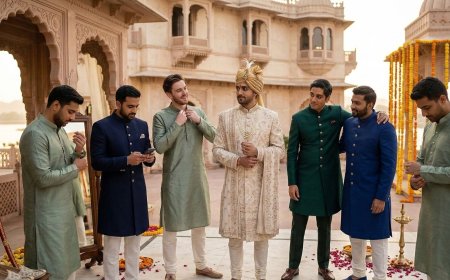
The sehra [the veil of flowers or beaded strings that hangs over the groom's face from the front of the turban] and the Kalgi are placed together as the final elements of the groom's shringar [adornment, the complete ritual dressing of the groom]. The turban — called pagri or dastar [the Sikh turban, one of the most significant articles of identity and honour in Punjabi culture] — is tied first, often by a skilled family member or professional turban-tier. The Kalgi is then brought forward — typically on a decorated thali [brass plate] by the groom's mother or sister — and placed at the front of the turban by the most honoured male figure present. In most Punjabi families, this is the mama [maternal uncle] — a role of profound ceremonial significance in Punjabi wedding culture. In some families, it is the father. In others, it is the paternal grandfather or a revered elder.
The placement of the Kalgi is accompanied by shagun [auspicious gifting] — the mama or father presents the groom with an envelope of money or a gold gift alongside the Kalgi, blessing him for the day and the life ahead. Female relatives sing ghorian [Punjabi wedding songs sung specifically for the groom, celebrating his departure toward his bride] during the ceremony. The groom sits still — which, for most grooms on their wedding morning, is the hardest thing they have been asked to do in years.
Once the Kalgi is placed and the sehra lowered, the groom is complete. He is no longer simply dressed. He is adorned. He is raja [king] for the day — and in Punjabi wedding tradition, this is not a metaphor. It is the literal role he is asked to inhabit: the noble one, the chosen one, the one whose arrival the bride's family has prepared for.
Community Comparison: Groom Adornment Traditions Across Indian Communities
| Community / State | Local Name | Key Tradition | How NRIs Abroad Adapt It |
|---|---|---|---|
| Punjabi Sikh | Kalgi / Sehra Bandi | Kalgi placed on dastar by mama; ghorian sung; full Punjabi shringar with sherwani or achkan | Full ceremony maintained; mama travels specifically for this role or video calls in; professional turban-tier booked in all major diaspora cities |
| Punjabi Hindu | Kalgi / Sehra Bandi | Similar to Sikh tradition; sehra of flowers hung from turban front; tilak applied before Kalgi placement | Tilak performed by pandit; flower sehra sourced from Indian florists; Kalgi purchased from Punjabi jewellers in Southall or Gerrard Street |
| Himachali | Topi Ceremony / Shringar | Groom adorned with traditional Himachali topi [distinctive Himachali cap] rather than turban; floral garlands placed around neck | Himachali topi sourced through community networks; family elder performs adornment; ghorian-equivalent folk songs sung |
| Garhwali | Groom Shringar | Groom adorned with traditional white dhoti-kurta and floral crown; community elder performs first dressing | Floral crown assembled by family; white dhoti-kurta sourced from Indian clothing stores; adornment performed by eldest male relative |
| Kumaoni | Mukut Ceremony | Mukut [ceremonial crown] of flowers placed on groom's head; specific Kumaoni folk songs sung during adornment | Flower mukut assembled by female relatives; Kumaoni songs played via recording; maternal uncle performs placement |
| Ladakhi | Groom Adornment | Traditional Ladakhi goncha [robe] worn; elaborate headdress specific to Ladakhi Buddhist-influenced tradition | Goncha sourced through Ladakhi community networks; community elder assists with headdress; both Ladakhi and modern elements incorporated |
| Kashmiri Pandit | Dastarband | Dastarband [turban tying ceremony] performed by the groom's brother-in-law; specific Kashmiri turban style tied; floral Kalgi equivalent placed | Kashmiri dastar style sourced through community; brother-in-law or designated male relative performs tying; Kashmiri family songs sung |
| Marathi | Mundavalya Ceremony | Mundavalya [strings of pearls or flowers worn across the forehead] placed on groom; pheta [Marathi turban] tied in specific style | Mundavalya sourced from Marathi community stores or Indian jewellers; pheta tied by family member following YouTube tutorials or with professional help |
| Tamil | Pattam / Kreedam | Pattam [a decorative forehead band] or floral kreedam [crown] placed on groom; specific Tamil Brahmin shringar performed | Tamil jewellers in London, Toronto, and Sydney stock pattam; family elder performs placement; Tamil songs played during adornment |
| Bengali | Topor Ceremony | Topor [a distinctive white conical crown made from shola pith, a plant-based material] placed on groom's head by mother; considered deeply auspicious | Topor sourced from Bengali community suppliers in London and Toronto; mother performs placement with full ceremony; dhak player hired for the moment |
| Rajasthani | Safa Bandi / Kalgi | Elaborate safa [Rajasthani turban] tied in specific regional style; jewelled Kalgi placed; bandhanwar [decorative door hanging] involved in departure | Rajasthani safa-tier booked through community networks; jewelled Kalgi commissioned from Rajasthani jewellers; full ceremony preserved |
The Meaning Behind the Ritual
The Kalgi is a crown. Every culture in human history has understood that a crown is not merely an object — it is a statement about who is responsible for what happens next. When a Punjabi family places the Kalgi on their son's turban, they are making this statement publicly, deliberately, and with full awareness of its weight: this man is now responsible. For a home. For a wife. For the continuation of everything we have built and everything we have preserved.
The dastar [turban] in Punjabi and Sikh culture is already the most significant article of identity a man can wear — it represents honour, dignity, commitment, and the willingness to be seen and recognised as a person of character. The Kalgi placed upon it adds a dimension that the turban alone does not carry: glory. Not the quiet glory of honour, but the active, visible, outward glory of a king on the day of his most important ceremony.
The mama's role in placing the Kalgi is equally significant. In Punjabi tradition, the maternal uncle holds a unique ceremonial position — he represents the bride's world brought into the groom's preparation, the acknowledgement that what is about to happen joins two families rather than simply launching one man forward. When the mama places the Kalgi, he is saying: I bless you on behalf of the world you are about to enter.
The ghorian sung by the women during this ceremony are among the most complex emotional texts in Punjabi folk culture — they celebrate the groom while simultaneously mourning his departure from the family home, understanding that every arrival requires a leaving.
For a non-Indian partner or family member: this is the moment we tell our son he is ready — not with words, because words are never enough, but with a jewel placed on his crown.
Doing the Kalgi Ceremony Abroad: The Practical Reality
The Kalgi ceremony is among the most manageable of NRI wedding rituals to perform abroad — it requires no fire, no pandit for its central act, no complex venue permissions. What it requires is the right Kalgi, the right turban tier, the right people in the room, and the right music. In diaspora cities, all of these are findable with the right guidance.
Sourcing the Kalgi: This is where NRI families most commonly struggle, and where advance planning pays the greatest dividends. A quality Kalgi — jewelled, weighted correctly, designed to sit properly on a Punjabi dastar — is not available at every Indian jeweller. In London, the jewellers and wedding accessory shops on Southall Broadway stock Kalgis specifically for the Punjabi groom market, and several shops on Green Street in East Ham carry bridal and groom accessories including Kalgi sets. In Toronto, the jewellery and groom accessory shops along Gerrard Street and the Dixie Road corridor in Mississauga carry Punjabi groom sets including Kalgi, sehra, and matching accessories. In Sydney, specialist Indian jewellers in Harris Park in Parramatta can order Kalgis on request with four to six weeks notice. In Houston, the Indian wedding accessory shops along Hillcroft Avenue carry Punjabi groom sets. In Dubai, the gold and jewellery souk in Deira and the Indian wedding shops in Bur Dubai and Meena Bazaar are your primary resources. Commission or purchase your Kalgi at least six to eight weeks before the wedding — do not leave this to the week before.
The Turban Tier: A Punjabi dastar tied correctly for a wedding is a skilled art — the style, the height, the tightness, and the fold are all specific to the occasion and the family's regional tradition. Professional turban-tiers serving the NRI community are available in all major diaspora cities. In London, the Southall and Gravesend Punjabi communities have professional dastar-banders who travel to wedding venues. In Toronto and Mississauga, professional turban-tiers are bookable through gurdwara networks and South Asian wedding vendor platforms. Book your turban tier at least two months ahead — they book out on popular wedding dates just as quickly as any other specialist vendor.
The Ghorian: The women's songs that accompany the Kalgi ceremony are called ghorian [Punjabi songs sung for the groom, named after the word for horse — as the groom was traditionally imagined arriving on horseback]. These songs require women who know them — typically the groom's mother, aunts, and sisters. If the family's older female relatives know ghorian, this is the moment they shine. If not, recordings of traditional ghorian are available and widely used — played through a Bluetooth speaker, they provide the sonic backdrop that makes the ceremony feel complete. Some NRI families hire a live folk singer for the morning — this is increasingly popular and deeply memorable.
The Mama's Role: If the groom's mama is travelling from India or another country for the wedding, confirm his availability for the morning ceremony specifically — not just the main event. Many mamas arrive the night before the wedding specifically to be present for this moment. If the mama cannot attend in person, the role is passed to the groom's father, a paternal uncle, or the most senior male figure available. This substitution is entirely acceptable and warmly practised — what matters is that the role is filled with love and intention.
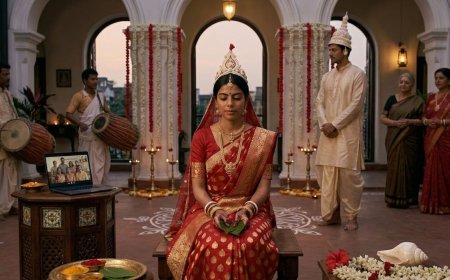
Coordinating with India: For grandparents and relatives in Punjab watching via video call, the Kalgi ceremony is visually clear and emotionally immediate. Position a tablet on a tripod at the groom's eye level — so relatives can see his face and the turban simultaneously. For families joining from Amritsar or Chandigarh, a mid-morning ceremony in the UK — around 10:00am — corresponds to 3:30pm IST, comfortable for elderly relatives. In Canada, a 9:00am Eastern ceremony reaches India at 7:30pm IST — still workable. Assign a dedicated person on each side to manage the connection and to describe what is happening during the music.
Doing the Kalgi Ceremony as a Destination Wedding in India
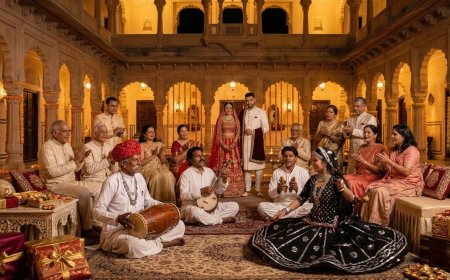
If your wedding is a destination event in Punjab or anywhere in India, the Kalgi ceremony returns to the setting it was designed for — a family home in the early morning, the smell of marigolds from the night before still in the air, the women of the household already singing, the men gathered in the courtyard.
Amritsar, Chandigarh, Jalandhar, and Ludhiana are the natural homes of the full Punjabi groom shringar experience — in these cities, professional turban-tiers, Kalgi suppliers, and folk singers are embedded in the wedding industry and available with ease. A Kalgi ceremony performed in an ancestral Punjabi family home — in the courtyard, with the full extended family present and the neighbours watching from their rooftops — is among the most complete wedding experiences available anywhere.
For destination weddings at palace or haveli hotels in Jaipur or Udaipur that are hosting Punjabi weddings, experienced wedding coordinators are accustomed to sourcing Punjabi groom accessories and arranging turban-tiers. For non-Indian guests attending the ceremony, a brief printed explanation of the Kalgi's significance — its royal origins, the mama's role, the meaning of the ghorian — transforms observation into genuine participation in something ancient and specific.
What You Need: Kalgi Ceremony Ritual Checklist
Ritual Items The Kalgi — sourced and fitted in advance; the sehra [veil of flower strings or beaded strands to hang from the turban front]; the groom's full shringar set including matching kaleere [decorative ornaments] if gifted by the bride's family; a decorated thali on which the Kalgi is presented; shagun envelope or gold gift prepared by the mama; fresh marigold garlands for the room; a Bluetooth speaker loaded with ghorian recordings if live singers are not arranged; and matching dupatta or sash in the wedding colour for the groom's outfit.
People Required The professional turban-tier [booked separately, well in advance]; the mama or designated elder to place the Kalgi; the groom's mother to present the thali; female relatives — mother, aunts, sisters — to sing ghorian or manage the music; a designated family member to manage the video call for India-based relatives; and a photographer specifically briefed that the Kalgi placement is one of the most important frames of the entire morning.
Preparation Steps Source and purchase the Kalgi six to eight weeks before the wedding. Book the turban-tier two to three months ahead. Confirm the mama's travel arrangements and morning availability four weeks ahead. Prepare the shagun envelope one week before. Source ghorian recordings or confirm live singer booking three weeks ahead. Set up and test the video call connection the morning of the ceremony. Brief the photographer on the Kalgi placement sequence one week before the wedding.
NRI.Wedding's vendor network includes verified Punjabi groom accessory suppliers, professional turban-tiers, and folk singers across the UK, Canada, UAE, and Australia. Let us connect you to the right people so that when the mama steps forward with the Kalgi, everything else is already handled.
5 Questions NRI Couples Always Ask
Can the Kalgi ceremony happen at the wedding venue rather than at home?
Absolutely — and the majority of NRI Kalgi ceremonies happen exactly this way. The groom's preparation suite at the venue becomes the ceremonial space. What matters is that the room is set up with intention — flowers, the decorated thali, the music — so that the space feels like a ceremony is happening rather than a getting-ready session. Many NRI families book an additional room at the wedding venue specifically for the groom's morning preparation, keeping it separate from the main event space and giving the Kalgi ceremony its own contained, intimate atmosphere. This works beautifully.
My mama lives in Australia and my wedding is in Canada. How do we manage his role if he cannot travel?
If the mama genuinely cannot be present, the role passes to the groom's father or the most senior and beloved male figure in the family. Many NRI families, however, find that the mama makes extraordinary efforts to attend specifically for the Kalgi ceremony — it is one of the roles in Punjabi wedding culture that people fly across the world for, understanding its significance. If a video call participation is the only option, position the device so the mama can see the groom's face and turban clearly, and have a local elder physically place the Kalgi at the moment the mama gives his blessing via the call. This hybrid approach is increasingly common and genuinely moving.
My partner is not Punjabi. How do we incorporate a groom's adornment tradition from their culture alongside the Kalgi?
This is one of the most joyful planning conversations in intercultural NRI weddings. If the groom is Punjabi and the bride is from a different community, the Kalgi ceremony happens as part of the Punjabi groom's preparation. Many intercultural families then incorporate a parallel adornment tradition from the bride's community — a topor for a Bengali groom, a mundavalya for a Marathi groom — as a second ceremony that the bride's family performs. This double adornment, each family honouring the groom in their own tradition, is among the most beautiful expressions of intercultural NRI weddings.
Where do we find a professional turban-tier in a city like Melbourne or Houston where the Punjabi community is smaller?
The Sikh gurdwara network is the most reliable starting point in any city — most gurdwaras maintain connections to skilled dastar-banders within the community who perform this service for weddings. In Melbourne, the Sikh community in the western suburbs has a small but well-connected wedding services network reachable through the local gurdwara. In Houston, the Sikh community centred around the gurdwara in Sugar Land and the Shri Guru Singh Sabha maintains connections to turban-tiers. NRI.Wedding's vendor directory lists verified turban-tiers across diaspora cities including smaller Punjabi communities. If no local option exists, some families fly in a turban-tier from a city with a larger Punjabi community — this is more common than you might expect and entirely worth the cost.
Does the Kalgi need to be a specific style or can we choose any design?
The Kalgi should be appropriate to the turban style being tied — a tall Punjabi dastar requires a Kalgi with sufficient weight and height to be visible and proportional. The design itself is a matter of family preference and budget — traditional Kalgis feature real or faux feather elements with jewelled bases in gold or silver settings, while contemporary Kalgis range from minimalist jewelled pins to elaborate multi-feathered statement pieces. The key considerations are weight [it must sit securely on the turban without sliding], proportion [it should be visible from a distance without being so large as to be absurd], and coherence [it should complement the colour and style of the sherwani and turban]. Your turban-tier can advise on appropriate Kalgi styles for the specific dastar they will tie — consult them before purchasing.
The Emotional Angle
Nobody talks about what the Kalgi morning is like for the groom's father. The conversation is always about the bride — her emotions, her farewell, her journey. The groom is expected to be composed. Excited, perhaps. Nervous, certainly. But composed.
The groom's father stands in the corner of the preparation room watching his son sit still while the turban is tied — watching the transformation happen in real time, fold by fold, inch by inch — and he is doing something privately that nobody in the room can see. He is going back. Back to the morning his own dastar was tied, in a house that no longer exists in a city he has not lived in for thirty years. Back to his own father's hands. Back to a version of himself that was nervous and ready and not yet aware of how much would be asked of him in the years ahead.
His son does not know any of this yet. He will. The years will teach him what the ceremony cannot.
When the mama steps forward with the Kalgi on the thali and the room goes quiet and the women begin the ghorian — in that particular moment, in a preparation suite in Mississauga or Southall or Houston — the father understands something he has always known but never had to hold so clearly: that the whole point was this. All of it. Every sacrifice, every difficult year, every morning he went to work in a city that was not his because the alternative was unthinkable. The whole point was to get his son to this room, in this turban, with this jewel on his crown.
The Kalgi catches the light. His son is ready. He has never been more proud in his life.
A Moment to Smile
At a wedding in Houston two summers ago, the groom's professional turban-tier — a meticulous and highly experienced gentleman from the Punjabi community in Sugar Land — had been tying dastars for thirty-one years without incident. He was, by all accounts, unflappable.
He had not previously encountered the groom's younger brother, aged sixteen, who had decided independently and without consultation that he would also like his turban tied in the same style as his brother's, and who positioned himself directly beside the groom throughout the ceremony, mirroring every instruction given to the groom with complete seriousness.
The turban-tier, to his enormous credit, tied both turbans. The younger brother's was slightly less architecturally ambitious but entirely respectable. When the mama placed the Kalgi on the groom, the younger brother looked at his own turban, looked at his brother's Kalgi, and said, with complete composure: "Next time."
The turban-tier said it was the best compliment he had received in thirty-one years. The younger brother's turban is in every wedding photograph. He has not stopped talking about it.
Quotes from the Diaspora
"I thought I was prepared for the Kalgi moment. I had seen it at every cousin's wedding since I was seven years old. I was not prepared. When my mama placed it on my turban and I saw myself in the mirror — I did not recognise myself immediately. Not because I looked different. Because I looked the way I was supposed to look. Like it had always been there, waiting." — Harjinder Singh Dhaliwal, Punjabi Sikh community, Toronto
"My husband's family is Punjabi. We are Tamil. I had never seen a Kalgi ceremony before his wedding morning. I stood in the doorway of the preparation room and watched his mama place the Kalgi and the women begin singing and I understood, without anyone explaining it to me, exactly what I was watching. A family telling their son he was ready. It is the same in every language." — Priya Krishnamurthy, Tamil community, London
"We sourced the Kalgi from a shop in Southall six weeks before the wedding. My mother-in-law carried it in her hand luggage from London to Melbourne because she did not trust the checked baggage. She presented it on the thali herself on the morning of the wedding, standing in a hotel suite in the Melbourne CBD, singing a ghori her own mother had taught her. The shop in Southall. The hotel in Melbourne. Her mother's song. This is what we carry." — Simran Kaur Brar, Punjabi Sikh community, Melbourne
Your Roots Travel With You
Somewhere right now, a groom is sitting very still in a preparation room — in a hotel in Mississauga, in a banquet hall suite in Southall, in a villa in Dubai, in a hired room in Sydney — while a skilled pair of hands folds a turban around his head. His mother is holding a decorated thali. His mama is standing nearby, composing himself. The women are beginning to sing.
The Kalgi catches the light. The sehra falls. The groom sees himself in the mirror and understands, perhaps for the first time, what this day actually is.
NRI.Wedding's vendor network includes verified Kalgi suppliers, professional turban-tiers, and Punjabi folk singers across the UK, Canada, UAE, and Australia. Our planning resources ensure every element of the groom's morning — from the sourcing of the Kalgi to the coordination of the family video call — is handled before the day arrives. Let us carry the logistics. You carry the crown.
The Kalgi is placed. The king is ready. Everything else begins now.
What's Your Reaction?
 Like
0
Like
0
 Dislike
0
Dislike
0
 Love
0
Love
0
 Funny
0
Funny
0
 Angry
0
Angry
0
 Sad
0
Sad
0
 Wow
0
Wow
0