









































































The Sacred Science of Mandap Mahurat: How NRI Families Are Honouring Vedic Timing Across Every Time Zone
Mandap Mahurat is the Vedic science of identifying the precise auspicious moment for raising and consecrating the wedding canopy — a calculation drawn from five simultaneous cosmic variables in the ancient Panchang almanac that has governed Indian wedding ceremonies for over 2,500 years. This guide explores the spiritual logic behind Mahurat timing, regional variations across UP Brahmin, Rajasthani, Marathi, Tamil, and Bengali communities, and practical advice for NRI families navigating late-night Mahurats, venue curfews, time zone conversions, and Jyotishi consultations in cities like Leicester, Mississauga, Edison, Melbourne, and Houston.


In Indian wedding tradition, the Mandap is not simply a decorative structure — it is a consecrated cosmic space, a temporary temple built specifically for the union of two souls. The Mahurat that governs when this canopy is raised and when the ceremonies beneath it begin is not a scheduling preference — it is a calculation thousands of years in the making, drawn from Vedic astronomy, planetary alignment, and the precise spiritual logic of auspicious time. For NRI couples planning weddings across time zones, continents, and calendars, understanding Mandap Mahurat is the difference between a ceremony that feels aligned and one that feels approximate.
You have booked the venue. You have confirmed the caterer. You have had three separate conversations with your mother about the flowers and one extremely long conversation with your future mother-in-law about the flowers, and those were different conversations. You have done everything a modern, organised, internationally located person does when planning a wedding.
And then your pandit calls and says the Mahurat for your ceremony is 2:47 AM.
You laugh. He does not laugh. You realise he is not joking. You spend the next week trying to understand why the most auspicious moment for the most important ceremony of your life has been identified as happening in the middle of the night — and in doing so, you begin to understand something about Vedic time that no calendar app has ever tried to explain to you.
This guide will explain it. And by the end, 2:47 AM will make complete sense.
🌟 DID YOU KNOW?
- The calculation of Mahurat (auspicious timing) draws from the Panchang — the Vedic almanac that tracks five simultaneous cosmic variables: Tithi (lunar day), Vara (weekday), Nakshatra (lunar mansion), Yoga (planetary combination), and Karana (half-day period) — making every Mahurat the intersection of five independent astronomical cycles, a calculation so complex it requires years of specialised training to perform correctly.
- The Mandap structure itself is prescribed in precise detail in the Grihyasutras — ancient Sanskrit household ritual manuals — with specifications for the number of posts, the direction it must face, the materials from which it must be constructed, and the sequence of consecration rituals that transform raw timber and fabric into sacred ceremonial space. These texts are over 2,500 years old and are still consulted by practising pandits today.
- A 2024 survey of NRI wedding planners across the UK, US, Canada, and Australia found that Mahurat timing is the single most common source of conflict between NRI couples and their wedding venues — with over 58% of respondents reporting that their auspiciously timed ceremony fell outside their venue's standard operating hours, requiring special negotiation.
What Is Mandap Mahurat?
Mandap Mahurat is the Vedic determination of the precise auspicious moment at which the wedding canopy — the Mandap — must be erected, consecrated, and ceremonially activated, and within which the main wedding rites must begin. It is not one calculation but several, layered together with the precision of an astronomical equation, and it governs not just the wedding ceremony itself but a sequence of pre-ceremony rituals that prepare the physical and spiritual space for what is about to happen.
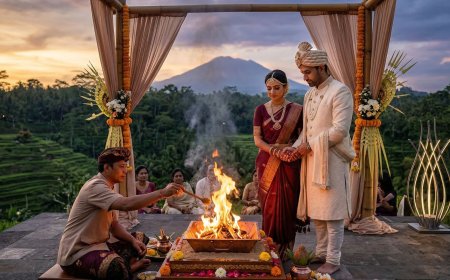
The Mandap (from Sanskrit, meaning a pavilion or canopy of honour) is the temporary sacred structure — typically four-posted, fabric-draped, and decorated with flowers, mango leaves, and toran (threshold garlands) — beneath which the couple sits for the main wedding rites. In Vedic understanding, the Mandap is a yagnashala — a sacred fire hall — and its construction transforms an ordinary space into a consecrated one. This transformation cannot happen at a random time. It must happen when the cosmos is aligned to receive and support the intention of the ceremony.
The Mahurat is calculated from the Panchang — the Vedic five-limbed almanac — by a qualified Jyotishi (Vedic astrologer) or pandit using the birth details of both the bride and groom, the specific day and location of the wedding, and the current positions of planetary bodies. The calculation identifies Shubh Muhurta — auspicious windows — by finding moments when the five Panchang variables align favourably and no inauspicious doshas (planetary afflictions) are active.
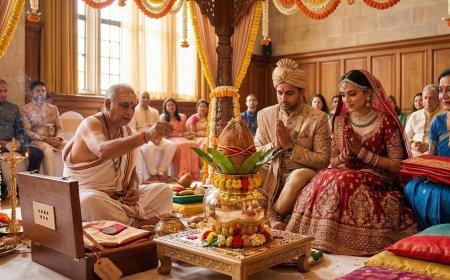
Before the Mandap is raised, a Bhoomi Puja (earth-honouring ceremony) consecrates the ground on which it will stand. The four posts are then erected in sequence, each accompanied by specific mantras. Mango leaves are strung across the entrance — their presence invoking abundance and auspiciousness — and the central space is purified with Ganga jal(holy water), gomutra (purified cow preparation), and incense. Only when the Mandap has been physically constructed and spiritually consecrated does the space become ready to hold the weight of what will happen inside it.
The Mahurat for the main ceremony — the moment the couple sits beneath the Mandap and the fire is lit — is the most precisely calculated timing in the entire wedding sequence. Missing it, in Vedic understanding, is not merely inconvenient. It is cosmologically significant.
Community Comparison Table
| Community / State | Local Name | Key Tradition | How NRIs Abroad Adapt It |
|---|---|---|---|
| UP Brahmin | Mandap Mahurat / Vivah Mahurat | Panchang-based calculation; mango leaf toran essential; Mandap faces east; Bhoomi Puja before erection | Mahurat calculated by Varanasi pandit consulted remotely; mango leaves sourced from Indian grocery shops or substituted with artificial |
| Rajasthani (Marwari) | Mahurat / Lagn | Highly specific clan-based Mahurat calculation; Lagn Patrika (auspicious timing document) printed and distributed to all family | Lagn Patrika printed in UK or Canada; Jyotishi in Jodhpur consulted via video; timing honoured even at late hours |
| Rajasthani (Rajput) | Vivah Mahurat with Kuldevi blessing | Kuldevi invocation precedes Mandap consecration; specific clan-based auspicious timing | Kuldevi puja conducted via live stream from ancestral temple; Mahurat preserved exactly |
| Himachali | Mahurat with Devta blessing | Local deity consulted through Gur (oracle) before wedding date is finalised; community blessing integrated | Community elders consulted for Devta blessing via video call; Mahurat verified by Himachali pandit |
| Garhwali | Mahurat / Shubh Ghadi** | Dhol-damau played at the exact Mahurat moment; community gathers at the auspicious time regardless of hour | Dhol played at Mahurat time even if 5 AM; Garhwali diaspora community gathers specifically for this moment |
| Kumaoni | Shubh Muhurta | Similar Panchang calculation; emphasis on Nakshatra compatibility between bride and groom | Calculation done by Kumaoni pandit; Nakshatra compatibility document prepared and shared with both families |
| Kashmiri Pandit | Muhurta / Lagna | Specific Kashmiri Pandit almanac used; Lagna Patri prepared by family pandit; saffron and walnut offered at Mandap | Kashmiri pandit diaspora community well-organised; Lagna Patri prepared months in advance |
| Punjabi (Hindu) | Shubh Muhurta / Mahurat | Mahurat consulted but ceremony timing more flexible; emphasis on Anand Karaj timing for Sikh ceremonies | Mahurat window used as guidance; ceremony scheduled within window rather than at exact minute |
| Marathi Brahmin | Muhurta / Lagnapatrika** | Lagnapatrika (formal wedding invitation) includes precise Muhurta timing; considered binding | Lagnapatrika printed with exact timing; Marathi pandit sourced to honour specific Muhurta |
| Tamil Brahmin (Iyer) | Muhurtam | Tamil Panchangam used; highly specific calculation; Kashi Yatra and main ceremony timing both calculated | Tamil Panchangam consulted via specialist apps; Tamil Brahmin pandit essential for correct calculation |
| Bengali Brahmin | Lagna / Shubho Drishti timing** | Specific Shubho Drishti (auspicious first sight) moment calculated precisely; couple's first look timed cosmically | Shubho Drishti timing preserved exactly; Bengali pandit in UK or North America consulted months ahead |
| Gujarati | Mahurat / Lagn | Lagn Lekhu (auspicious timing document) prepared; specific Gujarati Panchang used | Lagn Lekhu prepared by Gujarati Jyotishi; shared digitally with all family members including those in India |
The Meaning Behind the Ritual
The Vedic understanding of time is not linear — it is cyclical, textured, and alive. Not all moments are equal. Some moments carry more shakti (energy), more prana (life force), more receptivity to human intention than others. The science of Mahurat is the art of identifying those moments and aligning human action with cosmic readiness.
The Nakshatra (lunar mansion) under which a wedding ceremony begins is understood to imprint itself on the marriage itself — certain Nakshatras favour longevity, others favour abundance, others favour spiritual harmony. The Tithi (lunar day) determines the emotional and relational quality of what is initiated. The Yoga (planetary combination) active at the Mahurat moment governs the broader trajectory of the union.
This is not superstition. It is a sophisticated system of natural observation developed over millennia by scholars who understood that human beings are not separate from the cosmos they inhabit — they are expressions of it. To begin a marriage at the moment when the cosmos is most aligned with the intention of union is not magical thinking. It is the application of the deepest available knowledge about the nature of time to the most important beginning of a human life.
The Mandap erected at the Mahurat moment becomes, in this understanding, a sacred container — a space where cosmic alignment and human intention meet and reinforce each other. The four posts represent the four directions, the four Vedas, the four Purusharthas (life goals: Dharma, Artha, Kama, Moksha). The canopy above represents the sky — the cosmos itself — made intimate, brought down to human scale, held in place by the devotion of the family that built it.
For a non-Indian partner or guest: the Mandap Mahurat is the belief that the universe has good moments and better moments — and that love deserves the best one available.
Doing Mandap Mahurat Abroad: The Practical Reality
This is where the ancient science meets the modern NRI reality — and where honesty, flexibility, and advance planning matter more than anywhere else in the wedding process.
The Mahurat timing problem is real, and NRI families must address it directly rather than hoping it will resolve itself. If your Jyotishi calculates a Mahurat of 11:30 PM, 2:00 AM, or 5:15 AM — all of which are entirely common — you have several options, and each has genuine validity.
The first option is to honour the Mahurat exactly. Many NRI families do this, and venues that are experienced with Indian weddings — particularly in areas with large South Asian communities like Brampton, Leicester, Southall, and Parramatta — are accustomed to late-night or early-morning ceremony timings. Book your venue for a 24-hour period rather than a standard evening slot. Brief your guests in advance and frame the timing as what it is: a cosmically identified moment of extraordinary auspiciousness. Guests who understand this arrive willingly at 2 AM. Guests who are told "the astrologer said so" tend to be less enthusiastic — so the framing matters.
The second option is to work with a Jyotishi who can identify the best available Mahurat within a practical time window. Most qualified Vedic astrologers can identify multiple auspicious windows within a given date — some more optimal than others, but all within the range of shubh (auspicious). Communicating your constraints — "we need a Mahurat between 6 PM and midnight" — is not a betrayal of tradition. It is a practical negotiation that pandits have been helping families make for generations.
The Mandap construction abroad requires sourcing materials that carry the correct symbolism. Mango leaves for the toran are available at Indian grocery stores in most major diaspora cities — in London at Southall and Wembley, in Toronto at Gerrard Street East, in Houston at Hillcroft Avenue, and in Sydney at Parramatta Road stores. Fresh mango leaves are preferable, but high-quality fabric or artificial versions are an accepted substitution when fresh leaves are unavailable. Marigold garlands for Mandap decoration are available through Indian florists in all major diaspora cities — book four to six weeks ahead for wedding quantities. Sacred threads and Kalash (ceremonial copper pot) for Mandap consecration are available at Indian religious goods shops on the same streets.
The pandit's role in Mandap Mahurat is both computational and ceremonial. Find your pandit before you finalise your wedding date — not after. The correct sequence is: pandit consultation, Mahurat calculation, then venue booking with that timing in mind. Most NRI families do this in reverse order and then face the Mahurat problem as a crisis rather than a plan. NRI.Wedding's pandit directory includes Jyotishis experienced in calculating Mahurats for international locations across multiple time zones — an important detail, as the calculation must be done for the specific geographic coordinates of your venue, not for India.
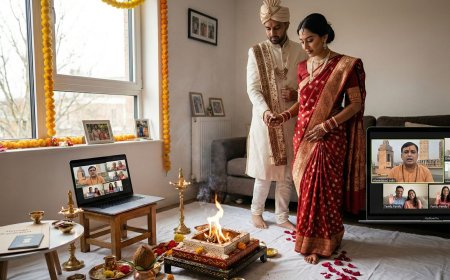
Time zone coordination for the Mahurat is a genuine technical challenge that is often overlooked. If your Jyotishi in Varanasi calculates a Mahurat and gives you an IST time, confirm explicitly that the conversion to your local time zone has been done correctly — not assumed. A 6:47 PM IST Mahurat is 1:17 PM GMT, 8:17 AM EST, and 5:17 AM PST. These are four completely different ceremony realities. Always verify the conversion with your pandit and your local coordinator independently.
Doing Mandap Mahurat as a Destination Wedding in India
In India, Mandap Mahurat finds its most natural and fully supported expression — the infrastructure of Vedic ceremony is built into the fabric of every aspect of the wedding industry here, and no venue coordinator will be surprised by a 3 AM ceremony time.
Varanasi is the most spiritually resonant location for a Mahurat-governed wedding — the city's Jyotishis are among the most learned in the country, and a Mandap erected on the banks of the Ganga at an auspiciously calculated moment carries a quality of sacred alignment that is genuinely difficult to describe to someone who has not been there. Jaipur, Udaipur, and Jodhpur offer heritage venues with experienced staff who manage multi-day, late-night Mahurat ceremonies as standard practice. Rishikesh is increasingly popular with NRI families who want a spiritually grounded destination wedding with access to Himalayan-trained pandits.
Brief your venue on the exact Mahurat timing at least three months ahead — not as a courtesy but as a contract requirement. Confirm that the venue staff, catering team, and all vendors are confirmed for the precise timing, including any late-night or early-morning windows. Heritage venues in Rajasthan and UP are experienced with this; newer boutique properties may need more explicit briefing.
For international guests, the Mahurat timing in India is actually easier to manage than abroad — guests staying at the wedding venue or nearby accommodation simply need clear advance communication about the ceremony schedule, and the immersive environment of an Indian destination wedding makes even a 2 AM ceremony feel like exactly what it is: a once-in-a-lifetime moment.
What You Need: Ritual Checklist
Ritual Items Four wooden or bamboo Mandap posts decorated with fabric and marigold strings. Mango leaf toran for the entrance. Kalash — copper pot filled with water, topped with coconut and mango leaves — for each post. Navagraha(nine planetary) invocation items as specified by pandit. Sacred thread (mauli) to tie around each post. Havan samagri(sacred fire offering materials) for Mandap consecration. Ganga jal for purification of the space. Fresh flower garlands for overhead decoration. Rangoli at the Mandap entrance. Incense and dhoop for the ceremony space.
People Required A qualified Jyotishi or pandit for Mahurat calculation — ideally engaged before the wedding date is finalised. A ceremony pandit to conduct the Bhoomi Puja and Mandap consecration. The groom's father or senior male relative to lead the Mandap erection ceremony. A trusted family member to coordinate the construction timing against the calculated Mahurat. A photographer present from the Mandap erection — the consecration rituals are visually extraordinary and often overlooked for documentation.
Preparation Steps Engage Jyotishi and calculate Mahurat before booking venue — minimum eight months ahead for peak season. Book venue for full Mahurat-accommodating time period. Source Mandap construction materials six to eight weeks ahead. Brief pandit on specific regional tradition and any family-specific Mandap customs four weeks ahead. Confirm all vendor timings against Mahurat at least two weeks before. Conduct a Mandap space walk-through with the decorator and pandit three days before the wedding.
NRI.Wedding connects couples with Jyotishis who calculate Mahurats for international locations, experienced ceremony pandits, Mandap decorators across diaspora cities, and heritage venue partners in India who understand the sacred logic of auspicious timing — find everything in our vendor directory.
5 Questions NRI Couples Always Ask
Our venue has a strict midnight curfew and our Mahurat is at 1:30 AM. What do we do?
You have two practical paths. The first is to ask your Jyotishi to identify the next best available Mahurat within your venue's operating hours — most qualified astrologers can find a workable auspicious window and will advise you on the relative quality of different options. The second is to negotiate with your venue — many Indian wedding-experienced venues in diaspora cities have provisions for late-night ceremonies if requested in writing at the time of booking, with appropriate additional charges. Some families in this situation have also chosen to hold the main ceremony elements at the auspicious time in a smaller private space — a suite, a garden — and move the celebration to the main venue before or after.
Can the Mahurat be calculated by an app or an online Panchang rather than a qualified Jyotishi?
Panchang apps and online calculators can give you a general sense of auspicious windows and are useful for preliminary planning. However, a wedding Mahurat calculation is not a general auspicious timing — it is a specific calculation that must account for both individuals' birth charts, the geographic coordinates of the wedding location, and the interaction of multiple planetary factors that require trained interpretation. An app will give you a starting point. A qualified Jyotishi will give you a calculation you can trust and explain. For the most important ceremony of your life, invest in the latter.
We are having a destination wedding in Rajasthan. Should we use a Jyotishi from our home community or a local Rajasthani astrologer?
Use your home community's Jyotishi for the Mahurat calculation — the calculation should be based on your family's traditional almanac and both individuals' birth details, and a pandit who knows your community's tradition will produce a more appropriate result. Then share the calculated Mahurat with the local Rajasthani venue coordinator and ceremony pandit, who will manage the practical implementation. The calculation and the execution are two separate roles.
My non-Indian partner thinks Mahurat timing is superstition. How do I explain it in a way that makes sense to them?
Start not with the astrology but with the underlying philosophy: the Vedic worldview holds that time is not uniform — that the universe has rhythms, and that beginning important things in alignment with those rhythms rather than against them is simply wisdom. Point out that this is not entirely foreign to Western culture — people consult weather forecasts before outdoor events, check financial calendars before major transactions, and understand intuitively that timing matters. The Mahurat is a much more sophisticated version of the same insight, applied to the most important beginning of a human life. Most non-Indian partners, approached this way, find it not just acceptable but genuinely interesting.
What happens spiritually if we miss the Mahurat window?
This is the question NRI families ask most quietly and most sincerely, and it deserves a genuine answer. Most learned pandits will tell you that the Mahurat is the ideal — the moment of maximum cosmic support — but that intention, devotion, and the quality of the family's preparation carry their own powerful weight. A ceremony conducted with complete sincerity just outside the ideal window is infinitely more auspicious than a ceremony conducted within it carelessly. The cosmos responds to consciousness, not just to timing. Do your best to honour the Mahurat. And if circumstances make that impossible, honour the ceremony itself with everything you have. That is never wrong.
The Emotional Angle
There is something that happens to NRI families in the hours before the Mandap Mahurat that nobody adequately prepares you for. It is the hour when everyone who has been managing logistics and coordinating relatives and chasing vendors for months suddenly goes quiet. When the Mandap is standing, decorated and lit, and the pandit is preparing his materials, and the family is gathered not in the frantic way of wedding preparations but in the still way of people who know something irreversible is about to happen.
For NRI families, this stillness carries an extra dimension. Because the Mandap standing in a banquet hall in Brampton or a hotel ballroom in New Jersey or a marquee in Melbourne is not just a wedding canopy. It is proof. Proof that the family did not lose what they crossed oceans to keep. Proof that the knowledge of when to build and how to consecrate and which mantras to speak survived not just in books but in people — in the pandit who flew in from Varanasi, in the grandmother who remembered the toran pattern, in the father who knew without being told that the Kalash must face east.
The Mahurat moment — that precise, calculated, cosmically identified instant when the priest signals that it is time — does something to a room. It makes everyone in it understand simultaneously that they are part of something much larger than a wedding. They are part of a conversation between human beings and the universe that has been going on for thousands of years.
And tonight, in this room, it is their turn to speak.
A Moment to Smile
At a wedding in Mississauga last spring, the Mahurat was calculated at 11:52 PM — manageable, everyone agreed. The venue had been briefed. The pandit was ready. The family was assembled.
At 11:49 PM, the groom's youngest uncle — who had been managing the Mandap decoration and was extremely proud of his work — discovered that one of the four Kalash had been placed facing the wrong direction. With three minutes to the Mahurat.
What followed was the fastest ceremonially correct repositioning of a copper pot in the history of the Mississauga South Asian wedding community. Two aunties, the pandit's assistant, and a decorator who was still technically on his break converged on the Kalash with an efficiency that would have impressed military planners. The pot was repositioned, the mauli retied, and the space re-purified with Ganga jal at exactly 11:51 PM.
The pandit began at 11:52 PM precisely. He has never acknowledged that he noticed anything. The uncle has never admitted that he was responsible. The Kalash, however, faced exactly the right direction for the entire ceremony, and the marriage has been, by all accounts, beautifully aligned ever since.
Quotes from the Diaspora
"Our Mahurat was 4:15 AM. I want you to understand that we had 200 guests in a banquet hall in Leicester at 4:15 in the morning, and not one of them complained. Not one. Because we had explained what the Mahurat meant — really explained it — and by the time that moment came, everyone in that room understood they were exactly where they were supposed to be, at exactly the right time. I have never felt more certain of anything in my life." — Deepika Sharma, UP Brahmin family, Leicester
"My son asked me why the Mahurat mattered when we had already signed the civil papers six months ago. I told him: the civil papers tell the government you are married. The Mahurat tells the universe. He stopped asking questions after that."— Ramesh Tiwari, Brahmin community, Edison, New Jersey
"I am a software engineer. I work in data. I was skeptical about Mahurat timing for most of my adult life. Then I sat under the Mandap at the exact moment the pandit had calculated, with the fire lit and my husband's hand in mine, and something shifted in the room that I cannot explain with data. I have stopped trying to explain it. Some things you just know." — Priya Kulkarni, Marathi Brahmin family, Melbourne
Your Roots Travel With You
The Mandap Mahurat asks something profound of every NRI family that chooses to honour it: the willingness to let the cosmos set the schedule. In a world of calendar apps, venue contracts, and catering cutoffs, this is genuinely countercultural. And it is precisely that quality — the insistence that some things are more important than convenience — that makes it so worth preserving.
NRI.Wedding is here to make the ancient and the practical coexist without compromise. From Jyotishis who calculate Mahurats for venues in London, Toronto, Houston, and Sydney, to Mandap decorators who know the difference between a beautiful canopy and a consecrated one, to ceremony pandits who can conduct Bhoomi Puja in a Brampton banquet hall with the same rigour they would bring to a Varanasi courtyard — we are with you for every moment of this extraordinary alignment.
Your roots travel with you. Let them find the right moment.
What's Your Reaction?
 Like
0
Like
0
 Dislike
0
Dislike
0
 Love
0
Love
0
 Funny
0
Funny
0
 Angry
0
Angry
0
 Sad
0
Sad
0
 Wow
0
Wow
0