







































































Why Tamil Weddings Ask a Couple to Hold Milk Together First — And How NRI Families Preserve Paal Pidithal Abroad
Paal Pidithal — the Tamil wedding ritual of holding milk together — is one of the most quietly profound ceremonies in the entire Tamil matrimonial sequence, a brief and deeply symbolic act in which the newly married couple jointly holds a vessel of fresh milk as their first shared gesture, offering a portion to the sacred fire before keeping anything for themselves. This guide explores the complete Paal Pidithal tradition, community variations across Tamil Iyer, Iyengar, Nadar, Vellalar, and Sri Lankan Tamil families, and practical advice for NRI families recreating this ceremony in cities like London, Toronto, Melbourne, Houston, and Sydney — including vessel sourcing, Paal Homam fire offering, Paal Payasam continuity, and pandit briefing.

In Tamil wedding tradition, Paal Pidithal — the ritual in which the bride and groom hold a vessel of milk together for the first time as a married couple — is one of the most quietly profound ceremonies in the entire matrimonial sequence. It does not have the visual drama of the Thali tying or the musical magnificence of the Oonjal, but it carries a theological weight that Tamil families have always understood intuitively: that the first thing a new marriage should hold together is something pure, white, nourishing, and shared. For Tamil NRI families recreating this ceremony in London, Toronto, Sydney, and beyond, Paal Pidithal is the ritual that makes the marriage feel, for the first time, like a home.
You have seen your parents hold things together your whole life. The same end of a shopping bag walking home from the market. The same corner of a newspaper on Sunday mornings. The same edge of a grandchild, passed between them at family gatherings with the specific ease of people who have been handing things back and forth for so long that the motion has become a single gesture shared between two bodies.
You never noticed, until now, that it began with milk.
Now you are in Wembley or Mississauga or Melbourne, planning your Tamil wedding, and the Paal Pidithal is a ceremony you may have half-remembered from a cousin's wedding, or heard mentioned in passing, or are encountering for the first time through a conversation with your mother who says simply: this is what we do, and we do it because it means something, and you will understand what it means when you are holding the vessel.
She is right. This guide will explain what she means. But she is right that the explanation will only be complete when you are holding the vessel.
🌟 DID YOU KNOW?
- Paal Pidithal (literally "holding milk" in Tamil) is rooted in the ancient Tamil and Vedic understanding of milk as amrita — the nectar of immortality, the substance that sustains life from its very first moments — making the act of holding milk together the Tamil wedding tradition's way of saying that this marriage will be a source of nourishment and life for everything it touches.
- Milk holds a unique position in both Tamil Shaiva and Vaishnava ritual traditions — it is one of the five substances of Panchamrit (the sacred five-fold nectar used in temple worship), it is the medium in which the Shivalingam is bathed daily in Tamil temples, and it is the first food offered to a newborn in Tamil households — making it the substance that Tamil culture associates with beginnings more than any other.
- Tamil diaspora wedding research indicates that Paal Pidithal has among the lowest awareness rates of any Tamil wedding ritual among second-generation NRI families — with fewer than 45% of Tamil NRI brides and grooms under 35 able to name or describe the ceremony before their wedding planning begins — yet over 88% of families who include it report it as one of the most emotionally resonant moments of their entire wedding day, rating its impact above ceremonies they had considered more significant.
What Is Paal Pidithal?
Paal Pidithal (from Tamil: paal — milk, pidithal — the act of holding or grasping together) is a Tamil wedding ritual in which the newly married bride and groom jointly hold a vessel containing milk — typically a palagai (flat wooden board or tray) on which a pot of milk is placed, or in many traditions, a chombu (traditional brass or silver vessel) filled with fresh milk — as one of the first acts they perform together as a married couple. The ceremony follows the Mangalsutra Dharanam (Thali tying) and in many Tamil Brahmin families occurs as part of the broader post-tying ritual sequence that includes the Sapthapadi (seven steps) and the blessing ceremonies that follow.
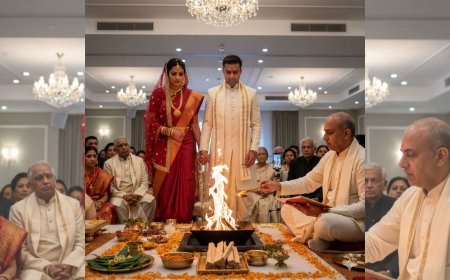
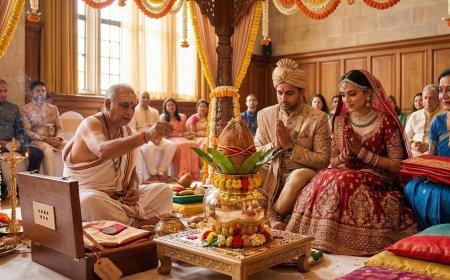
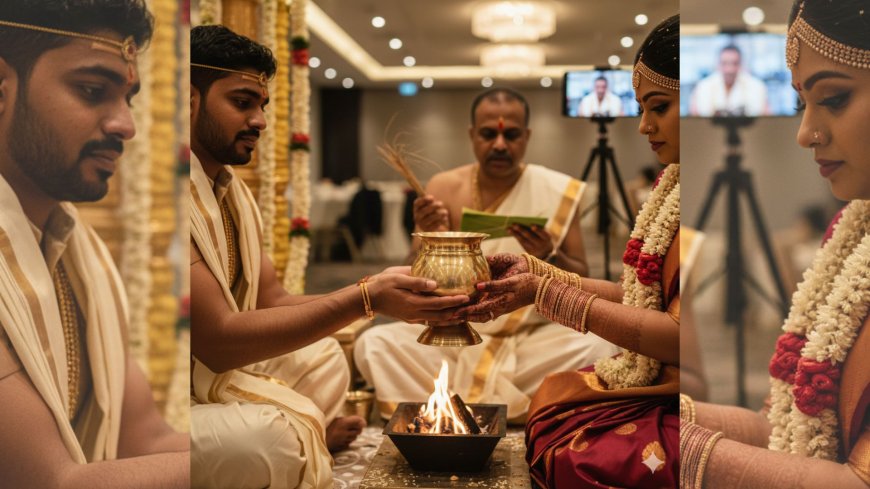
The physical act is simple: the groom holds the vessel with both hands, the bride places her hands over his, and together they present the milk — sometimes to the assembled family elders for blessing, sometimes to the sacred fire of the ceremony, sometimes simply to each other — as the first shared offering of their married life. The pandit recites specific mangala shlokas (auspicious verses) over the joined hands and the milk during this holding, invoking the purity, nourishment, and abundance that milk symbolises into the beginning of the union.
In many Tamil families, the Paal Pidithal is immediately followed by the couple together pouring a small amount of the milk into the sacred fire — an offering called Paal Homam (milk fire offering) — which transforms the domestic act of holding milk into a cosmic one, offering the nourishment they have just held together to the fire that witnesses all Tamil Hindu ceremony.
In some family traditions, the milk is subsequently used to make the Paal Payasam (milk pudding with rice and jaggery) that is served at the wedding feast — a beautiful continuity in which the couple's first shared holding becomes the food that sustains their guests.
The ceremony is brief — ten to fifteen minutes in most families — but its brevity should not be mistaken for simplicity. It is the Tamil wedding tradition's way of giving the new marriage its first task and watching what the couple does with it. Do they hold it steadily? Do they hold it together? Do they offer it before they keep it for themselves?
The answers, Tamil tradition believes, tell you everything about the marriage that will follow.
Community Comparison Table
| Community / State | Local Name | Key Tradition | How NRIs Abroad Adapt It |
|---|---|---|---|
| Tamil Brahmin (Iyer) | Paal Pidithal / Paal Homam | Couple holds milk vessel together; milk poured into sacred fire; specific Iyer mangala shlokas recited | Fresh whole milk used; brass chombu sourced from Tamil religious goods shops in Wembley or Markham |
| Tamil Brahmin (Iyengar) | Paal Pidithal with Vaishnava elements | Vishnu invocation during milk holding; tulsi leaf placed in milk before offering; distinct Iyengar mantra sequence | Iyengar pandit essential; tulsi from home plant placed in milk; ceremony follows Iyengar-specific sequence |
| Tamil Nadar | Milk holding ceremony | Community-specific blessings during milk holding; extended family participation; elder women pour milk over joined hands | Elder women's pouring role preserved; community songs accompany; ceremony held in family gathering space |
| Tamil Vellalar | Paal Pidithal with elder blessing | Senior family elders place hands over couple's during milk holding; multi-generational blessing embedded in ritual | Elder blessing round preserved; eldest family member present given primary blessing role |
| Sri Lankan Tamil | Milk ritual with Sri Lankan customs | Similar structure with Sri Lankan Tamil specific songs and blessings; coconut milk occasionally used alongside regular milk | Sri Lankan Tamil diaspora in Toronto and London preserve community-specific elements; coconut milk sourced locally |
| Kannada Brahmin | Halu Kudiyuvudu / Milk ritual | Couple drinks milk together from same vessel after holding; shared consumption emphasised | Shared drinking from vessel preserved as central gesture; Karnataka-specific mantras requested from pandit |
| Telugu Brahmin | Palu Piditham | Similar holding ceremony; milk mixed with jaggery before holding in some families; sweet milk emphasises abundance | Jaggery mixed into milk if family tradition; Telugu pandit sourced for correct mantra sequence |
| Malayali Hindu | Milk blessing ceremony | Milk presented to family elders for blessing; less formalised holding sequence; emphasis on elder participation | Elder participation preserved as central element; Kerala-specific flowers used in decoration of milk vessel |
| UP Brahmin | Panchamrit offering | Milk as component of Panchamrit offered during main ceremony; separate milk holding not standard | Panchamrit sequence preserved with milk as central ingredient; UP Brahmin pandit leads specific formulation |
| Rajasthani (Marwari) | Paal / Milk welcome ceremony | Bride welcomed into groom's home with milk offering; milk threshold crossing tradition | Milk threshold welcome preserved at venue entrance; decorated vessel carried by groom's mother |
| Punjabi Hindu | Milk welcome at threshold | Bride's hands dipped in milk at groom's home threshold as welcome ritual; similar nourishment symbolism | Threshold milk ritual adapted to venue entrance; family elder leads blessing over milk vessel |
| Bengali Brahmin | Dugdha offering | Milk offered during main ceremony as part of broader ritual sequence; no specific joint holding ceremony | Milk offering preserved within ceremony sequence; Bengali pandit incorporates at correct ritual point |
The Meaning Behind the Ritual
Paal Pidithal operates within a theology of shared holding that is one of Tamil culture's most distinctive contributions to the philosophy of marriage. In a wedding tradition that contains ceremonies of great individual drama — the groom's solo Kashi Yatra, the bride's solo Nalangu anointing, the precise solitary act of tying three knots — Paal Pidithal is the moment that is entirely, essentially, irreducibly joint. Neither person can perform it alone. The vessel held by one person is not Paal Pidithal. The vessel requires two.
Milk in Tamil religious and cultural thought is the substance most closely associated with life's beginning and continuation. It is the first food. It is offered to gods in daily worship. It is the medium of Abhishekam (sacred bathing of deities) in Tamil temples. It is the substance from which Amrit — the nectar of immortality — was churned from the cosmic ocean in the Puranic creation narrative. When a Tamil wedding places milk in the hands of a newly married couple, it is placing life itself there — and asking them to hold it together.
The vessel matters in this ritual in a way that is specifically Tamil. Tamil material culture has always understood objects as carriers of intention — the same vessel used to hold offering milk in a home daily, blessed by family prayer and domestic devotion over years, carries a different spiritual charge than a new vessel purchased for the occasion. Many Tamil families use a chombu or palagai that has been in the family for generations — a brass vessel that has held milk at family ceremonies across decades. When the newly married couple holds this vessel, they are not just holding milk. They are holding the accumulated devotional history of every family member who held it before them.
The Paal Homam — the offering of some of the milk to the sacred fire — completes the ritual's theological arc. The couple does not keep the milk for themselves. They offer a portion first. This is the Tamil marriage tradition's first lesson to the new couple: before you nourish yourselves, offer. Before you consume what you hold together, give a portion to something larger than yourselves. The fire that receives the milk offering is the same fire that witnessed the Thali tying — it is the cosmic witness, and the couple's first shared act before this witness is an act of giving.
For a non-Indian partner or guest: Paal Pidithal is the moment Tamil tradition gives a marriage its first instruction — hold what nourishes together, and offer before you keep.
Doing Paal Pidithal Abroad: The Practical Reality
Paal Pidithal is, in practical terms, one of the most straightforward Tamil wedding ceremonies to recreate abroad — it requires no special venue infrastructure, no fire permit (unless the Paal Homam element is included), and no equipment that cannot be sourced in any city with an Indian grocery shop. What it requires is awareness, intention, and a pandit who knows to include it in the ceremony sequence rather than skip it as a minor ritual.
The milk must be fresh and whole — not skimmed, not UHT-processed if it can be avoided, and ideally organic. In Tamil Brahmin tradition, the quality of the offering reflects the quality of the intention — offering inferior milk at the most important ceremony of your life is a contradiction that most families intuitively understand without needing it explained. Fresh whole milk is available everywhere. Buy it the morning of the ceremony.
The vessel is where families have the most meaningful choice. A traditional chombu — a brass or silver vessel with a distinctive Tamil form — is available at Indian religious goods shops in all major diaspora cities. In London, shops on Wembley High Road and Southall Broadway carry brass ceremonial vessels. In Toronto, Gerrard Street East and the Scarborough Tamil corridor have Tamil religious goods shops with appropriate vessels. In Sydney, Harris Park in Parramatta has Tamil-run shops. In Houston, Hillcroft Avenue carries a range. If your family has a vessel that has been used at previous family ceremonies — a grandmother's chombu that travelled with her when the family first emigrated — the decision to use it for your Paal Pidithal is one of the most meaningful choices you can make in your entire wedding planning process. Contact your family about it. The vessel is waiting to be asked.
The Paal Homam element — the offering of milk to the sacred fire — requires fire, which means it must be incorporated within the main havan (sacred fire ceremony) rather than conducted as a separate flame. Brief your pandit on your family's tradition regarding whether Paal Homam is performed and at which point in the ceremony sequence it occurs. If your venue has fire restrictions, the milk holding can be performed as a complete ceremony without the fire offering element — the theology of shared holding is intact even without the fire.
The pandit must know to include Paal Pidithal as a distinct ceremonial moment rather than a passing gesture. This ceremony is occasionally abbreviated or omitted by pandits who are managing time pressure — brief your pandit explicitly at your pre-wedding meeting that you want Paal Pidithal given its full ceremony time, with the appropriate mangala shlokas recited during the holding. NRI.Wedding's pandit directory includes Tamil Brahmin pandits who are briefed on the importance NRI families place on preserving each individual ceremony within the Tamil wedding sequence.
The Paal Payasam continuity — using the milk from Paal Pidithal to make the wedding feast payasam — is a beautiful tradition that requires coordination with your caterer. Discuss this at least one month before the wedding. Some caterers will be familiar with this tradition; others will need guidance. The amount of milk used in the ceremony is small relative to a full Payasam preparation, so the wedding milk typically joins a larger quantity rather than constituting the entire batch — but the symbolism of its inclusion transforms an ordinary dessert into something the couple and their guests are eating together for the first time.
Coordinating with India for Paal Pidithal is simpler than for more visually complex ceremonies — the ritual is intimate and relatively still, which means a video call from India can actually observe it properly rather than struggling to track a moving procession. Set up a stable video connection and position it to show both the couple's faces and the vessel clearly. If your family is in Tamil Nadu (IST), a morning ceremony in the UK (11:00 AM GMT) falls at 4:30 PM IST — comfortable for grandparents. A mid-morning ceremony in Toronto (11:00 AM EST) falls at 9:30 PM IST — a late but manageable evening.
Doing Paal Pidithal as a Destination Wedding in India
In Tamil Nadu, Paal Pidithal exists within its fullest cultural context — a ceremony that every family elder present will recognise and carry their own memories of, a ritual that requires no explanation because it has always simply been part of what Tamil weddings are.
Chennai is the natural destination for Tamil Brahmin NRI weddings, with Mylapore's dense concentration of Tamil Brahmin ceremony infrastructure making every element of the Paal Pidithal — from the brass vessel to the correct pandit to the fresh milk delivered on the morning of the ceremony — straightforwardly available. Madurai's sacred atmosphere adds a layer of spiritual depth to the ceremony that is difficult to articulate — milk offered in a city where the temples have been receiving milk offerings for two thousand years carries a resonance that geography alone creates. Thanjavurand Kumbakonam offer heritage venues where the ceremony feels embedded in the living tradition rather than recreated from memory.
Brief your local pandit on the specific point in your ceremony sequence at which Paal Pidithal occurs in your family tradition, and whether your family observes the Paal Homam element. Tamil wedding ceremony sequences vary in detail between families and sub-traditions, and a written brief ensures the ceremony receives its correct placement and timing rather than being absorbed into a generic sequence.
For non-Indian guests, Paal Pidithal is one of the most accessible Tamil wedding ceremonies to explain and witness — its physical simplicity makes its meaning immediately visible. A one-sentence explanation in the wedding programme — "the couple holds milk together as their first shared act, offering nourishment before they keep it for themselves" — is sufficient for any observer to understand exactly what they are witnessing.
What You Need: Ritual Checklist
Ritual Items Fresh whole milk in sufficient quantity for the holding ceremony and Paal Homam offering if included — minimum one litre. A traditional brass or silver chombu or ceremonial vessel — family heirloom preferred, newly sourced entirely appropriate. A decorated palagai (flat wooden board) if your tradition uses a tray rather than a vessel. Fresh tulsi leaves for Iyengar families — placed in milk before ceremony. A small copper ladle for pouring the milk offering into the fire if Paal Homam is performed. Kumkum and chandanam for the bride's forehead. Fresh flowers for decorating the milk vessel — jasmine preferred. Ingredients for Paal Payasam if the wedding feast will include the ceremonial milk continuity.
People Required The bride and groom as the primary holders — this ceremony belongs entirely to them. The pandit for mangala shloka recitation during the holding. Family elders positioned near the couple to witness and offer blessings immediately after the holding. The groom's mother to receive the vessel from the couple after the ceremony if your family tradition includes a post-holding elder blessing. A photographer — the image of two pairs of hands around a brass vessel is one of the most compositionally beautiful photographs in the Tamil wedding sequence and deserves a photographer who knows to be ready for it.
Preparation Steps Brief pandit on Paal Pidithal inclusion and timing minimum four weeks ahead. Source vessel — family heirloom or new purchase — minimum six weeks ahead. Confirm with caterer regarding Paal Payasam continuity one month ahead. Purchase fresh milk the morning of the ceremony. Prepare vessel with flower decoration before the ceremony begins. Position photographer specifically for the vessel-holding image before the ceremony sequence reaches Paal Pidithal. Set up India video call thirty minutes before the ceremony.
NRI.Wedding connects Tamil families with pandits who honour every ceremony in the Tamil wedding sequence, Tamil religious goods suppliers across diaspora cities, and photographers who understand that sometimes the most powerful wedding image is two pairs of hands around a brass vessel full of milk — find everything in our vendor directory.
5 Questions NRI Couples Always Ask
Our pandit has not mentioned Paal Pidithal and we are worried it will be omitted. How do we ensure it is included?
Raise it explicitly at your pre-wedding meeting with your pandit — not as a question but as a requirement. Say clearly: we want Paal Pidithal included as a distinct ceremonial moment with the appropriate mangala shlokas, not as a passing gesture within another ceremony. Provide the pandit with your family's specific tradition regarding placement in the ceremony sequence and whether Paal Homam is included. A good pandit will welcome this specificity — it tells them that you are a family who cares about the ceremony being complete. If your pandit is resistant to including what your family considers an important ritual, NRI.Wedding can connect you with a Tamil Brahmin pandit who understands the full ceremony sequence.
We want to use my grandmother's chombu for the ceremony but she is in Chennai and we are in London. Can the vessel be shipped safely?
Yes — brass and silver ceremonial vessels travel well if properly wrapped in bubble wrap and placed in a sturdy box. Most international shipping services will handle it without issue as a declared household item. The more pressing question is whether the vessel needs any restoration — old brass vessels sometimes benefit from professional cleaning before a ceremony. There are Tamil metalwork restoration services in Chennai's Mylapore area that can clean and polish a family chombu appropriately before shipping. Arrange this at least six to eight weeks before the wedding to allow shipping time. The effort of using the family vessel is worth every logistical challenge it presents.
Can Paal Pidithal be performed without a sacred fire if our venue does not permit open flames?
Yes — the Paal Homam element (offering milk to the fire) is a beautiful addition but not the essential core of the ceremony. Paal Pidithal itself — the joint holding of the milk vessel with mangala shloka recitation — is complete without a fire offering. The theology of shared holding and nourishment is entirely intact. If your family wishes to include a fire offering element, some venues permit small contained flames in specific areas — discuss this with your venue coordinator well in advance, and NRI.Wedding's venue partner network includes venues experienced with Tamil ceremony fire requirements.
My partner is not Tamil and does not know what to do during Paal Pidithal. How do we prepare him?
The ceremony requires very little instruction beyond: hold the vessel, hold it with both hands, and when I place my hands over yours, do not let go. That is genuinely all. The meaning will communicate itself — the warmth of the milk through the brass, the weight of the vessel, the sound of the mantras, the image of two pairs of hands around something that has always meant life and beginning. Brief your partner on the meaning before the wedding day so he holds the vessel with understanding rather than just compliance. Non-Tamil partners who have been told what the milk means consistently describe Paal Pidithal as one of the moments they felt most genuinely part of the Tamil wedding, rather than a participant in something foreign.
Is there a specific time within the wedding ceremony sequence when Paal Pidithal must occur?
In most Tamil Brahmin traditions, Paal Pidithal occurs after the Mangalsutra Dharanam (Thali tying) and within the broader post-tying blessing sequence, before or during the Sapthapadi (seven steps). The exact placement varies by family tradition and sub-community practice — Iyer and Iyengar sequences differ in detail. The consistent principle is that it occurs after the couple is married (after the Thali tying) and before they complete the main ceremony sequence. Confirm the specific placement with your pandit at your pre-wedding meeting, providing your family's sub-tradition as the reference point for the sequencing decision.
The Emotional Angle
There are Tamil wedding ceremonies that announce themselves — the nadaswaram of the Thali tying, the akshat shower, the nalangu songs filling a room. And then there is Paal Pidithal, which arrives quietly, without announcement, in the space between the ceremonies that everyone has been watching for.
The couple's hands are already full — full of garlands, full of the weight of everything that has just happened at the sacred fire, full of the specific tiredness that comes from having been the centre of every eye in a room for several hours. And the pandit places a vessel of milk in the groom's hands and says: hold this. And the bride places her hands over her husband's — the first time she has moved toward him as his wife, in the quiet of this moment that is just theirs — and they hold it together.
For NRI families, this moment carries an additional weight that the ceremony's ancient architects could not have anticipated. The milk in that vessel was bought this morning at a supermarket in Brampton or Wembley or Parramatta. The vessel may have come from a shop on the high street or from a grandmother's trunk packed thirty years ago when the family first left. The pandit flew in from Varanasi or was found through a community association. The ceremony is happening in a function room decorated with jasmine ordered six weeks ago by someone who understood, without being able to fully explain why, that jasmine was not optional.
And yet when the hands close around the vessel and the mantras begin, none of the logistics remain. There is only the milk, and the warmth of it through the brass, and the specific gravity of two people holding something pure together for the first time.
Tamil tradition has always known what NRI families discover in this moment: that the most important things a marriage will ever hold will often be simple, warm, and shared. The ceremony is just the beginning of a very long practice.
A Moment to Smile
At a Tamil Brahmin wedding in Melbourne three summers ago, the Paal Pidithal was proceeding beautifully when the bride's youngest cousin — aged five, elaborately dressed, and operating with the freedom of a child who has been told to sit still for three hours and has reached his absolute limit — decided that the milk in the ceremonial chombu looked interesting.
He was, fortunately, intercepted approximately thirty centimetres from the vessel by three separate family members moving with the coordinated efficiency of people who had been tracking him as a risk since the ceremony began. The interception was seamless enough that the pandit did not notice, the groom's expression remained composed, and the bride — who had seen it all from her peripheral vision — maintained perfect ceremonial dignity with only the very slightest tremor at the corner of her mouth.
The cousin was subsequently occupied with a phone displaying a cartoon for the remainder of the ceremony. The milk was held, offered, and later incorporated into the Paal Payasam served at the reception dinner, which the cousin ate two portions of without any awareness of the role he had almost played in its ceremonial history.
The family has since described him as the ceremony's most energetic blessing. He remains unaware of this honour.
Quotes from the Diaspora
"Nobody told me that Paal Pidithal would be the moment I cried. I had prepared myself for the Thali tying. I had tissues ready for the Kashi Yatra. And then they placed that brass vessel in our hands and my husband's hands were underneath mine for the first time, warm through the brass, and the pandit was reciting and the room was quiet and I just — understood. This is what married is. This is what it feels like. I was not prepared for how simple and how enormous it would be simultaneously." — Meenakshi Raghavan, Tamil Iyer family, Wembley
"My mother's chombu came to Melbourne in 1987 in a suitcase with her sarees and her cookbooks and a photograph of her parents. It has held milk at every important ceremony in our family since then. My daughter held it with her husband at their wedding last spring. I watched from beside the pandit and I thought: that vessel has now held the beginning of three marriages. My parents'. Mine. My daughter's. I don't have words for what that is. I just know it is everything." — Lakshmi Sundaram, Tamil Brahmin family, Melbourne
"I am Irish and my wife is Tamil Iyengar. I did not know what Paal Pidithal was until our wedding morning. The pandit placed the vessel in my hands and explained: hold this, and when she puts her hands on yours, hold it together and do not let go. I have thought about those instructions every day of our marriage. They were the best instructions anyone has ever given me." — Seamus Krishnaswamy, Irish-Tamil family, Toronto
Your Roots Travel With You
Paal Pidithal is Tamil wedding tradition's quietest ceremony and its most durable teaching. In a sequence of extraordinary ritual moments — the swing, the Thali, the sacred fire — this brief holding of a vessel of milk between two pairs of hands carries the instruction that will govern everything that follows: hold what nourishes together, offer before you keep, and do not let go.
NRI.Wedding is here to make sure this ceremony is never abbreviated, never skipped, and never treated as a minor ritual within a busy wedding day. From Tamil Brahmin pandits who know the full ceremony sequence and will give Paal Pidithal the time and mantras it deserves, to Tamil religious goods suppliers in Wembley, Scarborough, Parramatta, and Houston where the right vessel can be found, to caterers who understand the Paal Payasam continuity, to photographers who know that two pairs of hands around a brass vessel is one of the most quietly powerful images in Tamil wedding photography — we are with you for every drop of this ceremony.
Your roots travel with you. Hold them together, warmly, and do not let go.
This article explores Paal Pidithal — the Tamil wedding milk holding ritual — including the Paal Homam fire offering, Paal Payasam continuity, community variations across Tamil Iyer, Iyengar, Nadar, and Sri Lankan Tamil traditions, and practical guidance for NRI families planning ceremonies in diaspora cities including London, Toronto, Melbourne, Houston, and Sydney.
What's Your Reaction?
 Like
0
Like
0
 Dislike
0
Dislike
0
 Love
0
Love
0
 Funny
0
Funny
0
 Angry
0
Angry
0
 Sad
0
Sad
0
 Wow
0
Wow
0