

























































Desert Drums, Sacred Circles, and All-Night Dancing: The Truth About a Rajasthani Bhil Wedding No One Has Written About
The Rajasthani Bhil tribal wedding is one of the most viscerally alive and least documented wedding traditions in India — a multi-day communal celebration built around sacred drumming, Ghoomar circle dancing, Badwa-led tribal prayers, Pithora sacred art, and a community spirit that treats the entire village as an active participant rather than a passive guest. For NRI couples with Bhil heritage planning their wedding from Leicester to Houston, this tradition is a living inheritance of extraordinary depth and beauty. This guide covers every ritual, every musical element, and every practical step for honouring Bhil heritage abroad or as a destination wedding in the Mewar and Vagad regions of Rajasthan.

The Bhil tribal wedding of Rajasthan is one of the most viscerally alive, musically extraordinary, and spiritually rooted wedding traditions in the Indian subcontinent — a multi-day celebration in which the boundary between the human and the sacred dissolves entirely into music, dance, colour, and community. For NRI couples with Bhil heritage planning their wedding from Leicester to Houston, this tradition is not just cultural memory — it is a living inheritance that deserves to be carried forward with full knowledge of what it contains.
You grew up hearing about the weddings back in the village. Not from photographs — there were rarely photographs — but from the way your grandmother described them. The drumming that started before dawn and did not stop until the following night. The women who danced in circles so long their feet knew the rhythm without their minds having to think about it. The colours — not the muted, coordinated palette of a modern wedding — but something wilder, more insistent, as if the desert itself had decided to dress for the occasion.
You are in Leicester now, or Houston, or somewhere in Western Sydney, and you are planning your wedding. The Bhil tradition runs in your blood even if it has never been explained to you in full. You want to honour it — not as a performance for guests, not as a decorative gesture toward heritage — but as a real, living, breathing expression of who your family is and where it comes from.
This article will give you the full picture.
🌟 DID YOU KNOW?
The Bhil community is one of the largest tribal groups in India, with a population estimated at over twelve million people spread across Rajasthan, Gujarat, Madhya Pradesh, and Maharashtra. In Rajasthan alone, the Bhil and Bhil Mina communities represent a significant proportion of the tribal population, with deep roots in the Mewar, Vagad, and Dungarpur regions where their wedding traditions have been practised continuously for thousands of years.
The Pithora [a form of sacred tribal art painted on the walls of homes during auspicious occasions including weddings] is one of the most significant artistic traditions associated with Bhil and Rathwa tribal communities. These paintings — depicting horses, deities, and scenes of community life — are considered living prayers, and the act of painting them is itself a ritual requiring specific knowledge and community participation.
The Bhil community has its own oral epic tradition called the Gavri [a ritual theatrical performance combining drama, dance, and music], which is performed during specific community occasions. Wedding music among the Bhils draws from the same deep well of oral tradition — songs that have been passed down without being written, living entirely in the memories and voices of community singers for generations beyond counting.
What Is a Rajasthani Bhil Tribal Wedding?
A Bhil tribal wedding is not an event with a beginning, a middle, and an end in the conventional sense. It is a sustained communal experience — typically spanning three to five days — in which the entire village or community participates not as guests but as active celebrants. There is no audience at a Bhil wedding. There are only participants.
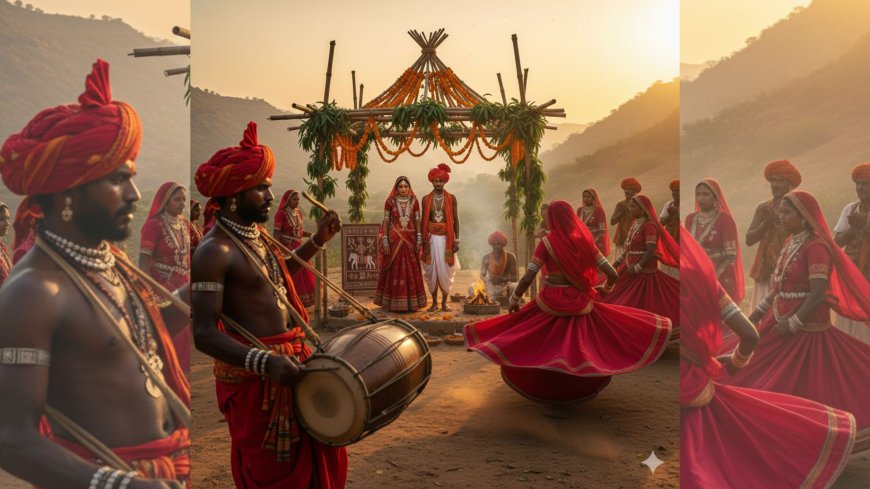
The wedding sequence begins with the Mandav [the ceremonial wedding canopy or pavilion, constructed from bamboo and decorated with leaves, flowers, and cloth] being erected at the bride's home. This is not a vendor's responsibility — it is built by the men of the community together, and the construction itself is treated as a ritual act requiring specific songs to be sung as the work proceeds. The Mandav is the sacred space within which the central ceremonies will take place, and its erection marks the formal beginning of the wedding period.
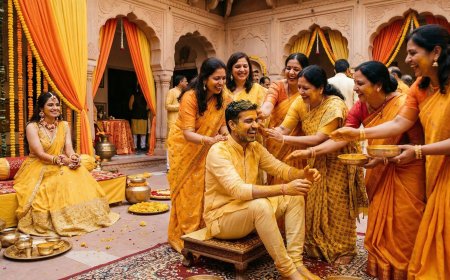
The Pithi [turmeric paste ceremony] is performed for both bride and groom separately, with female relatives applying the paste to the body while singing specific lok geet [folk songs] that have been composed for this precise moment — not generic songs but songs that address the bride or groom by the circumstances of their transition. The turmeric is understood not merely as a cosmetic preparation but as a purification — a yellowing of the body that marks the person as set apart, moving from one state of being to another.
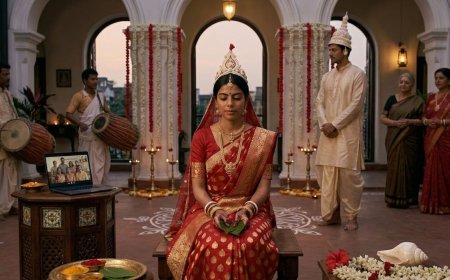
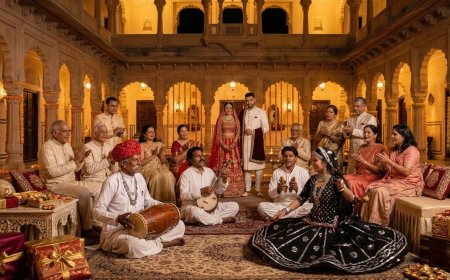
The Var [the groom's wedding procession] is among the most spectacular elements of a Bhil wedding — a procession that moves to the sound of the dhol [the large double-headed drum that is the heartbeat of Bhil music], the shehnai [the oboe-like wind instrument whose piercing, reedy sound has announced auspicious occasions across North India for centuries], and the thali [metal plates beaten rhythmically by women as percussion]. The groom rides — traditionally on a horse, though mules and decorated vehicles are also used — and the procession dances rather than walks. By the time the Var arrives at the bride's home, it has become a moving celebration in its own right.
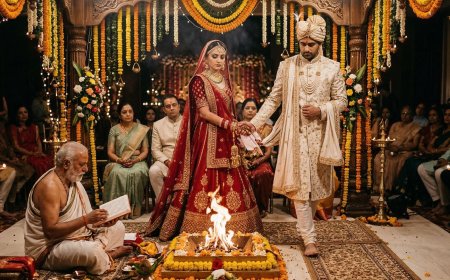
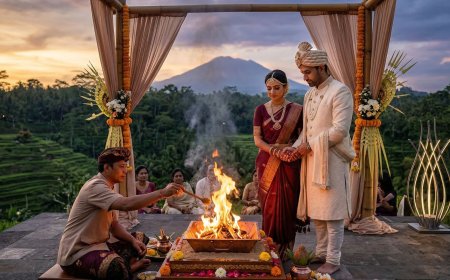
The central marriage ceremony is overseen by the community's Badwa [the Bhil tribal priest, keeper of oral traditions and ritual knowledge] rather than a Sanskrit-reciting Brahmin pandit. The Badwa conducts the ceremony in the Bhili language, invoking the Bhil deities — particularly Baba Dev [the supreme ancestral deity of the Bhil community] — and performing rituals that draw from a cosmological tradition entirely distinct from mainstream Hinduism while existing in conversation with it. The Saat Phere [seven circumambulations around the sacred fire] are performed, but the prayers said during each phera are in Bhili and invoke Bhil ancestors and deities alongside the more widely recognised Hindu deities.
The Ghoomar [the traditional women's circle dance of Rajasthan, here performed in its original tribal form rather than the courtly version popularised in mainstream Rajasthani culture] is danced by women throughout the wedding, at multiple points across the days of celebration. In its Bhil form, the Ghoomar is not a performance — it is a ritual. The women dance to bless the bride, to invoke fertility, to celebrate womanhood, and to keep the community's energy alive through the long night of celebration.
Community Comparison Table
| Community/State | Local Wedding Name / Key Ritual | Key Tradition | How NRIs Abroad Adapt It |
|---|---|---|---|
| Rajasthani Bhil | Mandav ceremony + Badwa-led rites | Multi-day celebration, dhol procession, Ghoomar dance, Pithora art, Bhili language prayers | Find Bhil community associations abroad, hire folk musicians, recreate Mandav at venue |
| Rajasthani Meena | Similar tribal structure with Meena-specific deities | Community-led ceremony, folk music, tribal priest | Connect with Meena community networks in diaspora |
| Rajasthani Hindu (mainstream) | Saat Phere with Brahmin pandit | Sanskrit Vedic ceremony, fire rituals, seven vows | Widely available pandits in diaspora worldwide |
| Gujarati Adivasi (Rathwa) | Pithora ceremony | Sacred wall paintings, tribal priest, community feast | Source Pithora artists or recreate paintings with community knowledge |
| Madhya Pradesh Bhil | Similar to Rajasthani Bhil with regional variations | Badwa-led ceremony, regional folk songs, tribal dress | MP Bhil diaspora communities maintain cultural associations |
| Himachali | Dev blessing ceremony | Local deity invoked, community music, hill folk traditions | Perform deity prayer via video call with family in hills |
| Garhwali | Jaan procession | Groom's procession with folk singing | Recreate with recorded folk music at venue |
| Punjabi | Anand Karaj | Sikh ceremony with four laavans | Conducted at local Gurdwara worldwide |
| Bengali | Biye | Shubho Drishti, sindoor ceremony, conch shell rituals | Bengali cultural associations and priests in major diaspora cities |
| Tamil | Kalyanam | Multi-step Vedic ceremony, nadaswaram music, silk sarees | Tamil temple priest networks in UK, US, Canada, Australia |
The Meaning Behind the Ritual
The Bhil wedding tradition rests on a cosmological foundation that mainstream Indian wedding culture rarely pauses to examine: the belief that the human community and the natural world are not separate orders of existence but participants in the same living system, and that a wedding — properly conducted — is an event that the land itself attends.
The dhol that drives the wedding music is not simply a percussion instrument. In Bhil cosmology, the drum speaks to the ancestors. Its sound travels beyond the gathering of living people and reaches those who are no longer present in body — the grandparents, the great-grandparents, the long chain of Bhil men and women whose lives made this wedding possible. When the dhol beats through the night at a Bhil wedding, it is calling the ancestors to witness and to bless.
The Ghoomar circle dance is similarly not entertainment. The circle formation — women moving together, no beginning and no end — enacts the Bhil understanding of community as an unbroken continuity. When women dance in a circle around a bride, they are placing her at the centre of a living tradition, surrounding her with the accumulated wisdom and love of every woman who has stood where she stands, and assuring her that she is held.
The Badwa's role in the ceremony carries a significance that goes beyond the priestly. The Badwa is the community's memory — the keeper of the oral traditions, the songs, the deity names, the ritual sequences that exist nowhere in writing and would vanish from the world if he did not carry them. His presence at a wedding is the presence of history itself.
For any non-tribal guest or partner trying to understand what they are witnessing at a Bhil wedding, the truest explanation is this: you are not at a party — you are at the earth celebrating itself through the people who have always known how to listen to it.
Doing a Bhil Tribal Wedding Abroad: The Practical Reality
Planning a Bhil tribal wedding abroad presents challenges that are distinct from those faced by NRI couples from mainstream Hindu, Sikh, or Muslim backgrounds — because the tradition is oral, the priests are rare outside India, and the community network abroad is smaller and less institutionally organised than those of larger diaspora groups. But it is achievable, and the reward is a wedding experience that no guest — Indian or non-Indian — will ever forget.
Finding a Badwa: This is your most significant challenge. Badwas are community-specific tribal priests whose knowledge is passed down within families, and they rarely travel internationally. For NRI couples planning a wedding abroad who wish to have authentic Bhil ceremony prayers, the most workable solution is a hybrid approach: conduct the civil or standard Hindu ceremony with an available pandit for the formal religious elements, and separately conduct the Bhil-specific elements — the community music, the Ghoomar, the Mandav construction, the Pithora if possible — as the cultural heart of the celebration. For couples conducting a destination wedding in India, a Badwa from the Mewar or Dungarpur region can be engaged through community connections.
The Music: This is the most achievable element and the most transformative. Rajasthani folk musicians — dhol players, shehnai players, and rawanhatta [a traditional Rajasthani bowed instrument with a haunting, distinctive sound] players — are available for hire in cities with significant South Asian populations. In the UK, Rajasthani folk music ensembles operate in London, Leicester, and Birmingham. In the US, South Asian music networks in Houston, New Jersey, and the Bay Area can connect you with folk musicians. In Canada, Toronto and Vancouver have Rajasthani cultural associations. In Australia, Melbourne and Sydney have South Asian music communities. Specify that you want Bhil folk music rather than generic Rajasthani music — the distinction matters, and a good musician will understand immediately.
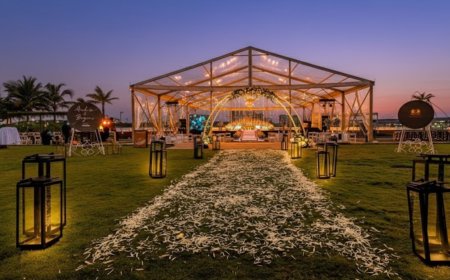
The Mandav: A full traditional Mandav — bamboo poles, mango leaves, marigold garlands — can be constructed at most outdoor or marquee venues with advance planning. Source bamboo from garden supply companies, marigold garlands from Indian flower suppliers, and mango leaves from South Asian grocers or specialty shops. In London, the Wembley and Southall areas have Indian flower suppliers. In Toronto, the Gerrard Street area and Brampton Indian grocers carry garlands and fresh flowers. The construction of the Mandav should ideally involve family members — the communal building of the structure is itself part of the tradition.
The Ghoomar: Every Bhil wedding needs its Ghoomar, and the good news is that this is the element that travels most easily. Gather the women of your family and community, learn the basic steps — there are Rajasthani folk dance teachers in most major diaspora cities — and dance. The Ghoomar does not require professional performers. It requires willing women and a dhol player who knows what they are doing. That combination is achievable anywhere.
The Pithora: Recreating Pithora wall paintings at a wedding venue abroad is challenging but not impossible. Digital prints of Pithora designs can be commissioned from artists in Gujarat and Rajasthan who ship internationally. Alternatively, a community artist with knowledge of the tradition can be engaged to create a version on canvas or board that is displayed at the venue. Contact the Bhil Seva Mandal or similar tribal welfare organisations in Rajasthan for artist referrals.
Fire and Smoke: The sacred fire at the centre of the Saat Phere requires the same venue negotiation as any other Indian wedding ceremony with fire. Establish with your venue in writing what is permitted, discuss smoke alarm management, and ensure the fire is contained in an appropriate vessel. Most UK and Australian event venues have managed this for Hindu weddings and will have a standard protocol.
Time Zone Coordination: For family joining from Udaipur, Dungarpur, or Banswara via live stream, aim for a ceremony start between 4 PM and 6 PM UK time, or between 8 AM and 10 AM US East Coast time. Village internet connectivity can be variable — test the connection multiple times in advance and have a phone call as backup.
Doing a Bhil Wedding as a Destination Wedding in India
For NRI couples choosing to marry in India and wishing to honour Bhil heritage, the Mewar and Vagad regions of Rajasthan offer settings of incomparable beauty and cultural authenticity.
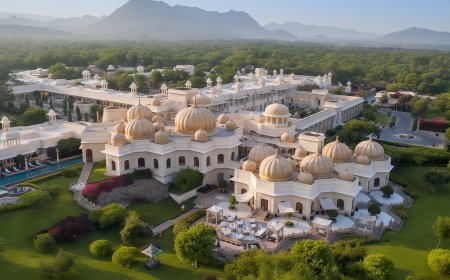
Udaipur is the most accessible base — a city of extraordinary beauty that sits at the edge of Bhil tribal territory, with established wedding hospitality infrastructure and proximity to genuine tribal villages where authentic elements can be sourced. A wedding ceremony at a heritage haveli in Udaipur, with Bhil musicians and dancers brought from surrounding villages, creates an experience that no urban Indian wedding can replicate.
Dungarpur and Banswara — the heartlands of Rajasthani Bhil culture — offer more intimate and more authentic settings for couples willing to travel further from the main tourist circuit. Weddings here can involve genuine community participation, real Badwa-led ceremonies, and a level of cultural immersion that Udaipur, for all its beauty, cannot quite match.
When working with local planners, be explicit that you want Bhil tribal elements rather than generic Rajasthani wedding aesthetics — the difference between a Bhil dhol player and a mainstream Rajasthani band is significant, and a good local planner will understand and respect the distinction. NRI.Wedding can connect you with Rajasthan-based planners who have specific experience with tribal wedding traditions.
For non-Indian guests, prepare a detailed ceremony programme explaining the significance of each ritual element. Bhil wedding culture is visually extraordinary and spiritually profound, and guests who understand what they are witnessing respond with a depth of appreciation that transforms the atmosphere of the entire event.
What You Need: Ritual Checklist
Ritual Items: Bamboo poles and mango leaves for Mandav construction, marigold and flower garlands, turmeric paste and oil for Pithi ceremony, sacred fire vessel and materials, red cloth for bride, traditional Bhil jewellery including hansuli [a rigid collar necklace traditional to tribal Rajasthani women], dhol and shehnai for procession music, Pithora artwork or prints for decoration, sweets and community feast ingredients including lapsi [a sweet wheat porridge traditional at Rajasthani auspicious occasions] and dal baati churma [the definitive Rajasthani festive meal].
People Required: Badwa tribal priest if available or Brahmin pandit for formal ceremony, dhol player and folk music ensemble, Ghoomar dance leader, senior female elders for Pithi ceremony, community members for Mandav construction, AV team for live streaming to village family, photographer briefed on tribal wedding traditions.
Preparation Steps Connect with Bhil community associations in your city six months ahead. Book Rajasthani folk musicians six months ahead. Source Mandav construction materials two months ahead. Commission or source Pithora artwork two months ahead. Arrange sacred fire permissions with venue four months ahead. Organise Ghoomar rehearsal with female family members one month ahead. Source traditional tribal jewellery through community networks. Test live stream to India one week ahead.
NRI.Wedding connects couples with Rajasthani folk musicians, tribal wedding specialists, Bhil heritage photographers, and destination wedding planners in the Mewar and Vagad regions who understand the difference between a Bhil wedding and a generic Rajasthani celebration. Your heritage deserves that distinction.
5 Questions NRI Couples Always Ask
Can we have an authentic Bhil wedding without a Badwa, since there are none in our country?
Yes, and many diaspora Bhil families do exactly this. The Badwa's role can be partially fulfilled by a knowledgeable Brahmin pandit who conducts the Saat Phere, with the Bhil-specific elements — the music, the Ghoomar, the Mandav, the community participation structure — constituting the cultural soul of the ceremony. If you have an elder in your family or community who holds knowledge of Bhil prayers and ritual sequences, their participation in a leadership capacity is more meaningful than any substitute. The ceremony's authenticity comes from intention, knowledge, and community, not from the formal title of the person leading it.
My partner is not from a tribal background and has never encountered anything like a Bhil wedding. How do I help them understand and participate?
Begin with stories rather than explanations. Tell your partner about the specific wedding your grandmother described — the one with the drumming that lasted all night, the women dancing in circles, the Mandav built by the men of the village. Let the tradition enter through narrative before it enters through information. Then, as the wedding approaches, involve your partner in the preparation in a specific physical way — help them learn a few Ghoomar steps, involve them in the marigold garland hanging, let them hear the dhol being played before the wedding day so the sound is familiar when it matters. Participation builds understanding far more effectively than explanation.
How do we find Rajasthani Bhil folk musicians in a diaspora city where the community is small?
Start with South Asian cultural organisations and folk music networks rather than community-specific associations, since the Bhil diaspora abroad is small enough that dedicated organisations may not exist in every city. Rajasthani cultural associations in Leicester, London, Houston, and Toronto often maintain connections to folk musicians who specialise in tribal music traditions. Online platforms connecting South Asian musicians with event organisers are also useful. When you make contact, specify clearly: you want Bhil folk music, dhol and shehnai at minimum, and raw village sound rather than a polished Bollywood-influenced version. Any musician worth hiring will understand and respect that distinction.
We want to include the Pithora painting tradition at our wedding venue. Is this achievable abroad?
Achieving genuine Pithora at a venue abroad requires either commissioning a Pithora artist from Gujarat or Rajasthan to travel to your location — which is possible for couples with the budget and the advance planning time — or commissioning prints or canvas versions of Pithora designs to be displayed at the venue. The latter is more practical for most couples. Several artists working in the Pithora tradition now ship internationally, and NRI.Wedding can help connect you with them. If you have a family member with artistic skill and community knowledge, involving them in creating a version of Pithora for the venue is the most meaningful approach of all.
We are doing a civil registry marriage in our country but want a full Bhil ceremony during a trip to India. How do we sequence this?
This is among the most natural arrangements for NRI couples with tribal heritage. Complete the civil registry in your country of residence — quietly, with witnesses, as a legal formality — and plan the full Bhil ceremonial wedding in Rajasthan for a trip that involves the whole family. Many NRI Bhil families do exactly this, and the Indian ceremony is universally understood by both families as the real wedding. The community in the village will count that date as your anniversary. Your grandmother will too. Plan the India trip for a season when the Rajasthan climate is hospitable — October through February is ideal.
The Emotional Angle
There is a specific grief that comes with being the generation that might be the last to remember. You carry it quietly — the knowledge that the drumming your grandmother described has never been heard by your children, that the Ghoomar your mother learned from her mother exists in her body but has never been taught to yours, that the Badwa who knows your family's specific ritual prayers is ageing in a village in Mewar and there is no younger person learning what he knows.
And then you plan a wedding, and something shifts.
Because the wedding is the moment when you stop being passive about what you carry and start being active. You call your mother and ask her to teach you the Ghoomar. You find a dhol player in Leicester who learned his craft in Rajasthan and has been waiting for someone to ask for the real thing. You commission the Pithora prints and hang them at your venue and watch your non-Indian friends stand in front of them with their mouths slightly open, asking what they mean, and you realise that you know the answer.
The Bhil tradition has survived empires, displacement, and a century of being told it was less than. It survived because women danced in circles and men built Mandavs and Badwas memorised prayers and passed them to their sons in the dark before dawn. It will survive your wedding too. But only if you choose to bring it forward.
You are the generation that chooses. Choose the drums. Choose the dance. Choose the tray of marigolds and the all-night dhol and the women's circle that has no beginning and no end.
A Moment to Smile
At a Bhil-heritage wedding in Leicester two years ago, the dhol player — a magnificent and entirely self-confident musician from Udaipur who had been in the UK for six months — arrived at the venue to discover that the event coordinator had booked him into what was, at that moment, a very quiet and very formal corporate awards dinner happening in the adjacent ballroom.
The wall between the two events was not, it became apparent, soundproof.
What followed was a forty-minute period during which the corporate awards dinner's announcements competed with increasingly vigorous dhol beats, a negotiation between two event coordinators that involved much gesturing and no shared language, and ultimately a compromise in which the dhol player performed at a volume that the wedding family described as "still the best thing we have ever heard" and the awards dinner coordinator described in their feedback form as "unexpected."
The dhol player was entirely unbothered throughout. He had played at louder weddings in smaller villages and he was not about to let a corporate awards dinner interrupt the Var procession.
Quotes From the Diaspora
"My nani described Bhil weddings like they were something from another world — the drumming, the dancing, the colours. I grew up thinking it was gone, that we had left it behind when we left Rajasthan. Planning my wedding was the moment I realised it was still there, inside us, waiting to be called back." — Savita Damor, Bhil heritage, Leicester
"When the dhol started at my son's wedding, I saw my mother's face change. She was back somewhere. Somewhere she hadn't been in forty years. I didn't expect the music to do that. I should have known — it was always the music that held everything together." — Kamla Ninama, Bhil heritage, resident of Houston for twenty-two years, mother of the groom
"We did the Ghoomar at our wedding in Western Sydney. Just eight of us — me, my sisters, my cousins, two aunties. We had practised for three weeks in my lounge room. When we danced, something happened that I cannot explain in English. It felt like the circle had always been there and we just stepped into it." — Priya Katara, Bhil and Rajasthani heritage, Sydney
Your Drums Are Still Beating
The Rajasthani Bhil wedding tradition is not a relic. It is a living system of knowledge, music, art, and community that has survived everything history has thrown at it — and it will survive your diaspora life too, if you choose to carry it forward. The drumming that your grandmother described is still happening in the villages of Mewar and Vagad. The Ghoomar circle is still turning. The Badwa is still speaking the prayers that no one wrote down because they were never meant to be written — they were meant to be lived.
NRI.Wedding is here to help you bring that living tradition to your wedding — wherever in the world you are celebrating. From Rajasthani folk musicians and Bhil heritage photographers to destination wedding planners in Udaipur and Dungarpur who understand the difference between Bhil culture and its Bollywood imitation, we are here for the real thing.
Build the Mandav. Light the fire. Start the dhol.
Your drums are still beating. Listen, and dance.
This article covers Rajasthani Bhil tribal wedding traditions including the Mandav ceremony, Badwa-led rituals, Ghoomar dance, Pithora art, and dhol music, with practical planning guidance for NRI couples in the UK, US, Australia, and Canada, and destination wedding guidance for the Mewar and Vagad regions of Rajasthan.
What's Your Reaction?
 Like
0
Like
0
 Dislike
0
Dislike
0
 Love
0
Love
0
 Funny
0
Funny
0
 Angry
0
Angry
0
 Sad
0
Sad
0
 Wow
0
Wow
0