





































































Subha Muhurtham: The Ancient Science of Auspicious Wedding Timing Every Telugu NRI Couple Must Understand
Subha Muhurtham — the Vedic practice of selecting the most cosmically auspicious moment for a Telugu Hindu wedding — is the single most sacred scheduling decision an Andhra family will make. Rooted in 3,000 years of Jyotisha astronomy, it governs everything from the tying of the mangalsutra to the saptapadi. This guide breaks down how Telugu NRI couples across the US, UK, Canada, UAE, and Australia can calculate, coordinate, and honour their muhurtham without compromise — wherever in the world they marry.

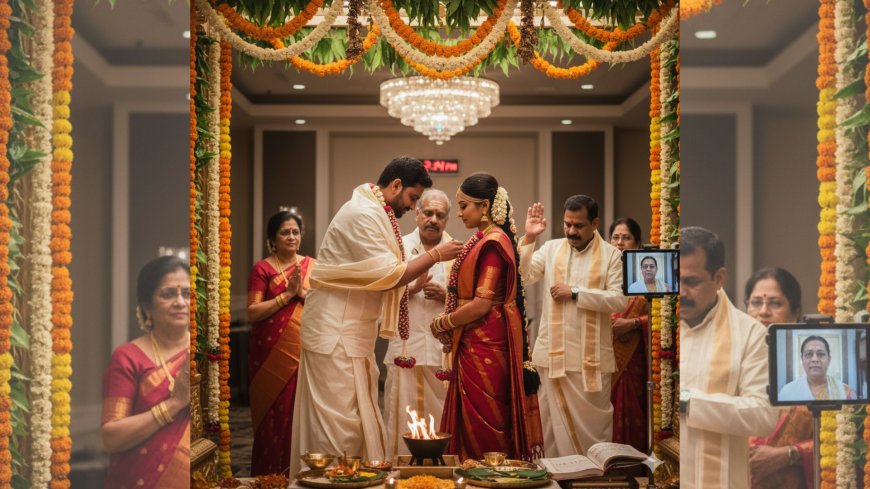
In Andhra and Telangana wedding tradition, the most important decision a family makes is not the venue, the caterer, or the lehenga — it is the precise moment the sacred fire is lit. Subha Muhurtham is the ancient science and spiritual art of choosing the most auspicious window for a wedding, and for Telugu NRI families planning ceremonies across time zones and continents, understanding it is not optional — it is everything.
You didn't plan your wedding around a Saturday because it suited the venue's availability calendar. You planned it around a window of forty-seven minutes on a Thursday afternoon in March because a pandit in Vijayawada, consulting a panchang [traditional Vedic almanac] that his father used before him, determined that in that particular convergence of stars, planets, and lunar energy, a union begun would be a union blessed.
Your colleagues at the office think this is charming. Your non-Indian friends think it is exotic. Your grandmother thinks it is simply obvious — the way gravity is obvious. Of course you don't begin the most important ceremony of your life at a random hour. Of course the cosmos has something to say about it.
You're in Atlanta or Auckland or Aberdeen, trying to reconcile the banquet hall's 6 PM standard start time with a muhurtham your family's jyotishi [astrologer-priest] has calculated as 11:43 AM. You are not being difficult. You are being Telugu.
🌟 DID YOU KNOW?
- The Sanskrit term muhurta originally referred to a unit of time equal to 48 minutes — one-thirtieth of a solar day — making the Subha Muhurtham not a vague "auspicious period" but a mathematically precise window rooted in Vedic astronomical calculation.
- Telugu wedding muhurthams are calculated using a combination of at least five distinct astrological factors: tithi [lunar day], nakshatra [star constellation], yoga [planetary combination], karana [half-lunar day], and vara [weekday] — all five must align favourably for a muhurtham to be declared truly subha [auspicious].
- A 2023 survey of Telugu NRI wedding planners across the US, UK, and Australia found that over 74% of Telugu NRI couples reported that the Subha Muhurtham timing caused the single greatest logistical conflict with their overseas wedding venue — and over 91% of those couples said they ultimately prioritised the muhurtham over the venue's preferred timing.
What Is Subha Muhurtham?
Subha Muhurtham [auspicious sacred moment] is the Vedic practice of identifying the most cosmically favourable time window for the commencement of a Hindu wedding ceremony — specifically, the moment of vivaha [the sacred marriage rite] when the bride and groom take their saptapadi [seven steps] around the sacred fire. In Telugu tradition, it is the gravitational centre around which every other element of the wedding orbits.
The word subha means auspicious, blessed, or of divine favour. Muhurtham derives from the Sanskrit muhurta, a precise unit of time. Together, the concept encodes a fundamental belief of Vedic civilisation: that time is not uniform. Some moments carry more shakti [divine energy] than others. Beginning a marriage in the right moment is not superstition — it is the application of thousands of years of astronomical observation to the most sacred of human acts.
The calculation is performed by a jyotishi or pandit who consults the panchang — a Vedic almanac that tracks the positions of the sun, moon, and planets with extraordinary precision. The five limbs of the panchang (the word itself means "five limbs") — tithi, nakshatra, yoga, karana, and vara — are assessed for their individual and combined qualities. A shubha tithi [auspicious lunar day] like Dwitiya or Panchami is preferred; certain nakshatras like Rohini, Mrigashira, Magha, and Uttara are considered highly favourable for marriage. Malefic planetary positions — particularly Rahu Kalam [the inauspicious period governed by the shadow planet Rahu, recurring daily] — are strictly avoided.
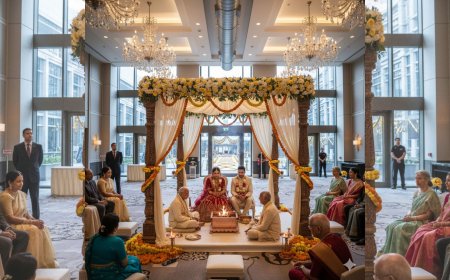
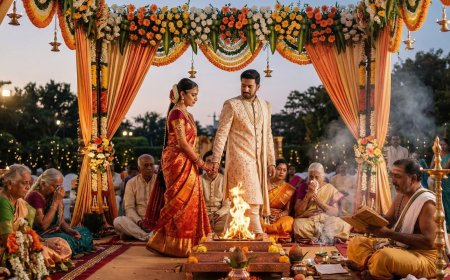
The muhurtham itself typically lasts between 20 minutes and 90 minutes, though the core sacred moment — the tying of the mangalsutra [sacred thread / wedding necklace] and the saptapadi — is usually concentrated in a window as narrow as 11 to 48 minutes. Every Telugu family knows that when the pandit says "now," everything else stops. The photographer stops adjusting his lens. The caterer stops arranging the buffet. The universe, briefly, holds its breath.
Community Comparison: How Different Indian Communities Mark Auspicious Timing
| Community / State | Local Name | Key Tradition | How NRIs Abroad Adapt It |
|---|---|---|---|
| Telugu (Andhra/Telangana) | Subha Muhurtham | Precise panchang-calculated window; pandit announces exact minute; all rituals pause for the core moment | Venue briefed months in advance; muhurtham time printed on invitations; guests seated early |
| Himachali | Shubh Ghadi | Auspicious moment determined by local Brahmin; often tied to sunrise or specific mountain-facing alignment | Adapted to venue timing; family pandit consulted from Himachal via video call |
| Garhwali | Lagan / Muhurt | Pandit calculates based on panchang; specific attention to lunar calendar and local deity's favourable days | Panchang consulted by Garhwali pandit communities in UK and Canada |
| Kumaoni | Muhurt | Emphasis on Navami and Panchami tithis; family priest holds hereditary calculation rights | Family priest in Uttarakhand consulted via WhatsApp; time confirmed months ahead |
| Ladakhi | Lungsta | Auspicious timing determined by Buddhist lamas using Tibetan astronomical calendar | Lama consulted in Leh; ceremony adjusted to align with Tibetan lunar calendar |
| Kashmiri Pandit | Lagnamu / Muhurat | Highly precise; calculated by community-specific Brahmin using Kashmiri Sharada tradition | Kashmiri Pandit sabhas in London, New Jersey maintain lists of qualified priests |
| Punjabi | Shagan / Lagan | Astrological timing important but ceremony often structured around milni [family meeting] and practical logistics | More flexible adaptation; many Punjabi NRI weddings work backward from venue timing |
| Marathi | Muhurt | Calculated using Marathi panchang; Antarpat[ritual curtain lowering] happens precisely at muhurt | Maharashtra Mandals in US and Australia maintain panchang resources |
| Tamil | Nalla Neram | Deeply precise; Tamil panchang used; Nazhigai [Tamil time unit] system applied; specific to Tamil Brahmin tradition | Tamil Brahmin pandits widely available in UK, USA, Canada, Singapore, Australia |
| Bengali | Shubho Drishti | Auspicious moment of first eye contact between bride and groom, timed to panchang | Well-preserved in diaspora; Bengali pandits available in London, Toronto, New York |
| Rajasthani | Saat Phere Muhurt | Seven circumambulations timed to auspicious nakshatra; family priest holds significant authority | Rajasthani Samaj networks in UAE and UK coordinate pandit availability |
The Meaning Behind the Ritual
The Subha Muhurtham rests on one of the most profound ideas in Vedic philosophy: that the human soul does not exist in isolation from the cosmos. The same stars whose positions govern tides and seasons, whose light took millennia to reach us, are participants in the unfolding of a human life. When a man and woman unite in vivaha, they are not merely signing a social contract — they are weaving two destinies into a new cosmic thread. The moment of weaving matters.
In Jyotisha [Vedic astrology, literally "science of light"], the premise is that planetary positions at the time of any significant beginning — a birth, a business, a marriage — imprint themselves on that event and shape its unfolding. This is not fatalism. It is the opposite. By choosing the most auspicious moment, the family is exercising the fullest possible agency — selecting the most fertile ground in which to plant the seed of a marriage.
The Rahu Kalam avoidance is particularly telling: Rahu, the shadow planet, governs deception, obstruction, and confusion. To begin a marriage in Rahu Kalam would be, in Vedic terms, to invite opacity into a union that should be built on clarity and light. The Subha Muhurtham is therefore an act of intention — a family saying, with the full weight of ancient knowledge, that this marriage deserves the best the universe has to offer.
For a non-Indian partner or family member: "It is the moment the family chooses, from all of time, the one window when the universe most fully agrees."
Doing Subha Muhurtham Abroad: The Practical Reality
The single most important thing to understand about Subha Muhurtham as an NRI is this: the muhurtham is calculated for your location, not for India. A competent Vedic astrologer adjusts the panchang calculations for the latitude and longitude of your wedding city. A muhurtham valid in Hyderabad at 11:43 AM IST does not automatically translate to 6:13 AM in London or 6:13 AM in anything else — it must be recalculated for your local coordinates. If your pandit does not ask you for your wedding city's location, find a different pandit.
This is the first conversation to have with your jyotishi, and it should happen at least six to eight months before the wedding. The pandit will need the bride and groom's janma nakshatras [birth star constellations, derived from birth date, time, and place] and rashis [moon signs] to calculate a personalised muhurtham. Do not rely on a generic "auspicious dates" list posted in a Telugu WhatsApp group — those are calculated for India Standard Time in Indian cities and are not transferable.
For finding a qualified Telugu jyotishi or pandit abroad: NRI.Wedding maintains a verified directory of Telugu Brahmin priests in the US, UK, Canada, UAE, and Australia, each of whom specifies their competency in muhurtham calculation. When contacting a pandit, ask specifically whether they calculate for Western longitude/latitude adjustment and whether they are familiar with Vaikhanasa or Smartha traditions, as muhurtham customs vary between these.
The venue conversation is the second challenge. Most banquet halls, hotel ballrooms, and garden venues in the UK, US, Canada, and Australia operate on the assumption that a wedding begins at a time stated in the contract and that the ceremony fits within a defined slot. When you tell your venue coordinator that the actual sacred ceremony must occur at precisely 2:17 PM and cannot start at 2:00 PM or 2:30 PM, you will encounter confusion. The solution is documentation. Provide your venue with a written ceremony timeline that is structured backward and forward from the muhurtham — showing them exactly when guests arrive, when pre-rituals occur, when the core muhurtham window falls, and when the reception begins. Frame it not as a religious eccentricity but as the equivalent of a church service with a fixed liturgical moment. Most professional venues, when they understand, will respect it.
For Rahu Kalam avoidance specifically: Rahu Kalam occurs for approximately 90 minutes every day, at different times on different days of the week, and is calculated differently by latitude. In cities like Houston, London, Toronto, Sydney, and Dubai, Rahu Kalam charts are available through the Drik Panchang app and the Panchangam website, both of which allow location-based daily calculation. Download these before your wedding planning begins and share them with your venue's event manager with a simple explanation — "this 90-minute window on our wedding day is spiritually significant to avoid, can we structure catering/photography schedules accordingly?"
For relatives in India watching via video call: the muhurtham moment is the one that must be streamed without fail. Invest in a dedicated streaming device — a tablet on a stand, positioned at the vivaha vedi [sacred wedding altar/platform] — with a reliable internet connection (not dependent on the venue's shared WiFi). Brief your India family on the IST equivalent of the muhurtham time so they are seated and ready. A 2 PM ceremony in Toronto EST is 12:30 AM IST — yes, this means your grandmother in Guntur may be watching from a charpoy at midnight, but she will be there.
Doing Subha Muhurtham as a Destination Wedding in India
Returning to India for your Telugu wedding transforms the muhurtham logistics from a complex adaptation to a homecoming. In Hyderabad, Vijayawada, Tirupati, Visakhapatnam, and smaller ancestral towns across Andhra and Telangana, pandits who specialise in muhurtham calculation are embedded in the wedding ecosystem — your venue's wedding planner almost certainly has established relationships with three or four.
The caution here is specificity. Many pandits in Indian cities are generalists, familiar with standard muhurtham calculation but less fluent in the specific customs of your family's community, caste tradition, or regional variant. If your family is from coastal Andhra, confirm the pandit understands Smarta traditions. If you are Kamma or Kapu, your family may have hereditary priests — kulapurohitulu [family priests] — whose authority over your muhurtham calculation is considered superior to any outside pandit's.
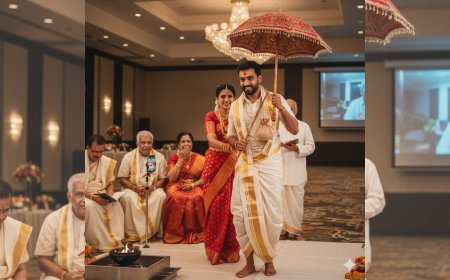
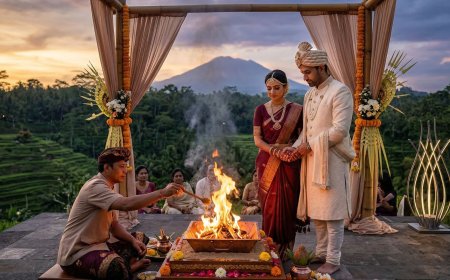
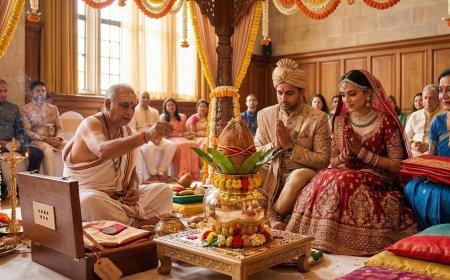
For your non-Indian guests attending the destination wedding, the muhurtham is the most clarifying moment of the entire ceremony. Prepare a short printed or digital programme explaining that what they are about to witness — the groom tying the mangalsutra in three knots, the saptapadi, the pouring of laja [puffed rice] into the fire — all of it is happening in a window chosen by generations of astronomical knowledge. Most international guests, once they understand this, watch the muhurtham with a quality of attention they rarely give anything.
What You Need: Ritual Checklist
Ritual Items Required — the panchang for the relevant year (physical copy preferred; Drik Panchang or Panchangam app as digital backup), the bride and groom's birth details (date, time, and city of birth in full), a patrika [horoscope document] for both bride and groom if available, the muhurtham calculation document prepared by your jyotishi (request this in written form, not just verbally communicated), the vivaha vedi setup including the homa kundam [sacred fire pit], samidha [ritual fire wood], ghee [clarified butter], and akshata [blessed rice grains], a designated timekeeper (usually a trusted family member with a watch synchronised to the pandit's), and printed muhurtham timing cards for your photographer, videographer, caterer, and venue manager.
People Required — the jyotishi or pandit who performed the original muhurtham calculation (ideally the same one performing the ceremony), a family elder who understands the muhurtham's specific timing requirements and can communicate with the venue on the day, the bride and groom's parents, and a reliable point-of-contact guest who can ensure all pre-muhurtham rituals complete on schedule.
Preparation Steps — share birth details with your jyotishi at least six months before the wedding date. Receive the muhurtham in writing with the specific minute confirmed for your wedding city's coordinates. Share the wedding day timeline with your venue at least three months ahead. Build buffer time before the muhurtham to absorb delays in earlier rituals. Confirm streaming setup for India family at least two weeks before. Brief your photographer on the exact muhurtham minute — the tying of the mangalsutra is a non-repeatable moment.
NRI.Wedding connects Telugu NRI couples with verified jyotishis and pandits experienced in overseas muhurtham calculation, as well as photographers and videographers who understand the timing precision a Subha Muhurtham demands. Begin your planning at NRI.Wedding.
5 Questions NRI Couples Always Ask
What happens if our venue simply cannot accommodate the muhurtham time — do we find a new venue or adjust the muhurtham?
This is the central tension of every Telugu NRI wedding, and the answer depends on how strictly your family observes the tradition. Most experienced Telugu pandits abroad will work with you to identify the best muhurtham window within a range of dates, giving you some flexibility. If the pandit identifies a primary muhurtham at 11:30 AM and a secondary acceptable window at 4:15 PM on the same day, the venue conversation becomes much easier. Always ask your jyotishi for a range before you sign your venue contract — not one fixed time. Then find a venue that can accommodate your preferred window.
My partner is not Hindu and doesn't have a janma nakshatra. Can a muhurtham still be calculated?
Yes, and this situation is increasingly common for Telugu NRI families. Most pandits experienced with interfaith weddings will calculate the muhurtham based solely on the Hindu partner's birth details, using the non-Indian partner's birth date for basic dasha [planetary period] compatibility assessment only. The muhurtham is ultimately a blessing upon the union, not a requirement of symmetrical astrological data. Discuss this directly with your pandit — the right priest will navigate it with warmth, not rigidity.
How do I find a Telugu pandit in the UK or Canada who can actually calculate muhurtham for a Western location?
Through NRI.Wedding's pandit directory, which lists priests by regional tradition and confirms their competency in Western-coordinate muhurtham calculation. Additionally, the Tirumala Tirupati Devasthanams (TTD) has a network of trained priests posted to temple communities in the UK, USA, and Australia — contact your nearest TTD-affiliated temple directly. Always ask the pandit: "Do you calculate muhurtham adjusted for UK/Canada coordinates?" If they say yes without hesitation and ask for your city, you have found the right person.
Can the Subha Muhurtham be done via video call with the pandit in India and the ceremony happening abroad?
This has become increasingly practised post-2020, and while traditionalists prefer the pandit physically present, many Telugu families abroad have conducted ceremonies with the jyotishi calling in the muhurtham via live video — giving the precise moment in real time and chanting mantras alongside the local officiating priest. What matters is that the pandit conducting the ceremony on the ground is aligned with the jyotishi's calculation. Both priests must be briefed together in advance.
We are doing a civil wedding first and the Telugu ceremony six months later. Does the muhurtham apply to the civil ceremony?
No. The Subha Muhurtham governs the vivaha — the Hindu religious ceremony specifically. The civil registration is a legal act and carries no Vedic astrological requirement. Many NRI Telugu families do exactly this: register legally in their country of residence at any convenient time, and then conduct the full Telugu vivaha with Subha Muhurtham at a later date, either abroad or in India. Your muhurtham is calculated for the religious ceremony only, and it carries its full spiritual weight regardless of when the civil paperwork was signed.
The Emotional Angle
There is something your parents never told you about the muhurtham. They would not know how to say it directly. But you will understand it when you see your father — who has lived in this Western city for twenty-eight years, who wears a suit to work, who watches cricket on a streaming subscription — standing outside the banquet hall at 11:38 AM, watching his watch, watching the doors, counting down five minutes to the moment a pandit in Vijayawada calculated six months ago would be the best the universe could offer his child.
He is not doing this because he is superstitious. He is doing it because it is the one thing left — in this city where the language is different and the food is different and the seasons are wrong — that connects his daughter's wedding to every Telugu wedding in his bloodline going back further than any family record exists. The muhurtham is the thread. The muhurtham is the proof that they are all still the same people, still watching the same stars, still trusting that the cosmos cares about the children they have raised.
When the pandit says the moment has come, and the groom's hands move toward the mangalsutra, something passes through the room that is not quite describable in English. It is the feeling of a very long journey arriving, precisely on time.
A Moment to Smile
At a Telugu wedding in Southall last summer, the family had done everything correctly. The muhurtham was calculated, the pandit was present, the vivaha vedi was set up beautifully in the banquet hall's rear garden, the relatives in Hyderabad were on the video call. The groom's mother had been checking her watch every three minutes for an hour.
At exactly two minutes before the muhurtham, the banquet hall's automatic sprinkler system — set on a timer nobody had thought to deactivate — turned on.
The pandit was briefly misted. The flower arrangements tilted. Three aunties screamed. The bride, already seated at the vedi, looked up at the sky with an expression of profound philosophical acceptance.
The groom's mother, to her eternal credit, immediately announced: "It's Varuna's blessing," invoking the Vedic god of rain and water. The sprinkler completed its cycle in ninety seconds. The pandit dried his glasses. The muhurtham proceeded, exactly on time, with a freshly watered vivaha vedi and a room full of people laughing too hard to cry.
The marriage, everyone agreed, was off to a very good start.
Quotes from the Diaspora
"Our muhurtham was at 2:14 PM on a Wednesday. My office colleagues thought I was insane to book a Wednesday wedding. But that 2:14 PM — my nana in Kakinada watched from her phone, my mum held my hand, and the pandit said 'now,' and I can't explain what happened in that moment but I knew. I just knew." — Swapna Deverakonda, Kamma community, Dallas, Texas
"I was the one who had to explain to the hotel manager in Melbourne why we needed the ballroom completely silent at 3:47 PM for approximately eleven minutes. I showed him the panchang calculation printout. I showed him photos of Telugu weddings. He finally said, 'So it's like the exact moment in a church ceremony.' Yes. Exactly like that. Just older."— Padmavathi Rao, mother of groom, Telugu Brahmin community, Melbourne, Australia
"My husband is from Cork. He had no context for any of this. But he studied the muhurtham — he actually read about it, asked our pandit questions, wrote down what each of the five panchang limbs meant. On the day, when the pandit said the moment was coming, my husband was already still. Already ready. That was when I knew I had chosen correctly." — Ananya Krishnamurthy, Reddy community, London
Your Roots Travel With You
The stars that your great-grandparents consulted from a village in Andhra Pradesh are the same stars visible — if you look past the light pollution — from your city in the West. The panchang has been updated, the calculations now account for your longitude, the pandit calls in from a temple in Wembley or a home office in Fremont. But the fundamental act is unchanged: your family is choosing, with love and intention and the weight of millennia behind them, the single best moment the universe has available for your marriage to begin.
NRI.Wedding understands what Subha Muhurtham means to Telugu families. Our directory of verified jyotishis and pandits, our venue-briefing templates, our photographer network trained to capture the exact muhurtham moment — everything we offer is built around the understanding that the timing of your ceremony is not a logistical detail. It is the ceremony.
The stars are the same. Trust them.
This article explores Subha Muhurtham — the Vedic auspicious wedding timing tradition central to Telugu Hindu weddings in Andhra Pradesh and Telangana — and how NRI Telugu communities in the US, UK, Canada, UAE, and Australia navigate its practice in cities including Houston, London, Toronto, Melbourne, and Dubai.
What's Your Reaction?
 Like
0
Like
0
 Dislike
0
Dislike
0
 Love
0
Love
0
 Funny
0
Funny
0
 Angry
0
Angry
0
 Sad
0
Sad
0
 Wow
0
Wow
0