
















































Where the River Sings the Wedding: Inside the Traditional Meitei Manipuri Wedding Rituals That Carry the Soul of the Valley
The traditional Meitei wedding of Manipur — rooted in the ancient Sanamahism faith, governed by the sacred lunar calendar, expressed through the iconic Potloi bridal costume, and conducted by Maiba priests invoking clan deities older than recorded history — is one of the most spiritually intricate and visually extraordinary wedding traditions in all of India. For NRI Meitei couples planning their wedding from London to Melbourne, these rituals are not simply heritage but the living language of a valley civilisation that refused to be absorbed. This guide covers every ceremony in depth, from the Yumnak clan verification and Meitei Panchang date selection to sourcing the Potloi from Imphal and recreating the Sanamahi Puja abroad.

The traditional Meitei wedding of Manipur — rooted in the ancient Sanamahism faith, governed by the sacred lunar calendar, and expressed through rituals so specific they vary by clan, day, and direction of the rising sun — is one of the most spiritually intricate and visually extraordinary wedding traditions in all of India. For NRI Meitei couples planning their wedding from London to Melbourne, these rituals are not simply heritage — they are the living language of a civilisation that refused to be absorbed.
You grew up knowing that Manipur was different. Not in the way people say every place is different — but genuinely, specifically, historically different. A valley civilisation with its own script, its own classical dance form that the world has finally begun to recognise, its own ancient faith that predates the arrival of Vaishnavism, its own calendar that governs when weddings can and cannot happen. You grew up knowing that the Lai [the Meitei deities of the ancient Sanamahi faith] were real presences in your grandmother's house, that the Sanamahi [the supreme household deity of the Meitei people, understood as the protector of the family and the home] had a specific place in the east corner of the kitchen, and that certain things were done in certain ways because that was how they had always been done and the reasons were older than anyone living could fully explain.
You are in London now, or Melbourne, or somewhere in the greater Toronto area, and you are planning your wedding. The Meitei tradition runs in your blood with a specificity that is almost overwhelming when you begin to examine it — because this is not a generalised Indian wedding tradition with regional flavour. This is a complete civilisational system of marriage, with its own priests, its own sacred objects, its own clan-specific protocols, its own dances that are simultaneously art and prayer.
This article will give you the fullest picture of it that has ever been written for an NRI audience.
🌟 DID YOU KNOW?
The Meitei people of Manipur follow the ancient indigenous faith called Sanamahism — also referred to as Meitei Sanamahism or Sanamahi Religion — which predates the introduction of Vaishnavism to the valley in the 18th century. Many Meitei families today practice a blend of Sanamahism and Vaishnavism, and this dual spiritual inheritance is reflected directly in the wedding ceremony, which often incorporates elements of both traditions simultaneously.
The Meitei script — called Meitei Mayek — is one of the oldest scripts of Northeast India, with roots going back at least fifteen hundred years. After decades of suppression, Meitei Mayek was officially recognised and reintroduced in Manipur's schools in 2006, making it one of the few living examples of a script being formally restored to active use in modern times. Wedding invitations and ceremonial documents in traditional Meitei families are increasingly being written in Meitei Mayek as an act of cultural reclamation.
Ras Leela — the classical Manipuri dance form depicting the divine love of Radha and Krishna — originated in the royal courts of Manipur and remains one of India's eight classical dance forms. The specific movements of Ras Leela directly influence the ceremonial gestures and aesthetic of Meitei wedding rituals, giving even the most practical wedding ceremony elements an quality of classical grace that is entirely unique to this tradition.
What Is a Traditional Meitei Wedding?
A traditional Meitei wedding is a multi-day ceremonial sequence governed by the Meitei Panchang [the Meitei lunar calendar, which determines auspicious dates and times for all significant life events] and conducted by the Maiba [the male priest of the Sanamahi tradition] or Maibi [the female priest-oracle, considered the most powerful ritual specialist in Meitei religious tradition]. It is simultaneously a religious ceremony, a clan agreement, a community celebration, and an act of cosmological alignment — a moment when two family lineages are formally woven into the larger fabric of Meitei social and spiritual life.
The wedding sequence begins long before the wedding day itself with the Luhongba [the formal Meitei engagement ceremony], which involves the exchange of gifts and the formal announcement of the match between the two families. The Luhongba is not simply a social occasion — it is a ritually structured event in which the Yumnak [the Meitei clan or patrilineal family group] of both families are formally acknowledged and their compatibility confirmed according to specific clan rules. Meitei society follows strict Yumnak exogamy — meaning that a couple cannot marry within the same clan — and this rule is verified and publicly confirmed at the Luhongba.
The pre-wedding period involves the Numit Kappa [the auspicious date-selection ceremony], in which the Maiba consults the Meitei Panchang to identify the most auspicious date and time for the wedding. This is not a casual consultation. The Maiba examines the birth details of both the bride and groom, the current positions of celestial bodies according to the Meitei calendar system, and the specific clan considerations of both families before identifying the Numit [the auspicious day] on which the ceremony can proceed. No traditional Meitei wedding proceeds without this confirmation.
The Heijingpot Katpa [the ceremony of the auspicious oil lamp] is performed at the bride's home on the eve of the wedding, in which a senior female elder lights a sacred lamp that will burn through the night as a protective and auspicious presence. The Leihao Thaba [the flower-offering ceremony] involves the preparation and offering of specific flowers — particularly the Siroi lily [the state flower of Manipur, found only in the Siroi hills and considered sacred] where available, and lotuses, marigolds, and other auspicious blooms — at the family's Sanamahi shrine.
The wedding day itself begins with the Sanamahi Puja [worship of the household deity Sanamahi] performed by the senior women of the bride's family at the eastern corner of the home where the Sanamahi deity resides. This worship acknowledges the deity's role as the protector of the household and formally requests his blessing for the daughter who is about to leave her birth home and establish a new one.
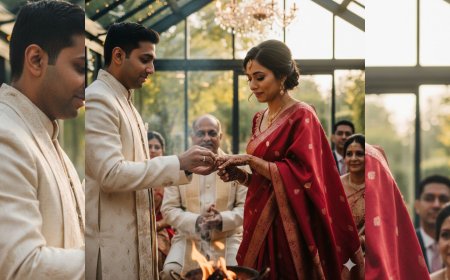
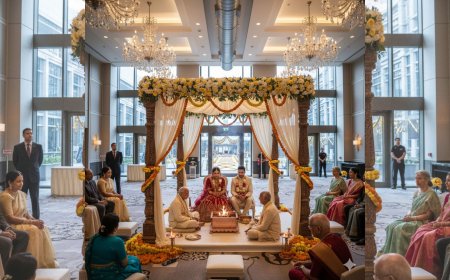
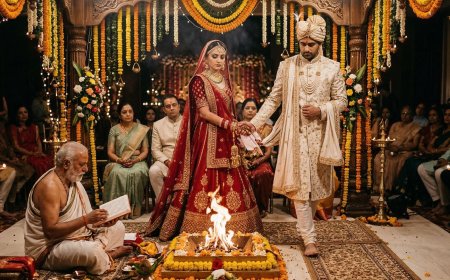
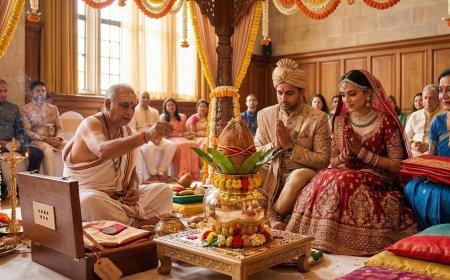
The central ceremony is the Khongjom Parba [the sacred wedding rite conducted by the Maiba], during which the couple is seated together for the first time in the ceremonial space and the Maiba recites prayers in Meitei lon [the Meitei language, also called Meiteilon or Meithei] invoking the Atiya Guru Sidaba [the supreme deity of the Meitei Sanamahi pantheon, understood as the source of all creation] and the specific clan deities of both families. Sacred fire is present throughout, and the couple makes offerings of laipot [sacred ritual items including flowers, fruits, and specific leaves] at key moments of the ceremony.
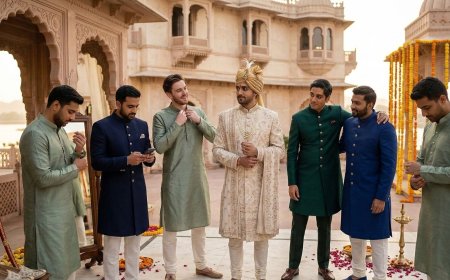
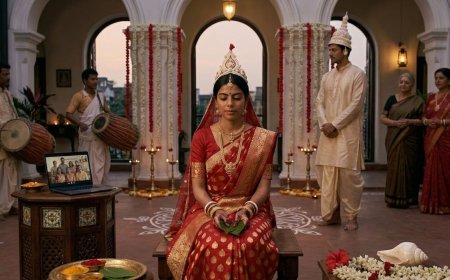
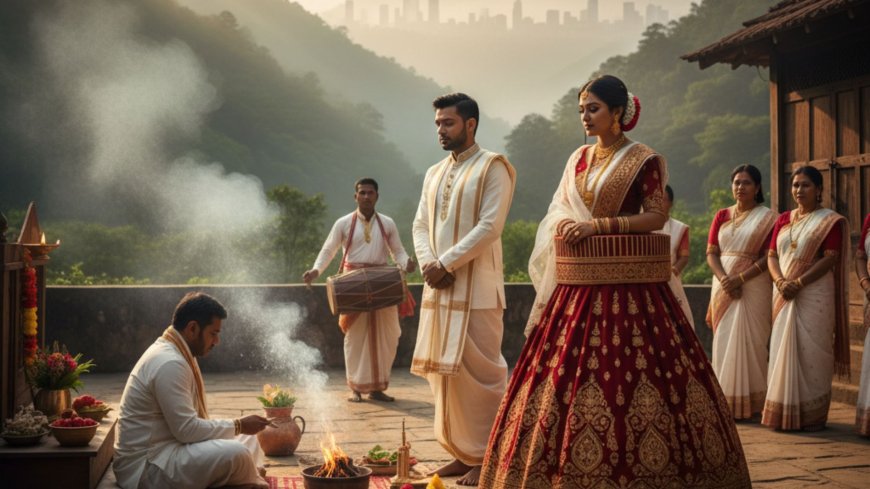
The Khudei Ngaakpa [the sacred cloth ceremony] is one of the most visually distinctive elements of a Meitei wedding. The bride wears the Potloi [the traditional Meitei bridal costume — a magnificent cylindrical skirt of stiff, embroidered fabric that stands away from the body in a distinctive silhouette] and the Innaphi [the traditional Meitei woven shawl draped over the upper body]. The Potloi is not simply a garment — it is a ritual object, and wearing it correctly is itself an act of ceremonial precision. The groom wears the Khwangjet [a traditional dhoti-style lower garment] and Sarit Phee [a white upper cloth].
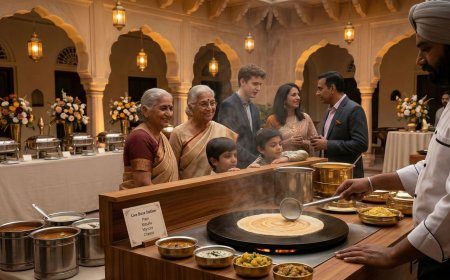
The Nongmaiching [the ceremony of the wedding feast] that follows is a community gathering of extraordinary scale in traditional Meitei families, featuring specific dishes that vary by clan and season — Eromba [a traditional Meitei dish of boiled vegetables and fermented fish paste], Singju [a finely chopped raw salad with fermented fish and herbs], Chamthong [a light vegetable stew], and Ngari [fermented fish, the defining flavour of Meitei cuisine] — served to the entire community in a communal feast structure that mirrors the social values of Meitei life.
Community Comparison Table
| Community/State | Local Wedding Name / Key Ritual | Key Tradition | How NRIs Abroad Adapt It |
|---|---|---|---|
| Meitei (Manipur) | Khongjom Parba + Sanamahi Puja | Maiba-led Sanamahi ceremony, Potloi bridal costume, clan verification, Meitei Panchang date selection | Find Meitei diaspora associations abroad, source Potloi from Imphal, connect with Maiba through community networks |
| Mizo (Mizoram) | Inkhelh ceremony | Baptist church wedding, community choir, puanchei cloth, communal feast | Mizo church communities in UK, US, Australia |
| Naga — Angami (Nagaland) | Church wedding + tribal blessing | Angami shawl, community contribution feast, church vows | Naga Students Federation chapters in diaspora cities |
| Khasi (Meghalaya) | Church ceremony + matrilineal blessing | Maternal elder blessing, jainsem dress, church vows | Khasi diaspora associations in UK and US |
| Meitei Christian | Church wedding + cultural elements | Phi cloth worn as shawl, church ceremony, Meitei cultural reception | Meitei Christian church groups in UK and US |
| Assamese | Biya[Assamese wedding ceremony] | Mekhela Chador worn by bride, community feast, specific Assamese ritual sequence | Assamese diaspora associations in UK, US, Canada |
| Bengali Hindu | Biye | Shubho Drishti, sindoor ceremony, conch shell rituals | Bengali cultural associations and priests in major diaspora cities |
| Rajasthani Bhil | Mandav ceremony + Badwa-led rites | Multi-day tribal celebration, Ghoomar dance, dhol music | Rajasthani folk musicians available in UK, US, Canada |
| Gondi (Central India) | Mandwa ceremony + Pujari-led rites | Forest-blessed ceremony, Karma and Sela dances, Gondi painting | Central Indian folk musicians and Gondi artists available internationally |
| Tamil Brahmin | Vivaham | Vedic fire ceremony, nadaswaram music, multi-step ritual sequence | Tamil temple priest networks worldwide |
The Meaning Behind the Ritual
The Meitei wedding tradition rests on a cosmological understanding that is both ancient and extraordinarily precise: that the universe is organised into specific forces — the Lai [the Meitei pantheon of deities], the Sanamahi [the household deity], the Leimaren [the female deity associated with the earth and fertility] — and that a marriage, properly conducted, brings these forces into alignment in a way that protects and blesses the new household for its entire existence.
The Yumnak clan system that governs Meitei marriage is not merely social convention. In Meitei cosmology, each clan carries specific ancestral energies and divine associations, and the prohibition on marrying within the same clan is understood as a spiritual requirement — not a social one. Two people from the same clan would bring duplicate energies into a household, which Meitei cosmology considers imbalanced. Two people from different clans bring complementary energies, creating a household that is spiritually complete.
The Potloi bridal costume encodes this cosmology visually. Its cylindrical form — standing away from the body, creating a geometric silhouette that is unlike any other bridal costume in India — represents the bride as a cosmic axis, a pillar connecting the earth and sky at the moment of her transformation from daughter to wife. The elaborate embroidery on the Potloi depicts specific auspicious motifs whose meanings are specific to the bride's clan and family tradition.
The Maibi — the female priest-oracle of the Sanamahi tradition — represents one of the most extraordinary aspects of Meitei spiritual life: a tradition in which women hold the highest ritual authority. The Maibi is understood to be possessed by the Lai deities during ritual performance, becoming a vessel through which the divine speaks directly to the community. Her presence at a wedding is the most powerful blessing the tradition can offer.
For any non-Meitei guest or partner trying to understand what they are witnessing, the truest explanation is this: this wedding is not simply asking the divine to bless two people — it is aligning two family lineages with the cosmic forces that govern all of life, and the ceremony is the precise instrument of that alignment.
Doing a Meitei Wedding Abroad: The Practical Reality
Planning a traditional Meitei wedding abroad is among the most complex tasks in the NRI wedding landscape, because the tradition is extraordinarily specific — clan-based, calendar-dependent, priest-specific, and intimately connected to ritual objects and foods that are not easily sourced outside Manipur. But the Meitei diaspora is among the most culturally determined communities in the world, and the networks that support this specificity abroad are stronger than they might initially appear.
Finding a Maiba or Maibi: This is your first and most critical step. Maibas and Maibis are Manipur-specific ritual specialists whose knowledge is passed down within specific families and communities. They rarely travel internationally. For NRI couples abroad, the most workable approach is a layered ceremony: conduct the Sanamahi Puja at your family home with the senior women of your family leading the prayers, and engage a sympathetic Hindu pandit for any formal fire-based elements, while conducting all Meitei-specific cultural elements — the Potloi dressing, the clan verification, the community feast — as the cultural heart of the celebration. For couples planning a destination wedding in India, a Maiba from Imphal can be engaged through community connections.
The Potloi: The Potloi bridal costume is the non-negotiable element of the Meitei wedding and it must come from Manipur. There is no substitute available abroad, and a printed or synthetic approximation would be a significant departure from the tradition's integrity. Contact your family in Imphal well in advance — at least six months — and specify the full costume requirements including the Potloi itself, the Innaphi shawl, and all associated jewellery. Many skilled tailors in Imphal specialise in Potloi and ship internationally. The Ima Keithel [the famous Imphal market run entirely by women traders] is the starting point for any Potloi sourcing conversation in Imphal. Your mother or aunt in Manipur will know exactly who to contact.
The Meitei Panchang: Even abroad, the selection of the wedding date according to the Meitei lunar calendar is important to most traditional families. A Maiba in Imphal can be consulted remotely — increasingly via video call — for date selection based on the birth details of both the bride and groom. This consultation is worth the effort, as it ensures the wedding date carries the full weight of traditional auspiciousness and will be accepted as correct by elders in both families.
Sourcing Ritual Items: The Ngari [fermented fish] that is central to Meitei cuisine and ritual food traditions is available in some South Asian grocery stores and in shops serving Southeast Asian communities in diaspora cities. In London, Brick Lane and some East London shops carry Southeast Asian fermented fish products that can serve as alternatives. In Toronto, the Scarborough area's Southeast Asian grocers are your best source. In Melbourne, Victoria Street in Richmond and the Springvale South Asian market area carry fermented products. For Singju ingredients, most items are available from South Asian grocers in any major diaspora city. The Siroi lily is not available abroad and should be substituted with white lotuses, which carry similar auspicious associations in the broader Hindu-adjacent tradition.
The Sanamahi Shrine: For NRI Meitei families who maintain a Sanamahi shrine at home, the pre-wedding Sanamahi Puja can proceed exactly as it would in Imphal, with the senior women of the family leading the worship. For families who do not have a shrine established, setting one up in the east corner of the home before the wedding with guidance from elders in Manipur — via video call if necessary — is the correct approach. The shrine requires specific items: a laipot [ritual offering vessel], specific leaves, flowers, and the traditional eyek [a small lamp].
Meitei Music and Dance: Pung Cholom [the traditional Manipuri drum dance, performed with the pung barrel drum] and Kartal Cholom [the cymbals dance] are performed at Meitei celebrations. In diaspora cities, Manipuri classical dance teachers exist — often connected to Indian classical dance schools that teach Manipuri alongside Bharatanatyam and other forms. In London, the Akademi South Asian Dance organisation and similar bodies can connect you with Manipuri dance practitioners. In the US and Canada, Indian classical dance schools in cities with South Asian populations often have Manipuri dance programmes. A live pung performance at the wedding creates an atmosphere of extraordinary cultural authenticity.
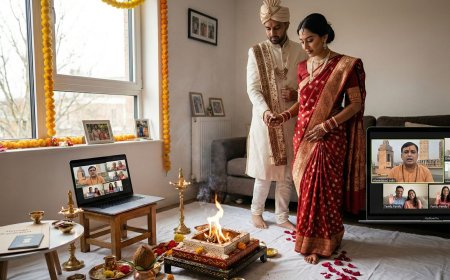
Time Zone Coordination: For family joining from Imphal via live stream, aim for a ceremony start between 3 PM and 5 PM UK time, or between 7 AM and 9 AM US East Coast time — these windows correspond to comfortable evening hours in Manipur, which observes IST. Test the connection multiple times in advance; internet connectivity in parts of Manipur can be variable. Assign a dedicated tech person to manage the stream throughout the ceremony.
Doing a Meitei Wedding as a Destination Wedding in India
For NRI couples choosing to marry in India with Meitei tradition at the centre of the celebration, Imphal is the only answer. The Manipur valley — surrounded by green hills, centred on the ancient Kangla Fort complex that was the seat of Meitei civilisation for centuries — provides a setting of extraordinary historical and natural beauty.
A wedding ceremony at a traditional Meitei home in Imphal, conducted by a genuine Maiba with full community participation, wearing a Potloi made by a master tailor from the Ima Keithel, followed by a feast of authentic Meitei cuisine — Eromba, Singju, Chamthong, and the specific dishes of your family's clan tradition — is an experience that no urban Indian wedding destination can approximate.
The Kangla Fort complex, now a heritage site open to the public, provides a ceremonial backdrop of profound historical resonance. The Shree Shree Govindajee Temple in Imphal — the most important Vaishnava temple in Manipur, reflecting the dual Sanamahism-Vaishnavism heritage of most Meitei families — offers a setting for any Vaishnava elements of the ceremony.
When working with local planners, insist on genuine Meitei cultural specificity — the distinction between a Sanamahism-led ceremony and a generic Hindu wedding is significant, and a good local planner will understand and respect this. NRI.Wedding can connect you with Imphal-based coordinators who have specific experience with traditional Meitei weddings and understand the clan protocols, the Panchang requirements, and the Potloi tailoring networks.
For non-Indian guests, prepare a detailed ceremony programme explaining every element. The visual beauty of a full Meitei wedding — the Potloi, the classical dance, the Maiba's chanting, the feast — will be immediately extraordinary to any guest. But the meaning behind each element will transform their experience from aesthetic wonder to genuine understanding.
What You Need: Ritual Checklist
Ritual Items: Potloi bridal costume and Innaphi shawl sourced from Imphal, Sarit Phee and Khwangjet for groom, Sanamahi shrine items including laipot and eyek lamp, sacred fire materials, Siroi lily substitutes of white lotus and marigolds, Meitei Panchang consultation for date selection, laipot offering materials, specific feast ingredients including Ngari, Singju vegetables, Eromba ingredients, Chamthong vegetables, pung drum for music if available.
People Required: Maiba or senior female family elder for Sanamahi Puja, Maibi if available for highest blessing, Meitei Panchang consultant in Imphal for date selection, Manipuri classical dance performer for pung Cholom, senior female elders for Potloi dressing ceremony, community members for feast preparation, AV team for live streaming to Imphal family, photographer briefed on Meitei wedding traditions and Potloi significance.
Preparation Steps: Consult Meitei Panchang for date selection twelve months ahead. Order Potloi from Imphal tailor eight to ten months ahead. Contact Meitei diaspora associations for community support six months ahead. Arrange Maiba consultation remotely or source local Hindu pandit four months ahead. Source Sanamahi shrine items through community three months ahead. Arrange Manipuri dance performer two to three months ahead. Source feast ingredients through South Asian and Southeast Asian grocers three weeks ahead. Test live stream to Imphal one week ahead. Brief all non-Meitei guests on ceremony significance in advance.
NRI.Wedding connects Meitei couples with Imphal-based Potloi tailors, Maiba consultants, Manipuri classical dance performers, community feast coordinators, and photographers who understand the extraordinary visual and spiritual complexity of the Meitei wedding tradition. You do not have to explain your tradition to us.
5 Questions NRI Couples Always Ask
Can we have an authentic Meitei wedding ceremony without a Maiba, since there are none in our country?
Yes, and many diaspora Meitei families navigate exactly this. The Maiba's specific ceremonial role can be partially filled by the senior women of the family who hold knowledge of the Sanamahi Puja sequence — and in Meitei tradition, the female elders of the family hold significant ritual authority in their own right, particularly for the household-based ceremonies. The Khongjom Parba elements that specifically require a Maiba can be conducted in simplified form with elder guidance, or supplemented by a remote consultation with a Maiba in Imphal via video call who guides the proceedings in real time. Focus on the cultural elements — the Potloi, the clan verification, the feast, the music — that can be fully and authentically recreated abroad.
The Potloi is the element I am most anxious about. What if it doesn't arrive in time, or doesn't fit correctly?
This anxiety is entirely understandable and entirely manageable with sufficient lead time. Order the Potloi at least six to eight months before the wedding, not three. Share your precise measurements — waist, height, the specific circumference the skirt structure requires — with the tailor in detail, and request a progress photograph at the mid-point of construction. The Potloi is a structured garment and alterations are difficult once it is complete, so accuracy of measurement at the ordering stage is critical. Ship via a tracked international courier service and insure the package. Have a family member in Imphal inspect the completed Potloi before it is shipped. With this level of preparation, the Potloi has arrived on time and correctly for diaspora families in London, Melbourne, and Toronto.
My partner is not Meitei and has no connection to this tradition. How do we include them meaningfully?
The Yumnak clan system — which governs so much of Meitei marriage — is specific to the Meitei community and cannot meaningfully be extended to a non-Meitei partner. But meaningful inclusion does not require pretending the tradition applies universally. The most powerful approach is genuine education and genuine witness: ensure your partner understands every element of the ceremony before the wedding day, give them a specific role in the celebration that is appropriate — receiving the community's welcome on behalf of both families, speaking at the feast about what the tradition means to them — and let their genuine engagement with something unfamiliar be its own form of participation. Authentic curiosity is more valuable than performed belonging.
How do we manage the Yumnak clan verification when families are in different countries and the relevant elders are in Manipur?
This is one of the most practically complex elements of a diaspora Meitei wedding, and it is best handled early. The clan verification should be initiated at the Luhongba stage — the formal engagement — rather than left to the wedding day. Conduct the Luhongba in Manipur if possible, with the relevant elders present, and document the clan verification formally. If this is not possible, arrange a video call between the senior elders of both families, mediated by a respected community figure, at which the Yumnak details are confirmed. The confirmation should be communicated to both families in writing so that all elders are satisfied before the wedding planning proceeds.
We want to incorporate Ras Leela or Manipuri classical dance into our wedding. How do we find a performer abroad?
Manipuri classical dance teachers and performers exist in most major diaspora cities, typically through Indian classical dance schools that teach multiple forms. Search for Manipuri dance teachers specifically — not general Indian classical dance — through organisations like Akademi in the UK, or through South Asian arts organisations in Toronto, Melbourne, and Houston. Many Manipuri dance practitioners in the diaspora are deeply connected to the wedding tradition and will understand exactly what you are asking for. Book at least four to six months ahead and brief the performer on the specific elements of your ceremony — whether you want a performance during the wedding feast, during the entrance of the bride, or at another specific moment.
The Emotional Angle
There is a quality of longing specific to Meitei NRI families that is difficult to articulate to people outside the community. You come from a valley that is geographically enclosed — mountains on every side, a civilisation that developed in relative isolation for centuries, building its own script and its own classical arts and its own cosmological system with the focused intensity that only that kind of bounded geography produces. And then you left. Or your parents left. Or your grandparents left. And the valley stayed where it was, enclosed by its hills, continuing its rituals without you.
The Potloi arrives in a package from Imphal — wrapped in layers of protective cloth by hands you have not seen in years — and when you lift it out and hold it, the weight of it is unexpected. Not the physical weight, though that is significant. The other weight. The weight of everything it took to make this garment, in that valley, by those hands, for this wedding that is happening in London or Melbourne or Toronto because your family crossed an ocean and kept this tradition alive in the gap between where they came from and where they arrived.
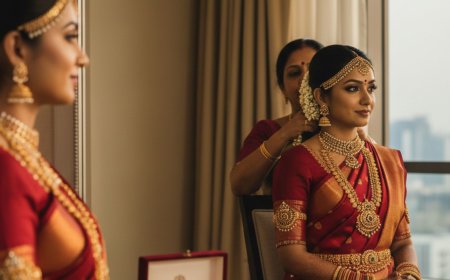
You put on the Potloi and you stand in front of a mirror in a country that has no word for what you look like, and you feel — completely and specifically — like yourself. Not the self you are every day. The self you were always going to be, on this day, in this costume, at this ceremony that your great-grandmother attended in the valley before you had a name.
The Lai came with you. They always come with the Meitei people. Wherever the valley's children go, the deities follow.
A Moment to Smile
At a Meitei wedding in Harrow two years ago, the elaborate process of dressing the bride in her Potloi — a procedure that in Imphal would be managed by experienced senior women who have done it dozens of times — was being attempted by four aunties, none of whom had dressed a Potloi bride in at least fifteen years, in a hotel suite with a ceiling that was slightly too low for the Potloi's full height when the bride stood upright.
The solution, arrived at after twenty minutes of creative deliberation, was that the bride sat on a slightly lower chair for the dressing and stood only when the Potloi was fully secured. This worked perfectly. The bride then discovered that the hotel room door was four centimetres too narrow for the Potloi's circumference at its widest point. The aunties considered this problem for approximately thirty seconds before determining that the Potloi, being a structured but flexible garment, could be rotated forty-five degrees to pass through the door sideways.
The bride entered her wedding ceremony having already performed what her cousin described as "the most elegant act of structural problem-solving in the history of Meitei diaspora weddings." The photographs are magnificent. The Potloi was undamaged. The aunties were extremely pleased with themselves.
Quotes From the Diaspora
"The Potloi took eight months to arrive. I tracked that package like it contained my entire identity, which in a way it did. When I finally put it on in our flat in Harrow, my mother sat down and cried for ten minutes. I understood exactly why." — Sanatombi Laishram, Meitei, London
"My son married a girl from outside the community. I was nervous about how the ceremony would feel. But when she stood in the Meitei ceremonial space in her saree, watching everything with complete attention and genuine respect, I felt something shift. She was learning our world on our terms. That is the only way it works." — Ibemhal Yumnam, Meitei, resident of Melbourne for twenty years, mother of the groom
"We did the Sanamahi Puja in our apartment in Toronto at five in the morning because that was the auspicious time the Maiba in Imphal had identified. My husband's family thought we were slightly mad. But when the puja was done and the day began, something felt settled in a way I cannot explain. The deities were present. Even in Toronto, they were present."— Thoibi Konsam, Meitei, Toronto
Your Valley Came With You
The traditional Meitei wedding is one of the most complete and most specific civilisational expressions of marriage in all of India — a tradition so precisely calibrated to its community's cosmology, clan structure, artistic heritage, and seasonal calendar that it resists generalisation at every turn. It demands to be known in full, conducted in full, and honoured in full. It does not simplify well, and it does not need to.
If you are planning your Meitei wedding — in a hotel suite in Harrow or a heritage venue in Toronto, in Imphal or in the shadow of the Kangla Fort — NRI.Wedding is here to help you do it with the full depth of knowledge and care it deserves. From Potloi tailors in Imphal and Maiba consultants to Manipuri classical dance performers, Meitei feast coordinators, and photographers who understand what they are documenting when a bride stands in a Potloi in a foreign city carrying the weight of a valley civilisation on her embroidered shoulders, we are here.
Order the Potloi. Light the eyek. Consult the Panchang.
Your valley came with you. Let it be seen in full.
This article covers traditional Meitei Manipuri wedding rituals including the Khongjom Parba ceremony, Sanamahi Puja, Potloi bridal costume, Yumnak clan system, Maiba and Maibi priests, and practical planning guidance for NRI Meitei couples in the UK, Australia, Canada, and the US, with destination wedding guidance for Imphal and the Manipur valley.
What's Your Reaction?
 Like
0
Like
0
 Dislike
0
Dislike
0
 Love
0
Love
0
 Funny
0
Funny
0
 Angry
0
Angry
0
 Sad
0
Sad
0
 Wow
0
Wow
0