





































































Getting Everyone There and Back: The NRI Couple's Complete Guide to Wedding Guest Transportation Logistics
The bus that left without the bridal party. The guests who boarded the wrong vehicle. The two in the morning when the last bus had gone and the dancing guests had nowhere to go. Wedding guest transportation fails in specific, preventable ways — and the couple who builds a complete movement inventory, matches vehicles to movements, briefs every driver thoroughly, and manages the system in real time prevents most of them. This guide delivers a complete framework covering the full movement inventory, vehicle type selection, airport arrival and departure coordination, event inbound and outbound scheduling, baraat logistics, accessibility provisions, driver briefing strategy, technology tools for real-time management, and the budget approach that produces an accurate transportation cost rather than a significant underestimate.

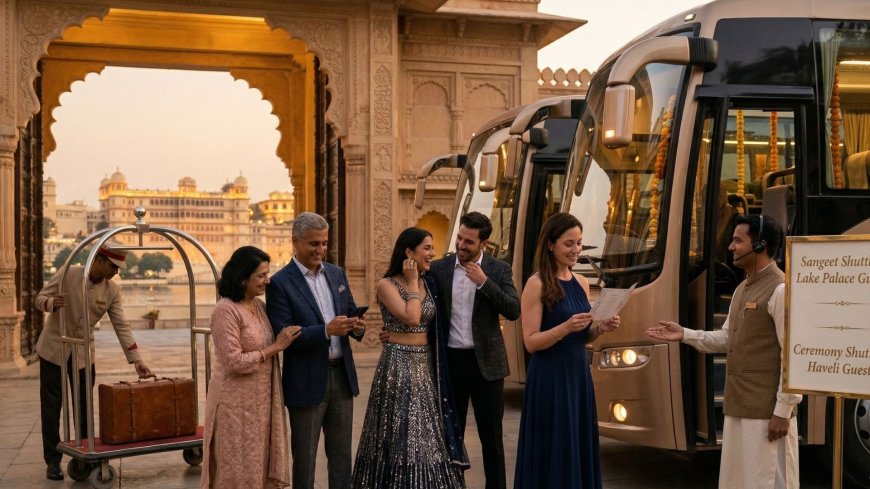
Transportation Logistics: Moving Guests Between Hotels and Venues
The NRI couple's complete guide to planning the guest transportation that nobody notices when it works and everybody remembers when it does not — covering every movement from airport arrival to final departure across the full wedding weekend
The Buses That Left Without Knowing They Were Supposed to Wait
The sangeet venue was twenty-five minutes from the hotel. The couple had arranged shuttle buses — three of them, departing at thirty-minute intervals beginning at seven in the evening. The logistics seemed sound. The bus times had been communicated in the welcome booklet. The hotel concierge had the schedule.
What the logistics plan had not accounted for: the guest who had asked the bus driver, in a combination of English and gesture, whether this was the bus to the party, received a nod that the bus driver intended to mean yes, I understand that you are going to an event, and the guest interpreted as yes, this is your bus, resulting in the guest boarding the second bus bound for a corporate event at a different venue in the same hotel's fleet and spending forty minutes in the back of a bus to a technology company's annual dinner before the situation was identified and resolved.
The bus that was supposed to wait for the last guests from the bridal party's extended getting-ready session did not wait, because the bus driver's instructions specified a departure time rather than a departure condition, and the departure time arrived before the bridal party was ready, and the driver followed his instructions correctly.
The return buses were scheduled to depart at eleven, midnight, and one in the morning. The event ran until two. The guests who had not made the one o'clock bus — which was the majority of the dancing-inclined guests — discovered at two in the morning that there was no return transportation and that app-based rideshare in this particular city at this particular hour had a forty-minute wait time that was climbing.
None of these failures were catastrophic. All of them were preventable. All of them required the expenditure of coordinator time and guest goodwill that would have been better spent on the actual celebration.
This guide provides the planning framework that prevents all of them.
The Scope of the Transportation Problem
The NRI wedding transportation challenge is larger in scope than most couples initially appreciate — because the full picture of guest movements across a multi-day wedding with multiple hotels, multiple venues, and a significant international guest contingent involves a number of individual transportation decisions that, when counted explicitly, is almost always larger than the initial estimate.
Consider the complete movement inventory for a typical NRI wedding weekend with four events across three days and one hundred and fifty guests staying at two hotels:
Airport arrivals distributed across a two-day window, each requiring transport to a hotel. Airport departures distributed across a two-day window, each requiring transport from a hotel. The welcome dinner, requiring transport from two hotels to the venue and back. The mehendi, requiring transport from two hotels to the venue and back. The sangeet, requiring transport from two hotels to the venue and back. The ceremony, requiring transport from two hotels to the venue and back, with additional provision for the baraat if the groom's procession involves a separate movement. The reception, requiring transport from two hotels to the venue and back, with late-night returns. The morning-after brunch, requiring transport from two hotels to the venue and back.
Each of these movements involves multiple departure times, multiple vehicle types, multiple route options, and a specific set of things that can go wrong. The transportation plan that is equal to this scope is not a single WhatsApp message to a driver. It is a comprehensive logistics document that addresses every movement explicitly.
The Planning Foundation: The Movement Inventory
Before any vehicle is booked, any driver is briefed, or any schedule is communicated, a complete movement inventory — a document that lists every movement required across the full wedding weekend — is the planning foundation that every subsequent decision depends on.
The movement inventory should be structured as a table with the following columns for each movement: the movement date and day, the departure point, the destination point, the departure time, the estimated arrival time, the number of guests requiring this movement, the vehicle type appropriate for this number, and any special requirements — wheelchair accessibility, luggage capacity, the specific timing constraints that make this movement time-sensitive.
Building the movement inventory from the event schedule — working through each event and identifying the inbound and outbound movements it requires — produces a complete picture of the transportation scope before any booking decisions are made.
For most NRI weddings, the complete movement inventory contains between forty and eighty individual movements. The number surprises most couples who have been thinking about transportation in terms of events rather than movements. It also produces the specific understanding — not available from any other analytical approach — of which movements are the most complex, which are the most time-sensitive, and which can be consolidated to reduce cost and complexity.
The Vehicle Types: Matching the Movement to the Transport
Different movements require different vehicle types, and the selection of the appropriate vehicle type for each movement is one of the most important decisions in the transportation plan.
The Luxury Coach or Mini-Coach
The luxury coach — forty-five to fifty-five seats — and the mini-coach — twenty-five to thirty-five seats — are the primary vehicles for large-group movements between hotels and venues. They are appropriate for the primary wedding events where the majority of guests are moving simultaneously — the sangeet departure, the ceremony arrival, the reception return.
The quality difference between luxury coaches and standard buses at Indian wedding vendors spans an enormous range, and the quality of the vehicle directly affects the guest experience of the movement. A well-maintained, air-conditioned luxury coach with functioning entertainment systems and comfortable seating creates a movement that is pleasant — a shared social moment that begins the event before the event begins. A poorly maintained vehicle with inadequate air conditioning and uncertain punctuality creates a movement that is the first negative experience of the event.
Inspect the vehicles before confirming the booking. A video call with the vendor showing the specific vehicles to be used, not a representative vehicle from the fleet, is the minimum verification standard for any vehicle that will carry wedding guests.
The Tempo Traveller
The Tempo Traveller — a twelve to fifteen seat minivan that is ubiquitous in Indian transportation — is the most flexible and most versatile vehicle in the Indian wedding transportation fleet. Its size makes it appropriate for smaller group movements, for the movements of specific guest subgroups, and for the flexible additional capacity that every wedding transportation plan eventually needs.
The Tempo Traveller is also the most appropriate vehicle for movements that require specific routing — through old city lanes that larger coaches cannot navigate, to heritage properties whose access roads require smaller vehicles, or for guests requiring door-to-door service rather than hotel lobby pickup.
For NRI weddings with international guests who are making independent movements between events, a Tempo Traveller on standby — available for ad-hoc movements at specific times during the wedding weekend — is the transportation resource that resolves the most situations that the scheduled transportation plan does not cover.
The Luxury Sedan
The luxury sedan — typically a Toyota Innova, a Mercedes E-Class, or a similar premium vehicle — is appropriate for the movements of the VIP guest tier: the couple, the immediate family, the elderly or mobility-limited guests for whom shared coach transport is not appropriate, and the specific guest movements where the quality of the vehicle is itself part of the hospitality statement being made.
The bridal couple's own transportation requires specific consideration beyond the standard VIP sedan tier. The vehicle that carries the bride to the ceremony, the vehicle in which the couple makes their first departure as a married couple — these are vehicles that appear in photographs and that carry symbolic significance beyond their transportation function. A beautifully decorated vintage car, a classic Ambassador, a specific regional vehicle type with cultural resonance — the couple's transportation choice is a design decision as much as a logistics one.
Auto-Rickshaws and Tuk-Tuks
For weddings at heritage properties in old city areas where the narrow lanes make coach access impossible, or for events at venues where the final approach requires a vehicle smaller than a car, auto-rickshaws provide both a logistics solution and a genuinely enjoyable transportation experience for international guests who have not traveled by auto before.
The organized auto-rickshaw fleet — a convoy of decorated autos coordinated by a single contact, departing together with a lead auto that knows the route — is one of the most memorable transportation experiences the NRI wedding can create, particularly for international guests for whom the auto is a novel and specifically Indian experience.
The Airport Movement: The Most Complex Transportation Element
The Arrival Coordination
The airport arrival transportation is the most logistically complex element of the wedding transportation plan because guest arrivals are distributed across the widest time window — typically two to three days — with the most variable arrival times and the most variable luggage volumes.
The practical options for managing airport arrivals are not mutually exclusive and most NRI weddings use a combination:
Arranged hotel transfers: The primary guest hotel typically offers airport transfer services — either as part of the room rate or at a supplementary charge — and coordinating with the hotel to ensure that all arriving guests have confirmed transfers is the most straightforward approach for guests who are staying at the primary hotel. The hotel's transfer service is familiar with the route, knows the specific hotel arrival process, and provides a level of reliability that independently sourced drivers may not.
Group transfer coordination: For guests arriving within a window that allows coordination — multiple guests arriving at the same airport within two to three hours of each other — coordinating shared transfers reduces cost and provides the social benefit of arriving together. This requires a coordinator who can track flight arrivals in real time, manage the wait for the last arrival in the window, and brief the driver on the consolidated pickup.
Pre-booked app-based services: For guests with smartphones and data access, pre-booking an Ola or Uber from the airport before clearing customs — available in the arrivals hall area — provides an independent, transparent-pricing option that requires no coordination from the couple.
The dedicated arrival coordinator: For weddings with more than twenty international guest arrivals across a two-day window, a dedicated arrival coordinator — stationed at the arrival airport during the primary arrival window, equipped with a sign identifying the wedding, and briefed on every arriving guest's flight details — provides a specific welcome at the first moment of the guest's India experience. The arrival coordinator who meets guests at the airport, helps them with SIM card purchase if needed, ensures their transfer is confirmed, and sends a WhatsApp confirmation to the couple that each guest has arrived safely is a logistics investment with a disproportionate return in guest experience quality.
The Departure Coordination
Departure transportation is logistically simpler than arrival — the movements are outbound to a known destination and the timing is more controllable — but it carries specific risks that arrival transportation does not.
The primary departure risk: guests who miss their flights because the departure transfer was inadequate. The specific situations that produce this: an underestimation of the time required to reach the airport during peak traffic, a shared transfer that boards all passengers at the stated departure time without confirming that all booked passengers are present, and a guest who has not confirmed their departure transfer in advance and attempts to arrange one independently at the last minute.
The departure transportation plan should include: a confirmed transfer booking for every departing guest, departure times calculated from the airport's check-in requirements working backwards through the realistic traffic conditions, and a departure confirmation communication to each guest the day before their departure.
The Event Transportation: The Primary Logistical Challenge
The Inbound Movement
The inbound movement — from hotels to the event venue — is the more straightforward direction of the event transportation because it is happening at a known time with a known group of people.
The inbound schedule should be designed to have all guests at the venue before the event begins — which means the last inbound departure must arrive at the venue with sufficient time before the stated event start time to allow guests to settle, find their seats, obtain a drink, and be ready for the event to begin. Working backwards from the event start time, accounting for the journey time with a buffer for traffic variability, produces the latest departure time. Building additional departure slots earlier than this ensures that guests who prefer to arrive early — and there will always be guests who prefer to arrive early — have a transport option that serves them.
For events where the invitation time and the actual start time are expected to differ — the sangeet that is scheduled for eight but will realistically begin at eight-thirty or nine — the inbound schedule should serve the realistic start time rather than the invitation time, while also providing an early departure option for guests who will arrive at the invitation time regardless of the realistic expectation.
The Outbound Movement
The outbound movement — from the event venue back to the hotels — is more complex than the inbound because it happens across a time range rather than at a specific time.
The challenge: guests leave events at different times based on their energy, their age, their specific responsibilities on the following morning, and their individual tolerance for late-night dancing. A transportation plan with outbound departures only at fixed times — eleven, midnight, one — creates the specific situation where guests who want to leave at eleven-fifteen either wait until midnight or arrange independent transportation, and guests who are still dancing at one-thirty are stranded.
The most effective outbound transportation plan uses a combination of scheduled departures at one-hour intervals from the end of the dinner service through the expected event conclusion, plus on-demand capacity for the late-night stragglers who will always exist at any event that has good music and an open bar.
The on-demand capacity can be provided by: a Tempo Traveller on standby at the venue for the full evening, available for additional runs as needed; a pre-arranged account with a local taxi or rideshare service for additional capacity beyond the scheduled buses; or a coordinator whose specific responsibility is managing the outbound transportation and calling additional vehicles as the demand pattern becomes clear during the evening.
The Venue Logistics at the Point of Departure
The physical organization of the transportation at the venue's departure point is a specific logistics element that is often overlooked in the planning and that produces specific chaos at the event conclusion if it is not addressed.
The departure point should be: clearly signed so that guests know where to wait for the buses, sheltered from weather if the event is in a season where this matters, organized to allow specific buses to load and depart without blocking each other, staffed by a coordinator who can answer the question "which bus goes to which hotel" without ambiguity, and separated from the venue's general circulation so that guests loading onto buses do not obstruct guests who are still at the event.
The specific guest communication at departure: a brief announcement at the event that departure buses are available, with a reminder of the departure point location and the schedule, prevents the situation where guests miss buses because they did not know the buses were leaving.
The Baraat: The Special Case
The baraat — the groom's wedding procession — is the wedding transportation element that is least like standard event transportation and that requires the most specific planning.
The baraat involves a procession of the groom, the groom's family, and the groom's friend group moving from a starting point — typically the hotel — to the ceremony venue. The movement is not simply transportation — it is a celebratory procession that includes music, dancing, and the specific Punjabi or regional wedding culture that makes the baraat the most exuberant public moment of the wedding.
The transportation elements that require specific planning: the horse or decorated vehicle for the groom, the band or dhol players who provide the musical energy of the procession, the vehicles or walking route for the procession participants, and the logistical coordination with the ceremony venue reception.
For NRI weddings in hotel venues with specific access restrictions — no horses, limited outdoor space for procession formation — the baraat planning must account for the venue's specific constraints and identify the creative solutions that honor the tradition within those constraints.
The street procession baraat — moving through public streets between the hotel and the venue — requires coordination with local authorities for road closure or traffic management in busy urban areas, and with the venue for the specific arrival protocol.
The Accessibility Considerations
The transportation plan must specifically address the needs of guests with mobility limitations, elderly guests for whom standard coach or bus transport is physically challenging, and guests with other accessibility requirements.
The specific provisions: luxury sedans for guests who cannot manage coach boarding steps, a designated accessibility coordinator who ensures that these guests have confirmed, appropriate transportation for every movement, and advance communication with event venues about accessible arrival routes and facilities.
The groom's grandmother who uses a walker does not need to be accommodated in the same coach as the general guest group — she needs a sedan with a driver who has been specifically briefed on her specific needs and a coordinator who has confirmed her transportation for every movement independently.
The Drivers: The Human Element in Every Vehicle
Every vehicle in the wedding transportation fleet is only as reliable as the driver operating it. The driver is the transportation plan's human execution layer — the person whose local knowledge, whose punctuality, whose communication skills, and whose basic competence determine whether the transportation plan that exists on paper becomes the transportation experience that guests actually have.
The driver briefing is one of the most important transportation management tasks, and it is the one most commonly skipped or conducted inadequately.
Every driver operating a wedding transportation vehicle should be briefed on: the specific route for each journey they are making, the specific hotels and venues involved with their addresses in both English and the local language, the specific departure time and departure condition — whether to depart at the stated time or to wait for a specific signal from the coordinator, the specific guests they are transporting and their expectations, the contact number of the on-ground transportation coordinator for any situation that requires guidance, and the return logistics if the movement involves a return journey.
The driver briefing should be conducted in the driver's language by someone who can communicate effectively in that language — either a coordinator who speaks it or through a translator — rather than assumed on the basis of a written schedule that the driver may or may not have fully understood.
The coordinator who checks in with each driver thirty minutes before their first departure — confirming that the driver is at the correct location, with the correct vehicle, with the correct briefing — catches the specific driver situations that produce last-minute transportation failures before they become the couple's problem.
The Technology Tools
The technology tools that make wedding transportation management significantly more effective than management by phone calls and written schedules alone.
WhatsApp groups for driver coordination: A dedicated WhatsApp group for all wedding transportation drivers — managed by the transportation coordinator — allows real-time communication of schedule changes, traffic updates, and any situation requiring coordination. A driver who can receive a WhatsApp message that the departure time has been delayed by thirty minutes is significantly more manageable than one who can only receive phone calls.
Real-time flight tracking for arrival coordination: The arrival coordinator tracking incoming flights in real time — using FlightAware or a similar service — can identify delays and manage pickup timing adjustments without waiting for passengers to call from the arrivals hall.
GPS tracking of vehicles: Many Indian transportation vendors now operate vehicles with GPS tracking accessible through a web interface or app. The transportation coordinator who can see in real time where each vehicle is and how far it is from its pickup point can manage the transportation plan proactively rather than reactively.
Shared movement document: A Google Sheet or equivalent shared document that the transportation coordinator updates in real time — showing the status of each vehicle, each movement, and any situations requiring attention — allows the wedding planner and the couple's family to monitor transportation status without requiring individual phone calls to the transportation coordinator.
The Budget: What Transportation Actually Costs
The transportation budget for an NRI wedding with significant international guest attendance and multiple events across multiple days is frequently the most significantly underestimated line in the overall wedding budget.
The underestimation happens for a predictable reason: couples estimate the cost of the primary event transportation — the coaches for the ceremony and reception — and do not account for the full movement inventory including airport transfers, event shuttle services for all events, the baraat logistics, the VIP sedan fleet, the standby Tempo Traveller, and the departure coordination.
The complete transportation budget should be built from the movement inventory — calculating the cost of each movement in the inventory and summing to a total — rather than from a top-down estimate of "what transportation should cost." The bottom-up approach produces a number that is typically thirty to fifty percent higher than the top-down estimate, and it is the accurate number.
The Transportation That Disappears
The goal of wedding guest transportation planning is to create a transportation system that is invisible to guests — that operates so smoothly, so punctually, and so specifically that guests do not think about it at all. They arrive at the pickup point, they board the correct vehicle, they are delivered to the correct destination at the correct time, and they spend the journey in conversation with other guests rather than managing transportation anxiety.
This invisibility is not an accident. It is the specific result of a complete movement inventory, a well-negotiated vehicle fleet, a thoroughly briefed driver team, a standby capacity that absorbs the unpredictable, and a coordinator who is managing the system in real time and resolving situations before they become guest experiences.
The transportation that works is the transportation that nobody notices. The transportation that does not work is the transportation that guests remember for years — as the story of the bus that left without them, the driver who took them to the wrong venue, the midnight moment when there was no bus and no taxi and a two-kilometer walk in wedding clothes seemed like the only option.
Plan the transportation with the same care given to the décor, the food, and the music. The care will be invisible. The absence of it will not be.
NRIWedding.com — Expert guidance for Indian weddings planned across borders.
What's Your Reaction?
 Like
0
Like
0
 Dislike
0
Dislike
0
 Love
0
Love
0
 Funny
0
Funny
0
 Angry
0
Angry
0
 Sad
0
Sad
0
 Wow
0
Wow
0