


























































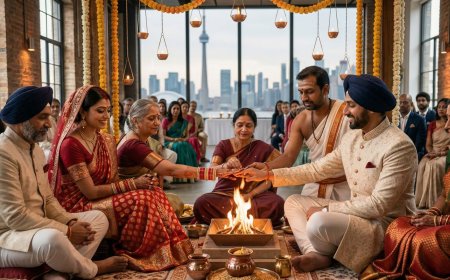



She Soaked the Wicks the Night Before: What the Bride's Mother Is Really Saying With Five Flames at Aukshan
Aukshan — the sacred Maharashtrian ritual in which the bride's mother welcomes the groom at the wedding threshold with a brass thali of five lit oil lamps — is the first act of consecration in the entire wedding ceremony. More than a greeting, it is a theological statement: five flames representing five divine principles, circled before the groom's face in the oldest available gesture of sacred welcome. Rooted in Vedic Aarti tradition and Maharashtra's Panchopasana philosophy, Aukshan transforms a threshold into a tirtha. For Maharashtrian NRIs planning weddings across the US, UK, Canada, UAE, and Australia, this is your complete cultural and practical guide.


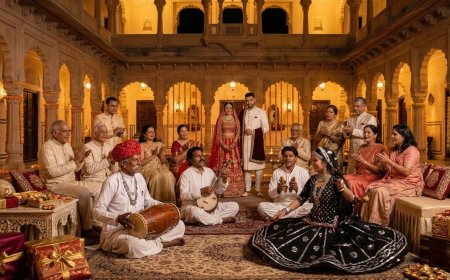
Before the groom crosses the threshold of the wedding mandap, before the Antarpat is raised, before a single wedding vow is spoken — there is Aukshan. The ritual of welcoming the groom with a plate of lit oil lamps, performed by the bride's mother with the specific tenderness of a woman receiving not a guest but a son, is one of the most visually luminous and emotionally layered rituals in the Maharashtrian wedding sequence. Aukshan is not a greeting. It is a consecration. And for Maharashtrian NRIs from Pune to Perth, from Nashik to New Jersey, from Mumbai to Melbourne, it is the ritual that makes the groom's arrival feel like something the gods planned.
You have seen it at the edge of your memory — the brass plate, the small flames, the bride's mother's face above it, the specific quality of attention she brings to the circling of the lamp before a man who is about to become her son. You were a child at a cousin's wedding in Pune, or a teenager at a community event in a temple hall in Harrow, and you registered that something important was happening at the threshold without knowing enough to stop and watch properly.
You know enough now. You are planning your own wedding. You are in a flat in Wembley or a house in Fremont or an apartment in Mississauga, and your mother is on the phone from Nashik or Aurangabad or Kolhapur saying, "The Aukshan thali I will prepare myself — the wicks must be cotton, the oil must be sesame, and the number of diyas must be five, not three, not seven, five." She has been thinking about this since the day you told her you were getting married. She has been thinking about the five flames and what they mean and what it will feel like to carry them to the threshold and raise them before the man her child has chosen.
She is ready. Let this article make sure you are ready too.
🌟 DID YOU KNOW?
- The Aukshan ritual derives its name from the Sanskrit aukshanam — meaning the act of sprinkling or anointing with a sacred substance — but in Maharashtrian practice it has evolved into a specifically lamp-based welcoming ceremony that combines the Vedic tradition of Aarti (the waving of a lamp before the divine) with the specific social ritual of welcoming an honoured guest at the threshold. The combination creates something theologically unique: a ritual that is simultaneously temple worship and domestic hospitality.
- The traditional Aukshan thali contains five oil lamps — a number of specific cosmological significance in Maharashtra's Panchopasana (five-deity worship) tradition, representing the five primary deities of the Maharashtrian household: Ganesha, Vishnu, Shiva, Devi, and Surya. By welcoming the groom with five flames, the bride's mother is asking all five divine principles to be present at the threshold and to bless the man who is crossing it.
- In the Maharashtrian diaspora tradition, Aukshan has become one of the most photographed single moments of the wedding day — the bride's mother's face illuminated by five small flames in a darkened or dimly lit threshold space produces one of the most visually extraordinary wedding photographs possible, and professional wedding photographers with experience in Maharashtrian weddings specifically position and light for this moment as a priority capture. Several award-winning wedding photographs from Maharashtrian NRI weddings in the UK, US, and Australia have featured the Aukshan as their central image.
What Is Aukshan?
Aukshan — from the Sanskrit aukshanam (the act of sacred sprinkling or anointing, evolved in Maharashtrian practice to mean the specific welcoming ritual with lamps) — is the ceremony in which the bride's mother formally receives the groom at the threshold of the wedding venue with a puja thali (sacred offering plate) carrying five lit oil lamps, performs a clockwise circular Aarti (the ritual waving of light before the divine or the honoured) before him, applies a tilak(auspicious forehead mark) of kumkum (vermillion) and chandanam (sandalwood paste) to his forehead, and showers him with akshata (turmeric-dusted rice) as a blessing.
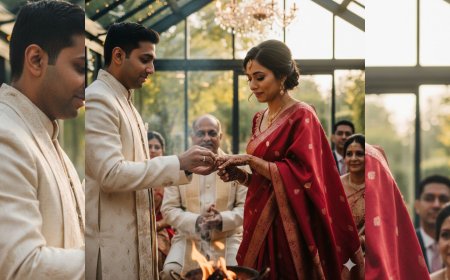
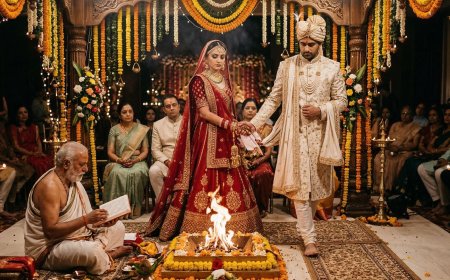
It occurs immediately before the groom crosses the threshold into the mandap — before the Vara Puja sequence in some family traditions, or as the opening act of the Vara Puja in others — making it literally the first sacred gesture of the wedding ceremony, the inaugural act of the day's spiritual sequence. Before any mantra is chanted at the mandap, before the Ganesh Puja opens the ceremony, before the Antarpat is raised — the bride's mother has already performed the first act of consecration by welcoming the groom with light.
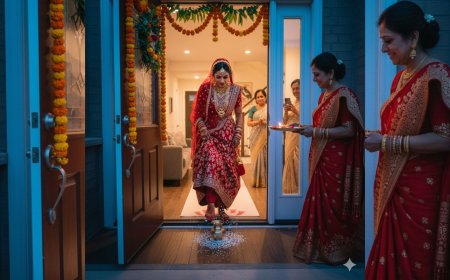
What physically happens is precise and beautiful. The bride's mother stands at the threshold — the entry point to the mandap or the ceremony space — holding the Aukshan thali with both hands. The thali is a brass or silver plate, decorated with a rangoli pattern of kumkum and turmeric, carrying five small diyas (oil lamps) with cotton wicks lit in sesame oil or ghee, a small mound of akshata, a kumkum tilak preparation, chandanam paste, fresh flowers, and sometimes a small amount of dahi (curd) for the groom's toe in some family traditions.
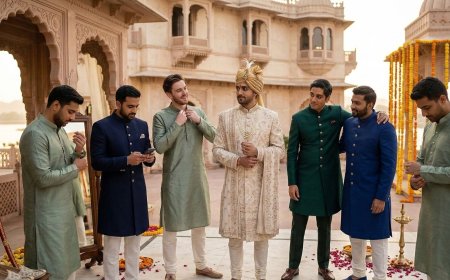
The groom arrives at the threshold, accompanied by his family. He removes his footwear before the threshold — crossing barefoot into the sacred space. The bride's mother raises the thali and performs the Aukshan: a slow, deliberate, clockwise circular motion of the lit lamps before the groom's face — three times in most family traditions, five times in others — the flames tracing a circle of light and blessing in the air between them. She then applies the tilak to his forehead — the kumkum mark of auspiciousness and divine welcome. She applies the chandanam. She showers the akshata over his head.
In many Maharashtrian families, the Aukshan is followed by a brief, specific ritual in which the groom places his right foot on a small stone or a measure of rice, and the bride's mother washes his toe with water — a gesture that parallels the full Paadya (foot-washing) of the Vara Puja and serves as its intimate, threshold-specific precursor.
The bride's mother then steps aside and the groom crosses the threshold. The wedding has begun.
Community Comparison Table
| Community / State | Local Name | Key Tradition | How NRIs Abroad Adapt It |
|---|---|---|---|
| Maharashtrian (Brahmin — Deshastha) | Aukshan | Five diyas on brass thali; bride's mother performs; kumkum tilak; sesame oil wicks | Brass thali sourced from Indian stores; sesame oil universally available; full ritual preserved |
| Maharashtrian (Brahmin — Kokanastha) | Aukshan | Similar sequence; specific Kokanastha variations in tilak application; coastal family traditions | Kokanastha pandit confirms sequence; thali prepared by bride's mother morning of wedding |
| Maharashtrian (Brahmin — Saraswat) | Aukshan | Saraswat-specific variations; five lamps maintained; coconut oil sometimes used | Community elder confirms oil tradition; coconut oil universally available |
| Maharashtrian (Maratha) | Aukshan / Ovaalne | Community-specific lamp welcome; sometimes performed by multiple women of family | Multiple women's participation preserved; thali decorated with family-specific rangoli |
| Gujarati | Aarti at Vara Puja threshold | Bride's mother performs Aarti with single or multiple diyas; kumkum tilak applied | Brass thali with diyas prepared fresh; bride's mother's role central and preserved |
| Punjabi (Hindu) | Aarti at Milni | Bride's mother performs Aarti at groom's arrival; often with multiple lamps or single flame | Aarti thali prepared morning of wedding; flower garlands added for Milni welcome |
| Rajasthani | Aarti at Dwarcharya | Bride's mother or senior female performs Aarti at threshold; tilak applied | Brass thali sourced from Indian stores; Rajasthani-specific rangoli on thali |
| Tamil (Iyer) | Vara Varaippu Aarti | Lamp welcomed at threshold; bride's mother or senior woman performs | South Indian brass lamp (kuthuvilakku) sourced from Tamil stores; ritual preserved |
| Bengali | Arati / Boron | Bride's mother performs Arati with conch shell and lamp; ululation by women | Conch shells from Bengali stores; Arati lamp prepared fresh; ululation preserved |
| Kashmiri Pandit | Lagan Aarti | Lamp welcomed at threshold with specific Kashmiri ritual elements | Kashmiri pandit coordinates; specific lamp sequence confirmed with family elder |
| Telugu | Aarti at Vara Swagatanam | Lamp welcome as part of groom's formal reception; bride's mother leads | Telugu pandit coordinates sequence; brass thali universally available |
The Meaning Behind the Ritual
To understand Aukshan at its philosophical core, you need to understand what Jyoti — flame, light — means in the Vedic and specifically Maharashtrian cosmological imagination. It is not simply illumination. It is not simply warmth. In the Vedic understanding, Jyoti is Brahman made visible — the divine principle manifesting in the most direct and immediately perceptible form available to the human senses. This is why the lamp is the central object of the Aarti ritual: not because it is beautiful (though it is), not because it creates atmosphere (though it does), but because it is the closest the material world comes to making the divine visible.
To wave five flames before a person is to say, in the oldest available language: I see the divine in you. I am acknowledging it with the most direct symbol of divinity that I have. I am bringing the divine toward you and making it circle you, blessing you in the five directions — north, south, east, west, and the sacred fifth direction which is akasha(the space above, the cosmic dimension) — because you are about to enter my family and I want the divine to know you are welcome here.
The five lamps carry their own specific theological grammar in Maharashtra's Panchopasana tradition. The five flames represent the five primary cosmic principles — creation (Brahma), preservation (Vishnu), transformation (Shiva), power (Shakti/Devi), and illumination (Surya) — and by welcoming the groom with all five, the bride's mother is not choosing which divine aspect to invoke. She is invoking all of them simultaneously. She is saying: every dimension of the sacred is being asked to witness and bless this crossing.
The tilak applied after the Aarti is the specific mark of divine recognition — the same mark placed on the forehead of a deity being worshipped, the same mark placed on the forehead of a devotee who has received divine blessing. To apply a tilak to the groom's forehead at the threshold is to mark him as the divine recipient of the family's deepest welcome — to say, on his forehead in kumkum and sandalwood, what the tradition teaches: you have been seen. You have been blessed. You are welcome here.
The akshata showered over his head after the tilak is the final gesture of abundance — rice, the food of life, scattered over the person being blessed as a wish for fullness, completeness, and a life that never lacks what it needs.
For a non-Indian partner or family member seeking the simplest truth: the bride's mother is saying, with five small flames and her own two hands, everything she could never say in words — that she sees something sacred in the person her child has chosen, and she is bringing her family's light to meet it at the threshold.
Doing Aukshan Abroad: The Practical Reality
Aukshan abroad is, in terms of pure logistics, one of the most manageable Maharashtrian wedding rituals to execute correctly — it requires no large spaces, no elaborate infrastructure, no fire arrangements, and no lengthy sourcing process. What it requires is the right thali, the right oil, the right wicks, and the right woman holding it. The first three are entirely findable in any diaspora city. The fourth is already in your family.
The Aukshan thali is the central item to source and prepare. A proper Aukshan thali is a brass or silver plate — not a steel plate, not a decorative painted plate, but a traditional Indian brass or silver puja thali that conducts the warmth of the lamps and carries the weight of the ritual appropriately. Brass puja thalis are available at Indian puja supply stores and Indian homeware stores in every major diaspora city without exception. In London, the puja supply stores of Southall Broadway carry brass thalis in several sizes — the right size for Aukshan is large enough to hold five diyas comfortably with space for the kumkum and akshata mounds. In Houston, the Indian stores on Harwin Drive and Hillcroft Avenue carry them. In Toronto and Mississauga, the Indian grocery and puja stores in Brampton. In Sydney, Harris Park in Parramatta. In Dubai, the puja supply stores in Meena Bazaar. If you or a family member have a family brass thali that has been used at previous Aukshans or pujas in the family — bring it. The inherited thali carries its own kind of continuity.
The five diyas should be small, traditional clay diyas — matka diyas or mitti diyas — rather than decorative metal oil lamps. Clay diyas are available at Indian grocery stores and puja supply stores in all diaspora cities, typically in packets of ten or twenty. Buy more than you need — diyas can crack during transport or when the oil soaks in. The oil for the wicks should be sesame oil in the Maharashtrian tradition — til ka tel — which is available at Indian grocery stores everywhere. Some families use pure ghee instead of sesame oil, which produces a brighter, more fragrant flame. Confirm with your family elder or pandit which your family traditionally uses. The wicks should be pure cotton — available as pre-made wick rolls at Indian grocery stores, or made by rolling small pieces of cotton wool into thin cylinders.
Preparing the thali the morning of the wedding is the bride's mother's task and should not be delegated. The preparation itself — cleaning the thali, drawing the rangoli pattern in kumkum and turmeric, placing the five diyas in their correct positions, measuring the akshata and the chandanam paste, cutting the fresh flowers — takes approximately thirty minutes and is a private, meditative act of preparation that the bride's mother needs to do herself, for herself, before she stands at the threshold. Give her the right ingredients and a quiet kitchen and an hour.
The lighting of the five diyas should happen as close to the threshold moment as possible — ideally two to three minutes before the groom arrives at the threshold, so the flames are established and burning cleanly when he appears. Lit diyas in sesame oil or ghee burn cleanly and steadily for twenty to thirty minutes, which is ample time for the Aukshan ceremony and its immediate aftermath. Brief whoever is managing the groom's arrival timing to give a clear two-minute warning signal to the bride's mother so she can light the diyas and position herself correctly before the groom appears.
Venue considerations for Aukshan are minimal compared to most fire-based rituals. Five small clay diyas do not produce significant smoke, do not produce significant flame height, and do not create fire safety concerns that most venues would object to. However, it is always best to inform your venue coordinator in advance that five small oil lamps will be lit briefly at the ceremony entrance — frame it as a threshold candle ceremony if the coordinator is unfamiliar with Indian wedding rituals, which most venue managers find entirely acceptable. If your venue truly cannot accommodate any open flame, electric tealight candles can substitute for the diyas — the visual effect is preserved and most venues accept electric lights without concern. Discuss the flame versus electric option with your pandit and family elder if this becomes necessary.
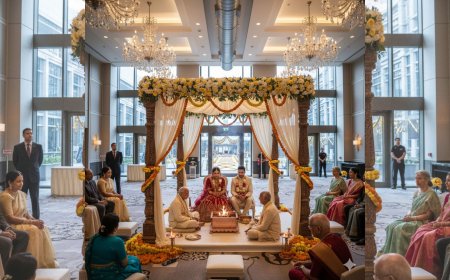
The threshold space needs the same attention as described in the Antarpat article — a clear, decorated entry point that is identifiably the threshold, with enough space for the bride's mother to stand and perform the Aukshan with the full circular motion without being crowded by guests or family members. Arrange for the threshold space to be kept clear in the minutes before the groom's arrival so the bride's mother has the full ceremonial space she needs.
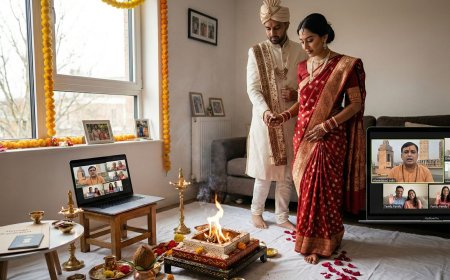
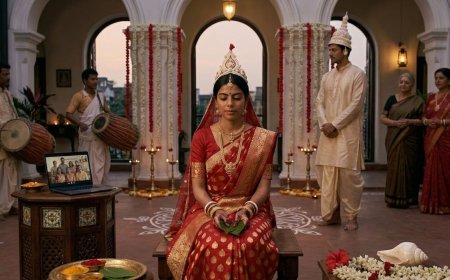
For streaming to family in India, the Aukshan is one of the most photogenic and emotionally immediate ritual moments to share — the five flames in the bride's mother's hands, the groom's face above them, the light and shadow of the threshold moment. Position your streaming camera slightly to one side of the threshold so it captures both the bride's mother's face and the groom's face simultaneously, with the five flames between them. This angle produces the most complete visual narrative of the Aukshan. Begin the stream at least fifteen minutes before the groom's arrival so your India-side family is present and settled before the moment begins. If your wedding is at midday in Toronto (EST), your family in Pune will be watching at 10:30pm — brief them the night before and confirm they have set their alarms.
Doing Aukshan as a Destination Wedding in Maharashtra
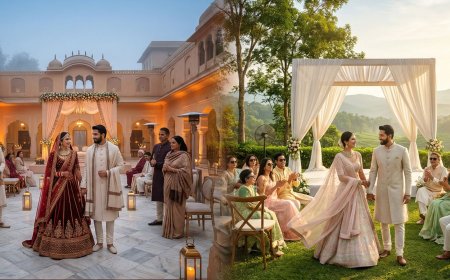
To perform Aukshan in Maharashtra — at the carved wooden threshold of a traditional wada in Pune's Kasba Peth, or at the entrance of a mandap overlooking the Nashik valley, or at the stone doorway of an ancestral family home in the Konkan — is to perform it in the light that shaped it. The sesame oil lamp catches the Maharashtra morning light in a specific way. The five flames look different against a background of carved teak and terracotta than they do against hotel wallpaper.
The most resonant destination wedding settings for a full traditional Aukshan in Maharashtra are the heritage wadas of Pune's old city — Kasba Peth, Sadashiv Peth, and Narayan Peth — whose elaborate carved wooden thresholds are among the most architecturally appropriate settings for a threshold ceremony in the world. The farmhouse and resort properties of the Nashik valley offer equally beautiful settings with natural light and open-air mandap structures. The Konkan coast — Ratnagiri, Sindhudurg, and Guhagar particularly — offers the dramatic backdrop of the Western Ghats and the Arabian Sea for families with Kokanastha roots who want to marry in the landscape their tradition came from.
For non-Indian guests at a Maharashtra destination wedding, the Aukshan is one of the most immediately beautiful ritual moments to witness — five small flames in a woman's hands at a threshold, the light moving in slow circles, the silence of a family gathered to watch the first act of consecration — requires no cultural explanation to be felt. Brief your international guests anyway, because understanding that those five flames represent five cosmic principles, and that the woman holding them is the mother of the bride, and that she is saying with fire what she cannot say with words, transforms witnessing into participation.
What You Need: The Aukshan Ritual Checklist
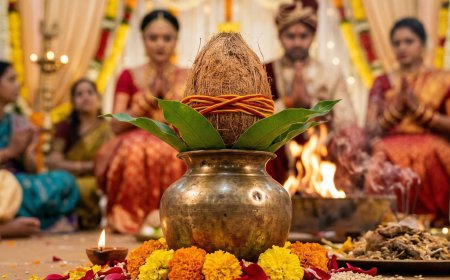
Ritual Items A brass or silver puja thali (large enough to hold five diyas comfortably — source from Indian puja stores or bring a family heirloom), five small clay diyas (matka diyas — buy a packet of at least ten to have spares), sesame oilor pure desi ghee for the wick fuel, pure cotton wicks (available as pre-made wick rolls at Indian stores), kumkum(vermillion powder) for the tilak and thali rangoli decoration, chandanam (sandalwood paste) for the tilak, akshata(turmeric-dusted rice) for showering, fresh flowers for the thali decoration (marigold petals and rose petals traditional), a small amount of dahi (curd) if your family tradition includes the toe-washing gesture, a clean white cloth for the threshold floor beneath the thali, and a small matchbox or lighter for lighting the diyas (carried discreetly by a family member assisting the bride's mother).
People Required The bride's mother as the primary and non-delegable performer of the Aukshan (her role is the most important human element of the entire ritual), senior female relatives of the bride's family to stand in witness at the threshold, the officiant pandit if mantras are to be chanted during the Aukshan (in some family traditions the Aukshan is performed silently by the mother; in others the priest chants the welcoming verses), the groom and his accompanying family positioned correctly for the threshold arrival, a designated family member to provide the two-minute arrival warning to the bride's mother so the diyas can be lit in time, and your wedding photographer and videographer briefed specifically that the Aukshan — the bride's mother's face above five flames — is the single most important portrait capture of the entire wedding day.
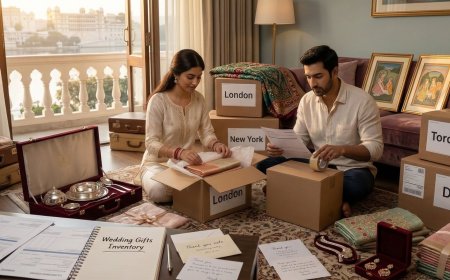
Preparation Steps Source all thali items at least two weeks before the wedding. Prepare and practise the thali layout the evening before — the bride's mother should arrange the five diyas in their positions, prepare the kumkum rangoli pattern on the thali, and measure the akshata and chandanam so there is no fumbling on the day. Soak the cotton wicks in sesame oil the evening before so they are saturated and light immediately on the day. Brief the groom's family on the arrival timing and threshold sequence at least one week before. Brief the photographer on the Aukshan as the priority portrait capture at least one week before. Set up the threshold space at least two hours before the ceremony. Test the India video call connection thirty minutes before the groom's arrival.
NRI.Wedding connects Maharashtrian couples abroad with verified pandits experienced in the full Aukshan sequence, puja item suppliers, and wedding photographers who understand that the five flames in a mother's hands is the most important portrait of the wedding day. Begin planning at NRI.Wedding.
5 Questions NRI Couples Always Ask
Our venue says no open flames anywhere in the building. Can we still do Aukshan meaningfully?
Yes, and the solution is simpler than most families fear. Electric tealight candles — the warm-white LED variety rather than the cold blue ones — produce a visual effect remarkably close to a lit oil diya, particularly when photographed. Place five electric tealights in your clay diyas (they fit perfectly in the diya's well) and the thali looks, from the distance of the assembled family, essentially identical to the traditional version. The one element that is genuinely lost is the fragrance of burning sesame oil or ghee — which is a real loss for a ritual where scent is part of the experience. The workaround is to prepare a small amount of sesame oil with a cotton wick in a covered container and open it briefly near the threshold to release the fragrance, even without the flame. This sounds fussier than it is — it takes thirty seconds and it restores the olfactory dimension of the ritual that the electric candles cannot provide. Discuss the electric candle approach with your pandit and confirm it is acceptable within your family's tradition.
My mother-in-law wants to perform the Aukshan jointly with the bride's mother. Is this traditional?
In the traditional Maharashtrian sequence, the Aukshan is performed by the bride's mother alone — it is specifically her ritual, her threshold moment, her act of welcoming the groom as a son. The groom's mother has her own corresponding ritual moments in the wedding sequence. However, in the NRI context where both families are deeply invested in every ritual moment and where the desire to create inclusive, shared experiences is strong, many contemporary families and pandits support a joint Aukshan in which the groom's mother stands beside the bride's mother at the threshold — not holding the thali, but present in witness, perhaps adding the tilak after the bride's mother has completed the Aarti. This inclusive approach is increasingly common in NRI Maharashtrian weddings and is warmly accepted by most family elders when the bride's mother's primary role is clearly maintained. Discuss the specific arrangement with your pandit and both mothers in advance so the threshold moment is choreographed rather than improvised.
How do we make the Aukshan meaningful for our non-Indian guests who have never attended a Maharashtrian wedding?
The Aukshan is one of the most naturally accessible Maharashtrian wedding rituals for non-Indian guests because its gesture — a mother bringing light to welcome the person her child has chosen — is immediately legible across every cultural tradition in the world. Include a brief description of Aukshan in your wedding ceremony booklet or website: what the five flames represent, what the tilak means, what the bride's mother is saying with her hands and her light. On the day, arrange for your MC or a family member to give a warm, brief English explanation of the ritual immediately before the groom arrives at the threshold — two minutes of context transforms your international guests from polite observers into moved witnesses. Many non-Indian guests who have witnessed Aukshan describe it as the most beautiful single moment of the entire wedding — and several have specifically cited the bride's mother's face above the five flames as the image they carry with them longest.
We want the Aukshan to be part of our outdoor ceremony but it has been raining. How do we protect the flames?
Wind and rain are the natural enemies of outdoor Aukshan flames, and they require specific planning if your ceremony is outdoors in a climate like the UK, Canada, or Australia where weather is unpredictable. The most practical solution is a wind-protected temporary shelter at the threshold — a fabric canopy or even a large umbrella held by a family member on the windward side can protect the flames sufficiently for the two to three minutes of the Aukshan ceremony. If rain is forecast, move the threshold ceremony to just inside the venue entrance — even one metre inside a doorway is typically sufficient to protect small clay diya flames from wind and rain. The electric candle option described above is also entirely appropriate for outdoor weddings in changeable weather. Brief your event coordinator on the weather contingency plan at least one week before and confirm the threshold location backup.
My partner's non-Indian family is curious about why the bride's mother specifically performs this ritual and not both mothers together. How do we explain the significance?
The answer that resonates most completely across cultural contexts is this: the Aukshan belongs to the bride's mother because it is specifically her act of welcoming — of receiving the groom into the family she has built, through the threshold she has maintained, with the light her household has always kept burning. In the Maharashtrian understanding, the bride's mother is the gruhalakshmi (the Lakshmi of the home, the keeper of the household's abundance and auspiciousness), and the threshold is her domain. For her to welcome the groom at her threshold with her own hands and her own flames is the most complete expression of her authority and her love — the authority of a woman who has kept this home and the love of a mother who is now opening it to its next chapter. The groom's mother has her own domain and her own moments in the wedding sequence. This one belongs to the bride's mother alone. Tell your partner's family: this is not exclusion. This is precision. Every person in this ceremony has their moment. This one is hers.
The Emotional Angle
Nobody tells the bride's mother what the five flames feel like in her hands.
She has attended enough Maharashtrian weddings to have watched other mothers carry this thali. She has seen the faces of women she knows — women as capable and practical and unsentimental as herself — transformed by the act of standing at a threshold with five small lights and welcoming a man as a son. She has thought, at those other weddings, that she understood what they were feeling. She was wrong. You cannot understand it from the outside. You understand it only when it is your thali and your threshold and your child's wedding.
She prepared the thali herself this morning. She drew the kumkum rangoli on the brass plate the way she has seen it drawn at every family wedding since she was small, the pattern transferred from memory rather than instruction. She placed the five clay diyas in their positions. She soaked the wicks in sesame oil the night before because she did not want to be fumbling with saturated wicks on the morning of her child's wedding, because she plans for things, because planning for things is how she loves.
And now she is at the threshold. The five flames are burning in her hands. The groom's procession is approaching. She can hear them — the family, the music, the specific sound of a group of people moving toward something important.
He appears at the entry point. He is wearing the sherwani they chose together — she and her child, on a video call that lasted two hours and covered seventeen options. He looks the way her child described him when they first told her about him — serious in a way that suggests someone who takes things seriously that deserve to be taken seriously.
She raises the thali. She begins the Aukshan — the slow, deliberate, clockwise circle of the five flames before his face. The light moves between them. She can see his face in the glow of the lamps and he can see hers and in this specific, suspended, luminous moment she understands what the ritual is for.
It is not for him. It is not for the assembled family or the pandit or the tradition. It is for her. It is a moment in which she is given permission — by the tradition, by the ritual, by the weight of the thali in her hands — to say with light what she has been trying to find words for since the day her child told her: I have found someone.
The five flames say: I see you. I welcome you. I am bringing all the light this household has to your threshold. Be worthy of it.
The circle completes. She applies the tilak. She showers the akshata. The groom crosses the threshold.
She steps aside. The wedding begins.
She does not cry until the eighth verse of the Mangalashtaka. This is impressive restraint. She is very proud of herself.
A Moment to Smile
At a Maharashtrian Brahmin wedding in Melbourne, Australia, in the winter of 2022, the Aukshan was set up perfectly — the brass thali gleaming, the five diyas burning cleanly, the bride's mother positioned at the threshold with the composure of a woman who has been ready for this moment for six months.
The groom arrived. The family gathered. The bride's mother raised the thali and began the first clockwise circle of the Aukshan.
At which point the venue's smoke detector, positioned directly above the threshold and apparently calibrated for extreme sensitivity, registered the five clay diyas as a fire event and emitted three sharp warning beeps.
The bride's mother did not lower the thali. She did not pause the circle. She completed the first rotation with the serenity of a woman who has raised three children and negotiated a venue contract and survived a global pandemic and is not going to be interrupted by a smoke detector.
A family member reached the detector panel in approximately fifteen seconds and silenced it.
The bride's mother completed all three circles. Applied the tilak. Showered the akshata. The groom crossed the threshold.
"Five flames," she said to her daughter afterward, at the reception. "Not four. Not three. Five. The detector can take it up with Ganesha."
The photographer captured all three circles. The photographs are extraordinary.
Quotes from the Diaspora
"I have performed Aukshan for three of my children's weddings. Each time, I think I know what I will feel. Each time, I am wrong. The flames are the same. The thali is the same. The circle is the same. But each child is different, and each groom is different, and each time I raise those five lights I am saying something specific to the specific person in front of me. You cannot prepare for that. You can only show up with your thali ready." — Vandana Kulkarni, Deshastha Brahmin community, Fremont, California
"My son married a woman from Ireland. Her mother stood beside me at the threshold and watched me perform the Aukshan. She did not understand a word of what the pandit was chanting. Afterward she said to me: 'I don't know what just happened, but I cried.' I said: 'That is exactly what is supposed to happen.' We have been friends since that moment. The five flames introduced us properly." — Sunanda Joshi, Kokanastha Brahmin community, mother of the groom, London, UK
"Our venue in New Jersey said no open flames. We used electric tealights. My mother was skeptical. She prepared the thali the same way she always has — the kumkum rangoli, the chandanam, the akshata — and placed the electric lights in the diyas. When she raised the thali at the threshold, the photographer said it was the most beautiful thing he had photographed all year. My mother said: 'The light is what matters. Not the fuel.' She was right. She is always right about these things." — Priya Deshpande, Saraswat Brahmin community, New Jersey, USA
Your Roots Travel With You
Your mother soaked the cotton wicks in sesame oil the night before the wedding because she planned for things and planning was how she loved. She drew the kumkum rangoli on the brass thali from memory — the pattern her own mother drew at every family wedding — in a hotel suite in Melbourne that smelled briefly and completely of sesame oil and sandalwood and the specific combination of things that means a Maharashtrian wedding is beginning.
She stood at the threshold. The five flames burned in her hands. And when she raised the thali and began the first circle — when the light moved in the air between her and the man your child had chosen, the light of five cosmic principles asked to witness this crossing — she was not in a Melbourne venue with industrial carpeting and a smoke detector above the door.
She was at every threshold she had ever stood at in her life, in every home she had ever kept, carrying every flame she had ever lit, bringing all of it to this specific moment for this specific person.
The circle completed. The tilak was placed. The akshata fell.
The groom crossed the threshold. The wedding began.
NRI.Wedding is here for every flame of that journey — from finding your Maharashtrian pandit to sourcing your brass thali and clay diyas, from planning your threshold ceremony to connecting you with photographers who know that the bride's mother's face above five flames is the most important portrait of the wedding day.
Your roots traveled with you. Tonight, they burned in five small flames and lit the way home.
This article explores Aukshan, the sacred lamp welcoming ceremony for the groom at the heart of Maharashtrian Hindu weddings across Deshastha, Kokanastha, and Saraswat Brahmin traditions, its Vedic and Panchopasana philosophical roots, the five-lamp symbolism, and complete practical guidance for Maharashtrian NRI couples planning the ritual in the US, UK, Canada, UAE, and Australia — and as a destination wedding in Maharashtra.
What's Your Reaction?
 Like
0
Like
0
 Dislike
0
Dislike
0
 Love
0
Love
0
 Funny
0
Funny
0
 Angry
0
Angry
0
 Sad
0
Sad
0
 Wow
0
Wow
0