





























































The Songs That Carry the Wedding Home: Biya Naam in Assamese Hindu Weddings
Biya Naam — the ancient tradition of ceremonial folk songs sung by women at every sacred threshold of an Assamese Hindu wedding — is not performance. It is the wedding's living voice, its emotional spine, and its oldest irreplaceable language. Rooted in the Vaishnavite devotional tradition of Srimanta Sankardeva and carried across oceans by NRI Assamese families in London, Toronto, Dubai, Sydney, and Houston, this oral tradition exists nowhere except in the throats of the women who remember it. This complete guide covers the Juron geet, Tel geet, Biya geet, and Bidaai geet traditions, community music comparisons across Indian regions, and full practical advice for NRI Assamese couples preserving and performing authentic Biya Naam at home or as destination weddings in Guwahati, Jorhat, and Majuli.


Biya Naam — the ancient tradition of ceremonial folk songs sung by women at every threshold of an Assamese Hindu wedding — is not performance. It is the wedding's living voice, its emotional spine, its oldest and most irreplaceable language. For NRI Assamese families in London, Toronto, Houston, Dubai, and Sydney, preserving this oral tradition across oceans is not nostalgia — it is the fiercest possible act of cultural survival, because Biya Naam exists nowhere except in the throats of the women who remember it.
You grew up hearing it at the edge of sleep. Your mother, your mahi [maternal aunt], your aita [grandmother] — gathered in the kitchen or the courtyard or the living room of whatever house your family was building a life in, singing something that sounded like it came from a place older than memory. You didn't always know the words. You knew the feeling. You knew that when those voices rose together in that particular way, something sacred was being tended.
Now you are planning your Assamese wedding. In Toronto. In Slough. In some suburb of Melbourne where the jacaranda trees are beautiful and entirely wrong and nothing smells like the Brahmaputra in the early morning. And you are realising, with a specificity that surprises you, that what you want most is not the venue or the flowers or the photographs — though you want those too. What you want is the songs. Your aita's songs. The ones she learned from her mother who learned them from hers, going back to an Assam that exists now only in those voices and in the muscle memory of the women who carry them.
This is Biya Naam. And it is irreplaceable. And it is still here.
🌟 Did You Know?
- Biya Naam [wedding songs] in Assamese tradition form one of India's most complete and least-documented oral ceremonial music traditions. Unlike classical Indian music systems that have been transcribed, codified, and taught in institutions, Biya Naam exists almost entirely in oral transmission — passed from mother to daughter, from elder women to younger, across generations without written notation. This makes the diaspora preservation of Biya Naam one of the most urgent and most beautiful cultural conservation challenges in the NRI Assamese community.
- The songs of Biya Naam are not generic wedding music — they are a precise ceremonial map. Specific songs are assigned to specific ritual moments: there are songs for the Juron [ceremonial welcome of guests], songs for the Tel Diya [oil and turmeric application], songs for the Biya [main wedding ceremony], songs for the groom's arrival, songs for the bride's departure, and songs for the morning after. An experienced elder woman who knows the complete Biya Naam repertoire knows the wedding ceremony as thoroughly as the priest — she knows exactly which song belongs to which threshold.
- In Assamese cultural understanding, a wedding performed without Biya Naam is considered spiritually incomplete — not in a formal theological sense, but in the lived community sense that matters more in Assamese tradition. The absence of women's ceremonial songs is understood as the absence of the community's blessing, which is why NRI Assamese families go to extraordinary lengths — flying elderly aunts across continents, recording grandmothers in Guwahati, rehearsing with cousins over video call for months — to ensure Biya Naam is present at every wedding, wherever in the world it is held.
What Is Biya Naam?
Biya Naam [from Assamese biya meaning wedding and naam meaning song or name — in this context, ceremonial song] is the tradition of women's ritual folk singing that accompanies every significant threshold of an Assamese Hindu wedding from the pre-wedding preparations through to the post-wedding celebrations. The songs are sung by the women of the family and community — not professional musicians, not hired performers, but the mothers and aunts and grandmothers and sisters and neighbours whose presence at a wedding is understood as inseparable from their voices.
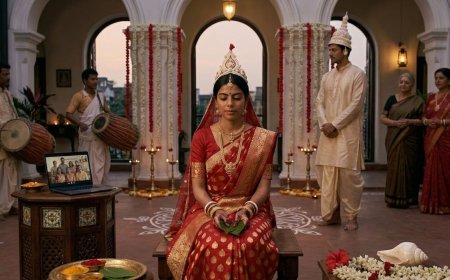
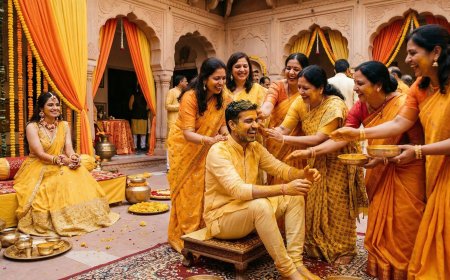
The Biya Naam tradition encompasses multiple categories of songs, each with specific ceremonial assignments. Juron geet [welcome songs] are sung when distinguished guests or the groom's party arrive at the bride's home — these songs are formal acts of welcome, their specific melodies and lyrics constituting a sacred greeting that transforms arrival into ceremony. Tel geet [oil songs] accompany the Tel Diya ritual in which turmeric and mustard oil are applied to the bride and groom — these songs are often more playful and teasing in character, reflecting the relative informality of the pre-wedding ritual space. Biya geet [main wedding songs] accompany the core ceremony, their tone becoming more solemn and more emotionally weighted as the ceremony progresses toward the moments of greatest spiritual significance. Bidaai geet [farewell songs] are sung as the bride leaves her natal home — and these are the songs that carry the most grief, the most love, and the most complete understanding of what it means to be a woman moving from one family into another.
The instruments that traditionally accompany Biya Naam are minimal — the dhol [double-headed drum], the taal [bronze cymbals], and sometimes the pepa [a traditional Assamese wind instrument made from buffalo horn]. But the instruments are secondary. The voices are primary. Biya Naam is, at its core, the sound of women bearing collective witness to one of their own crossing a threshold — and in that witnessing, blessing her passage.
The Biyanaam [the collective term for the women who sing] are not a chorus hired for the occasion. They are the wedding's living community — and their songs are understood as the most direct form of blessing available, because they come not from scripture or from priestly authority but from the accumulated love and lived experience of women who have crossed this same threshold themselves.
Community Comparison Table
| Community / State | Local Name | Key Instruments | Song Categories | How NRIs Abroad Adapt It |
|---|---|---|---|---|
| Assamese Hindu (Brahmin/Koch/Kalita) | Biya Naam | Dhol, taal, pepa | Juron geet, Tel geet, Biya geet, Bidaai geet | Elder women of family lead singing; recordings from Guwahati used as backup; rehearsals over video call months before |
| Assamese Hindu (Bodo community) | Biya Naam / Bodo wedding songs | Sifung [bamboo flute], kham [drum], serja | Distinct Bodo ceremonial song tradition; nature imagery central | Bodo community networks in diaspora cities assist with cultural preservation |
| Bengali Hindu | Biye Gaan / Aiburo Bhaat songs | Dhak, shanai, harmonium | Welcome songs, Gaye Holud songs, Bidaai songs | Bengali community associations active in London, Toronto, Dubai; women's singing groups preserve tradition |
| Odia Hindu | Biya Gita / Mangala Gita** | Dhol, mahuri, tasha | Auspicious songs at each ritual threshold; Mangala Gita at ceremony | Odia community networks assist with song preservation; recordings from Bhubaneswar used |
| Punjabi Hindu/Sikh | Ghorian / Suhaag | Dhol, harmonium | Ghorian [songs for groom's departure], Suhaag [bride's songs], Sithanian [teasing songs] | Large Punjabi diaspora ensures live performance possible in most diaspora cities |
| Rajasthani | Badhawa / Panihari geet | Dholak, harmonium, sarangi | Welcome songs, water-fetching songs, farewell songs; desert imagery central | Rajasthani folk music groups active in diaspora; recordings widely available |
| Marathi | Ovya / Mangalashtak | Harmonium, tabla | Ovya [women's grinding songs adapted for wedding], Mangalashtak [auspicious verses] | Marathi community associations in Toronto and London support cultural preservation |
| Tamil Brahmin | Lali / Mangala Isai | Nadaswaram, tavil | Temple-derived auspicious music; specific compositions per ritual | Tamil Sangams in every major diaspora city maintain music traditions |
| Gujarati | Garba / Wedding Geet | Dhol, harmonium, clapping | Garba [circle dance songs], specific wedding folk songs | Gujarati community infrastructure strongest in diaspora; full music traditions preserved |
| Himachali | Nati songs / Wedding Pahadi** | Dhol, nagara, shehnai | Mountain folk songs specific to wedding thresholds; Nati dance accompaniment | Himachali community networks in diaspora cities; Nati dance groups preserve tradition |
| Kashmiri Pandit | Wanwun | Harmonium, tumbaknaer | Specific KP women's wedding songs; distinct melody tradition | KP Sabhas in London and Toronto actively preserve Wanwun tradition |
| Goan Hindu (GSB) | Mando / Dulpod | Guitar, violin, ghumot | Konkani ceremonial songs; Mando at formal moments, Dulpod at celebrations | GSB Sabha networks support cultural preservation; recording archives available |
The Meaning Behind the Ritual
In Assamese cultural philosophy, the voice is the most direct medium through which human love reaches the divine. This is not a poetic metaphor — it is a lived theological position. The Vaishnava [devotional] tradition that deeply shapes Assamese Hindu culture, as articulated through the work of the great saint-reformer Srimanta Sankardeva in the fifteenth and sixteenth centuries, understands devotional singing as the highest form of worship available to ordinary human beings. The Naam [sacred song] is not just music — it is prayer in its most embodied form.
Biya Naam draws directly from this tradition. When the women of a family gather to sing at a wedding, they are not entertaining guests — they are performing an act of Bhakti [devotional love] on behalf of the bride and groom. They are asking the divine, through the medium of their own voices and their own love, to be present at this threshold and to bless the crossing. The specific songs assigned to specific moments carry this devotional intention in their very structure — their melodic patterns, their specific lyrical images, their rhythmic shapes are all designed to create the particular vibrational atmosphere that each ritual moment requires.
The Bidaai geet [farewell songs] sung as the bride leaves her natal home deserve particular attention. These songs do not attempt to suppress grief or to reframe departure as celebration. They acknowledge, with full directness, that a daughter is leaving — that the house will be different, that the mother's arms will be emptier, that a particular quality of ordinary daily life is ending. This honesty is not cruelty. It is the community's gift to the bride — the acknowledgement that what she is leaving behind was real and was loved, so that she can enter her new life without the weight of unexpressed grief.
For a non-Indian partner or guest: "The women singing are not the entertainment. They are the community's voice — blessing the couple, witnessing the threshold, and saying with their songs everything that cannot be said in any other way."
Performing Biya Naam Abroad: The Practical Reality
For NRI Assamese families, Biya Naam presents the most distinctively challenging preservation task of any element in the Assamese wedding — because unlike ritual items that can be sourced, or purohits who can be found through community networks, Biya Naam lives in specific people. In specific voices. In the specific elder women of your family and community who learned these songs from their mothers and have been carrying them ever since.
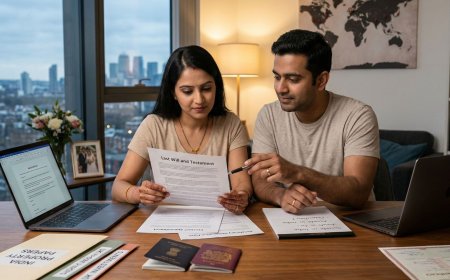
The first and most important task for NRI Assamese couples planning a wedding abroad is a Biya Naam audit — an honest assessment of who in your family knows the songs, how complete their repertoire is, and whether they are able to travel to your wedding city. This conversation should happen minimum twelve months before the wedding. If your aita [grandmother] in Guwahati knows the complete song sequence and is willing and able to travel, this is your most precious wedding resource — more valuable than any vendor you will book. If she cannot travel, the next task is a recording project: visiting her in Guwahati, or connecting via video call across multiple sessions, and recording every song she knows with their ceremonial assignments clearly noted. This recording then becomes the foundation of your diaspora Biya Naam — played at the correct moments, supplemented by whatever live singing your diaspora family members can contribute.
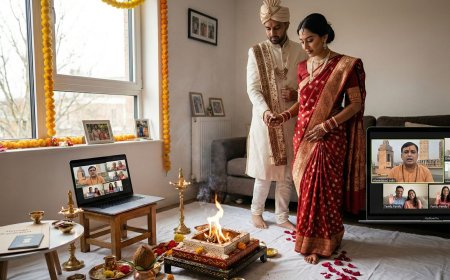
For rehearsing Biya Naam abroad, the community video call rehearsal has become one of the most moving and practically effective tools in the NRI Assamese wedding toolkit. Gather the women of your family — in Toronto, in London, in Guwahati, in wherever your family is scattered — on a video call three to six months before the wedding and begin learning the songs together. The elder women in Guwahati teach, the younger women in the diaspora learn, and what might have been lost in one generation is recovered in a single series of Sunday evening calls. Several NRI Assamese families have reported that these rehearsal calls became some of the most meaningful pre-wedding experiences of the entire planning process.
In London, the Assamese community concentrated in and around Harrow, Wembley, and East London has a small but culturally active presence. The Assamese Society of UK is your primary contact for community connections, including identifying elder women who know Biya Naam and may be available to guide your ceremony. In Toronto, the Assamese Association of Ontario maintains active community networks. In Houston, the significant Assamese professional community in the Texas South Asian network has informal but reliable cultural preservation connections. In Dubai, the Assamese community within the broader Indian professional diaspora in the UAE has active social and cultural networks. In Sydney, the Assamese community in Western Sydney and the broader South Asian network are your starting points.
For instruments, the dhol and taal required for Biya Naam accompaniment are available through South Asian music supply stores in most diaspora cities — in London at specialist stores in Southall, in Toronto through South Asian music retailers in Brampton, and through online South Asian instrument suppliers that ship internationally. A community dhol player who knows Assamese rhythmic patterns is harder to source but achievable through community networks — a general South Asian dhol player can learn the basic patterns with sufficient lead time and a reference recording.
For coordinating with Guwahati, Assam is IST (GMT+5:30). A 3 PM ceremony in London gives Guwahati a comfortable 8:30 PM viewing window. For Toronto, a 5 PM ceremony means a 3:30 AM Guwahati connection — and yes, your aita will be awake for it. Position your streaming microphone to capture the women's voices clearly — the sound is the entire experience for relatives joining remotely, and a poor audio setup at this moment is the one technical failure that cannot be forgiven.
Biya Naam at a Destination Wedding in Assam
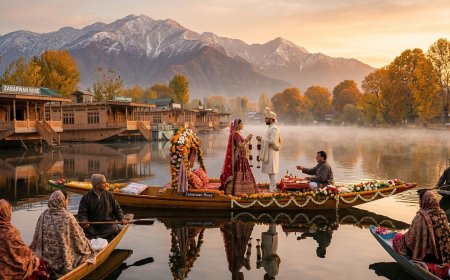
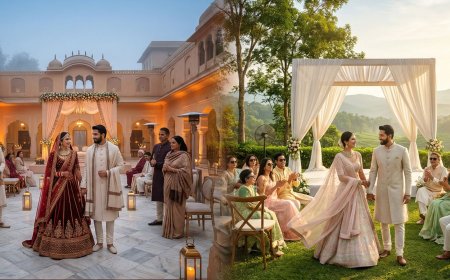
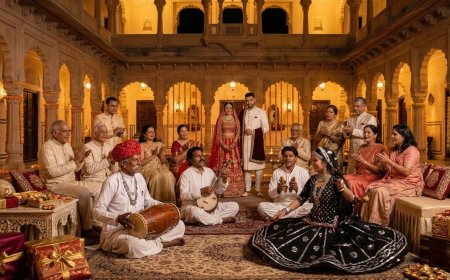
Returning to Assam for a destination wedding is to return to the source of everything Biya Naam is. Guwahati — the gateway city of the northeast, with the Kamakhya Temple on Nilachal Hill overlooking the Brahmaputra — offers wedding venues where Biya Naam arrives not as a preserved tradition but as a living one, where the elder women of the extended family gather without being asked and begin singing because this is simply what they do when a wedding happens.
Jorhat, the cultural heartland of Assam with its deep Vaishnavite tradition and its strong heritage of Sattriya [classical Assamese performing art] culture, offers a wedding atmosphere of extraordinary cultural richness. Majuli — the world's largest river island and the epicentre of Assamese Vaishnavite culture — is for couples seeking an utterly distinctive and deeply sacred destination wedding setting, one where the musical traditions that underlie Biya Naam are still practiced daily in the Satras [Vaishnavite monasteries].
For destination weddings in Assam, brief your local coordinator — or NRI.Wedding's Assam planning contacts — on your family's specific Biya Naam tradition well in advance. The songs vary by community, by region within Assam, and by family tradition — a Koch Rajbongshi family's Biya Naam differs from a Brahmin family's, which differs from a Kalita family's. Specificity matters. Ask your elder family members which songs belong to your specific tradition and share this with your coordinator.
For non-Indian guests at an Assam destination wedding, Biya Naam is often the element they describe most vividly and most emotionally afterward. There is something about a circle of women singing in a language you don't speak, at a moment of obvious sacred significance, with tears on some faces and laughter on others — something that communicates directly to the most ancient human understanding of what community means. No translation is needed. Some things are already in the body.
What You Need: Ritual Checklist
For Live Biya Naam: Elder women of the family who know the complete or partial song repertoire, identified and confirmed minimum six months before the wedding. Younger family women who have rehearsed the songs, ideally through a structured pre-wedding learning process. A dhol player familiar with Assamese rhythmic patterns. Taal [cymbals] sourced from South Asian music suppliers. A designated Biya Naam coordinator who knows which song belongs to which ceremony moment and can cue the singers at the correct time.
For Recorded Biya Naam Support: High-quality recordings of authentic Assamese Biya Naam — ideally recorded from your own family's elder women, supplemented by archival recordings of traditional Assamese wedding songs. A high-quality speaker system positioned at the ceremony space. A designated audio coordinator briefed on which recording plays at which ritual moment. Your purohit's confirmation that the recording sequence aligns with the ceremony's ritual flow.
Preparation Steps: Conduct Biya Naam audit with family minimum twelve months before. Begin video call rehearsal sessions with family women minimum six months before. Record elder family members' complete repertoire if they cannot travel. Source dhol and taal through community music networks or specialist suppliers. Designate Biya Naam coordinator and provide written ceremony song sequence. Test audio setup and recording quality 24 hours before. Position streaming microphone for clear voice capture.
NRI.Wedding connects Assamese couples with community cultural organisations, Biya Naam recording archives, and ceremony coordinators across London, Toronto, Dubai, Sydney, and Houston who understand that the songs are not the decoration — they are the wedding itself. Visit our vendor directory to begin.
5 Questions NRI Couples Always Ask
None of the women in our immediate diaspora family know Biya Naam. Is it too late to learn?
It is never too late, and the process of learning is itself part of the gift. Begin with your elder family women in Assam — your aita, your mahi, your mother's sisters — and ask them to teach you over video call. Even learning three or four songs specific to the most important ritual moments is infinitely more valuable than no live Biya Naam at all. The Assamese Association in your diaspora city may also be able to connect you with elder community women who know the tradition and would be honoured to share it for your wedding. And if you learn only the Bidaai geet [farewell song] — learn that one. It is the most important.
My partner is not Assamese and finds the concept of women's ceremonial singing unfamiliar. How do we explain its significance?
Tell them this: the women singing are not background music. They are the community speaking directly to the bride and groom at the most important moments of their lives — blessing them, witnessing them, and saying with songs what cannot be said in any other way. Tell them that the songs have been passed down through women's voices for longer than any written record confirms. And then let the singing begin and trust that the sound will do what explanation cannot. No one who has heard Assamese women sing the Bidaai geet has ever needed it explained afterward.
We want to include the Bidaai geet but are worried about how emotional it will make the ceremony. Is there a way to manage this?
With the greatest possible respect — do not manage it. The Bidaai geet is supposed to make people cry. It is specifically designed to give the grief of the bride's departure a form so beautiful that it becomes bearable. Suppressing the emotion suppresses the song's entire purpose. Brief your photographer to be in position for this moment. Brief your non-Indian guests in your ceremony guide that this is a song of loving farewell and that tears are the correct response. And then let the women sing, and let the room feel what it needs to feel. This is exactly what the song is for.
Can we incorporate Biya Naam into a civil ceremony registration or is it only appropriate for the Hindu religious ceremony?
Biya Naam is cultural rather than strictly religious in its function — it is the community's voice at a threshold, not a theological requirement of the Hindu ceremony specifically. Many NRI Assamese families have beautifully incorporated Biya Naam into civil ceremony celebrations, pre-wedding parties, and reception events as well as the formal religious ceremony. The songs are appropriate wherever the community gathers to witness and bless the couple — the threshold does not have to be a religious one for the songs to do their work.
Our aita knows all the songs but is too frail to travel from Guwahati. How do we include her meaningfully?
Record her. Go to Guwahati — or send a trusted family member with a good phone — and record every song she knows, with her speaking the ceremony assignment of each one before she sings it. This recording is your most precious wedding resource. Play it at the appropriate moments during the ceremony, with a note in your programme or a brief spoken introduction explaining who is singing and why she cannot be there in person. Many NRI Assamese families have done exactly this, and the moment when a grandmother's voice fills a room in Toronto or London or Dubai — singing the same songs she sang at her own children's weddings decades ago — is consistently described as the most emotionally powerful moment of the entire celebration. She is there. The voice is there. That is what matters.
The Emotional Angle
There is a specific kind of cultural grief that lives in NRI Assamese families that is rarely spoken about directly. It is the grief of an oral tradition — the understanding, felt rather than articulated, that certain things exist only in people, and that people are finite, and that when those people go, those things go with them unless someone makes an extraordinary effort to catch them first.
Biya Naam lives in this grief and transcends it simultaneously.
For the NRI Assamese mother who left Jorhat or Tezpur or some village in the Brahmaputra valley thirty years ago and raised her children in cities that could not pronounce Assam correctly — this woman has been the sole carrier of Biya Naam in her household for decades. She has sung fragments of the songs in the kitchen when she thought no one was listening. She has hummed the Bidaai geet at other people's weddings and pretended it was just a tune. She has wondered, in the quiet moments that diaspora parents are given, whether her children would ever know these songs. Whether the songs would end with her.
And then her daughter begins planning her wedding. And the daughter asks, with a specificity that surprises both of them: can we have Biya Naam? Can you teach me the songs?
And the mother, who has been carrying these songs alone for thirty years, sits down. And begins.
This is not just cultural preservation. This is a mother and daughter, across every ocean and every year of distance, finding each other again in the oldest language they share.
The songs were never lost. They were waiting. They are always waiting.
A Moment to Smile
At Priyanka and Callum's wedding in London last April, the Biya Naam had been prepared with extraordinary care — six months of Sunday evening video calls with the aunties in Guwahati, a WhatsApp group called "Biya Naam Practice DO NOT IGNORE" that had somehow remained active and functional, and a dhol player from Southall who had learned the Assamese rhythmic patterns from a YouTube tutorial and three sessions with Priyanka's mother.
The Juron geet [welcome songs] for Callum's arrival went beautifully. The Tel geet [oil songs] went beautifully, with the added bonus of Callum's mother joining in on the clapping after approximately forty-five seconds because the rhythm was simply irresistible.
Then came the moment when Priyanka's aita — eighty-three years old, who had flown from Guwahati specifically for this wedding in a decision her doctor had described as "medically inadvisable and spiritually inevitable" — stood up to lead the Bidaai geet.
She sang the first line. The room went silent in the way rooms only go silent for grandmothers.
She sang the second line. Priyanka, who had held herself together with remarkable composure all day, began crying.
She sang the third line. Callum, who had understood approximately eight words of Assamese in his entire life, began crying. He could not have explained why. Some things do not require explanation.
The aita finished the song, sat down, looked at Callum with great consideration, and said in Assamese — which Priyanka's mother translated immediately — "He'll do."
The room laughed for a long time. The aita accepted this as her due.
Quotes From the Diaspora
"I grew up hearing my mother hum fragments of Biya Naam in the kitchen in Toronto. I never asked her about it properly until I was planning my own wedding. When I asked her to teach me, she went very quiet for a moment. And then she said — I have been waiting for you to ask me this since you were born. We spent four months learning together. It was the best four months of my adult life." — Rimjhim Barua, Assamese Brahmin, Toronto
"My daughter-in-law's family is from Kerala. Beautiful people, completely different tradition. When our Assamese women began the Juron geet to welcome the groom's party, I watched his mother's face. She didn't understand a word. She was completely transfixed. Afterward she asked me what the songs were saying. I told her: we are welcoming your son into our family. We are saying he is ours now too. She cried. I cried. We understood each other perfectly." — Meera Hazarika, mother of the bride, Assamese Kalita community, Dubai
"We couldn't have live Biya Naam in Sydney — we simply didn't have enough women who knew the songs. We used my aita's recordings. When her voice came through the speakers at my Bidaai, singing the farewell song she had sung at my mother's wedding thirty years before, there was not a single person in that room who was not crying. My aita was in Guwahati watching on video call. She cried too. We were all crying together across twelve thousand kilometres. That is what Biya Naam does. It collapses every distance." — Pallavi Gogoi, Assamese Hindu, Sydney
Your Roots Travel With You
Biya Naam does not require the Brahmaputra's banks or Kamakhya's hills or a courtyard in Majuli where the Sattriya tradition has been alive for five hundred years. It requires women who remember, women who are willing to learn, and a bride who knows that the songs matter as much as the flowers.
NRI Assamese families are performing Biya Naam in living rooms in Toronto and hired halls in London and hotel ballrooms in Dubai — gathering around phones and laptops and speakers and each other, singing songs that their grandmothers sang and their grandmothers' grandmothers sang, in cities those grandmothers never imagined and in voices that carry everything those grandmothers entrusted to them.
NRI.Wedding supports Assamese couples with community cultural organisation connections, Biya Naam recording resources, ceremony coordinators, and photographers across London, Toronto, Dubai, Sydney, and Houston who understand that the most important sound at an Assamese wedding is not the music system or the DJ — it is the sound of women's voices doing the oldest work there is.
Find the women who know the songs. Learn what you can. Sing what you have. Let the rest be silence that honours what came before.
The songs are still here. They have always been here. Let them carry your wedding home.
This complete guide to Biya Naam covers the tradition of ceremonial folk songs in Assamese Hindu weddings, including Juron geet, Tel geet, Biya geet, and Bidaai geet traditions, comparisons with Bengali, Odia, Punjabi, Kashmiri Pandit, and other Indian regional song traditions, and practical advice for NRI Assamese families in London, Toronto, Dubai, Sydney, and Houston preserving and performing authentic Biya Naam at home or as destination weddings in Guwahati, Jorhat, and Majuli.
What's Your Reaction?
 Like
0
Like
0
 Dislike
0
Dislike
0
 Love
0
Love
0
 Funny
0
Funny
0
 Angry
0
Angry
0
 Sad
0
Sad
0
 Wow
0
Wow
0