
















































Matching or Complementary? The NRI Bride's Complete Guide to Bridesmaid Outfit Coordination for Indian Weddings
Six bridesmaids in six countries, all interpreting dusty rose differently — this is the bridesmaid coordination reality that most NRI brides discover too late to fix. This guide delivers a complete framework for designing a bridesmaid look that is visually cohesive, practically achievable across international distances, and genuinely flattering for the diverse group of women standing beside you. From the matching versus complementary decision and the multi-event outfit planning to skin tone and body type considerations, brief-writing strategy, and the four coordination models that work for real NRI bridesmaid groups — plan the bridesmaid look with the same clarity you bring to every other element of your wedding.


Bridesmaid Outfit Coordination: Matching vs. Complementary
The NRI bride's guide to dressing the women beside her — without the group WhatsApp drama, the body image complications, or the six months of negotiation that nobody planned for
The Matching Lehengas Arrived in Seven Different Shades of Pink
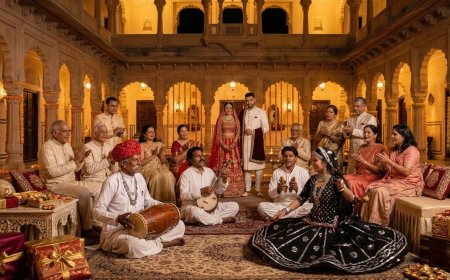
The brief had seemed simple enough when it was communicated. Dusty rose lehengas, midi length, minimal embellishment. The bride had sent a single reference photograph. Six bridesmaids in six countries had each sourced their own outfits with the understanding that they were all working toward the same color.
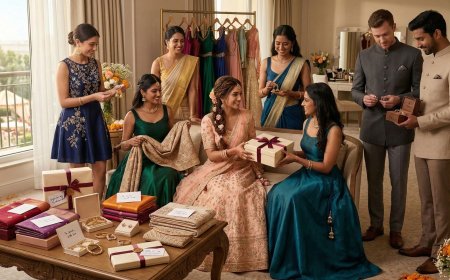
The photograph taken when all seven women stood together for the first time at the mehendi revealed what a single reference photograph and six independent shopping decisions produce: seven distinct interpretations of dusty rose, ranging from a pale ballet pink at one end of the spectrum to a deep mauve at the other, with every possible variation in between. The embellishment levels varied from genuinely minimal to enthusiastically embellished. Two of the lehengas were clearly a different silhouette from the others. One was technically a salwar suit.
Nobody said anything explicit. The photographer positioned them carefully and the photographs are beautiful. But the coordinated bridesmaid look the bride had imagined — the cohesive visual statement of the women beside her, the Instagram-worthy lineup that she had been picturing since the engagement — did not exist in the form she had envisioned.
The gap between the bridesmaid coordination vision and the bridesmaid coordination reality is one of the most consistently underestimated planning challenges of the entire NRI wedding. It involves more variables, more remote coordination logistics, more competing preferences and body types and budgets, and more potential for inadvertent hurt feelings than almost any other element of the wedding aesthetics. And it begins with a single foundational decision that shapes everything else: matching or complementary.
The Question Behind the Question
Before the color conversation, the style conversation, the budget conversation, and the twelve-person group chat, there is a more fundamental question that every bride needs to answer clearly before she communicates anything to her bridesmaids: what is the purpose of the bridesmaid look at your specific wedding?
This is not a decorative question. It is a design question with practical consequences. The purpose of the bridesmaid look determines whether matching or complementary is the right approach, what level of coordination is achievable and appropriate, and how much creative control the bride should retain versus delegate to the individual women involved.
If the purpose is visual cohesion in photographs — a specific, controlled aesthetic statement in the images that document the wedding — matching or near-matching produces the most reliable result, requires the most centralized coordination, and demands the most specific brief.
If the purpose is celebration of the specific women beside the bride — honoring their individuality, making each one feel beautiful and comfortable in her own way — complementary coordination with room for personal expression produces a better result and a better experience for the bridesmaids, at the cost of some photographic uniformity.
If the purpose is a beautiful visual backdrop to the bride's own look — a coordinated setting that makes the bride stand out rather than a homogeneous group that competes with her — both approaches can serve this, but the specific color and embellishment choices need to be made with this purpose explicitly in mind.
Most brides want some combination of all three. The decision about which to prioritize determines which approach serves the wedding best.
The Case for Matching
The matching bridesmaid look — all bridesmaids in the same outfit, or the same color and silhouette with minor individual variations — is the approach with the most straightforward execution logic and the most consistently photogenic result when it is done correctly.
What Matching Actually Achieves
A genuinely matched bridesmaid look, where every woman is wearing the same specific color in the same general silhouette, creates a specific visual statement in wedding photographs that no amount of complementary coordination replicates. The lineup photograph — six or eight or ten women in the same deep teal, the same blush pink, the same mustard yellow — has a visual power that comes from its uniformity. It reads as designed, considered, and deliberate. It creates a backdrop that makes the bride stand out precisely because the background is visually unified.
Matching also simplifies certain decisions that complementary coordination complicates. There is no negotiation about whether one bridesmaid's navy reads as complementary or as discordant with another's cobalt. There is no moment in the photographs where one woman's outfit choice visually disrupts the overall composition. The design decision is made once, executed uniformly, and produces consistent results.
The Challenges Matching Creates
The matching approach front-loads the coordination challenge. Someone has to source the same outfit in multiple sizes and ship or coordinate delivery across multiple countries — because the defining characteristic of matching is that everyone is actually wearing the same thing, and the defining challenge of matching is that sourcing the same thing for six women in six countries, in sizes that actually fit six different bodies, is a logistical exercise that is significantly more complex than it appears.
For NRI bridesmaid groups — which almost universally involve women in multiple countries — centralized sourcing is the only reliable matching solution. The bride sources all outfits, ships them internationally, and manages the fit and alteration questions that arise. This is a significant logistical undertaking that requires early initiation, budget clarity, and the specific patience of managing international garment shipping for multiple recipients.
Matching also creates the specific sensitivity of asking women with different body types, different skin tones, and different personal style sensibilities to wear the same thing. A color and silhouette that is flattering and comfortable for one bridesmaid may genuinely not serve another. The matching approach, at its most rigid, subordinates individual comfort and flattery to visual uniformity — a trade-off that is worth making deliberately rather than accidentally.
The Case for Complementary
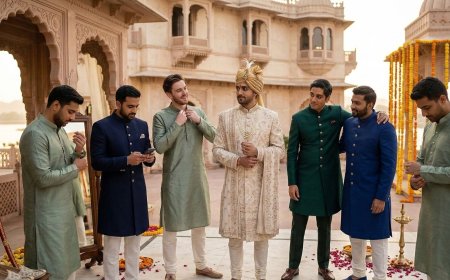
Complementary bridesmaid coordination — a shared color palette or a shared aesthetic theme within which individual bridesmaids make their own choices — is the approach that most respects individual bridesmaid autonomy and produces the most universally comfortable outcomes across a diverse group of women.
What Complementary Actually Achieves
A well-designed complementary approach — where the bridesmaids share a color family, a fabric type, or an embellishment level, and make their own choices within that framework — produces photographs that are visually cohesive without being uniform. The lineup reads as designed and intentional because the shared palette creates visual harmony, while the individual variations create visual interest and reflect the reality that these are distinct individuals rather than visual props.
Complementary coordination also distributes the creative and logistical burden much more evenly. Rather than the bride managing all sourcing centrally, each bridesmaid takes responsibility for finding an outfit that meets the brief. This is more manageable for the bridesmaids — they choose their own silhouette, their own fabric, their own embellishment level within the agreed parameters — and significantly less logistically complex for the bride.
The bridesmaids who feel best in their outfits are the ones who chose those outfits for themselves within a framework the bride established. A woman who chose her own blush salwar in a silhouette that suits her body and a fabric she loves is a bridesmaid who looks visibly comfortable and happy in every photograph. A woman who is wearing the same heavily embroidered midi lehenga as everyone else, in a color and silhouette that is not her best, looks visibly less at ease.
The Challenges Complementary Creates
The gap between the complementary coordination brief and the complementary coordination outcome is where the pink lehenga situation described at the opening of this article lives. A brief that is too open — "wear something in the blue family" — produces results as varied as the individuals interpreting it, and the degree of visual cohesion in the photographs depends entirely on how similarly six or eight different women interpret the same color family.
The complementary approach requires a more detailed, more specific brief than the matching approach — because the matching brief relies on the sameness of the garments to produce coherence, while the complementary brief relies on the quality of the instructions to produce coherence from difference.
A brief that specifies the color family precisely — "dusty rose to antique mauve, avoiding anything that reads as hot pink or purple" — with visual reference images that demonstrate the specific range, fabric guidance that ensures the outfits photograph with similar weight and texture, silhouette guidance that produces a similar overall line even across different garment styles, and embellishment level guidance that prevents one bridesmaid's heavily embellished lehenga from visually dominating a group of minimally embellished outfits — this brief produces complementary coordination that is genuinely cohesive.
A brief that simply names a color and trusts the bridesmaids to interpret it produces the seven shades of pink situation.
The Indian Wedding Bridesmaid Landscape: Specific Considerations
Indian wedding bridesmaid coordination has specific dimensions that Western bridesmaid coordination does not encounter — dimensions that affect both the approach and the execution.
The Multi-Event Reality
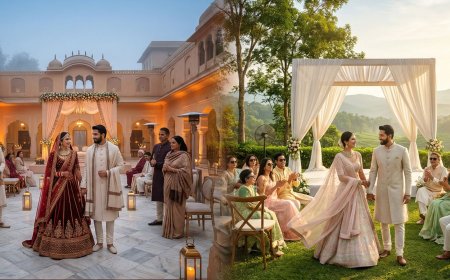
An NRI wedding typically involves multiple events — mehendi, haldi, sangeet, ceremony, reception — each with different aesthetic requirements and different formality levels. The bridesmaid coordination question is not a single decision but a sequence of decisions, because the same outfits rarely work appropriately across multiple events of different character.
Some brides coordinate bridesmaids across all events — different outfits for different occasions, all within a coordinated aesthetic framework. Others focus coordination on specific high-photography events — the mehendi and the ceremony — and leave other events to individual bridesmaid discretion. The scope of the coordination decision is worth defining early, because bridesmaids planning their own travel and shopping need to know which events require coordinated outfits before they can make complete plans.
The Indian Outfit Category Decision
Before color, before silhouette, before embellishment — the most fundamental bridesmaid outfit decision at an Indian wedding is the garment category. Lehenga, saree, salwar suit, sharara, and the growing range of Indo-Western options are all potential bridesmaid choices, and the decision about which category to coordinate within shapes everything else.
The lehenga is the most formal and most photographically impactful option — the structured, embellished silhouette reads as specifically ceremonial and creates the strongest visual statement in group photographs. It is also the most expensive and the most logistically complex to source in multiple sizes internationally.
The salwar suit is the most practical and the most size-flexible — a well-chosen salwar suit in the right color and fabric can be beautiful at a wedding without the cost and complexity of a lehenga, and the silhouette accommodates a wider range of body types with more universal flattery. For NRI bridesmaid groups where budget varies significantly between individuals — a reality in most real bridesmaid groups, regardless of how uncomfortable that reality is to acknowledge — the salwar suit category allows the coordination vision to be achieved at a more accessible price point.
The saree is the most culturally resonant choice and the most variable in terms of execution difficulty — bridesmaids who are not skilled saree drapers wearing sarees at a multi-hour event will spend the day managing a garment that is not cooperating, which is visible in photographs and genuinely uncomfortable to experience. If sarees are the chosen bridesmaid category, the cost of a professional draper for all bridesmaids on the wedding day is a genuine logistical consideration.
The sharara — the wide-leg trouser silhouette that is currently one of the most popular choices in the Indian bridal fashion market — is a contemporary option that photographs beautifully and accommodates a wider range of body types than the fitted lehenga silhouette, while retaining the embellished, specifically Indian character appropriate for a wedding.
The Skin Tone Reality
One of the most specific challenges of Indian wedding bridesmaid color coordination is the range of skin tones typically present within an Indian bridesmaid group — a range that is broader than is often acknowledged and that has significant implications for which colors serve all bridesmaids well and which serve some significantly better than others.
The colors that work most universally across the full range of Indian skin tones: deep jewel tones — emerald, sapphire, ruby, plum — which create contrast and visual presence against both lighter and darker skin tones. Deep coral and terracotta, which are warm-spectrum colors that tend to flatter warm-toned complexions across a wide range of depths. Deep teal and peacock blue, which have a similar range of complementary effectiveness.
The colors that create more variable results: pastels and very light tones, which can wash out darker skin tones while looking beautiful on lighter ones, creating visible inconsistency within a matched group. Very warm oranges, which can look extraordinary on some Indian skin tones and less flattering on others. Muted, desaturated tones — the dusty rose, the sage, the taupe — which require specific skin undertone compatibility to work well and that can look beautiful on some bridesmaids and muddy on others.
The most thoughtful bridesmaids color decisions account for this range explicitly — choosing colors that are genuinely flattering across the skin tone range present in the specific bridesmaid group rather than colors that are aesthetically appealing in the abstract.
The Body Type Conversation Nobody Wants to Have
The bridesmaid outfit coordination conversation almost universally avoids the body type conversation — because it is uncomfortable, because it feels unkind, and because the cultural framework around Indian women's bodies is complicated enough that adding explicit discussion of body shape to the wedding planning process feels like one complication too many.
The result of avoiding it: a matching brief that works beautifully for three of the six bridesmaids and creates a genuinely uncomfortable wearing experience for the other three. And the specific photograph taken at the wedding where the discomfort is visible on the faces of the women whose bodies are not being served by the outfit they are wearing.
The kindest approach to body type in bridesmaid coordination is to build flexibility into the brief that allows each bridesmaid to make the choice that works for her body without requiring explicit conversation about whose body needs what. A complementary brief that specifies color and fabric but leaves silhouette to individual choice allows each bridesmaid to select the silhouette — the garment shape, the sleeve length, the neckline, the waist placement — that suits her body best. A matching brief that allows individual variation in blouse construction accommodates the reality that the same lehenga skirt with individually fitted blouses serves more body types than the same complete outfit in a standard construction.
Building the Brief: What You Actually Need to Communicate
Whether the approach is matching or complementary, the brief communicated to bridesmaids needs to be specific enough to produce coherent results without being so controlling that it removes all individual choice and creates resentment.
The Effective Brief Elements
Color specification with visual reference: A color name alone is insufficient — "dusty rose" encompasses an enormous range of interpretations. A color specification accompanied by three to five photographs that demonstrate the specific range you are working within — the warmest acceptable version of the color, the coolest acceptable version, the saturation level — gives bridesmaids a visual framework rather than a verbal one. Color is inherently visual and briefs that attempt to convey it only verbally produce the seven shades of pink outcome.
Fabric guidance: The fabric choice significantly affects how bridesmaids read as a coordinated group. A mix of georgette, net, raw silk, and velvet in the same color will not read as coordinated because the different fabrics produce different weights, textures, and visual densities. Specifying the broad fabric category — lightweight and flowing, structured and embellished, matte rather than sheen — creates visual consistency across individually chosen outfits that color alone cannot produce.
Embellishment level guidance: One heavily embellished bridesmaid in a group of minimally embellished ones disrupts the visual cohesion of group photographs more than a color variation does. Specifying the embellishment level — minimal, moderate, no mirror work, avoiding heavy stonework — creates consistency that is as important as color.
What to avoid: The negative brief — what you do not want — is often as important as the positive brief. Colors to avoid, silhouettes to avoid, fabric weights to avoid, embellishment styles to avoid. These negative specifications prevent the interpretive errors that produce coordination failures more reliably than the positive specifications prevent them.
The budget reality: If the bride is not paying for bridesmaid outfits — which for most NRI weddings with international bridesmaid groups is the reality — the budget expectation needs to be communicated explicitly and early. A brief that implicitly assumes a budget that some bridesmaids cannot meet produces either financial strain or an outfit that does not meet the brief, both of which are avoidable with early honest communication.
The Coordination Models: A Practical Framework
Model One — Full Matching, Centrally Sourced
The bride sources and purchases all bridesmaid outfits centrally, ships them to individual bridesmaids, and manages all fit and alteration questions. This is the highest-control, highest-logistics, highest-cost model, and the one that produces the most visually uniform result.
Appropriate for: brides for whom photographic uniformity is the highest priority and who have the budget, time, and logistical capacity to manage central sourcing across multiple countries.
Timeline requirement: minimum four to six months before the wedding to allow for sourcing, alteration, international shipping, and any corrections.
Model Two — Same Color Family, Same Category, Individual Sourcing
Bridesmaids source their own outfits within a clearly specified color family and garment category — all lehengas in the teal-to-midnight-blue range, for example — with detailed guidance on fabric and embellishment level. The bride reviews photographs of planned outfits before purchase to confirm they meet the brief.
Appropriate for: brides who want visual cohesion without central logistical management, and who trust the detailed brief to produce sufficiently aligned results.
Timeline requirement: minimum three to four months to allow bridesmaids to source within the brief and for the review-and-approval process to catch and address any significant deviations.
Model Three — Coordinated Palette, Any Category
Bridesmaids wear any garment category — lehenga, salwar, saree, sharara — within a coordinated color palette with shared fabric and embellishment level guidance. The result is a group that reads as aesthetically coordinated without being uniform.
Appropriate for: brides with diverse bridesmaid groups where body type, cultural background, and personal preference vary significantly, and where individual comfort and self-expression are explicitly prioritized alongside visual cohesion.
Timeline requirement: minimum two to three months with photograph review.
Model Four — Aesthetic Theme, Full Individual Choice
Bridesmaids dress within a broad aesthetic theme — traditional Indian, contemporary Indo-Western, a specific cultural or regional aesthetic — without specific color coordination. The visual coherence comes from shared cultural aesthetic rather than shared color.
Appropriate for: brides whose priority is celebration of the individual women beside them rather than a specific photographic aesthetic, and who are genuinely comfortable with visual variety in bridesmaid group photographs.
Timeline requirement: as early as possible to allow individual planning, but less dependent on coordination timeline than the other models.
The Conversation That Makes the Process Work
The bridesmaid outfit coordination conversation is, fundamentally, a conversation about the relationship between the bride's vision and the individual experiences of the women being asked to participate in it. The most successful bridesmaid coordination experiences share a specific quality: the bride communicates her vision clearly and specifically, while genuinely remaining open to the feedback and constraints of the individual women involved.
The bridesmaids who feel most beautiful, most comfortable, and most genuinely honored to be beside the bride at her wedding are the ones who felt that their experience was considered in the process — not just their visual function. The ones who were asked whether the budget worked for them before the brief was finalized. The ones who had a conversation about the outfit before it was decided rather than receiving a directive that assumed compliance. The ones who were invited to flag any concern — physical, financial, personal — before the planning was too far advanced to accommodate it.
This is the quality of consideration that produces both beautiful photographs and genuinely joyful bridesmaids. And joyful bridesmaids produce better photographs than perfectly coordinated ones who are quietly uncomfortable.
Brief them clearly. Hear them honestly. And then dress them in a way that makes them feel as beautiful as the woman they are standing beside.
NRIWedding.com — Expert guidance for Indian weddings planned across borders.
What's Your Reaction?
 Like
0
Like
0
 Dislike
0
Dislike
0
 Love
0
Love
0
 Funny
0
Funny
0
 Angry
0
Angry
0
 Sad
0
Sad
0
 Wow
0
Wow
0