










































































Getting Your Wedding Outfits There in One Piece: The NRI Couple's Complete Guide to Packing and Transporting Delicate Indian Wedding Clothing
The lehenga that arrived with crushed zardozi. The sherwani that spent six hours folded in checked luggage. The dupatta whose embellished border caught and pulled on the fabric beneath it. Transport damage to Indian wedding outfits is specific, often preventable, and devastating to discover close to the wedding day. This guide gives NRI couples a complete framework covering pre-packing condition assessment, garment-by-garment packing techniques, carry-on versus checked luggage strategy, customs declaration guidance, shipping alternatives, and the on-arrival inspection and steaming protocol that catches and addresses any damage with maximum time to spare.

Destination Wedding Packing: Transporting Delicate Wedding Outfits
The NRI couple's practical guide to getting every wedding outfit — the lehenga, the sherwani, the sarees, the accessories — from wherever you are to wherever you are getting married, intact, uncreased, and ready to wear
The Lehenga Arrived. The Embroidery Did Not.
It was not a catastrophic loss. The lehenga itself was undamaged — the silk intact, the color exactly as it had been in the designer's atelier in Mumbai four months earlier. What had happened was more specific and more disheartening: a section of the three-dimensional zardozi embroidery on the front panel — the raised, wire-worked gold embroidery that the designer had described as the centerpiece of the piece — had been crushed flat by the pressure of six hours in a checked bag.
The embroidery was not broken. It was not missing. It had been compressed by weight and time into a flatness that its original three-dimensionality made visibly wrong. The loops of gold wire that should have caught and reflected light from multiple angles were now lying flat against the fabric, reflecting nothing.
A skilled tailor in Hyderabad spent four hours with a blunt needle and infinite patience, working the embroidery back toward its original state. The result was ninety percent of what it had been. Ninety percent is not the same as one hundred percent when the embroidery is the centerpiece of the most important outfit of your life.
The packing decision that caused this was not carelessness. It was a gap in knowledge — the bride had not known that three-dimensional embroidery crushed under weight rather than simply creasing, that this damage was different from fabric creasing in that it was harder to reverse, or that there was a packing technique specifically designed to prevent it.
This guide is that knowledge, provided before the packing begins.
Why Wedding Outfit Transport Is a Distinct Category of Packing
The transport of everyday clothing involves the same general principles as the transport of wedding clothing — fold carefully, avoid sharp creases, use garment bags for items that should not be folded. But wedding outfits, and particularly Indian wedding outfits, sit in a completely different category of transport challenge for reasons that everyday clothing does not encounter.
The embellishment density of Indian bridal and groom wear — the zardozi, the kundan settings, the mirror work, the three-dimensional stonework, the sequin embroidery — creates fragility that flat fabric does not have. Embellishments catch on each other. Three-dimensional elements compress under weight. Stonework can be dislodged by impact. Sequin work can scratch adjacent fabric surfaces during movement.
The volume of Indian wedding outfits creates physical packing challenges that standard luggage is not designed for. A heavily embroidered bridal lehenga with a full skirt, a matching blouse, and a dupatta is not a small package. A complete groom's sherwani with churidar and dupatta is similarly voluminous. Transporting the outfits for both bride and groom across a multi-event wedding weekend, plus the accessories and the remaining trousseau, requires a packing strategy that addresses volume as deliberately as it addresses fragility.
The multi-leg travel that most NRI couples undertake to reach their Indian wedding venue — flights, transfers, ground transport — creates multiple handling points at which something can go wrong. Each handling point is a risk. A packing strategy that reduces risk at each point rather than assuming safe handling produces significantly better outcomes.
The Pre-Packing Preparation That Changes Everything
The Condition Assessment
Before packing begins, assess every outfit that needs to be transported in its current condition. Note any existing fragilities — a loose stone that needs to be re-set, a seam that is slightly stressed, an embellishment that is not fully secured. Have these addressed before packing rather than discovering them on the other end of the journey. A loose stone that was hanging on at the time of packing may not be there after the journey.
The Cleaning and Preparation Decision
Transport any outfit that may have been tried on, worn to a fitting, or been in storage for several months in the cleanest possible state. Oils from skin contact, perfume residue, and storage-related dust or discoloration are all significantly harder to address after they have been set by the heat and pressure of a packed suitcase during international travel. A professional dry clean before packing ensures that the outfit arrives at the destination ready to wear rather than requiring a local dry cleaning solution in an unfamiliar city.
The Documentation Protocol
Before packing, photograph every outfit from every angle — front, back, both sides, and detail shots of every embellished section. These photographs serve two purposes: they provide evidence of the outfit's pre-transport condition in the event of damage that needs to be claimed through airline or insurance channels, and they provide a reference for the local tailor or dresser who may need to address any travel-related issues on the other end.
Photograph the accessories separately — jewelry laid flat, hairpieces, bangles, and other fragile accessories documented in the same way. A complete pre-packing photographic record takes thirty minutes and provides significant protection in the event of any transport-related issue.
The Packing Techniques: Garment by Garment
The Bridal Lehenga Skirt
The lehenga skirt — the voluminous, embellished lower garment that is typically the most elaborate and most fragile item in the entire bridal wardrobe — requires the most careful packing attention.
The fundamental principle for packing a heavily embellished lehenga skirt is to fold it in a way that puts embellishment against embellishment rather than embellishment against plain fabric or embellishment under compressive weight. This sounds counterintuitive — placing embellished surfaces together seems like it would cause them to catch and scratch — but embellishment against embellishment with tissue paper between them distributes any contact force across the embellished surface rather than concentrating it on individual elements against a flat, resistant fabric surface.
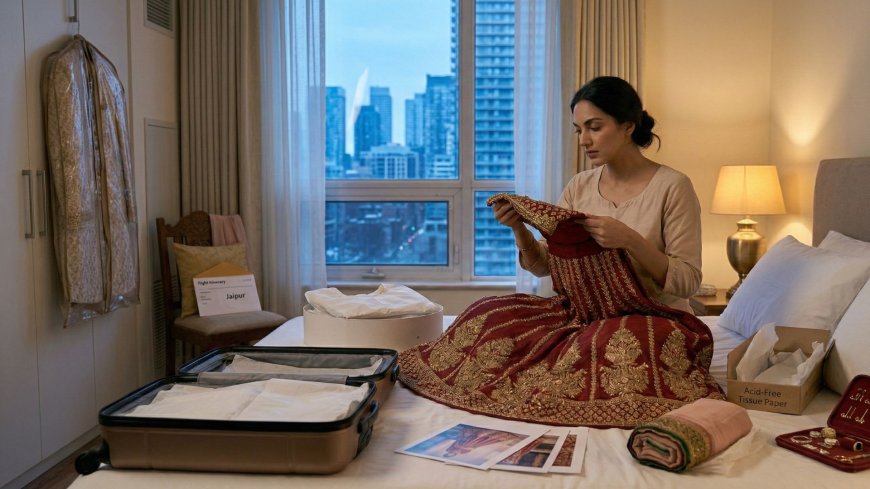
The tissue paper is non-negotiable. Acid-free tissue paper — the kind used by garment conservators and by good bridal boutiques for storage — creates a protective layer between fabric surfaces and between embellished sections that prevents the specific damage of embellishment catching, scratching, or compressing another surface.
The folding technique: lay the lehenga skirt flat on a clean surface. Begin placing crumpled tissue paper inside the embellished sections — particularly anywhere there is three-dimensional embroidery, raised stonework, or other non-flat embellishment. The crumpled tissue paper inside the embellished section supports the three-dimensional elements from within, preventing them from being compressed flat by the weight of the fabric above them. This is the specific technique that prevents the zardozi crushing situation described at the opening of this article.
Fold the skirt as few times as possible — every fold is a potential crease. For a full circular lehenga, this means accepting that the folded package will be larger than a minimally folded regular skirt, and planning the packing accordingly.
If the lehenga skirt can be rolled rather than folded — with the embellished surface on the outside of the roll rather than folded over itself, and the rolling done loosely rather than tightly — rolling often produces fewer creases than folding for certain fabric types, particularly net and lighter silks.
The Lehenga Blouse
The lehenga blouse is smaller and typically more densely embellished than the skirt, with stonework and embroidery concentrated on a small fabric surface. It is also the garment most likely to have sharp stone settings or wire embroidery elements that can scratch or snag other fabrics if not specifically protected.
Wrap the blouse in its own layer of tissue paper before placing it in contact with anything else. If the blouse has particularly sharp or protruding embellishments — heavy kundan settings, wire zardozi elements — wrap those specific sections in an additional layer of bubble wrap or foam padding within the tissue paper wrap.
Pack the blouse in a rigid box or structured container if one is available — the rigid structure prevents other items in the bag from placing direct weight on the embellishments. A hat box, a shoe box, or a small rigid travel container are all suitable rigid housing options for a heavily embellished blouse.
The Dupatta
The dupatta — the long embellished scarf that completes the lehenga set — is the most challenging item to pack due to its combination of large surface area, lightweight fabric, and often densely embellished borders that are vulnerable to crushing and snagging.
For dupattas with heavy border embellishments, the packing strategy mirrors the blouse approach: tissue paper between the embellished border and the fabric body, additional padding around the most three-dimensional border elements, and a folding technique that keeps the heavily embellished border sections from lying against each other without tissue protection.
For sheer dupattas — organza, net, or fine chiffon — the fabric itself is the fragility, as these fabrics crease in ways that are difficult to reverse without steaming and that are particularly visible because of the fabric's transparency. Minimize the number of folds, use the rolling technique if the dupatta is long enough to roll without the roll becoming unwieldy, and accept that some steaming on the other end may be necessary regardless.
The Sherwani
The groom's sherwani has different packing requirements from the bridal lehenga because the silhouette is structured rather than voluminous and the embellishment is typically concentrated on specific panels rather than distributed across the entire surface.
A structured garment bag — the kind with a rigid hanger section and a zippered body — is the ideal housing for a sherwani during transport. The garment hangs without folding, which prevents crease formation, and the garment bag structure provides a layer of protection against pressure from adjacent items in the same bag.
If a garment bag is being transported as carry-on luggage — which is the preferred option for the most valuable garments — many airlines will allow a garment bag to be hung in a cabin crew closet for the duration of the flight on request. This request is worth making at the check-in desk rather than at the boarding gate, as the availability of the crew closet is more easily confirmed early in the boarding process.
If the sherwani must be folded for transport — if a garment bag cannot be accommodated in carry-on — fold it with the embellished front panel facing outward and with tissue paper between the embellished sections. The churidar can be folded separately using standard suit trouser folding technique and packed alongside the sherwani.
Sarees
A saree's packing challenge is primarily about creasing rather than embellishment damage — though heavily embellished sarees have the same concerns as the lehenga about three-dimensional elements. A plain or minimally embellished saree in a fabric that creases easily — pure silk, thin georgette — requires a folding strategy that minimizes crease lines in the most visible sections of the drape.
The traditional Indian method of saree folding — folding in pleats along the length of the saree rather than in half — distributes the fabric in a way that creates multiple small folds rather than a small number of large crease lines. Large crease lines in the center of a saree's visible drape are significantly more difficult to remove than the distributed smaller folds of pleat-style folding.
The tissue paper principle applies to sarees with embellished borders — place tissue between the zari border and the body of the saree to prevent the metallic threads from catching and pulling at the lighter body fabric during the movement of transport.
The Luggage Strategy: What Goes Where
The Carry-On Rule for Irreplaceable Items
The single most important strategic principle in wedding outfit transport: the most irreplaceable item goes in the cabin with you.
For most brides, this is the bridal lehenga. For most grooms, this is the sherwani. The item that cannot be replaced, that took months to make, that carries the highest concentration of financial and emotional value — this item does not go in checked luggage under any circumstances if there is any possibility of it fitting in the cabin.
Airlines have specific policies about oversized carry-on items, about garment bags, and about the use of overhead compartments for non-standard items. Know these policies before you arrive at the airport. Some airlines permit a garment bag as a cabin item separate from the standard carry-on allowance. Others count it as the personal item or the carry-on. Contact the airline in advance — not the check-in desk on the departure day — to understand what is permitted and what the process is for requesting crew closet use for a garment bag.
For items that genuinely cannot be carried into the cabin due to size or airline policy constraints, the next best option is hand-delivery to the check-in desk with a specific request that the item be stored flat rather than placed in standard baggage handling, and that it be tagged as fragile. This does not guarantee flat storage or careful handling, but it creates a documented request that is relevant in the event of a damage claim.
Checked Luggage Hierarchy
For items that go into checked luggage, a hierarchy of placement within the bag affects the likelihood of damage.
Place the most fragile items — particularly anything with three-dimensional embellishment — at the top of the checked bag rather than at the bottom. Checked bags are typically handled in ways that keep the same orientation, but they are also stacked in cargo holds with other bags above them. An item at the top of the bag has less of your own bag's weight compressing it and is positioned to receive less weight from items stacked above in the cargo hold.
Never pack heavy items — shoes, toiletry bags, non-essential accessories — in the same bag as delicate wedding outfits. The weight migration during baggage handling places unpredictable pressure on everything in the same bag. Dedicate one bag to the wedding outfits specifically and keep that bag as free from heavy companions as possible.
Use a hard-shell suitcase rather than a soft-shell for the bag containing the most delicate items. Hard-shell cases provide a structural barrier against external compression that soft-shell cases do not. The hard shell does not prevent internal damage from items shifting against each other, but it prevents the specific damage of external weight or impact compressing the entire bag contents.
The Separate Shipping Option
For NRI couples whose total outfit and trousseau volume significantly exceeds their airline luggage allowance, or whose most fragile items are genuinely too large or too fragile to travel safely in standard luggage, professional shipping is a serious option worth planning for rather than a last resort.
Specialist garment shipping services — and the growing category of NRI wedding trousseau shipping services — provide packaging, collection, transit, and delivery of bridal clothing to the destination venue with a level of care and insurance coverage that standard luggage handling does not provide. The cost is significant but finite and predictable, and it eliminates the specific anxiety of the journey with irreplaceable items in luggage whose handling you cannot control.
If shipping is planned, initiate it at least four to six weeks before the wedding — international shipping timelines are not always reliable, and customs clearance for garments of significant value can introduce delays. Confirm that the destination venue has a suitable receiving and storage arrangement before committing to a shipping delivery.
Customs and Declaration: What You Need to Know
Wedding outfits carried across international borders are subject to the customs regulations of the destination country. For NRI couples traveling to India for their wedding, outfits purchased abroad and carried into India may be subject to duty assessment. For couples traveling from India to another country for their wedding, the same applies in reverse.
The general principle: wedding clothing is typically treated as personal goods for personal use, which in most countries qualifies for relief from import duties. However, the specific rules, the duty-free value thresholds, and the documentation requirements vary by country and by the specific circumstances of travel.
The practical approach: declare honestly and carry documentation of the value of what you are transporting. A customs officer who sees a bridal lehenga and the purchase receipt for its declared value is in a different conversation from one who suspects underdeclaration. The documentation that supports your declaration — receipts, designer invoices, bank transaction records — is worth having organized and accessible rather than buried in a bag.
For items of very high value — jewelry in particular, but also significant bridal outfits — travel insurance that specifically covers the declared value of the items during transit is worth investigating before the journey. Standard airline baggage liability limits are significantly lower than the replacement value of a high-end bridal outfit, and travel insurance that specifically covers bridal wear and jewelry fills this gap.
The On-Arrival Protocol: What to Do When You Get There
The Immediate Inspection
Within thirty minutes of arriving at your destination — before unpacking anything else, before showering, before sleeping — open every bag containing wedding outfits and conduct a visual inspection of every item.
This timing matters: any transport-related damage is most easily addressed with the maximum time available before the wedding. A crushed embellishment discovered three days before the wedding is manageable. The same damage discovered on the morning of the wedding is a crisis.
Work through the inspection methodically — the lehenga skirt, the blouse, the dupatta, the sherwani, the sarees, the accessories. Compare against the pre-packing photographs if anything looks uncertain. Note anything that requires attention: creases that need steaming, embellishments that need attention, any item that requires professional pressing.
The Steaming Protocol
Most crease-related transport damage is reversible with steaming — but the approach to steaming varies by fabric and by the nature of the damage.
Do not iron Indian bridal wear. The direct heat and pressure of an iron on embellished fabric is genuinely destructive — it can flatten embroidery, melt synthetic embellishments, scorch delicate fabrics, and create irreversible damage in attempting to solve the reversible problem of creasing. Steam, applied from a distance through a fabric that is hanging freely, is the correct tool.
A garment steamer — which produces a directed flow of steam without contact pressure — is the ideal tool for bridal outfit crease removal. Many hotels provide steaming services, and if the steaming is to be left to hotel services, specifically request a steamer rather than pressing, and watch the process if possible to ensure it is done correctly.
For heavy embellished items where steam cannot be safely applied directly, hanging the garment in a steamy bathroom — running a hot shower and hanging the garment in the steam-filled room — is a gentler alternative that works well for fabric creases even if it is less effective for very deep crease lines.
The Local Tailor Arrangement
For any transport damage that requires more than steaming — crushed three-dimensional embroidery, a displaced stone, a seam that has stressed during the journey — having a local tailor arrangement in place before you arrive is the difference between a manageable problem and a crisis.
Ask your wedding planner, your venue coordinator, or family members who know the wedding city to identify a skilled tailor who is available in the days before the wedding for exactly this purpose. A tailor who can be reached with twenty-four hours' notice and who has experience with embellished bridal wear is a specific resource worth confirming in advance rather than searching for under pressure on arrival.
The Mindset That Makes the Journey Possible
The transport of irreplaceable, beautifully made, emotionally significant wedding outfits across international journeys involves an unavoidable element of managed anxiety — there is no packing strategy that eliminates all risk, and the combination of valuable items and unpredictable handling produces a specific quality of concern that most couples describe as one of the more stressful elements of the wedding travel experience.
The preparation in this guide does not eliminate that concern. It reduces the probability of specific, preventable outcomes and maximizes the chance of successful recovery in the event that something does not go as planned. The documentation, the inspection protocol, the local tailor arrangement — these are not preparations for failure but preparations for resilience.
What the preparation cannot provide is certainty. The certainty that the embroidery arrives intact, that the steamer at the destination hotel is working, that the customs officer waves the bags through without a detailed inspection, that everything is exactly as it was in the designer's studio by the time you put it on.
What it can provide is the knowledge that you have done everything within your control to give these outfits the best possible journey. And the confidence that if something does not go perfectly, you have the documentation, the contacts, and the protocol to address it without losing the morning of your wedding to panic.
Pack well. Inspect immediately. Have the steamer ready.
And then put the outfit on and let it do what it was made to do.
NRIWedding.com — Expert guidance for Indian weddings planned across borders.
What's Your Reaction?
 Like
0
Like
0
 Dislike
0
Dislike
0
 Love
0
Love
0
 Funny
0
Funny
0
 Angry
0
Angry
0
 Sad
0
Sad
0
 Wow
0
Wow
0