

























































The Voice That Holds the Evening Together: The NRI Couple's Complete Guide to Hiring a Professional Emcee for Your Indian Wedding
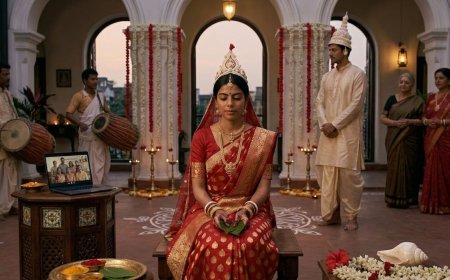
The reception that felt like a single coherent emotional experience and the reception that felt like a sequence of events happening in the same room. The difference was not the food, the florals, the music, or the venue. It was the person holding the microphone. The professional emcee at an NRI wedding is not an announcer who reads the programme — they are the invisible architecture within which everything else the couple has invested in is received. This guide delivers a complete framework covering what a great emcee actually does across orientation, programme management, cultural translation, emotional pacing and contingency management, the NRI wedding's specific requirements for dual cultural fluency, finding and auditioning candidates, the questions that matter, the briefing process across story, guest, programme and cultural briefs, the hybrid approach for couples who want a beloved friend involved, and the real-time communication protocol on the night.

Hiring Professional Emcees and Hosts for Your Indian Wedding
The NRI couple's complete guide to the person whose voice shapes the entire evening — understanding what a great emcee actually does, why the choice matters more than most couples realize, and how to find, brief, and work with the professional host who serves this specific occasion
The Evening That Held Together and the Evening That Did Not
Two weddings. Same city. Same month. Similar guest counts. Similar venues. Similar budgets.
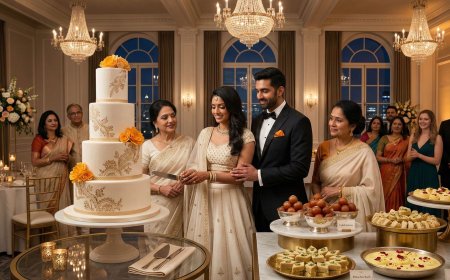
The first wedding's reception had a professional emcee — a woman the couple had found through their wedding planner, who had hosted Indian wedding events for eleven years, who had spent three hours with the couple in the month before the wedding understanding their story, their families, their specific guests, and the specific arc they wanted the evening to follow.
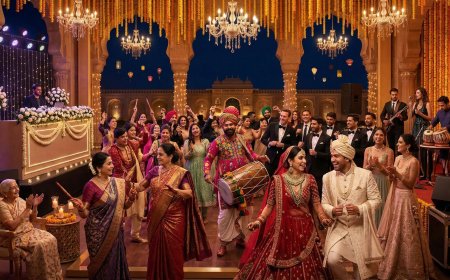
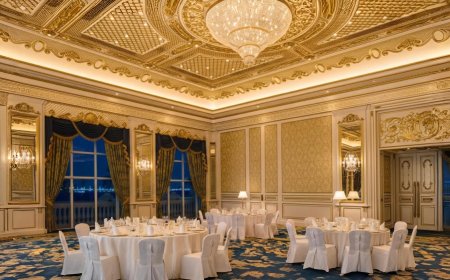
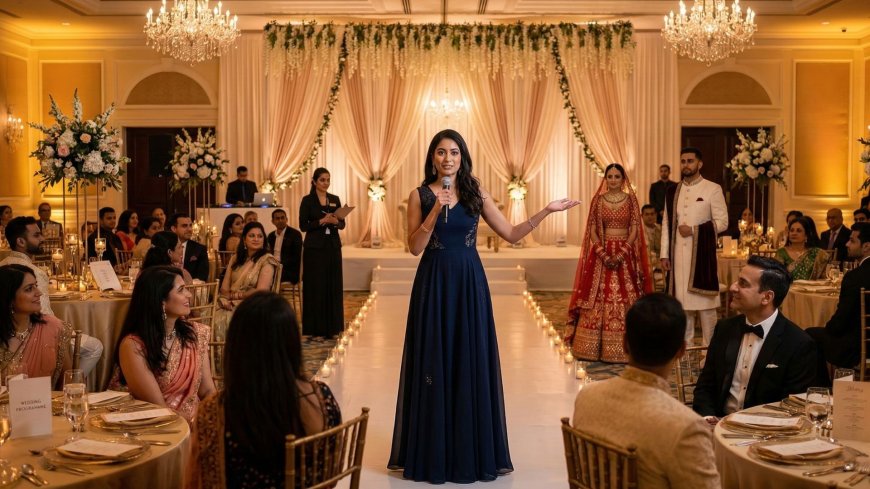
She opened the reception with a two-minute welcome that made three hundred people feel simultaneously greeted and oriented — that told them where they were, what was about to happen, and why it mattered — in language that was warm and specific and that referenced, in the first thirty seconds, something specific and true about the couple that made the people who knew them lean toward each other and smile.
She managed the transition from the couple's entrance to the first dance to the parent dances to the speeches with the specific invisible skill of a person who is guiding a large group through an emotional sequence without any member of the group feeling guided. Each element followed the previous one naturally, with no gaps, no confusion, no moment where the guests were uncertain what was happening or where to look.
When the speech by the groom's best friend ran seven minutes over its allocated time — as the speeches of best friends reliably do — she absorbed the overrun without visible effort, adjusted the programme in real time, and arrived at the dinner service two minutes behind schedule rather than twelve.
When the elderly grandmother needed to be brought to the stage for a blessing that had not been in the original programme — a spontaneous decision by the couple's parents that was communicated to the emcee via a whispered conversation during the appetizers — she introduced the moment with the specific warmth and the specific cultural framing that transformed an unplanned addition into the evening's most moving moment.
The first wedding's reception felt like a single, coherent, emotionally intelligent experience that built from arrival to midnight.
The second wedding's reception had no professional emcee. The groom's cousin — funny, charming, beloved by everyone who knew him — had been asked to host. He had agreed with genuine enthusiasm.
He was funny. He was charming. He was entirely unprepared for the specific demands of hosting a three-hundred-person formal reception that required him to be simultaneously a programme manager, a public address announcer, a cultural interpreter for the non-Indian guests, a timekeeper, and the emotional weather of the entire evening.
The couple's entrance was announced over a microphone that he had not tested — the gain was wrong and his voice was barely audible from the back of the room. The transition to the first dance happened after a two-minute gap during which the DJ was looking at the cousin and the cousin was looking at the DJ and nobody was certain whose responsibility the transition was.
The speech order was announced incorrectly — the bride's father was called to the stage when the groom's mother had been briefed she was speaking first. The correction was made, but the moment of confusion was felt by everyone in the room and by the groom's mother specifically.
By ten o'clock, the cousin had run out of material for the gaps between programme elements and was filling them with extended anecdotes about the groom that were genuinely funny and that were also not the right register for a formal reception and that were running the evening fifteen minutes behind the programme.
The second wedding's reception felt like a sequence of events that happened in the same room.
The difference between these two receptions was not the food, the florals, the music, or the venue. It was the person holding the microphone.
What a Professional Emcee Actually Does
The professional emcee is not an announcer. The announcer reads the programme. The emcee creates the experience.
The distinction is specific and consequential. The announcer who says "and now, please welcome to the stage the bride's father, Mr. Rajesh Sharma, who will deliver the first speech of the evening" has provided information. The emcee who says — with the specific warmth and the specific framing that the moment requires — "the bride's father has known her for thirty-one years and has been preparing this moment for approximately thirty of them. Mr. Rajesh Sharma" has created the anticipation that the speech now has to fulfill.
The emcee's specific functions at an Indian wedding reception, each of which requires skill and each of which the announcer does not provide:
Orientation and Welcome
The three hundred people who walk into a wedding reception arrive at different times, from different directions, with different levels of knowledge about the programme, the venue, and the occasion. Some are Indian family who know exactly what is about to happen. Some are international guests who have never attended an Indian wedding reception and who are navigating the cultural landscape without a map.
The opening welcome — delivered by the emcee in the first minutes of the reception — is the specific moment that orients the room. It tells every person present: what occasion this is, what is about to happen, how long the formal programme will be, and — most importantly — why this occasion is specifically worth being present for.
The opening welcome that achieves this is not a script read from a page. It is a carefully constructed two-to-three minute address that has the specific warmth of someone who genuinely knows the couple, delivered with the specific clarity of a professional who has done this hundreds of times.
Programme Management
The Indian wedding reception's formal programme — the couple's entrance, the first dance, the parent dances, the speeches, the dinner service, the first performances of the evening — is a sequence of elements that must follow each other seamlessly, with transitions that feel natural rather than administrative.
The programme management function is the emcee's most visible responsibility — and the one whose failure is most immediately apparent. The transition that lands badly, the gap between elements that leaves the room uncertain, the speech that overruns without management — each of these is a programme management failure whose consequences are felt throughout the evening.
The professional emcee manages the programme in real time — tracking the timing of each element, managing the transitions, absorbing the overruns and the additions and the last-minute changes that every wedding reception produces, and arriving at the end of the formal programme at approximately the time the programme specified, without the guests having been aware of any of the management that made it so.
Cultural Translation
The NRI wedding reception's guest list includes people who are deeply familiar with the Indian wedding's cultural conventions and people for whom everything — the traditions, the rituals, the specific meanings of the ceremony elements that the reception references — is new.
The emcee serves the unfamiliar guest as a cultural translator — the person who provides, with brevity and warmth and without condescension, the specific context that allows the unfamiliar guest to receive what is happening with understanding rather than benign confusion.
The non-Indian guest who does not know what the mangalsutra is, who does not understand why the couple's parents are being brought to the stage for a blessing at a specific moment, who does not know what the first dance song means in the context of the couple's relationship — this guest is physically present but not fully present in the meaningful sense.
The emcee's brief cultural translations — one or two sentences, delivered naturally rather than as a lecture, at the specific moments when the context is most useful — transform the unfamiliar guest's experience from attendance to participation.
Emotional Pacing
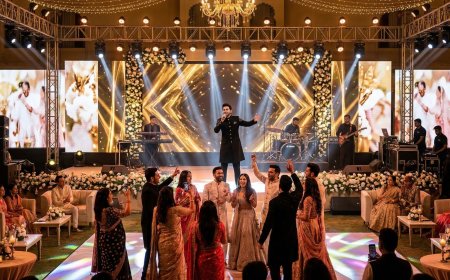
The Indian wedding reception moves through a range of emotional registers — from the formal ceremony of the couple's entrance to the specific intimacy of the parent dances to the warmth and humor of the speeches to the joy of the dance floor. Each register requires a different emotional key from the emcee, and the transitions between registers require specific management.
The emcee who brings the same energy to the introduction of a touching parent tribute and to the transition to the dance floor has not managed the emotional pacing. The emcee who reads the room's emotional state at each moment — who knows when to be quiet, when to be warm, when to be playful, when to be serious — is producing an emotional experience that the programme alone cannot produce.
Contingency Management
Every wedding reception produces unexpected moments — the speech that overruns, the technical difficulty that requires thirty seconds of silence to resolve, the family member who needs to be acknowledged from the stage, the programme addition that arrives via a whispered conversation during the appetizers.
The professional emcee's response to the unexpected is the specific test of their competence. The contingency that is managed invisibly — absorbed into the programme's flow without the guests being aware of the management — is the contingency that did not become a disruption. The contingency that is managed visibly — that produces an audible gap, a visible uncertainty, a moment where the emcee looks at the DJ or the wedding planner rather than at the audience — is the contingency that became a moment the guests remember for the wrong reasons.
The NRI Wedding's Specific Emcee Requirements
The NRI wedding places specific demands on the professional emcee that the generic Indian wedding or the generic Western wedding does not.
The Dual Cultural Fluency
The NRI wedding's guest list requires an emcee who is genuinely fluent in both the Indian cultural register and the international cultural register — not superficially familiar with each, but genuinely at home in both.
The emcee who is fluent in the Indian wedding's cultural conventions but who speaks only to the Indian guests — whose cultural references are exclusively Bollywood and whose humor assumes a shared Indian cultural context — is not serving the international guests in the room.
The emcee who is fluent in the Western wedding's conventions but who is self-consciously performing their knowledge of Indian culture — whose cultural references feel researched rather than lived, whose explanations of Indian traditions carry a faint tone of anthropological narration — is not serving the Indian guests in the room.
The emcee who is genuinely bicultural — who moves between the Indian and the Western register with the natural ease of someone who inhabits both — is the emcee the NRI wedding requires. This person exists. They are not common. They are worth finding.
The Multilingual Capability
Many NRI wedding guest lists include guests for whom English is a second language — the family in India for whom Hindi or a regional language is the natural medium, the elders for whom the English-only reception is a language barrier rather than a cultural one.
The emcee who can deliver key programme moments — the welcome, the introduction of the couple, the blessing before the meal — in both English and the family's primary Indian language is serving the full guest list rather than the English-speaking portion of it.
The multilingual capability is not the ability to deliver a pre-written translation — it is the genuine linguistic fluency to adapt, to respond to the room, to find the right word in the right language in real time.
The Knowledge of the Indian Wedding Sequence
The professional emcee for an NRI wedding must have specific knowledge of the Indian wedding's ceremonial and social sequence — not to replicate it as an announcer would, but to reference it correctly, to understand what has preceded the reception and what the reception's specific elements mean in the context of what has come before.
The emcee who does not know what the saptapadi is, who cannot reference the sindoor ceremony without reading from a script, who is unfamiliar with the specific significance of the vidai — this emcee is managing the reception as a generic event rather than as the specific occasion it is.
The Emcee vs. the Funny Friend: When to Have the Conversation
The decision to hire a professional emcee rather than asking a family member or a friend to host is a decision that many NRI couples delay making — because the conversation about professionalism can feel like a comment on the friend's capability, and because the friend who has already volunteered has made an offer that is difficult to decline without awkwardness.
The Honest Assessment
The honest assessment of whether a friend or family member can host the reception is not an assessment of their personal qualities — their intelligence, their charm, their love for the couple. It is an assessment of their specific experience with the specific demands of professional event hosting.
The demands: managing a large room's attention across a two-to-three hour formal programme. Transitioning between emotional registers smoothly and without self-consciousness. Managing the unexpected in real time. Operating a microphone competently. Keeping time without appearing to keep time. Serving a culturally diverse audience simultaneously. Doing all of this while also being a guest at the wedding — while being emotionally present in an occasion that matters to them personally.
These demands are professional skills. They are developed through practice and experience. The friend who has them — who has hosted formal events professionally, who has the specific skill set — can be an excellent host. The friend who does not have them but who is funny and beloved and has been told they are a natural public speaker has a genuinely different profile from the professional, regardless of their personal qualities.
The Hybrid Approach
For couples who want the personal warmth of a known host without the specific risks of an unprepared one, a hybrid approach works well: the professional emcee manages the formal programme — the entrance, the first dance, the speeches, the dinner service — while the beloved friend or family member delivers a specific, well-prepared hosting segment that plays to their strengths without requiring them to manage the full evening's complexity.
The friend who delivers the opening welcome — a prepared, rehearsed, specific welcome that they have written with the emcee's guidance — provides the personal warmth without the programme management risk. The professional emcee takes the programme from there.
Finding the Right Emcee: Where to Look and What to Ask
The Sources
The wedding planner's network:
The wedding planner who specializes in NRI weddings will have a network of emcees they have worked with and trust — people whose specific capabilities in the NRI wedding context have been tested in real events. The wedding planner's recommendation is the most reliable starting point for the emcee search because it comes with specific, tested knowledge of the emcee's capabilities rather than the generic testimonials that online search produces.
The referral:
The couple who has attended an NRI wedding whose emcee was specifically excellent has a specific, direct reference. The referral from a trusted person who has experienced the emcee's work is more valuable than any other source of information about their capability.
The event hosting community:
In major Indian wedding markets — Mumbai, Delhi, Jaipur, Udaipur, London, Toronto, Dubai — there is a specific community of professional event hosts who work in the Indian wedding space. This community is not always easy to find through generic searches, but it is findable through wedding planner networks, through Indian community event organizations, and through the NRI wedding forums and communities where these recommendations circulate.
The Audition and the Demo
Every emcee candidate should be assessed through a specific audition or a representative demo before the booking is confirmed.
The demo request: ask for a recording of an actual Indian wedding reception — not a promotional highlight reel, but a representative section of an actual event. Thirty minutes of actual footage reveals: the transitions between programme elements, the management of an unexpected moment if one occurred, the emcee's natural register when addressing a large room, and the specific quality of their cultural fluency.
The audition: a brief meeting in which the emcee is asked to demonstrate their hosting style — to welcome the room, to transition between two programme elements, to deliver a cultural explanation of a specific wedding tradition. The audition reveals, in a way that the demo does not, whether the emcee is responsive and adaptable or whether their hosting is a fixed format that they deliver regardless of the specific occasion.
The Questions That Matter
Experience with NRI weddings specifically:
How many NRI wedding receptions have they hosted? What is the cultural range of the guest lists they have managed? Have they hosted events with significant international guest populations, and how do they adapt their hosting for this audience?
The programme management approach:
How do they manage the relationship between the programme and the actual timing of the evening? What is their approach when a speech overruns significantly? How do they handle last-minute programme additions?
The cultural fluency:
What is their familiarity with the specific traditions of the couple's regional and religious background? Can they deliver key moments in the family's primary Indian language? What is their approach to the non-Indian guest who needs cultural context?
The brief process:
How do they approach the pre-wedding briefing? What information do they need from the couple, and when? How do they incorporate the specific story of the couple into their hosting?
The Briefing Process: Giving the Emcee What They Need
The professional emcee's performance on the night is only as good as the briefing they have received in advance. The briefing is the couple's most important contribution to the emcee's preparation — and it requires time, specificity, and the specific investment of sharing things about the couple's story, their families, and their guests that the emcee cannot know without being told.
The Story Brief
The emcee needs to know the couple's story — not the Instagram version, but the specific version. How they met. The specific moment the relationship became serious. The proposal. The elements of their individual backgrounds that make their specific pairing interesting and specific. The specific things that each person's family means to them.
The story brief is the source material from which the emcee creates the specific references that make the welcome feel personal and the introductions feel like they come from someone who genuinely knows the people being introduced.
The Guest Brief
The emcee needs to know the guest landscape — the cultural range, the language profile, the specific guests who will need to be acknowledged, the specific guests whose names must be pronounced correctly, the specific guests who have special significance at this specific event.
The guest brief should include: the approximate proportion of Indian to international guests, the primary languages represented in the room, the names and relationships of the family members who will be on the stage at any point during the evening — spelled phonetically if the pronunciation is not obvious — and any specific guests whose presence has a special significance that the emcee should know about.
The Programme Brief
The programme brief is the operational document — the running order with every element, its allocated time, the transitions between elements, and the specific cues the emcee needs for each. The programme brief should be prepared collaboratively between the couple, the wedding planner, and the emcee — with the emcee's input on what is achievable in the allocated time and what the programme's pacing requires.
The Cultural Brief
For emcees who are not from the couple's specific regional or religious background, a cultural brief — the specific traditions being referenced in the reception programme, the specific meanings of the elements that the audience will need context for, the specific conventions of address and acknowledgment that are appropriate for this family — is worth producing in addition to the story and programme briefs.
The Emcee at the Event: What to Expect
The Soundcheck and Setup
The professional emcee should arrive at the venue before the guests — with sufficient time to conduct a proper soundcheck, to walk the programme with the DJ and the wedding planner, and to address any technical or logistical issues that have emerged in the setup.
The emcee who arrives as the guests are arriving has not had the setup time that their performance requires. The emcee who arrives an hour before the reception begins, conducts a proper soundcheck, and has a thirty-minute briefing with the DJ and the wedding planner is the emcee whose performance begins from the moment the first guest walks in rather than from the moment they have oriented themselves to the space and the technology.
The Real-Time Communication
The emcee and the wedding planner should have a specific real-time communication channel throughout the evening — a discreet earpiece, a WhatsApp message system, or a designated signaling convention — through which programme updates, timing adjustments, and last-minute additions are communicated without visible disruption to the programme's flow.
The emcee who is receiving programme updates by being approached at the front of the room while holding a microphone in front of three hundred people is not receiving information discreetly. The communication channel established before the reception begins is the infrastructure that makes real-time programme management invisible.
The Investment: What a Good Emcee Costs and What They Are Worth
The professional emcee's fee — in the major Indian wedding markets — ranges from modest for less experienced practitioners to significant for the most sought-after and experienced hosts. Within this range, the emcee's fee is among the most efficient investments in the wedding budget: a relatively small sum relative to the total cost of the occasion, whose impact on the guest experience is disproportionately large.
The wedding that has invested in extraordinary florals, extraordinary food, and extraordinary music, and whose reception is announced by an emcee who has not been given the preparation time, the briefing, and the professional support their function requires — this wedding has invested heavily in the elements the guests see and hear and has underinvested in the element that holds all of them together.
The professional emcee is the architecture of the evening — the invisible structure within which everything else the couple has invested in is received. The architecture that works is the architecture nobody notices. The architecture that fails is the architecture everybody feels.
Invest in the architecture.
NRIWedding.com — Expert guidance for Indian weddings planned across borders.
What's Your Reaction?
 Like
0
Like
0
 Dislike
0
Dislike
0
 Love
0
Love
0
 Funny
0
Funny
0
 Angry
0
Angry
0
 Sad
0
Sad
0
 Wow
0
Wow
0