





































































Before the Wedding Can Begin, the Goddess Must Be Called: What Mata Ki Chowki Really Means for NRI Rajasthani Families
Mata Ki Chowki — the devotional goddess invocation gathering held before a Rajasthani wedding — is the most sacred ceremony of the wedding week, transforming the family home into a protected sacred space through bhajans, aarti, and collective prayer. For NRI families across the US, UK, Canada, UAE, and Australia, performing this ancient ceremony abroad requires finding a bhajan singer who knows the Rajasthani Chowki repertoire, sourcing the family deity's murti, and gathering the community. This guide covers the full ceremony sequence, deity traditions, practical planning, and the Chowki's profound spiritual meaning.


Mata Ki Chowki — the devotional gathering held before a Rajasthani wedding in which the family invites the goddess into their home through music, prayer, and collective bhajan — is the ceremony that transforms a house into a sacred space and a family gathering into a congregation of the divine. For NRI families carrying this ancient act of invocation across oceans, the Mata Ki Chowki is not a pre-wedding ritual — it is the permission the family asks before the wedding can truly begin.
You grew up knowing the sound of it before you knew its name. The particular quality of voices singing bhajans late at night — not the polished voices of a concert but the real voices of your family, imperfect and entirely committed, your grandmother's voice strongest of all because she had been singing these songs for sixty years and had long since stopped being self-conscious about anything. The smell of incense and marigolds. The particular orange and red of the deity's decoration. The way the room felt different — heavier, warmer, more significant — when the Chowki was in session.
Now it is your family's wedding. You are in a house in Mississauga or a flat in Birmingham or a home in Melbourne, and the Mata Ki Chowki is on the plan. Not because someone told you it was required — because you understand, without needing to articulate it fully, that you cannot begin something this important without first asking. Without first calling the goddess into the room and offering the ceremony to her care. Without the bhajans that connect this wedding to every wedding in your family's history in which the same songs were sung in the same spirit.
This guide is for that family. For the NRI Rajasthani household that knows the Mata Ki Chowki is not a devotional warm-up act before the real celebration begins — it is the most sacred event of the entire wedding week, and everything that follows happens under the protection it establishes.
🌟 DID YOU KNOW?
Mata Ki Chowki [literally "the gathering in the presence of the Mother Goddess"] is rooted in the ancient tradition of Shakti [divine feminine] worship that predates the formalised Hindu wedding ceremony itself — with devotional gatherings invoking the goddess before major life transitions documented in texts including the Devi Mahatmya [the foundational text of Shakti worship, composed approximately 400–600 CE] — making Mata Ki Chowki one of the most ancient continuously practised pre-wedding devotional traditions in South Asian religious life.
The specific goddess invoked at a Mata Ki Chowki varies by Rajasthani family tradition and regional community — Sherawali Mata [Durga in her lion-riding form], Vaishno Devi, Kali Mata, Amba Mata, and Sheetala Mata are all invoked across different Rajasthani communities, making the specific deity's identity one of the most intimate pieces of a family's religious heritage, passed down through generations alongside the family's specific bhajans and the specific way their Chowki is arranged.
Among NRI Rajasthani families in the UK, US, Canada, UAE, and Australia, the Mata Ki Chowki has emerged as one of the most actively revived pre-wedding ceremonies in the diaspora — with second-generation families who grew up attending Chowkis at community events now choosing to hold their own family Chowki before their wedding, often for the first time in their diaspora family's history, driven by a conscious recognition that the wedding cannot begin properly without this specific act of devotional preparation.
What Is Mata Ki Chowki?
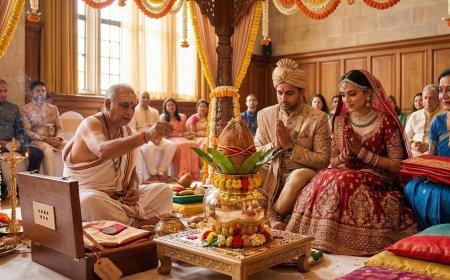
Mata Ki Chowki [from Hindi and Rajasthani — Mata meaning Mother Goddess, Ki meaning of, and Chowki meaning a sitting, a gathering, or a watch — the term encompasses both the physical arrangement of the goddess's space and the devotional gathering held in it] is a pre-wedding devotional ceremony in which the family creates a sacred space — the Chowki [the decorated platform or area on which the goddess's image or vessel is installed] — and invites the community to gather for an evening of bhajans [devotional songs], aarti [the ritual of light, in which a flame is offered to the deity in a circular motion], and collective prayer in the goddess's presence.
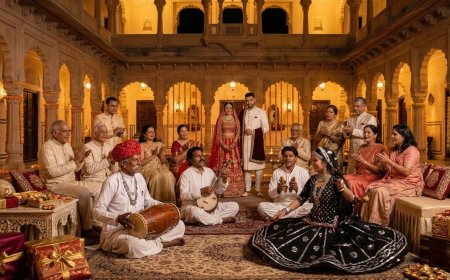
The ceremony begins with the preparation of the Chowki itself — a decorated space, typically in the family's main room, in which a murti [image of the deity] or kalash [a sacred brass pot representing the goddess's presence, filled with water and topped with mango leaves and a coconut] is installed. The space is decorated with chunri [the red and yellow cloth specifically associated with goddess worship in the Rajasthani tradition], fresh marigolds, diyas [oil lamps], incense, and the specific items associated with the family's deity — red hibiscus for Kali, lotus flowers for Lakshmi, jasmine for Saraswati.
A pandit or a senior family member opens the Chowki with the invocation of the goddess through specific mantras[sacred verses], asking her to be present in the murti or kalash for the duration of the ceremony. Once the goddess is understood to be present, the bhajan singing begins — led by a professional bhajan singer or by the family's most musically capable elder, with the assembled gathering joining in the chorus.
The bhajans sung at Mata Ki Chowki are specifically devotional compositions in honour of the Mother Goddess — Jai Mata Di, Sherawali Ka Kehna, Ambe Tu Hai Jagdambe Kali and dozens of others form the standard Chowki repertoire, though each family has specific favourite compositions that have been sung at every Chowki in their history. The singing builds in energy through the evening, reaching its peak at the aarti — the moment when the decorated lamp is offered to the deity in circular movements, accompanied by the entire gathering singing the aarti composition at full voice.
Prasad [the sacred food blessed by the goddess's presence] is distributed at the conclusion of the aarti — typically halwa[semolina sweet], puri [fried bread], and seasonal fruits — and the gathering breaks into informal celebration, with the bhajan singing often continuing informally for hours after the formal Chowki concludes.
Community Comparison Table
| Community/State | Local Name | Key Tradition | How NRIs Abroad Adapt It |
|---|---|---|---|
| Rajasthani | Mata Ki Chowki | Goddess invocation; chunri decoration; family and community bhajans; aarti; prasad distribution | Full Chowki maintained at home; bhajan singer hired; murti or kalash installed; community invited |
| Punjabi (Hindu) | Mata Ki Chowki / Jagrata | All-night goddess vigil with professional bhajan singers; Sherawali Mata central; dhol accompaniment | Indoor Jagrata in community hall; professional bhajan singer hired; community invited; condensed to evening |
| Himachali | Devta Puja / Chowki | Local deity invoked before wedding; specific Himachali deity tradition; community elder leads | Himachali community elder presides; deity invocation via video call with village temple; community gathered |
| Garhwali / Kumaoni | Devata Puja | Mountain deity invoked; specific Garhwali and Kumaoni ritual sequence; community participation | Community Pahadi elders lead; deity specific to family tradition; puja maintained at home |
| Kashmiri Pandit | Puja / Devta Invocation | Specific Kashmiri Pandit deity invocation before wedding; unique Kashmiri mantras and ritual sequence | Kashmiri Pandit pandit essential; specific deity tradition maintained; Kashmiri community invited |
| Gujarati | Mataji Ni Bhet / Chowki | Mataji [Mother Goddess in Gujarati tradition] invoked; garba sometimes follows; community celebration | Gujarati Mataji puja maintained; garba organised after puja; Gujarati community invited |
| Marathi | Mahalakshmi Puja / Devi Puja | Mahalakshmi invoked before wedding; specific Marathi ritual sequence; family women lead | Marathi pandit engages; Mahalakshmi murti installed; family women lead singing |
| Bengali (Hindu) | Durga / Kali Puja | Goddess worship central to Bengali religious life; specific puja sequence before wedding | Bengali pandit leads; Durga or Kali murti installed; Dhak player if available; community invited |
| Tamil (Hindu) | Amman Puja / Kolu | Village goddess invoked; specific Tamil ritual sequence; women lead ceremony | Tamil pandit leads; Amman murti installed; Tamil community women gather; flowers and milk offered |
| Sindhi | Chaliha / Mata Puja | Goddess invocation tradition; Sindhi bhajans sung; community participation central | Sindhi community invited; Sindhi bhajans played; puja maintained at home |
The Meaning Behind the Ritual
In the Shakti tradition that underlies Mata Ki Chowki, the universe is not governed by an abstract principle but by a living, responsive, infinitely compassionate maternal force — Adi Shakti [the primordial feminine power] from whom all creation emerges and to whom all creation returns. To invoke this force before a wedding is not a superstitious gesture — it is the most rational act available to a family that understands what kind of event a wedding actually is.
A wedding is a Sandhi [threshold] — the most significant transition in the social and spiritual life of two people and two families. Thresholds are, in the Vedic and folk understanding, the moments of maximum vulnerability and maximum openness simultaneously. They require protection. And the protection of the Mother Goddess — Mata — is understood in the Rajasthani tradition as the most complete protection available, because a mother's protection is by definition unconditional and total.
The Chowki itself — the decorated sacred space — is a physical declaration of the family's intention. By creating a beautiful, fragrant, lamp-lit space for the goddess and inviting the community to fill it with bhajans, the family is saying: we know we cannot do this alone. We are asking for help from the greatest help available.
The bhajans are not merely songs — they are invocations, each repetition of the chorus deepening the goddess's presence in the room, each voice added to the collective singing strengthening the protective atmosphere being generated. The aarti at the ceremony's peak is the moment of direct offering — the family turning its accumulated love and prayer into light and moving that light in the circular gesture of offering to the deity's face.
Mata Ki Chowki says: before we begin, we acknowledge that we are not sufficient alone — and we invite the original abundance into our home.
Doing Mata Ki Chowki Abroad: The Practical Reality
Mata Ki Chowki is one of the most home-centred and community-dependent pre-wedding ceremonies in the Rajasthani tradition, which means that its successful performance abroad requires two things above all else: a suitable domestic or intimate venue space and a community willing to gather and sing.
The venue question should be resolved first. Mata Ki Chowki belongs in a home — the family's living room, cleared of furniture and filled with seated guests on the floor or on cushions, with the Chowki installed against the main wall. If the family home is too small for the expected gathering, a close relative's larger home is the appropriate alternative. Community halls can work for larger gatherings, but the ceremony loses something significant when moved to an institutional space — the goddess being invoked is specifically the protector of the home, and the most authentic Chowki happens within the walls of the home being placed under her protection. If using a community hall, decorate it as closely as possible to a domestic setting — rugs on the floor, low seating, intimate lighting from diyas rather than overhead fluorescents.
Installing the Chowki requires advance sourcing of specific items. The murti [deity image] or kalash [sacred brass pot] for your family's specific goddess must be sourced at minimum four weeks before the ceremony. Many NRI Rajasthani families bring the murti from India — a deity whose image has been in the family for generations carries a sacred continuity that a newly purchased one does not. If this is not possible, religious supply stores in diaspora cities carry a wide range of deity murtis. In London, Wembley's Ealing Road and Southall have multiple Hindu religious supply stores. In Toronto, Gerrard Street East and Brampton's Dixie Road area carry puja supplies. In Houston, Hillcroft Avenue has South Asian religious supply stores. In Sydney, Harris Park in Parramatta carries puja items. In Dubai, Meena Bazaar in Bur Dubai is fully stocked.
The chunri [red and yellow cloth for goddess decoration] and marigold decorations should be sourced one week before. Indian fabric stores in all diaspora cities carry chunri fabric. Fresh marigolds are available from South Asian grocery stores and flower markets — in London, the early morning flower market at New Covent Garden supplies South Asian flowers.
Finding a bhajan singer is the most important hire for the Mata Ki Chowki and should be done minimum three months before the ceremony. A skilled bhajan singer who knows the Rajasthani Chowki repertoire — not generic Hindi devotional songs but the specific Mata Ki Chowki compositions — transforms the ceremony from a puja into a genuine devotional experience. Contact your Rajasthani samaj or community cultural association first — they will have the most reliable referrals for singers who know the specific Chowki repertoire. NRI.Wedding's vendor directory lists verified bhajan singers across UK, US, Canada, UAE, and Australia.
Prasad preparation should begin the morning of the ceremony. Traditional Chowki prasad includes halwa [semolina sweet cooked in ghee], puri, and seasonal fruit. All ingredients are available at Indian grocery stores in all diaspora cities.
For India family on video call, the aarti moment and the collective bhajan singing are the most important to share in real time. Set up a dedicated device with strong audio — India grandparents need to hear the singing, not just see the room. A morning Chowki in Toronto (EST) translates to evening IST, comfortable for India family participation.
Doing Mata Ki Chowki as a Destination in India
For NRI Rajasthani families returning to India for the wedding, the Mata Ki Chowki in Rajasthan itself offers possibilities of extraordinary cultural and spiritual depth.
Jaipur's tradition of goddess worship is among the most vibrant in Rajasthan — the city's numerous Mata temples, including the celebrated Moti Dungri Ganesh Temple vicinity and the goddess shrines of the old city, provide a sacred context for the Chowki that no diaspora setting can replicate. A Chowki held in the family's ancestral home in Jaipur, with the neighbourhood women gathering as they always have, with the family's own murti that has watched over every wedding in the family's history — this is the Mata Ki Chowki in its most complete form.
Jodhpur and Udaipur both have strong goddess worship traditions and experienced bhajan singers available for NRI returnee family ceremonies. For families with ancestral connections to specific Rajasthani villages, returning to the family village for the Chowki — with the village deity, the community pandit, and the neighbourhood women who remember how the ceremony was done — is among the most emotionally powerful experiences the wedding week can offer.
When coordinating from abroad, engage your India-based extended family members to arrange the murti, the pandit, and the bhajan singer at minimum three months before the wedding. For non-Indian guests attending the Chowki in India, prepare a simple printed guide explaining the goddess being invoked, the meaning of the bhajans, and the significance of the aarti — most international guests find Mata Ki Chowki one of the most moving and intimate ceremonies they have ever witnessed.
What You Need: Mata Ki Chowki Checklist
Ritual Items Murti or kalash of the family's specific deity, chunri [red and yellow cloth] for the Chowki decoration, fresh marigold garlands and loose petals, red hibiscus or specific flowers associated with your family's deity, diyas [oil lamps — minimum twelve, more is better], mustard or sesame oil for the diyas, incense [agarbatti] and incense holder, camphor [kapoor] for the aarti, an aarti thali [decorated plate for the aarti lamp], a large brass or copper lamp for the aarti, kumkum and roli [red powder], akshat [unbroken rice], supari [betel nut], paan [betel leaves], coconut, prasad ingredients [semolina, ghee, sugar for halwa; flour and oil for puri], fresh seasonal fruit, a red cloth to line the Chowki platform, and printed bhajan lyrics for guests who do not know the songs.
People Required A qualified bhajan singer who knows the Rajasthani Mata Ki Chowki repertoire [booked minimum three months before], a pandit for the formal invocation mantras if your family tradition requires one, a designated family member to perform the aarti, a senior family woman to lead the prasad distribution, a dedicated video call coordinator for India family, and a photographer — the Chowki's visual beauty, with its diyas and marigolds and the goddess's decorated space, produces some of the most extraordinary photographs of the entire wedding week.
Preparation Steps Source the murti or confirm the family murti's arrival four weeks before. Book the bhajan singer three months before. Source chunri and decoration items one week before. Purchase fresh marigolds and flowers the day before. Prepare the Chowki installation the morning of the ceremony. Cook prasad the afternoon of the ceremony. Set up and test the video call device the day before. Distribute printed bhajan lyrics to guests upon arrival. Brief the aarti performer on the sequence one day before.
NRI.Wedding's verified bhajan singer network, pandit directory, and Mata Ki Chowki planning checklists connect you to experienced professionals across the UK, US, Canada, UAE, and Australia.
5 Questions NRI Couples Always Ask About Mata Ki Chowki
Which goddess should we invoke if our family has never specified a particular deity?
The goddess invoked at Mata Ki Chowki is ideally the specific deity your family has always worshipped — this is the most sacred and personal element of the ceremony and should be established by consulting your family's senior members before any other planning begins. If your family does not have a specific established deity tradition, the most widely invoked goddesses at Rajasthani pre-wedding Chowkis are Sherawali Mata [Durga in her lion-riding form, associated with courage and protection] and Vaishno Devi [the mountain goddess of Jammu, widely venerated across North India]. If genuine uncertainty exists, your pandit will advise on the appropriate deity based on your family's gotra and regional tradition. What matters most is that the choice is made consciously and with family consensus rather than arbitrarily.
How long should the Mata Ki Chowki last, and how do we structure the evening?
A complete Mata Ki Chowki typically runs between two and four hours, though informal bhajan singing often continues beyond the formal ceremony. The standard structure begins with the pandit's invocation and the goddess's installation [approximately thirty minutes], followed by the bhajan session led by the professional singer with community participation [one to two hours], building to the aarti at the session's peak, followed by prasad distribution and informal celebration. For NRI families, a two-hour structured Chowki followed by an informal bhajan session and community gathering of another hour or two is entirely appropriate and manageable. The ceremony should never feel rushed — the quality of the bhajan singing and the depth of the communal devotion are the Chowki's essential qualities, and both require time to build.
Can men attend and participate in the Mata Ki Chowki, or is it primarily a women's ceremony?
Mata Ki Chowki is a community gathering that welcomes all family members regardless of gender — men, women, children, and elders all participate in the bhajan singing and the aarti. The ceremony's women-centred quality comes from the goddess being invoked rather than from any exclusion of men. In practice, Mata Ki Chowkis tend to be led by the women of the family in terms of organisation, decoration, and song leadership, but the gathering itself is open to everyone and the more voices singing the bhajans the stronger the devotional atmosphere. Encourage all family members and guests to attend and participate rather than treating it as a women's-only event.
How do we find a bhajan singer who knows the specific Rajasthani Chowki repertoire rather than generic devotional music?
This requires specificity from your first inquiry. When contacting potential bhajan singers, specify that you need someone who knows the Mata Ki Chowki repertoire specifically — compositions including Jai Mata Di, the Sherawali stutis, and the specific aarti compositions for your family's deity. Ask them to name several Chowki compositions they know and to confirm familiarity with Rajasthani Chowki tradition specifically. A singer who knows the specific Chowki repertoire will answer this question immediately and with specific composition names. Your Rajasthani samaj or community association is the most reliable referral source for this search. NRI.Wedding's bhajan singer directory lists performers specifically by their devotional music tradition.
Should the Mata Ki Chowki happen at the bride's home, the groom's home, or both?
In the most complete tradition, both families hold their own Mata Ki Chowki — the bride's family invoking the goddess's protection for their daughter who is about to leave, the groom's family invoking protection for the new member who is about to arrive. In NRI practice, where guests have often travelled internationally and event days are limited, many families hold a single combined Chowki that serves both families simultaneously. A combined Chowki has the advantage of bringing both families together in devotional space before the wedding — which creates a quality of mutual blessing and shared sacred experience that deepens the wedding week's emotional foundation. If choosing to hold separate Chowkis, the bride's family's Chowki traditionally occurs first, followed by the groom's family's.
The Emotional Angle
The bhajans have been going for an hour and the room has found its register. Not the self-conscious first twenty minutes when everyone was aware of themselves singing — but the later place, when the voices have merged and the individual has been absorbed into the collective and something that was separate from you is now around you and in you simultaneously.
Your grandmother's voice is the thread you follow. She has been singing these songs for sixty years and her voice does not wobble or hesitate — it knows exactly where it is going, has always known, has been going to exactly this place every time these songs have been sung at every family Chowki in her memory. You find her voice in the room and you follow it and suddenly you are not in Birmingham anymore. You are not anywhere that has a postcode.
For NRI families, the Mata Ki Chowki carries a specific quality of homecoming that no other ceremony in the wedding week provides. Because the goddess does not have a passport. Because the aarti flame is the same flame whether it is offered in Jaipur or in a living room in Mississauga that has been emptied of its furniture and filled with marigolds and diyas and the voices of everyone your family loves. Because the prasad your cousin is distributing from a steel thali in this room in Melbourne tastes exactly like the prasad distributed at every Chowki your family has ever held, because the recipe has not changed and the love going into the cooking has not changed and the goddess receiving the offering has not changed.
The room smells of incense and marigolds and ghee from the prasad cooking in the kitchen. Your grandmother is singing. The diyas are burning. The goddess is present.
The wedding can begin.
A Moment to Smile
At a Mata Ki Chowki in Houston two years ago, the family had prepared with extraordinary thoroughness — the Chowki beautifully installed, the bhajan singer confirmed, the prasad cooking perfectly in the kitchen, the diyas arranged in the most photogenic configuration anyone had ever assembled in that living room.
What the family had not fully anticipated was their five-year-old nephew Arjun, who had been watching the diya installation with the focused attention of a child with a specific plan forming.
At the moment of maximum ceremonial solemnity — just as the bhajan singer reached the peak of the first composition and the room was fully immersed in devotional atmosphere — Arjun made his move. He had decided, independently and with complete conviction, that the goddess's decorated space would be improved by the addition of his toy dinosaur, which he placed with great ceremony at the base of the murti before anyone could intervene.
The bhajan singer, to his enormous credit, did not miss a note. The grandmother, also without missing a note, removed the dinosaur with one hand while continuing to clap rhythm with the other. Arjun watched his contribution being removed with an expression of philosophical resignation and then joined the singing.
The goddess, the family agreed, had probably appreciated the gesture. The dinosaur attended the rest of the Chowki from a position of respectful distance.
Quotes From the Diaspora
"My dadi led the bhajans at our Mata Ki Chowki in Mississauga. She has led the bhajans at every family Chowki since before my mother was born — in Jaipur, in the family village, in Canada for thirty years. When she began the first verse of Jai Mata Di in our living room, I watched my mother's face. She looked like a child. Not because she was diminished — because she was returned to something. The bhajans gave her back something the immigration had taken without anyone noticing." — Priya Rathore, Rajasthani bride, originally from Jaipur, now in Mississauga
"My son's wife is from New Zealand. Her family are not Hindu and had never attended anything like a Mata Ki Chowki. When the aarti began — the lamp moving in circles, the whole room singing together, the diyas burning — her mother turned to me with tears on her face and said: I don't know what is happening but I can feel it. That is the correct response to a Chowki. She understood it perfectly." — Savita Sharma, Rajasthani mother of the groom, originally from Jodhpur, now in Birmingham
"We held the Mata Ki Chowki in our garden in Melbourne because the evening was warm and the garden felt right. My nani joined on video from Jaipur at 3 a.m. her time — she had refused to sleep. When the bhajan singer began the Sherawali aarti, she began singing along through the phone speaker. Her voice came across twelve thousand kilometres and sat in our garden like it had always been there. The goddess was present. I am completely certain of this." — Ananya Singhvi, Rajasthani bride, originally from Jaipur, now in Melbourne
Your Devotion Travels With You
Mata Ki Chowki is the ceremony in which a Rajasthani family does the most ancient and most necessary thing — asks. Asks for protection, for blessing, for the presence of the divine maternal in the rooms where the most important events of the family's life are about to unfold. For NRI families performing this devotional gathering in diaspora homes across the world, the goddess arrives without a visa. The marigolds smell the same. The diyas burn the same. The bhajans carry the same accumulated love and petition they have always carried, regardless of the postcode of the room in which they are sung.
NRI.Wedding supports Rajasthani families across the UK, US, Canada, UAE, and Australia with a verified bhajan singer directory covering the Mata Ki Chowki repertoire, pandit networks for the formal invocation sequence, puja vendor directories for sourcing deity murtis and Chowki decoration items in diaspora cities, and planning checklists built specifically for diaspora families restoring this ceremony to its rightful place before the wedding begins.
Install your Chowki. Light your diyas. Gather your voices.
Ask the goddess into your home — and everything that follows will happen under her care.
This article explores the Mata Ki Chowki ceremony — the devotional goddess invocation gathering before Rajasthani weddings — alongside related pre-wedding deity invocation traditions across Indian communities including Punjabi Jagrata, Gujarati Mataji Puja, Bengali Durga Puja, Tamil Amman Puja, and Kashmiri Pandit Devta traditions, with practical planning guidance for NRI families in the US, UK, Canada, UAE, and Australia.
What's Your Reaction?
 Like
0
Like
0
 Dislike
0
Dislike
0
 Love
0
Love
0
 Funny
0
Funny
0
 Angry
0
Angry
0
 Sad
0
Sad
0
 Wow
0
Wow
0