






















































Before There Were Priests, There Were Songs: The Sacred World of Naga Tribal Wedding Traditions for NRI Couples
Naga tribal weddings are among India's most extraordinary and least-documented ceremonial traditions — a community-first celebration rooted in morung culture, ancestral songs, handwoven shawls, and a communal feast that ratifies the marriage in the eyes of the entire village. Spanning sixteen distinct tribes including Ao, Angami, Sumi, Lotha, and Konyak, no two Naga weddings are identical. For NRI Naga families in London, Sydney, Melbourne, Houston, Bangalore, and Delhi, this guide covers every tribal tradition, diaspora adaptation, shawl-sourcing strategy, and feast-planning workaround needed to honour this ancient living culture at a wedding anywhere in the world.


The Naga wedding is unlike anything else in the Indian ceremonial landscape — a celebration rooted not in Sanskrit texts or Brahminical liturgy but in the living oral traditions of over sixteen distinct tribes spread across the hills of Nagaland, Manipur, and Arunachal Pradesh. For NRI Naga families now building lives in Delhi, Bangalore, London, Sydney, and across the United States, preserving these traditions is an act of fierce cultural pride in a world that rarely knows their names, let alone their songs.
You grew up knowing the difference between an Ao and an Angami, between an Sumi and a Chakhesang, before you knew the capital of any country outside India. You grew up hearing stories of the morung [the traditional community dormitory and cultural centre of Naga villages] — that extraordinary institution where young men learned the songs, dances, and warrior traditions that would one day make them worthy of marriage. You knew that in your family's village back in Nagaland, a wedding was not a private event between two families. It was a community declaration, a feast that the whole village attended, a moment when the drums said something that words never could.
Now you're in Bangalore or London or somewhere in the American Midwest, and you're planning a wedding. You want the traditional naga shawl draped across your shoulders. You want the songs your grandmother sang at her own wedding, songs in a language that has no Wikipedia page. You want your non-Naga partner to stand inside the tradition you come from and understand, without needing it explained, that you come from a people of extraordinary depth and beauty.
This is that guide. Written with the respect your tradition deserves and the practicality your diaspora life demands.
🌟 DID YOU KNOW?
Nagaland is home to over sixteen major tribes — including the Ao, Angami, Sumi, Lotha, Chakhesang, Khiamniungan, Chang, Phom, Konyak, Zeliang, Rengma, Sangtam, Pochury, Yimchunger, Tikhir, and Kuki — each with its own distinct language, wedding customs, music, and ceremonial dress. No two Naga tribal weddings are identical, making it one of the most diverse ceremonial traditions in all of Asia.
The morung system — the traditional Naga community dormitory where young men and women learned tribal songs, dances, crafts, and cultural values — has been described by anthropologists as one of the most sophisticated informal education systems in pre-colonial Asia. Though the morung as a physical institution has declined in urban contexts, its cultural legacy lives directly in wedding music, ceremonial dress, and the community feast tradition.
The Naga diaspora in India's metropolitan cities — particularly Delhi's Nagaland House community and Bangalore's significant northeastern population — has developed a thriving cultural preservation movement, with Naga cultural associations actively documenting wedding songs, ceremonial shawl patterns, and feast traditions that risk being lost as communities urbanise.
WHAT IS A NAGA TRIBAL WEDDING?
A Naga wedding — or Naga Vivah in the broadest sense, though each tribe has its own specific name for the ceremony — is fundamentally a community event before it is a family event. This is the philosophical starting point that distinguishes it from every other Indian wedding tradition: the Naga wedding belongs to the village, not just the household.
Traditionally, the process begins with the courtship songs — young men from the morung would sing outside the azo[the girls' dormitory in certain tribes] to attract the attention of potential partners. This was not a private romantic act but a public, communal one, witnessed and judged by the community. The quality of a young man's voice, his knowledge of tribal songs, and his reputation as a community member all factored into his marriageability.
The formal wedding sequence begins with the bride price negotiation — called thibi in Ao tradition and varying by name across tribes — where the groom's family offers a specific quantity of zu [rice beer, the sacred ceremonial drink of most Naga tribes], livestock, cloth, and sometimes brass objects to the bride's family. This is not a transaction but a covenant — a formal acknowledgement of the bride's value to her family and community.
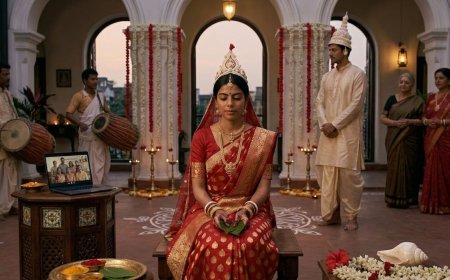
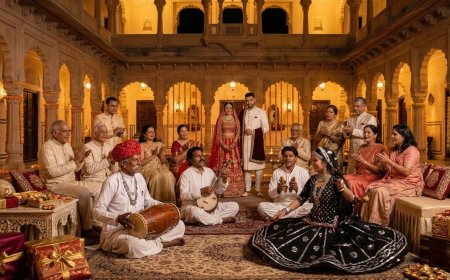
The wedding day itself features the feast as its central act — not as a reception afterthought but as the ceremony itself. The communal meal, prepared by the village collectively and served to everyone present, is the ritual through which the marriage is witnessed and ratified by the community. Zu is served in ceremonial quantities. Traditional naga songs — called aloho in Ao tradition — are performed by community singers. The couple is dressed in full tribal ceremonial regalia: the naga shawl specific to their tribe and gender, brass jewellery, and in some traditions, the warrior headdressworn by the groom.
In Christian Naga families — who constitute the majority of the community following widespread 19th and 20th century missionary activity — the wedding now typically includes a church ceremony alongside or preceding the traditional feast, creating a layered celebration that honours both faith and tribal heritage simultaneously.
COMMUNITY COMPARISON TABLE
| Community / Tribe | Local Name for Wedding | Key Tradition | How NRIs Abroad Adapt It |
|---|---|---|---|
| Ao Naga (Nagaland) | Aier / Naga Vivah | Bride price in zu and cloth, aloho songs, community feast, morung blessing | Community cultural events in Delhi/Bangalore adapted; tribal shawls sourced from Nagaland |
| Angami Naga (Nagaland) | Angami Kelhu | Elaborate feast, distinctive Angami shawl ceremony, village elder blessing | Angami associations in Delhi and Bangalore assist; church ceremony added |
| Sumi Naga (Nagaland) | Sumi Kelgu | Rice beer ceremony, traditional Sumi shawl gifting, communal singing | Sumi diaspora associations active in Delhi; shawls from Zunheboto district sourced online |
| Lotha Naga (Nagaland) | Lotha Vivah | Elder council approval, feast with specific meat offerings, Lotha folk songs | Lotha community in Dimapur coordinates with diaspora for shawl and zu sourcing |
| Konyak Naga (Nagaland) | Konyak Ceremony | Most elaborate tribal dress, brass headgear, face tattoo significance acknowledged | Konyak cultural associations preserve ceremony; tattoo elements now symbolic |
| Chakhesang Naga (Nagaland) | Chakhesang Wedding | Specific shawl patterns denoting clan, elder-led feast, distinctive folk music | Chakhesang associations in Kohima and Delhi assist diaspora couples |
| Meitei (Manipur) | Luhongba | Different tradition — Hindu-influenced, no morung, sindoor ceremony | Entirely distinct from Naga traditions; Meitei associations separate |
| Mizo (Mizoram) | Mizo Inneih | Christian ceremony central, traditional Mizo dress, community choir | Mizo associations in Delhi/Bangalore well-organised; church ceremony abroad feasible |
| Bodo (Assam) | Bodo Biya | Fermented rice drink ceremony, traditional dokhna dress, community feast | Bodo cultural events in Assam diaspora communities |
| Apatani (Arunachal Pradesh) | Apatani Marriage | Nose plug tradition (largely discontinued), community elder ceremony, feast | Cultural elements preserved through Apatani associations; simplified abroad |
THE MEANING BEHIND THE RITUAL
The Naga feast is not hospitality. It is theology.
In the Naga worldview — across all sixteen tribes despite their differences — generosity is the supreme social and spiritual virtue. A man who feasts his community at his wedding is not showing off his wealth. He is demonstrating his fitness to be a husband, a father, and a community member. The size and quality of the feast is a direct expression of character. The zu served at a Naga wedding is not merely rice beer — it is the fruit of collective agricultural labour, a liquid embodiment of the community's shared effort, offered back to the community in celebration.
The morung songs sung at weddings carry within them the entire oral library of the tribe — histories of ancestors, records of battles, teachings about land and seasons and human conduct. When these songs are sung at a wedding, the couple is being placed inside their people's story. They are not beginning something new. They are continuing something ancient.
The naga shawl draped across the bride and groom is perhaps the most visually powerful element of the ceremony. Each tribe's shawl pattern is a distinct visual language — a coded record of clan, status, achievement, and identity woven into cloth. When a Naga person wraps their wedding shawl around their shoulders, they are wearing their entire genealogy.
For a non-Naga partner trying to explain this ceremony to their own family: this is a wedding where the whole village is the priest, the feast is the vow, and the songs are the scripture.
DOING A NAGA WEDDING ABROAD: THE PRACTICAL REALITY
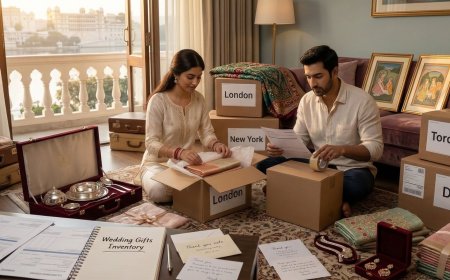
The most immediate challenge for Naga NRI couples planning a wedding outside Nagaland is this: the ceremony is fundamentally communal, and community, in the traditional sense, cannot be fully replicated in a rented hall in London or Sydney. What can be done — and what diaspora Naga families have been doing with growing creativity and emotional power — is to build a community for the day from whatever Naga families and northeastern Indian diaspora members exist in your city.
Naga Students' Union and Naga cultural association networks exist in London, Sydney, Melbourne, and across the United States. The Naga Club Delhi and the broader northeastern diaspora community in Bangalore have well-established networks for cultural events that can translate into wedding support. Reaching out to these associations twelve months in advance is the single most important logistical step you can take.
For sourcing tribal shawls abroad — the non-negotiable ceremonial item — Nagaland House in Delhi is the most reliable starting point for families based in India transitioning to an abroad wedding. Several Naga artisan collectives now sell authentic tribal shawls online, including through the Nagaland government's official e-commerce portals and through artisan platforms. Do not accept machine-woven imitations for a wedding shawl — the handwoven patterns carry cultural meaning that factory production cannot replicate. In London, the northeastern Indian community in Harrow and Wembley has informal networks for sourcing tribal items. In Sydney and Melbourne, the Naga and northeastern Indian associations can connect you with artisan contacts in Nagaland directly.
For the zu — the ceremonial rice beer — the authentic version requires rice, yeast, and fermentation time. Many diaspora Naga families prepare zu at home in the week before the wedding. Japanese sake or Korean makgeolli are sometimes used as ceremonial substitutes at Christian Naga weddings where alcohol is served symbolically rather than in the traditional quantities. This is a family decision that should be made with sensitivity to both tribal custom and personal faith.
For the feast — the heart of the ceremony — Naga cuisine requires specific ingredients. Smoked pork, fermented bamboo shoot [akhuni in Sumi tradition, anishi in Ao], dried fish, and bhoot jolokia [ghost pepper] are the foundational ingredients of any authentic Naga feast. Smoked pork is available from specialist butchers in all major diaspora cities. Fermented bamboo shoot — the ingredient most likely to cause a venue conversation — can be sourced from northeastern Indian grocery stores. In London, shops on the Drummond Street area near Euston and South Asian grocers in Harrow carry northeastern Indian ingredients. In Toronto, the South Asian grocery cluster on Gerrard Streetand the Bengali stores on Danforth Avenue sometimes stock akhuni. In Houston and New Jersey, Bangladeshi grocery stores carry similar fermented products. In Melbourne, the Dandenong market area is your best resource.
The smell of fermented bamboo shoot is the element most likely to trigger a venue conversation — be transparent with your venue coordinator and consider whether the feast can be held in an outdoor or well-ventilated space. Many Naga diaspora weddings solve this elegantly by holding the traditional feast at a private home the day before or after the formal wedding reception.
For India coordination by video call: Nagaland is IST (UTC+5:30). A 10:00 AM ceremony in London means 3:30 PM in Kohima — ideal for grandparents and village elders to join live. In the United States Eastern timezone, a 10:00 AM ceremony means 8:30 PM in Kohima — workable. Set up a large screen at the feast so village elders can be seen and can see the couple clearly. Ask the community singer to direct one song toward the screen where the elders are watching. This single gesture has reduced grown Naga men to tears at diaspora weddings more than once.
DOING A NAGA WEDDING AS A DESTINATION IN INDIA
For Naga NRI couples choosing to marry in Nagaland itself, Kohima — the state capital — offers the most developed wedding infrastructure while remaining deeply culturally authentic. The Hornbill Festival period in December brings the entire state's tribal culture to one location, and some diaspora couples have timed their weddings to coincide with it, giving non-Naga guests an immersive cultural experience that extends far beyond the wedding itself.
Mokokchung — the cultural heart of the Ao Naga people — and Dimapur — the commercial gateway to Nagaland — are increasingly popular destination wedding locations for families returning from Delhi, Bangalore, and abroad. The landscape of Nagaland itself — terraced hills, ancient village gates, mist-covered valleys — provides a natural ceremonial backdrop of extraordinary power.
Brief your local wedding coordinator and village elders on your specific tribal customs at least six months in advance. If you have been living abroad for many years and are not certain of your family's specific ceremonial sequence, consult the eldest female relative in your village — the keeper of song and custom knowledge in most Naga traditions is the older woman, not the pandit or the priest.
For non-Naga and non-Indian guests, arrange a village walking tour the day before the wedding, a briefing on the shawl patterns they will see, and a printed guide to the feast dishes. Nagaland's cuisine is one of India's greatest undiscovered culinary traditions — your guests will spend the rest of their lives talking about it.
WHAT YOU NEED: RITUAL CHECKLIST
Ritual Items: The tribal wedding shawl for bride and groom [tribe-specific, handwoven, sourced from Nagaland], brass jewellery and ceremonial accessories specific to the tribe, zu [rice beer, prepared at home or sourced via community], smoked pork and fermented bamboo shoot for the feast, fresh locally sourced ingredients for the communal meal, community singing recordings or live singers if available, and a printed bilingual programme explaining the ceremony sequence for non-Naga guests.
People Required: Community elders to formally bless the union, the tribal community singer or a recording of traditional songs, the bride's and groom's family feast preparation team, a church pastor if a Christian ceremony is included, and ideally one senior community member who can narrate the ceremony sequence for non-Naga guests.
Preparation Steps: Contact your tribal cultural association in your city at least twelve months ahead. Source handwoven shawls directly from Nagaland artisans six months ahead. Confirm feast ingredients and cooking arrangements three months ahead. Brief your venue on fermented ingredients and arrange appropriate cooking space. Prepare community song recordings from family in Nagaland. Set up live stream for village elders. Prepare bilingual programme.
NRI.Wedding connects Naga and northeastern Indian couples with cultural coordinators, tribal artisan networks, and photographers who understand the ceremonial significance of the shawl, the feast, and the song. Explore our northeastern Indian wedding directory today.
5 QUESTIONS NRI COUPLES ALWAYS ASK
Can we do a Naga traditional wedding ceremony without a church service if we are Christian Naga?
Yes — and many Naga diaspora couples are making exactly this choice, either holding only the church service or only the traditional feast and song ceremony, or separating the two across different days. The traditional Naga wedding predates Christianity in the region by thousands of years and stands entirely on its own cultural and spiritual authority. Many Christian Naga families now consciously hold both — the church service for their faith and the traditional feast for their heritage — as complementary rather than competing ceremonies.
My partner is from a completely different Naga tribe. Do our different tribal customs create complications?
Intertribal Naga marriages are increasingly common both in Nagaland and in the diaspora, and the approach most families take is to honour both traditions — a feast that incorporates elements of both tribes' songs, shawls from both traditions worn at different moments, and elders from both communities formally blessing the union. This requires coordination and sensitivity but produces weddings of extraordinary cultural richness. The couple essentially becomes a bridge between two tribal histories.
How do we find Naga community singers in Melbourne who know our tribe's specific wedding songs?
The Naga Students' Union Australia and the broader northeastern Indian associations in Melbourne and Sydney are your starting points. If no singer is available locally who knows your specific tribal songs, the most widely practised solution is to record the songs in Nagaland — ask your grandmother or village elder to record several songs on a phone — and play them at the ceremony with a spoken explanation of their meaning. This is not a compromise. It is an act of cultural transmission that will mean more to your children one day than you can currently imagine.
We want to serve a proper Naga feast but our venue in London has restrictions on cooking fermented ingredients. What are our options?
The most practical solution used by London-based Naga diaspora families is to hold the traditional feast element at a private home or rented community hall where cooking restrictions are more flexible, either the day before or the evening after the formal venue reception. Several northeastern Indian caterers in the Harrow and Wembley areas of London are familiar with Naga cuisine and can prepare akhuni-based dishes off-site for delivery. The feast does not need to happen in the wedding venue — it needs to happen with the community present.
My non-Naga partner's family has never encountered northeastern Indian culture. How do we make them feel included without diluting the tradition?
Prepare a one-page visual guide to the tribal shawl patterns, the meaning of the feast, and the songs — something beautiful and simply written that can be placed at each seat. Brief your partner's family on one or two specific moments to watch for, and explain their significance in advance. Ask your community elder or a confident family member to give a brief two-minute spoken explanation at the ceremony before the songs begin. Non-Naga guests who are welcomed into Naga wedding culture with this kind of generosity almost universally describe it as the most moving wedding experience of their lives.
THE EMOTIONAL ANGLE
There is something that happens to a Naga person when they hear their tribal wedding songs in a city far from Nagaland. It is not quite nostalgia and it is not quite grief. It is something older than both — a recognition that goes deeper than memory, a vibration in the chest that says: this is who we are. This is what we sound like. We are still here.
For NRI Naga families who have spent years being the community that India barely knows exists — the community whose home state most people couldn't find on a map, whose sixteen tribes are collapsed into a single word, whose extraordinary artistic and culinary traditions are treated as footnotes in the national story — the wedding is the moment when none of that invisibility matters. In that room, with those songs, in those shawls, you are not a footnote. You are the whole story.
The parents who drive forty minutes to the nearest northeastern grocery store to find akhuni. The grandmother who records the wedding songs on a cracked phone screen in a village in Mokokchung so her granddaughter can play them at a wedding in Sydney. The groom who wraps his grandfather's shawl around his shoulders in a Melbourne function hall and stands just a little taller than he has all day.
These are not small acts. These are acts of civilisational resistance — the quiet, fierce refusal of a people to become invisible just because the world doesn't know their name yet.
The drums that once called warriors now call families. The feast that once fed a village now feeds a diaspora. The songs that once echoed across Naga hills now rise in London living rooms and Sydney reception halls.
They are still rising.
A MOMENT TO SMILE
At a Sumi Naga wedding in Houston in 2023, the family had successfully sourced everything — the handwoven shawls shipped from Zunheboto, the smoked pork from a specialist butcher in the Hillcroft area, and the fermented bamboo shoot prepared at a cousin's house three days before. What nobody had fully accounted for was the enthusiasm of the groom's Texas-born college friends, who had been told about the feast with such passion that they arrived forty-five minutes early and positioned themselves with the focused intention of men who had done competitive eating.
When the akhuni dish arrived, the groom's best friend — a six-foot Texan named Brad who had been assured he could handle anything — took one confident bite, paused, and then looked at the groom with an expression of profound respect and mild alarm. He then took a second bite. And a third. He later told the groom it was the most interesting food experience of his life and asked to be sent the recipe. He has since learned to make smoked pork with fermented bamboo shoot. He brings it to cookouts. Nobody at the cookouts is ready for it. He considers this a triumph.
QUOTES FROM THE DIASPORA
"I wore my grandmother's shawl at my wedding in Bangalore. She had kept it for forty years in a trunk. When she took it out and placed it on my shoulders the morning of the wedding, she didn't say anything for a long time. Then she said: 'Every woman in our family has worn this.' I didn't understand the weight of that until I was standing at the altar and felt it on my shoulders." — Imtisunep Jamir, Ao Naga community, Bangalore
"My son married a girl from Kerala. Two completely different worlds. But at the feast, when our community singers began the aloho and her family sat very still and listened — really listened — I saw her father close his eyes. He said afterwards he had never heard anything like it. That is what our music does. It reaches people who have never heard it before." — Merenla Longkumer, Ao Naga community, Delhi
"We live in Sydney. There are maybe forty Naga families here. For my wedding, every single one of them came. People I had never met, from tribes different from mine, drove two hours. One aunty brought zu she had made herself. Another brought smoked pork from a butcher she had been training for three years. That is the Naga way. You don't need a village if you have a community." — Vizolü Sema, Sumi Naga community, Sydney
YOUR ROOTS TRAVEL WITH YOU
The Naga wedding tradition is proof that culture does not require a fixed geography to survive. It requires people who refuse to forget. It requires the grandmother who keeps the shawl in a trunk for forty years. The cousin who learns the songs from a phone recording. The community that drives two hours to be present at a feast in a city that has never heard of Nagaland.
NRI.Wedding is here for exactly this community. Our northeastern Indian wedding directory connects Naga couples with cultural coordinators who understand tribal ceremony distinctions, artisan networks for authentic handwoven shawls, photographers who know how to capture the shawl draping and the feast moment, and destination wedding specialists for Kohima and Mokokchung.
Your tribe is your identity. Your feast is your vow. Your songs are your scripture.
Your roots travel with you. Let them be heard.
This article covers Naga tribal wedding traditions including morung culture, community feast ceremonies, tribal shawl customs, zu rice beer rituals, and aloho wedding songs across Ao, Angami, Sumi, Lotha, Konyak, and Chakhesang Naga communities, with complete diaspora guidance for NRI couples in London, Sydney, Melbourne, Houston, Bangalore, and Delhi.
What's Your Reaction?
 Like
0
Like
0
 Dislike
0
Dislike
0
 Love
0
Love
0
 Funny
0
Funny
0
 Angry
0
Angry
0
 Sad
0
Sad
0
 Wow
0
Wow
0