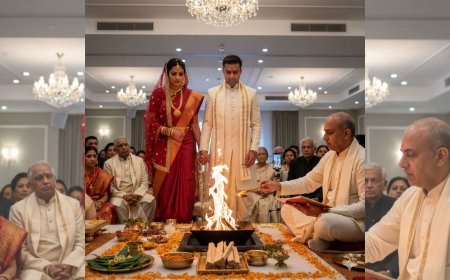




































































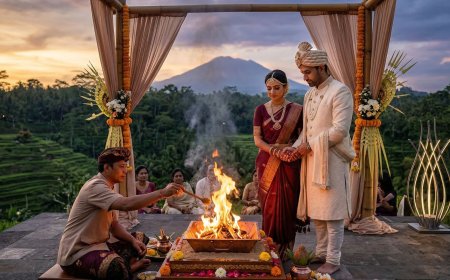
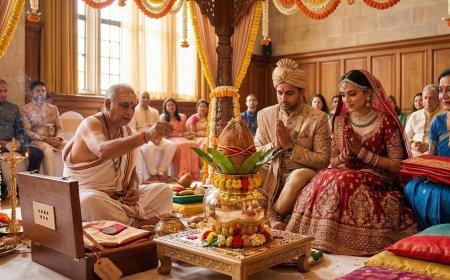






The Tray That Carries Everything: Inside Achumichu, the Sacred Parsi Pre-Wedding Ritual That Binds Two Families Before the Vows Are Spoken
The Achumichu is the sacred Parsi Zoroastrian pre-wedding exchange ceremony — a women-led ritual built around a carefully arranged tray of symbolic items including eggs, coconut, betel leaves, and a burning divo, carried between two families as a spiritual declaration that their union has been sanctioned before the vows are spoken. For NRI Parsi couples planning their wedding from London to Sydney, understanding and recreating the Achumichu is an act of cultural survival for one of the world's smallest and most extraordinary communities. This guide covers every tray item, every prayer, and every practical step for conducting the ceremony abroad or as part of a destination wedding in Mumbai.


In the Parsi Zoroastrian tradition, the wedding does not begin at the altar. It begins with a tray — carefully arranged, deeply symbolic, carried between two families as a physical declaration that this union has been sanctioned by the community, the ancestors, and the Divine. For NRI Parsi couples planning their wedding from London to Melbourne, understanding the Achumichu is understanding where the marriage truly starts.
You have probably seen the tray without knowing its name. A large silver or copper platter, arranged with eggs and coconut and betel leaves and rose water and things you couldn't quite identify, carried by a woman who moved with the careful deliberateness of someone transporting something irreplaceable. At a Parsi wedding in your childhood — a cousin's, an uncle's, someone from the community whose face you remember but whose name has blurred — you watched this tray move through the room and felt that something important was happening, even if nobody explained it to you.
You're in Toronto now, or Sydney, or somewhere in the Home Counties, and you're planning your own wedding. You want the Achumichu [the sacred Parsi pre-wedding exchange ceremony between the two families]. You want it done properly, with the right items on the tray, the right prayers said over them, the right women carrying it. You want your mother and your future mother-in-law to stand across from each other with that tray between them and feel what generations of Parsi women have felt in that moment.
But you're not sure you have all the pieces. This article will give them to you.
🌟 DID YOU KNOW?
The word Achumichu is derived from the Gujarati words Achu and Michu — roughly translated as "that which is auspicious and that which is binding." The ceremony is unique to the Parsi Zoroastrian community and has no direct equivalent in any other Indian wedding tradition, though it shares spiritual DNA with the exchange ceremonies found in other communities across the subcontinent.
The Achumichu traditionally takes place twice — once at the bride's home and once at the groom's home — on separate occasions before the wedding day. Each family hosts the other, presenting their own version of the tray and receiving the other's in a formal exchange that establishes the relationship between the two households as equals entering a sacred agreement.
The eggs used in the Achumichu tray are not merely symbolic in a vague sense — in Zoroastrian cosmology, the egg represents the universe itself, the contained potential of all creation. Ancient Zoroastrian texts describe the cosmos as having emerged from a primordial egg, making the presence of eggs at a wedding ritual a direct invocation of creation mythology that predates most of the world's major religions.
What Is Achumichu?
Achumichu is the sacred pre-wedding exchange ceremony of the Parsi Zoroastrian community — a ritual that formally establishes the bond between the two families before any religious vows have been spoken. It is, in the truest sense, the ceremony before the ceremony: the moment when the marriage moves from a private agreement between two individuals to a public, spiritually sanctioned union between two lineages.
The word itself gestures toward its dual nature. Achu carries the sense of something pure, untouched, and auspicious — the quality of a thing that has been set apart for sacred purpose. Michu carries the sense of something binding, sealing, and complete. Together, they describe what the ceremony does: it consecrates the union as both pure in intention and binding in commitment.
The Achumichu takes place in two stages, hosted on separate occasions by each family. The bride's family visits the groom's home first — or vice versa, according to regional and family custom — and presents the Achumichu tray. The groom's family then reciprocates. Each visit involves the formal presentation of the tray, prayers recited by the women of the family or by a Mobed [Zoroastrian priest] if one is present, and the exchange of the tray's contents as gifts between the families.
The Achumichu tray itself is the ceremony's centrepiece and its language. Every item on it has been chosen for specific symbolic meaning, and the arrangement of those items follows a tradition passed down through generations of Parsi women who have assembled this tray for daughters and daughters-in-law across centuries. The tray typically includes Sopari [betel nut], Paan [betel leaf], Nariyal [whole coconut], Kagdo [raw egg], Gol [jaggery or sugar], Draksh [dried grapes or raisins], Khajur [dried dates], Badam [almonds], Sukhad [sandalwood], a small divo [oil lamp], rose water, vermillion, and flowers — typically white flowers for purity and roses for love.
The divo — the small flame that burns on the tray — is not an afterthought. In Zoroastrian theology, fire is the supreme witness, the visible form of divine truth. When the divo burns on the Achumichu tray, it is as if the Divine itself is present at this exchange between families, witnessing the agreement being made.
The women of both families participate actively in the ceremony — it is traditionally a women-led ritual, with the senior female elder of each family taking the central role. The two mothers, or the senior women if the mothers are not present, face each other across the tray and perform a specific gesture: they move the tray in a circular motion between them — the utaarna [the circular warding-off gesture used in auspicious Parsi rituals] — and then touch each other's faces, forehead, and sometimes exchange the egg by passing it between their hands. This physical exchange between the two women is the ceremony's emotional core. It is the moment when two families become, formally and feelingly, one.
Following the tray exchange, the Haath Borvanu [the joining of hands ritual] may be performed in a preliminary form at the Achumichu, though its full form is reserved for the Ashirvad ceremony. Prayers in Avestan [the ancient language of Zoroastrian scripture] may be recited, and the gathering ends with the distribution of sweets and the sharing of refreshments that signal abundance and welcome.
Community Comparison Table
| Community/State | Equivalent Pre-Wedding Exchange Ritual | Key Tradition | How NRIs Abroad Adapt It |
|---|---|---|---|
| Parsi Zoroastrian | Achumichu | Sacred tray exchange between families, women-led, divo present, prayers in Avestan | Assemble tray with items from South Asian grocers, involve female elders, perform at family home |
| Gujarati Hindu | Sagaai / Gol Dhana[engagement ceremony with jaggery and coriander] | Exchange of sweets, formal engagement, family gathering | Widely practised in diaspora; items available at Indian grocers |
| Punjabi Hindu | Roka [the stopping ceremony, formal engagement] | Family gathering, gifts exchanged, formal announcement of union | Practised at home; easily adapted abroad |
| Marathi | Sakhar Puda [the sugar packet ceremony] | Bride's family presents sugar to groom's family as formal engagement | Recreated easily abroad with available ingredients |
| Tamil Brahmin | Nichayathartham [formal betrothal ceremony] | Priest-led betrothal with exchange of gifts and horoscope matching confirmation | Tamil priests available through temple networks abroad |
| Bengali | Aashirwad [family blessing ceremony] | Elder blessing, exchange of sweets and gifts, tilak applied | Recreated at home with family elders presiding |
| Rajasthani | Sagai [formal engagement with ring exchange] | Ring exchange, family gathering, folk songs | Widely adapted in diaspora communities |
| Kashmiri Pandit | Livun [purification and preparation ritual] | Home purification, priest-led preparation ceremonies | Connect with Kashmiri Pandit Samaaj chapters in diaspora |
| South Indian Christian | Nichayam [formal betrothal] | Church-blessed engagement, exchange of rings, family prayer | Conducted at church or home with community pastor |
| Sindhi | Pakki Misri [the confirmed sugar crystal ceremony] | Exchange of misri [rock sugar] as formal engagement seal | Available through Indian grocery stores in diaspora cities |
The Meaning Behind the Ritual
The Achumichu belongs to a category of ritual that exists in many ancient cultures but is increasingly rare in the modern world: the ceremony that treats the joining of two families as a sacred event in its own right, separate from and preceding the joining of two individuals. In the Zoroastrian worldview, a marriage is not a transaction between two people. It is a cosmological event — a moment in which the forces of creation, order, and truth are invoked to sanctify a new household that will carry the Asha [divine truth and righteousness] forward into the next generation.
Every item on the Achumichu tray participates in this cosmology. The egg carries the universe's creative potential. The coconut — hard-shelled and white within — represents the mind that is firm on the outside and pure within, the quality of character that a good marriage requires. The betel leaf and nut together represent the inseparability of the couple — two things that are always found together, that together produce a quality neither has alone. The jaggery and dates speak of the sweetness that the families are wishing upon this union. The sandalwood speaks of fragrance and longevity — a good marriage, like sandalwood, improves with time and leaves its scent on everything it touches.
The divo at the centre of the tray is the cosmological anchor: fire as truth, as divine witness, as the light that illuminates what is being chosen. Without the flame, the tray is a collection of objects. With the flame, it is a prayer.
For anyone outside the Parsi tradition trying to understand what they are witnessing, the most precise explanation is this: two families are not simply meeting — they are making a promise to the universe that this marriage will be built on truth, and they are asking the oldest light in the world to witness that promise.
Doing Achumichu Abroad: The Practical Reality
The Achumichu is, in many ways, the most achievable of all Parsi wedding rituals to conduct abroad — because it is fundamentally a home ceremony, requiring no fire temple, no consecrated space, and no elaborate venue. It requires a tray, the right items, the right women, and the right prayers. If you have those four things, you can perform the Achumichu in a living room in Mississauga or a kitchen in Southall and it will be fully, completely, spiritually valid.
Assembling the Tray: This is your primary practical challenge, and it is more manageable than you might fear. Most of the items on the Achumichu tray are available at South Asian grocery stores in any major diaspora city. In London, the grocery strips of Wembley and Southall carry fresh coconut, betel leaves, betel nuts, jaggery, dried dates, almonds, and raisins — everything you need in a single shopping trip. In Toronto, Gerrard Street and the Pape Avenue South Asian corridor carry the same. In Sydney, Harris Park in Parramatta is your destination. In Houston, Hillcroft Avenue, and in Melbourne, the Dandenong South Asian grocery area will provide everything on the list.
The silver or copper tray itself should ideally be a family heirloom — many Parsi families have a specific tray that has been used for generations of Achumichus and is considered semi-sacred in its own right. If your family does not have one abroad, contact community members through your Zoroastrian Association — it is common for families to lend their ceremonial trays for community weddings. A new tray purchased from an Indian houseware shop is also entirely acceptable; what matters is the intention with which it is used.
The divo requires ghee or oil and a specific type of cotton wick. Indian grocery stores carry both. Your mother or aunt will know how to set it correctly. If neither is available in person, a video call to Mumbai while you set up the tray is not just acceptable — it is a beautiful enactment of the community connection that the ceremony itself celebrates.
The Women: The Achumichu is a women's ceremony and its power comes from the female elders who lead it. If your mother and future mother-in-law are both present — in the same city or willing to travel — the ceremony is straightforward. If family members cannot travel, consider two options: conduct the ceremony in each city separately on the same day via video link, with the two mothers performing their respective parts simultaneously and seeing each other through a screen, or delay one half of the exchange until family can gather. The simultaneous video call option has been used successfully by several Parsi diaspora families in recent years and, while unconventional, carries genuine emotional power.
Prayers: If a Mobed is available in your city, invite them to attend the Achumichu and recite the Avestan prayers. If no Mobed is available, the senior female elder of the family can recite the prayers she knows — the Ashem Vohu [a foundational Zoroastrian prayer affirming righteousness] and the Yatha Ahu Vairyo [the most sacred Zoroastrian prayer, affirming divine order] are the prayers most commonly associated with auspicious family occasions. Recordings of these prayers are available through Zoroastrian Association resources and can be played if nobody present knows them by heart. Contact your nearest Zoroastrian Association for guidance specific to your community's practice.
Venue: Your family home is the ideal setting. A hotel suite works if family is gathering from multiple locations. The ceremony does not require a large space — it requires the right people around a tray. Clarity of intention matters more than grandeur of setting.
Time Zone Coordination: If the ceremony is being shared with family in Mumbai via video call, late afternoon UK time or mid-morning US East Coast time corresponds to comfortable evening hours in India. Set up the call before the ceremony begins, ensure Mumbai family can see the tray clearly, and include them in the distribution of sweets at the ceremony's end by having a family member in Mumbai present sweets at their end simultaneously.
Doing Achumichu as Part of a Destination Wedding in India
For NRI couples incorporating the Achumichu into a destination wedding in India, Mumbai is the natural heartland. The Dadar Parsi Colony and the surrounding areas of South Mumbai retain a concentration of Parsi community life — the agiaries, the Baugs [Parsi residential colonies], the community halls — that makes an authentic, fully attended Achumichu easier to organise here than anywhere else in the world.
A Mumbai-based Achumichu benefits from the presence of the full extended community — aunties who have attended dozens of these ceremonies and will ensure everything is done correctly, Mobeds who are available at short notice, and a network of Parsi caterers who will produce the specific sweets and refreshments that belong to this occasion. The Dar ni Pori [a sweet flatbread specific to Parsi auspicious occasions] and Ravo [a semolina sweet pudding] are the traditional refreshments served after the Achumichu, and in Mumbai, these are produced by community women or specific Parsi sweet shops whose recipes have remained unchanged for generations.
When coordinating from abroad, work with a Mumbai-based wedding coordinator who has specific Parsi community experience — NRI.Wedding can connect you with coordinators who understand the ceremony's requirements and the community's expectations. For non-Parsi guests attending a destination wedding that includes an Achumichu, prepare a short explanation of what they are witnessing. The ceremony is visually beautiful and spiritually profound, and guests who understand what they are seeing respond with a depth of appreciation that transforms the atmosphere of the room.
What You Need: Ritual Checklist
Ritual Items: Silver or copper tray, whole coconut, fresh betel leaves, betel nuts, raw eggs, jaggery or sugar, dried dates, almonds, raisins, sandalwood piece or powder, small divo with ghee and cotton wick, rose water in a small vessel, vermillion, fresh white flowers and roses, sweets for distribution after ceremony including Dar ni Pori and Ravo if available.
People Required: Senior female elder of bride's family to lead ceremony, senior female elder of groom's family, Mobed if available, female family members of both families to witness, dedicated person to manage video call for remote family, photographer to document tray arrangement and exchange.
Preparation Steps: Source all tray items from South Asian grocers four to six weeks ahead. Confirm Mobed attendance if required six to eight weeks ahead. Arrange family tray or source ceremonial tray through community two months ahead. Confirm which family visits first according to your family custom. Set up video call arrangements for remote family one week ahead. Prepare sweets and refreshments two days ahead. Brief all non-Parsi guests on ceremony significance in advance.
NRI.Wedding connects Parsi couples with Mobeds, community coordinators, Parsi cuisine caterers, and photographers who understand the rarity and beauty of what they are documenting. The Achumichu deserves to be remembered in full.
5 Questions NRI Couples Always Ask
Can the Achumichu be combined with the Ashirvad on the same day to reduce the number of events?
Technically yes, and some diaspora families do combine ceremonies for practical reasons. However, the Achumichu traditionally precedes the Ashirvad by at least a few days, functioning as the family-level sanctioning of the union before the religious ceremony solemnises it. The two ceremonies serve different purposes — one is a family exchange, the other is a priestly blessing — and conducting them separately preserves that distinction in a way that enriches both. If circumstances make separate events impossible, combining them with a clear break and transition between the two is preferable to omitting one entirely.
Both families are in different countries. How do we conduct the two-part exchange when we cannot physically be in the same place?
This is the most common practical challenge for diaspora Parsi families and there is no single correct answer. The most widely used approach is to conduct one half of the exchange in each country on the same day, connected by video call, so that both families experience the ceremony simultaneously even while physically apart. Each family assembles their own tray, the prayers are said in both locations, and the exchange of blessings happens across the screen. It is unconventional, and it works. Several families who have done this report that the video call format — far from diminishing the ceremony — added a layer of emotion that a conventional in-person exchange might not have produced, because the distance itself became part of the ceremony's meaning.
We cannot find a Mobed in our city. Can the Achumichu be conducted without one?
Yes. The Achumichu is fundamentally a family ceremony led by the senior women of both families. A Mobed's presence adds spiritual depth and ensures the Avestan prayers are recited correctly, but the ceremony is valid without one. The female elder leading the ceremony should recite the prayers she knows — the Ashem Vohu and Yatha Ahu Vairyo at minimum — and the intention and sincerity with which the ceremony is conducted matter more than formal priestly involvement. Contact your nearest Zoroastrian Association for a recording or written version of the appropriate prayers to use.
My partner's family is not Parsi. How do we include them meaningfully in the Achumichu without making them feel like observers of someone else's ceremony?
The Achumichu is specifically a Parsi family ceremony and it would not be accurate to pretend it is something it is not for the sake of inclusion. The most respectful approach is full transparency: explain the ceremony to your partner's family in detail beforehand, give them a written explanation of every item on the tray and what it means, and invite them to witness with the understanding that they are being honoured with access to something rare and private. Genuine curiosity and respectful witness is its own form of participation. Many non-Parsi families who have been invited to witness an Achumichu describe it as one of the most moving experiences of their lives — precisely because they were treated as guests of honour rather than outsiders to be managed.
Is there a specific order in which the tray items must be arranged, or can we arrange them as we see fit?
The arrangement of the Achumichu tray follows family tradition rather than a single universal rule, and you will find that Parsi families from different regions of Gujarat and Maharashtra arrange their trays slightly differently. The divo should be at the centre or in the most prominent position, as the flame is the ceremony's spiritual anchor. The eggs and coconut are typically placed prominently as the most symbolically significant items. Beyond these principles, follow the arrangement your mother or grandmother remembers — or call an aunty in Mumbai, photograph her tray, and replicate it. The visual memory of the tray is itself a form of cultural transmission, and using your family's specific arrangement is more meaningful than following a generic guide.
The Emotional Angle
The Achumichu is the ceremony that Parsi women remember most clearly. Not the Ashirvad, with all its formal gravity. Not the feast, for all its magnificence. The Achumichu. The tray. The moment when two mothers stood across from each other and moved that tray in a circle between their hands and looked into each other's eyes and understood without any words being exchanged in English or Gujarati or Avestan that they were now something to each other that they had not been before.
For NRI Parsi families, assembling the Achumichu tray in a flat in London or a house in Toronto is an act of extraordinary love. You are sourcing betel leaves from a Wembley grocery store because your grandmother carried this knowledge across an ocean and you are not the generation that lets it stop. You are calling Mumbai to ask which side the coconut faces because there are fewer than two hundred thousand people in the world who know the answer to that question and you intend to be one of them. You are lighting the divo in a kitchen that smells of English rain and Parsi spices and you are placing it at the centre of a tray that will carry everything your family has been, and everything this marriage promises to become.
The fire never goes out. It just travels to new kitchens and learns new weather patterns and keeps burning.
A Moment to Smile
At an Achumichu in a semi-detached house in Harrow three years ago, the ceremonial tray — a magnificent silver piece that had belonged to the bride's great-grandmother and had been transported from Mumbai in hand luggage wrapped in three layers of bubble wrap and one layer of maternal anxiety — was discovered, upon unwrapping, to have developed a significant tarnish during transit that rendered it, in the bride's mother's words, "completely unsuitable for a photograph."
What followed was forty-five minutes of emergency silver polishing involving three aunties, two brands of silver polish, one very soft cloth, and a level of focused collective energy that the bride later described as the most Parsi thing she had ever witnessed. The tray emerged gleaming. The ceremony proceeded. The photographs were beautiful. The bubble wrap was carefully refolded for the return journey.
Quotes From the Diaspora
"My mother assembled the Achumichu tray the night before from things she had brought from Mumbai in her suitcase. She had been carrying dried dates and sopari in her hand luggage for three days. When I asked her why she didn't just buy them in London, she looked at me like I had said something genuinely bewildering." — Dilnaz Mistry, Parsi Zoroastrian, London
"When I stood across from my son's bride's mother with that tray between us, I felt my own mother-in-law's hands on the tray too, even though she has been gone for eleven years. The Achumichu does that — it brings everyone who has ever done it into the room with you." — Roshan Unwalla, Parsi, resident of Toronto for twenty-seven years, mother of the groom
"We did our Achumichu on a video call between Sydney and Mumbai. My mother was on one screen. His mother was in the room. We each had our trays. When they moved the trays in the utaarna gesture at the same time, looking at each other through the screen, I completely fell apart. I didn't expect it to hit me that hard." — Freny Dadachanji, Parsi Zoroastrian, Sydney
Your Tray Carries Everything
The Achumichu is a small ceremony in the sense that it requires no temple, no stage, no elaborate production. It is a large ceremony in every other sense — in what it carries, in what it means, in what it asks the two families to become to each other before a single religious vow has been spoken. It is the marriage before the marriage, the promise before the promise, the fire before the fire.
If you are planning your Achumichu — in a living room in Harrow or a hotel suite in Vancouver, in a Dadar Parsi Colony flat or a heritage venue in Surat — NRI.Wedding is here to help you find every item for your tray, every prayer for your ceremony, every Mobed for your community, and every photographer who understands what they are documenting when that divo is lit and those two mothers face each other across a silver tray that has been waiting three thousand years for this moment.
Assemble the tray. Light the divo. Let the two families see each other.
Your tray carries everything. Carry it with pride.
This article explains the Parsi Zoroastrian Achumichu pre-wedding ritual in full detail, covering tray contents and symbolism, ceremony structure, and practical planning guidance for NRI Parsi couples in the UK, Canada, Australia, and the US, with destination wedding guidance for Mumbai and the Parsi community heartlands of Gujarat.
What's Your Reaction?
 Like
0
Like
0
 Dislike
0
Dislike
0
 Love
0
Love
0
 Funny
0
Funny
0
 Angry
0
Angry
0
 Sad
0
Sad
0
 Wow
0
Wow
0