







































































The Sound That Nobody Notices: The NRI Couple's Complete Guide to Sound System Rental vs. Venue-Provided Audio
The eleven seconds of microphone feedback during the pheras that became the specific memory several guests carried from the wedding — not the mandap, not the bride's lehenga, not the forty minutes of beautiful recitation that preceded it. Venue-provided sound systems range from genuinely excellent to entirely inadequate, and the phrase fully equipped sound system included conceals more than it reveals. This guide delivers a complete framework covering what venue-provided audio actually means, the NRI wedding's specific audio requirements across ceremony, sangeet, and outdoor events, the site visit's audio assessment, heritage venue challenges, the independent rental decision and equipment specification, audio technician selection and briefing, the hybrid approach that uses each option where it performs best, and the budget conversation that treats audio as the production value it is.


Sound System Rental vs. Venue-Provided: What NRIs Should Know
The NRI couple's complete guide to one of the most technically consequential and least understood decisions in wedding planning — understanding what venue-provided audio actually means, when to trust it, when to replace it, and how to ensure the sound at every event is equal to everything else the wedding has been designed to deliver
The Moment the Microphone Feedback Happened
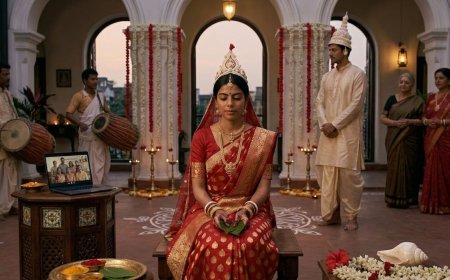
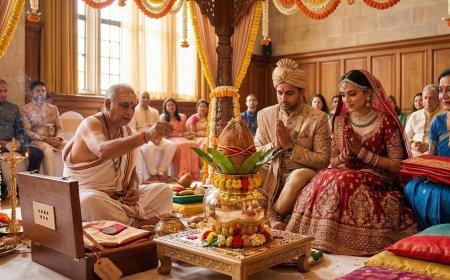
The ceremony had been building for forty minutes toward the specific moment of the pheras — the seven sacred circuits around the fire that are the ritual heart of the Hindu wedding ceremony. The Pandit's recitation had been beautiful. The mandap decorations were extraordinary. The guests were present and attentive in the specific way that a well-conducted ceremony produces.
The groom leaned toward the microphone to repeat the Sanskrit vow the Pandit had just recited.
The feedback was immediate, sustained, and catastrophic — a shriek of amplified sound that sent the front rows of guests physically recoiling, that shattered the ceremony's atmosphere in the specific way that only a sudden, very loud, very wrong sound can shatter it, and that took eleven seconds to resolve while the venue's audio technician — who had been found, eventually, standing near the catering station — located the gain control and reduced it.
Eleven seconds of audio feedback during the pheras of a Hindu wedding ceremony is not a minor inconvenience. It is the specific memory that several guests carry from that wedding — the thing they mention when they describe it to people who were not there. Not the mandap. Not the bride's lehenga. Not the Pandit's beautiful recitation of the forty minutes that preceded it. The eleven seconds of feedback.
The cause, identified afterward by the DJ who had been watching from the back of the room: the venue's provided microphone system had not been properly set up for the ceremony space. The gain had been set for the larger reception hall rather than recalibrated for the intimate ceremony room. The audio technician had not been briefed on the ceremony's requirements. The couple had been told that the venue's sound system was "fully managed" and had not known what questions to ask.
This situation — and the specific moment of the pheras feedback — was entirely preventable. It required either a properly briefed venue audio team or an independently rented system managed by someone who understood the ceremony's requirements.
This guide provides what the couple needed to know before the ceremony.
The Core Decision: Understanding What It Actually Involves
The decision between venue-provided audio and independently rented audio is not a binary choice between two equivalent options with different price points. It is a decision about who controls the sound quality at the most significant events of the wedding — and what their competence, their equipment, and their specific investment in the outcome actually is.
What "Venue-Provided Sound System" Actually Means
The phrase "fully equipped sound system included" in a venue's promotional materials describes a range of actual situations that are wider than the phrase implies.
At the best end of the range: a professionally installed, properly maintained audio system calibrated for the specific venue's acoustics, managed by an experienced in-house audio technician who has operated the system for hundreds of events in the space and who understands its specific characteristics and limitations.
At the other end of the range: a system that was installed when the venue opened, that has been maintained to the standard of a venue whose core business is the food and the decoration rather than the audio, managed by a staff member whose primary role is something else entirely and who operates the sound system as a secondary responsibility.
The majority of NRI wedding venues — including many prestigious and expensive properties — sit somewhere between these extremes, with audio provision that is adequate for the average wedding and that may not be adequate for the specific requirements of the NRI wedding's multi-event, multi-space, multi-format programme.
The specific questions that reveal where a venue sits on this range:
Who specifically operates the sound system during events — a dedicated in-house audio technician or a member of the general events staff? How many events using the current system has this person personally operated? When was the system last professionally serviced? What is the specific equipment — the make and model of the main speakers, the mixing desk, the wireless microphone system? Is the audio provision the same across all event spaces or different by room? What happens if equipment fails during an event — is there a backup system, and what is the response protocol?
The venue that answers these questions specifically and confidently has an audio operation it is proud of. The venue that answers vaguely, that redirects to the events coordinator rather than the technical team, or that does not know the equipment specifications — this venue's audio provision should be independently verified before it is relied upon.
What Independent Sound System Rental Actually Means
The independently rented sound system is a system sourced from a professional audio rental company, selected for the specific requirements of the specific events, operated by a technician whose entire professional focus is audio production rather than venue operations.
The independent rental is not automatically superior to the venue-provided system — a genuinely excellent venue audio system, properly operated by a competent in-house technician, may be better than a rental system managed by a less experienced operator. But the independent rental gives the couple control — the ability to specify the equipment, the operator, and the standard — in a way that the venue-provided system, whose variables are set by the venue rather than the couple, does not.
The specific advantages of independent rental:
Equipment selection: the couple selects the specific equipment appropriate for their specific events — the line array system for the outdoor reception, the discreet column speakers for the ceremony space, the wireless microphone system with the range and the reliability appropriate for a large wedding.
Operator selection: the couple selects the audio technician — can meet them in advance, can assess their experience and their specific familiarity with the NRI wedding's audio requirements, can brief them specifically on the ceremony's requirements and the sangeet's technical demands.
Accountability: the rental company's contract creates a specific accountability for the audio quality — the couple has a clear counterparty if the audio fails to deliver. The venue's included audio provision is typically not separately contracted and its failure is harder to address.
The NRI Wedding's Specific Audio Requirements
The NRI wedding's multi-event programme creates specific audio requirements that are more complex than the standard single-event wedding and that test the venue-provided system's capability more thoroughly.
The Ceremony's Audio Requirements
The Hindu ceremony's audio requirements are specific and often poorly understood by venue audio teams who have more experience with Western-format ceremonies or with receptions than with multi-hour Sanskrit recitation ceremonies with multiple microphone positions and specific acoustic requirements.
The Pandit's microphone:
The Pandit's recitation — delivered over a period of two to four hours, at close range to the microphone, in Sanskrit that is not intelligible to most guests but whose sound and cadence are part of the ceremony's atmosphere — requires a microphone setup that is unobtrusive, reliable, and calibrated for speech rather than performance. The lapel microphone is the most appropriate format — freeing the Pandit's hands for the ritual actions of the ceremony and providing consistent audio regardless of the Pandit's head position during recitation.
The feedback risk during the ceremony is highest at the Pandit's microphone — because the combination of sustained close-range speech, a relatively high gain setting needed to project across the ceremony space, and the acoustic reflections of a reverberant venue creates the specific conditions for feedback. The audio technician who understands this risk sets the gain appropriately, positions the speakers to minimize reflective paths, and monitors the system continuously during the ceremony rather than setting it and stepping away.
The couple's microphone:
The couple's microphone — used for their vow responses, for the moments when they are invited to speak during the ceremony — requires the same care as the Pandit's microphone, with the additional consideration that the couple is not an experienced microphone user and may hold it incorrectly, speak at inconsistent distances from it, or turn away from it at critical moments.
The wireless handheld microphone, passed between the Pandit and the couple at the appropriate moments, is a common solution — but requires a competent technician managing the gain changes as the microphone transfers between users with different voice volumes and microphone technique.
The ceremony music:
The shehnai, played live at the ceremony, requires either a dedicated microphone pickup or, for a large ceremony space, a microphone-and-amplification setup that projects the acoustic instrument without losing its specific tonal character. The shehnai amplified through a microphone that is optimized for speech — as venue-provided microphone systems often are — may sound thin and harsh. The microphone appropriate for the shehnai is a condenser microphone positioned at a specific distance from the instrument — a specific technical requirement that the venue audio team may not know to apply.
The Sangeet's Audio Requirements
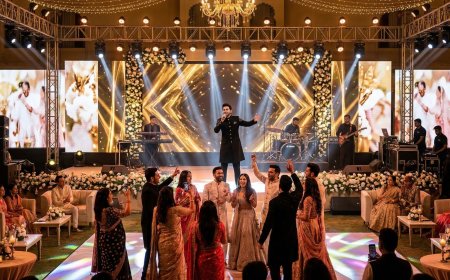
The sangeet's audio requirements are the most complex of any wedding event — combining the playback requirements of a DJ or live band, the reinforcement requirements of a live performance space, the specific audio cues of multiple family performances each with their own technical requirements, and the management of a programme that changes format frequently across a long evening.
The DJ's audio integration:
The DJ's equipment — their own mixer, their own laptop, their own specific audio processing — must integrate with the venue's speaker system cleanly. The interface between the DJ's output and the venue's amplification system is a specific technical connection point that, when managed incorrectly, produces audible noise, distortion, or level mismatches that degrade the audio quality throughout the evening.
The DJ who has worked in the specific venue before knows how to make this connection cleanly. The DJ working in a venue for the first time needs a soundcheck — a proper, unhurried soundcheck, not the five-minute check that happens as guests are arriving — to establish the correct connection and the correct levels.
The performance programme's audio requirements:
Each family performance in the sangeet programme has specific audio requirements — the audio file for the playback track, the microphone for any live vocal elements, the specific level adjustments as the programme moves from one performance to another. The audio technician managing the sangeet's performance programme is operating in a live production environment — making real-time adjustments across a complex, fast-changing programme — and their competence in this environment directly determines the quality of every performance.
The performance that begins at the wrong volume — either too quiet, so the energy is lost before the audience can respond, or too loud, so the first impression is overwhelming — is the performance whose quality has been compromised by the audio before the performers have done anything.
The Outdoor Event's Audio Requirements
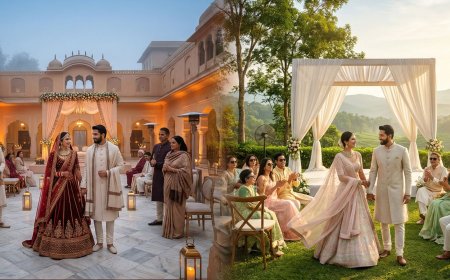
Many NRI weddings include outdoor events — the baraat arriving at an outdoor forecourt, the mehendi in a garden, the reception on a terrace or a lawn. Outdoor events have specific audio requirements that indoor systems are not designed to address.
The sound dispersion problem:
Indoor audio systems are designed for enclosed spaces where sound reflects off walls and ceilings, building the room's overall sound level. Outdoor spaces have no such reflection — sound disperses in all directions from the speaker, losing level rapidly with distance. The outdoor event that uses an indoor speaker system produces adequate volume near the speakers and insufficient volume at the edges of the event space.
The appropriate outdoor audio solution is a distributed speaker system — multiple speakers positioned to cover the full event space rather than a single speaker system attempting to cover it from a central position — or a line array system whose directional characteristics allow effective coverage of a large outdoor space from a smaller number of speakers.
The ambient noise competition:
Outdoor events compete with ambient noise — traffic, wind, neighboring events at the same venue — that indoor events do not. The audio level required to be heard clearly over outdoor ambient noise is higher than the level required in an indoor space of equivalent size, which requires both a more powerful system and more careful calibration to avoid the audio level that drives guests away from the event space rather than toward it.
The Venue Assessment: What to Look For
The Site Visit's Audio Component
Every site visit to a potential wedding venue should include a specific assessment of the venue's audio provision — not just the visual inspection of the spaces and the conversation with the events coordinator about menus and layouts, but a specific conversation with the venue's audio technician and, ideally, a demonstration of the system in the actual event spaces.
The demonstration:
Ask to hear the system operating in the ceremony space and in the reception space. Play a piece of music through it and listen for: the clarity of the high frequencies — the crispness of the speech and the definition of the upper harmonics that indicate a well-maintained system. The balance of the bass — the appropriate warmth without the muddiness that indicates a system with blown or aging drivers. The coverage — walking to the edges of the space and assessing whether the volume and the tonal character are consistent throughout or whether there are dead spots and hot spots that indicate a poorly designed coverage pattern.
The wireless microphone system:
Ask to see the wireless microphone system and ask specifically about the number of simultaneous wireless channels available. The NRI wedding ceremony may require simultaneous wireless operation for the Pandit's lapel microphone, the couple's handheld microphone, and the officiant's microphone — three simultaneous channels minimum. The reception's programme may require simultaneous wireless operation for the DJ, the emcee, and multiple performers — potentially six to eight simultaneous channels.
The wireless microphone system that has two channels is not adequate for the NRI wedding's requirements regardless of how good those two channels are.
The backup provision:
Ask specifically about the backup provision — what happens if a wireless microphone drops signal during the ceremony, if a speaker fails during the reception, if the mixing desk develops a fault during the sangeet. The venue that has a specific backup protocol — replacement equipment available, a technician who knows how to deploy it quickly — is a venue whose audio provision can be trusted to manage the unexpected. The venue that does not have a specific backup protocol is a venue whose audio failure becomes the couple's problem.
The Heritage Venue's Specific Challenges
Many NRI weddings take place at heritage venues — the Rajasthani fort, the Mughal garden, the colonial-era hotel — whose architectural character is the primary reason for their choice and whose audio provision is often an afterthought in a building that was not designed for amplified sound.
The heritage venue's specific audio challenges: stone walls that create long reverb tails that make speech unintelligible at high volume levels, irregular room shapes that produce standing waves and uneven coverage, restricted cable routing that limits speaker positioning options, and historic fabric that cannot be modified or drilled without permission that may not be granted.
The heritage venue that has invested in a specifically designed audio system — one that has been calibrated for the space's specific acoustic character, with speaker positioning that works within the venue's physical constraints — may have excellent audio despite its architectural challenges. The heritage venue that has placed a standard conference room speaker system in a five-hundred-year-old stone hall has not made this investment and its audio quality will reflect it.
For heritage venues, the independent rental of a specifically designed audio system — one selected by an audio professional who has assessed the venue's acoustic character and whose equipment choice reflects that assessment — is more likely to produce good results than reliance on a venue-provided system that may not have been specifically designed for the space.
The Independent Rental: How to Do It Well
The Audio Professional as Consultant
The NRI couple who is assessing their venue's audio provision and considering independent rental needs an audio professional — not a DJ, not the wedding planner, not the venue's events coordinator — to provide the technical assessment that the decision requires.
The audio professional who visits the venue, assesses the acoustic character of each event space, reviews the venue's existing equipment, and provides a specific recommendation — rent independently for these events, rely on the venue for these events, supplement the venue's system with these specific additions — is providing a service whose cost is modest and whose value is significant.
The couple who makes the audio decision without this professional assessment is making it on the basis of incomplete information — and the consequences of that incomplete information may not become apparent until the ceremony feedback or the sangeet's inadequate coverage reveals what the assessment would have identified in advance.
The Equipment Specification
The independently rented sound system should be specified by the audio professional based on the specific requirements of the specific events in the specific venues — not selected from a rental company's standard packages without venue-specific calibration.
The specification should include: the main speaker system — type, quantity, and positioning for each event space. The subwoofer provision — the bass reinforcement that gives the sangeet and the reception their physical energy. The monitoring provision — the stage monitors that allow performers to hear themselves during the sangeet's performance programme. The microphone system — the specific microphones for the ceremony, the wireless system for the reception, the DI boxes for the DJ integration. The mixing desk — the console that allows the audio technician to manage all these inputs simultaneously. The cabling and the power provision — the infrastructure that connects everything and powers it.
The Audio Technician Selection
The audio technician who operates the independently rented system is as important as the equipment — more important, in some respects, because a skilled technician can make a good system sound excellent and a poor technician can make excellent equipment sound bad.
The specific qualities to look for in the audio technician for an NRI wedding: experience with Indian wedding events specifically — the familiarity with the ceremony's acoustic requirements, the sangeet's complex programme management, the reception's dance floor audio demands. The ability to work with the DJ — to integrate the DJ's equipment with the rented system cleanly and to manage the gain structure across the interface. The calm under pressure that live event production requires — the audio technician who responds to unexpected problems methodically rather than visibly.
The audio technician briefing — the specific conversation that communicates the wedding's programme, the specific requirements of each event, the critical moments that cannot have audio failures — should happen before the wedding week, not on the day of the event.
The Hybrid Approach: When to Mix Both Options
For many NRI weddings, the optimal audio solution is neither fully venue-provided nor fully independently rented but a hybrid that uses the venue's system where it is genuinely adequate and supplements or replaces it where it is not.
The ceremony: Independent rental of a specifically designed system, operated by a dedicated audio technician briefed on the ceremony's requirements. The ceremony's audio requirements are too specific and the consequences of failure too significant to rely on a venue system that has not been specifically calibrated for this purpose.
The mehendi: Venue-provided system typically adequate — the mehendi's audio requirements are modest, the event is intimate, and the consequences of audio imperfection are significantly lower than at the ceremony or the reception.
The sangeet: Dependent on the venue's system quality and the sangeet's specific technical demands. The sangeet with a complex performance programme and a large dance floor requires professional audio management — either a venue system operated by a genuinely experienced technician or an independent rental.
The reception: The reception's dance floor requires the specific audio quality and the specific volume calibration that the DJ's performance depends upon. The venue system that cannot deliver this standard should be supplemented or replaced.
The Budget Conversation: What Good Audio Actually Costs
The audio budget for an NRI wedding is consistently under-allocated relative to its impact on the event experience — and the couple who has spent significant sums on florals, catering, and photography but who has accepted the venue's included audio provision without assessment has made a specific allocation decision whose consequences they may not discover until the feedback shriek during the pheras.
The specific cost guidance: professional audio rental for a multi-event NRI wedding — ceremony system, sangeet system, reception system, with a dedicated audio technician — is a meaningful budget line item. It is not the largest line item in the entertainment budget. It is not comparable to the cost of the florals or the catering. But it is the line item whose absence is most audible when the consequences of its absence arrive.
The investment in professional audio is not the investment in something extra. It is the investment in the baseline quality that everything else the couple has invested in deserves to be heard through.
The Sound That Nobody Notices
The best audio at a wedding is the audio that nobody notices — the sound that is simply there, that carries the Pandit's recitation and the couple's vows and the emcee's introductions and the DJ's midnight set with the clarity and the presence and the appropriate volume that allows every person in the room to receive the occasion fully.
The sound that nobody notices is not the default. It is the result of specific decisions — the venue assessment, the equipment selection, the technician briefing, the soundcheck that happened before guests arrived rather than as they were walking in. It is the result of treating audio as a production value rather than a facility, as an active design decision rather than a passive inclusion.
The eleven seconds of ceremony feedback is the sound that everybody notices.
The four-hour ceremony and the lifetime it consecrates deserves the sound that nobody notices.
NRIWedding.com — Expert guidance for Indian weddings planned across borders.
What's Your Reaction?
 Like
0
Like
0
 Dislike
0
Dislike
0
 Love
0
Love
0
 Funny
0
Funny
0
 Angry
0
Angry
0
 Sad
0
Sad
0
 Wow
0
Wow
0