







































































Bringing Fabric from Abroad to Jalandhar for Stitching — What Works Brilliantly and What Doesn't
For the NRI bride who has found the fabric before she has found the tailor — the vintage silk from a London market, the heirloom piece from a family trunk, the Japanese textile unavailable in India — bringing fabric from abroad to be stitched in Jalandhar is one of the most rewarding and most misunderstood approaches in the NRI bridal wardrobe process. This comprehensive guide by NRIWedding.com covers exactly which fabric categories work brilliantly with Jalandhar's master tailors and which create specific, avoidable problems — from pure silks and European wovens that translate exceptionally well, to stretch fabrics and fibre-unknown vintage pieces that require specific preparation and tailor selection. Includes the complete fabric preparation and travel protocol, customs and import guidance for fabric brought into India, the fabric information sheet every bride should carry to the first appointment, a full fabric-type compatibility table, and the five most costly mistakes NRI brides make when supplying their own fabric for commission work in Jalandhar.

Bringing Fabric from Abroad to Jalandhar for Stitching — What Works Brilliantly and What Doesn't
The Silk From Spitalfields
Amandeep had found it on a Saturday in November.
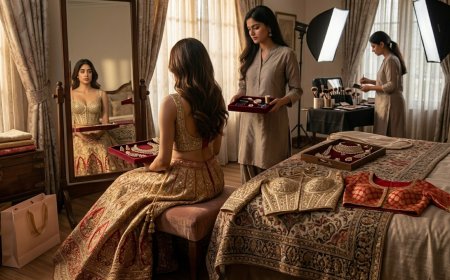
She had not been looking for it specifically — or not in the way that the finding of it suggested she had been looking for it. She had gone to Spitalfields Market in East London on a Saturday morning with a vague intention of looking at the vintage textile stalls, which she visited periodically with the specific pleasure of someone who loves fabric without always having a precise use for it. She had spent an hour moving through the covered market, running her fingers along the edges of folded pieces, holding lengths up to the November light that came through the market's glass roof, and had found — in the third stall from the entrance, beneath a stack of Liberty prints that were not what she was looking for — a piece of pure silk dupioni in a colour she had no name for.
It was not ivory. It was not champagne. It was not the pale gold that those two descriptions orbit around. It was something more specific and more rare than any of those — a warm, slightly green-toned cream, the colour of old paper held to a candle, with the characteristic horizontal slub of dupioni woven into it at irregular intervals that caught the light in a way that changed the colour's character depending on the angle. She had held it at three different angles before she understood that what she was looking at was not a single colour but a relationship between the fabric's structure and the light — a relationship that would change through the day of a December wedding in Jalandhar as the light moved from the thin morning sun through the bridal photographs to the warm interior light of the evening reception.
She had bought four metres. The stall owner, who had been watching her with the appreciation of someone who recognises genuine attention to fabric, told her it had come from a Venetian estate sale — that it was probably forty years old, that it had been kept in archival conditions that had preserved the lustre, and that it was, in his professional opinion, one of the finest pieces of vintage dupioni silk he had handled in twenty years of trading.
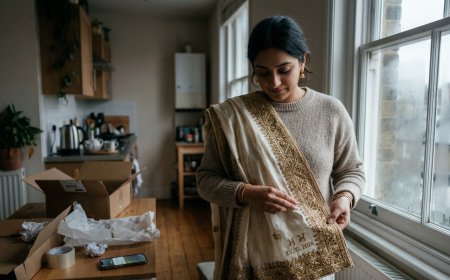
Amandeep had carried it home on the Overground, sitting with the folded piece in her lap with the specific care of something that has been recognised rather than simply purchased.
The question she had not yet asked herself — the question that would occupy her for the following three weeks, generating a WhatsApp conversation with her mother, two calls to a tailor in Jalandhar recommended by her aunt, and eventually the research that this guide emerged from — was whether the silk from Spitalfields could become the bridal outfit she wanted it to become, in the hands of a tailor in Jalandhar who had not handled the fabric, had not seen it in the specific light of a London Saturday, and who would be working from a brief communicated across time zones and a physical package delivered by international courier.
The answer, she discovered, was yes — with conditions.
This guide is for Amandeep, and for every NRI bride who has found the fabric before she has found the tailor, and who needs to understand exactly what bringing fabric from abroad to Jalandhar for stitching requires, what it achieves, and where it goes wrong.
Why This Happens More Often Than You Might Expect
The NRI bride who brings fabric from abroad to be stitched in Jalandhar is not an unusual customer in Jalandhar's tailoring market. She is, in fact, a recurring presence — frequent enough that the city's better tailors have developed specific experience, specific opinions, and specific practices for working with fabric sourced outside India.
The reasons NRI brides bring fabric from abroad are varied but tend to cluster around three distinct motivations. The first is the vintage or specialist fabric — the Spitalfields silk, the heirloom piece found in a family collection, the specific textile available only in a country other than India, bought because it was right before any other consideration had been resolved. The second is the quality-controlled purchase — the NRI bride who does not trust the fabric market in Jalandhar to provide what she wants at the quality she wants, or who has had a previous experience of fabric quality misrepresentation and has decided to source the fabric herself where she can verify it independently. The third is the specific fabric identity that forms the core of the design brief — the bride whose entire bridal vision is built around a specific fabric she has found, in which the fabric itself is not the starting point for the garment but is the garment's essential nature.
Each of these motivations is legitimate. Each of them also creates specific challenges in the tailoring process that are worth understanding before the fabric leaves its country of origin.
What Works Brilliantly — The Fabric Categories and Contexts Where This Approach Succeeds
Pure Silk in All Its Forms
Pure silk — dupioni, Banarasi, Kanjeevaram, raw silk, silk satin, silk georgette — is the category where bringing fabric from abroad to Jalandhar's tailors works most brilliantly and most consistently. Jalandhar's master tailors have a lifetime of experience working with pure silk in all its forms. They understand the specific cutting requirements of silk — the tendency of certain silks to slip during cutting, the need for tissue paper beneath the fabric when cutting slippery weaves, the specific seam allowances that silk requires to prevent fraying. They understand the pressing requirements — the temperature, the cloth between the iron and the fabric, the specific treatment of different silk weaves. They understand the finishing requirements — the French seams, the Hong Kong seams, the specific methods that protect a silk edge for the duration of a garment's life.
The silk brought from abroad arrives in Jalandhar as a known quantity — the bride has handled it, assessed it, verified its quality before it left her hands. The tailor receives fabric whose quality has been established rather than fabric whose quality must be assessed at the point of receipt. The garment that emerges from this collaboration — the bride's fabric, the tailor's skill — can be genuinely extraordinary, and in the specific category of the bridal outfit made from an exceptional piece of fabric found through patient, attentive searching, it represents the highest expression of what Indian bridal tailoring can produce.
European and Japanese Wovens
European and Japanese woven fabrics — the fine wools, the structured silk-wool blends, the Japanese double-weave cottons, the European brocades and jacquards that are produced to a manufacturing standard not always available in the Indian fabric market — translate exceptionally well to Jalandhar's tailoring skill set when the brief is appropriate. The NRI bride who wants a reception outfit in a structured European fabric, or a pre-wedding function outfit in a Japanese cotton of unusual fineness, and who is bringing that fabric to Jalandhar for construction, is using the combination of international fabric sourcing and Indian tailoring skill in exactly the way that produces the best results from both.
The specific advantage of Jalandhar's tailors for these fabric categories is their understanding of construction — the structural discipline that a woven fabric of this kind requires, the precision of the seam work that the fabric's quality demands, and the finishing standard that a European or Japanese fabric's inherent quality makes visible in a way that lower-quality base materials do not. A seam that is adequately finished on an inferior fabric is obviously inadequate on a fine European wool. Jalandhar's master tailors understand this relationship between fabric quality and construction standard, and the better ones rise to the standard that the fabric sets.
Heirloom and Vintage Fabrics
The heirloom piece — the grandmother's saree that is to be reborn as a blouse, the vintage silk rescued from a family trunk, the Partition-era Banarasi that has been kept in tissue for two generations and is now to be made into something the next generation can wear — represents the category where bringing fabric from abroad to Jalandhar achieves things that no other approach can achieve. The tailors of Jalandhar have a specific relationship with heirloom Indian textiles that comes from the culture and the history they share with those textiles. A Jalandhar tailor who receives a piece of seventy-year-old Banarasi silk and is asked to make a bridal blouse from it is working within a tradition that connects the old fabric and the new garment in a way that a tailor in London or Toronto, however skilled, cannot replicate.
The practical requirements for heirloom fabric work are specific and demanding, and the tailor selected for this brief must be chosen with particular care. The heirloom piece is irreplaceable. An error in cutting — a pattern piece placed incorrectly, a measurement applied to the wrong grain line — cannot be corrected. The tailor who receives heirloom fabric for a commission must demonstrate, before any cutting begins, a specific understanding of how to work with fabric whose irreplaceability changes the entire risk profile of the construction process.
Embellished Fabric Panels From Other Countries
The NRI bride who has purchased embellished fabric panels in another country — embroidered panels from a specialist in Uzbekistan, brocade panels from a Japanese textile house, the specific hand-woven embellished fabric available from certain Central Asian craft communities — and who wants these panels incorporated into a garment constructed in Jalandhar, is working in a category where the approach works well if the communication of the brief is precise and the tailor selected has specific experience with unusual fabric types.
The key challenge in this category is that the panels have been made without a garment pattern, and the construction must therefore be designed around the panels rather than the panels being cut to fit a pre-existing pattern. The tailor who understands this — who begins the design process by understanding the dimensions and the layout of the panels and works the garment pattern around what the fabric provides — produces a garment that honours the fabric. The tailor who imposes a standard pattern on an embellished panel, cutting it to fit the pattern regardless of how that cutting affects the embellishment, destroys the fabric to save the process.
What Doesn't Work — The Categories and Contexts Where Problems Arise
Fabric That Has Not Been Pre-Washed or Pre-Shrunk
This is the single most common source of failure when fabric is brought from abroad for stitching in Jalandhar, and it is the failure that is simultaneously most preventable and most frequently overlooked. Natural fibres — cotton, linen, even certain silk weaves — shrink when they encounter water for the first time after construction. A garment made from fabric that has not been pre-washed will shrink the first time it is cleaned, and the shrinkage will not be uniform — the fabric will shrink, but the seams and the interfacing will not shrink at the same rate, creating distortion that cannot be corrected after the fact.
The pre-washing requirement varies by fabric type. Cotton and linen should always be pre-washed before stitching — washed in the same manner they will be washed after construction, dried in the same conditions, and pressed before the tailor receives them. Silk typically does not require pre-washing but benefits from a gentle hand wash to remove any finishing chemicals applied during manufacturing. The specific pre-treatment required for the fabric being brought should be established before the fabric is prepared for travel.
The failure to pre-wash is not the tailor's error if the fabric arrives unprepared. It is the bride's error for not having understood the requirement before the fabric left her hands.
Stretch Fabrics and Knits
Stretch fabrics — jersey, lycra blends, ponte, and similar knit constructions — are the category where Jalandhar's tailoring skill set is least reliably equipped for the specific technical requirements that stretch fabric demands. Stretch fabric requires different machinery — specifically, an overlocker or serger for the seam finishing, and ideally a coverstitch machine for the hems — and a different pattern-making approach that accounts for the fabric's stretch in both directions. The tailors who work primarily with woven fabrics, which constitute the majority of Jalandhar's bridal tailoring, may not have the machinery or the specific pattern-making experience for stretch fabric work.
This does not mean that no tailor in Jalandhar can work with stretch fabric. It means that the specific question — do you work with stretch fabric, what machinery do you use, what is your approach to pattern-making for stretch — must be asked and answered specifically before any stretch fabric commission is placed. The tailor who answers vaguely, or who treats the stretch fabric question as equivalent to any other fabric type question, is a tailor whose stretch fabric experience may be limited.
Very Lightweight Fabrics Without Clear Construction Direction
Extremely lightweight fabrics — tissue silk, fine chiffon, the most delicate organza — require specific handling in construction that not every tailor is equipped to provide. The challenge is not the fabric's fragility, which experienced tailors can manage, but the specific construction decisions that very lightweight fabrics require: the seam type that provides structure without bulk, the hem treatment that finishes the edge without adding visible weight, the interfacing choice that provides enough body for the garment to hold its shape without overwhelming the fabric's inherent lightness.
The NRI bride who brings a very lightweight fabric to a tailor whose experience is primarily in heavy bridal fabrics — the zardozi-embellished silks, the brocades, the heavily structured base fabrics of the traditional bridal lehenga — may find that the construction decisions made with those fabrics in mind are not optimal for a tissue silk or a fine chiffon. The brief for very lightweight fabric should specify the construction approach explicitly, including the seam type, the hem treatment, and the interfacing requirement, and should be confirmed with the tailor as achievable before the commission is placed.
Fabric With Unclear Fibre Content
Fabric whose fibre content is uncertain — vintage pieces without documentation, fabric purchased from informal markets where labelling is absent, blended fabrics where the blend proportions are unknown — presents specific risks in the tailoring process that the tailor cannot manage without the information they need. The pressing temperature for a wool blend differs from the pressing temperature for a silk blend. The washing requirements for a cotton-synthetic blend differ from those for a pure cotton. The interfacing adhesion for a linen-rayon blend differs from that for a pure linen.
If the fibre content of the fabric being brought from abroad is uncertain, test it before it leaves. The burn test — a small snip from the hem edge, burned in a controlled manner and assessed for the smell, the ash, and the burn behaviour — is a reliable method for distinguishing the major fibre categories: silk burns slowly with a protein smell and a crushable ash; cotton burns quickly with a paper smell and a powdery ash; synthetic fibres melt rather than burn and produce a hard, non-crushable bead. Take this test at home, document the result, and communicate it to the tailor along with the fabric.
The Customs and Import Considerations
The NRI bride who is travelling to India with fabric — whether in hand luggage, in checked luggage, or as part of a larger consignment of personal effects — should understand the customs implications of bringing fabric into India from abroad.
Personal effects — items for personal use that are not being imported for commercial purposes — are generally permitted entry into India within the framework of the passenger baggage rules, which allow a duty-free allowance for personal items. Fabric brought for personal use as part of a wedding wardrobe falls within this framework in principle. The practical risk arises when the quantity or the declared value of the fabric exceeds what a customs officer considers reasonable for personal use, or when the fabric is of a type or provenance that attracts scrutiny.
The practical guidance is straightforward. Carry fabric in luggage rather than as a separate declared consignment where possible — fabric as part of personal luggage is treated as personal effects, while fabric shipped separately is treated as an import and attracts the corresponding duties and documentation requirements. Carry a receipt or proof of purchase for any high-value fabric, both to establish the declared value accurately and to provide documentation if the purchase is questioned. Do not carry fabric in quantities that exceed what a personal wedding wardrobe might plausibly require — the bride who arrives with twenty metres of silk dupioni may attract more scrutiny than the bride who arrives with four.
For fabric that is being shipped to Jalandhar in advance of the bride's own travel — the practical approach when the fabric quantity is larger than hand luggage accommodates — the import documentation requirements are more significant. The shipment must be declared as a personal import, the value must be accurately declared, and the applicable duty — which varies by fabric category and country of origin — must be paid on arrival. The tailor who will be receiving the shipped fabric should be consulted about the receiving process, as a shipment arriving at a commercial address may be treated differently from a shipment arriving at a residential address.
How to Prepare Fabric for Travel
The preparation of fabric for international travel is a step that most NRI brides either skip or conduct inadequately, and the inadequacy shows when the fabric is unpacked at the other end.
Washing and Pre-Treatment
As established above, natural fibre fabrics that require pre-washing should be washed before they travel. Wash them in the manner they will be cleaned after construction — not more aggressively, not less. Press them after washing. Fold them along the grain rather than across it where possible. The fabric that arrives in Jalandhar pre-washed and correctly pressed is fabric that the tailor can begin work on immediately without the delay of pre-treatment.
Folding and Storage for Travel
Fabric should be folded as few times as possible for travel, to minimise the fold lines that must be pressed out before cutting. Rolling rather than folding is the superior approach for most fabric types — a rolled piece arrives with a curve rather than a crease, and a curve can be removed by hanging while a crease requires pressing. Roll the fabric around an acid-free tissue paper core, secure the roll with a cotton tape tie rather than elastic or rubber bands that can leave marks, and wrap the exterior of the roll in a clean cotton pillowcase or a length of muslin.
For vintage or heirloom fabric that is being carried as hand luggage, additional protection is warranted. Place the rolled and wrapped piece inside a rigid tube — a cardboard tube from a fabric shop, a postal tube of appropriate diameter — that prevents the roll from being compressed in transit. Label the tube clearly as fragile and as containing textile material. Carry it on rather than checking it wherever the airline's policies permit.
Documentation
Prepare a fabric information sheet for every piece of fabric being brought to the tailor. The document should include the fibre content as determined, the fabric width, the total yardage or metreage, the country of origin, the washing and pressing requirements, the price paid and its currency, and any relevant information about the fabric's provenance or history that the tailor should know. This document travels with the fabric and is handed to the tailor at the first appointment as part of the brief.
The Brief for a Fabric-Supplied Commission — What It Must Cover
The brief for a commission in which the fabric is supplied by the bride rather than sourced by the tailor has specific requirements that the standard commission brief does not. It must cover the fabric's specific properties — what it does well, what it does not do well, what the construction approach should account for. It must cover the quantity available — the tailor cannot order more fabric if the cutting requires it, and the pattern must be designed to work within the available metreage. It must cover the cutting direction — whether the fabric has a nap, a pile direction, or a woven pattern that must be matched across the seam lines. And it must cover the specific treatment requirements — the pressing temperature, the interfacing type, the seam finishing method — that the fabric's properties demand.
The NRI bride who hands the tailor a piece of Venetian dupioni silk and says make me a blouse is providing the fabric without the brief. The NRI bride who hands the tailor the fabric, the fabric information sheet, the measurement document, and the design brief with the specific construction requirements specified has given the tailor everything they need to do the work correctly.
The Table: Fabric Types — Travel Suitability, Tailoring Compatibility and Jalandhar Tailor Skill Match
| Fabric Type | Pre-Treatment Required | Travel Method | Jalandhar Tailor Compatibility | Key Risk | Brief Requirement |
|---|---|---|---|---|---|
| Pure silk (dupioni, raw silk) | Light hand wash if new | Roll in acid-free tissue, carry on | Excellent — lifetime experience | Slippage during cutting | Specify seam type and pressing temperature |
| Silk georgette / chiffon | None typically | Roll, rigid tube if vintage | Very good — common in bridal work | Seam bulk at lightweight | Specify French seam or rolled hem |
| Vintage / heirloom silk | Specialist conservation clean | Roll in acid-free tissue, rigid tube, hand luggage only | Excellent with right tailor | Irreplaceable — cutting error unrecoverable | Full provenance document, test swatch for pressing |
| European brocade / jacquard | None | Roll or fold on grain, carry on | Very good — structured fabric experience | Pattern matching at seams | Specify pattern repeat and matching requirement |
| Japanese cotton (fine weave) | Pre-wash in cool water | Roll, carry on | Good — experienced tailors adapt | Shrinkage if unwashed | Pre-wash documentation, specify finish |
| Linen / linen blends | Pre-wash, press on grain | Fold on grain, avoid excess folds | Good — common fabric in region | Shrinkage, pressing creases | Pre-wash required, pressing temperature specified |
| Stretch jersey / knit | None | Roll, avoid compression | Variable — machinery dependent | Seam puckering, hem rolling | Confirm machinery availability before commission |
| Embellished panels (foreign) | None | Rigid protection, carry on | Good with experienced tailor | Pattern imposed on panel | Brief must specify panel-led construction |
| Fabric with unknown fibre content | Burn test and document | Standard for identified type | Good if fibre content confirmed | Pressing damage, interfacing failure | Fibre content document essential |
Common Mistakes NRI Brides Make When Bringing Fabric From Abroad to Jalandhar
The first mistake is not pre-washing natural fibre fabrics before travel. The garment that shrinks after the first cleaning because the fabric was not pre-washed before construction is a garment that was made incorrectly from the first appointment, regardless of how skilled the construction. The pre-washing requirement is the bride's responsibility, not the tailor's, when the fabric is supplied by the bride. Know the requirement, execute it before the fabric leaves your hands.
The second mistake is bringing insufficient metreage. The NRI bride who purchases exactly the metreage she estimates the garment requires, without the additional allowance for pattern matching, grain line requirements, potential cutting errors, and the specific inefficiency of cutting a garment pattern from a piece of fabric that was not produced with that garment in mind, arrives in Jalandhar without enough fabric to make the garment correctly. The general rule is to purchase twenty to thirty percent more fabric than the garment's estimated requirement — more for fabrics with a pattern repeat that must be matched, more for very lightweight fabrics that require greater seam allowances for structural reasons, more for heirloom pieces where the anxiety of insufficient fabric is not manageable.
The third mistake is not communicating the fabric's specific properties to the tailor in the brief. The tailor who receives the Venetian dupioni silk without knowing it is vintage, without knowing its pressing requirements, without knowing its specific cutting behaviour, is being asked to apply standard construction decisions to a non-standard fabric. Some tailors will ask the right questions. Some will not. The bride who provides the information proactively, in the fabric information sheet that accompanies the piece, ensures the tailor has what they need regardless of whether they would have asked for it.
The fourth mistake is selecting a tailor on the basis of their general bridal reputation rather than their specific experience with the fabric type being brought. The tailor who is excellent with heavily embroidered bridal fabrics — the zardozi silks, the structured base fabrics of the traditional lehenga — may not be the correct tailor for a commission in fine European linen or stretch jersey. Ask specifically about experience with the fabric type. Ask to see previous work in the same category. The general reputation is evidence of general competence. The specific reputation for the specific fabric category is the evidence that matters for this commission.
The fifth mistake is not having a test cutting done before the main garment pieces are cut. A small test piece — a seam sample in the actual fabric, pressed with the actual pressing method, finished with the proposed seam finish — takes twenty minutes and costs a small amount of the fabric's total metreage. It reveals, before any irreversible cutting has been done, whether the proposed construction approach works with this fabric or whether adjustments are required. For vintage or heirloom fabric specifically, the test cutting is not optional. It is the minimum required before any irreplaceable material is committed to a construction process whose compatibility with that material has not been confirmed.
What Amandeep Wore in December
The silk from Spitalfields became a blouse.
Not the entire four metres — the blouse required one and a half metres, leaving two and a half metres that Amandeep kept in the original fold, stored in the muslin wrap the stall owner had used, because the remaining piece was too extraordinary to use carelessly and the correct use had not yet presented itself.
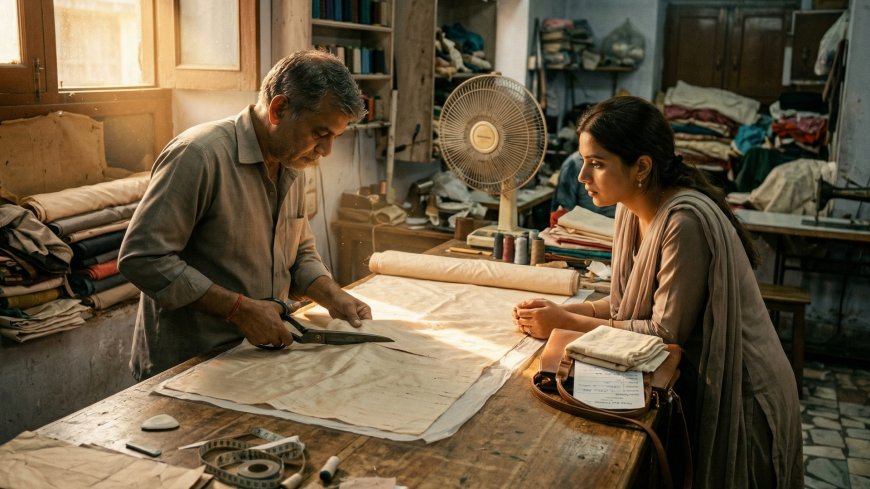
The tailor in Jalandhar — a specialist in the Model Town lanes who had been recommended by two independent NRI community contacts and who had, at the consultation appointment, spent ten minutes handling the fabric before she said a single word about the construction — made the blouse over three weeks. The first week was the toile, which revealed a shoulder adjustment that the measurements had not anticipated. The second week was the construction — the cutting done with tissue paper beneath the fabric to prevent slippage, the seams French-seamed in the traditional manner for fine silk, the pressing done with a dry iron at the lowest silk temperature with a press cloth between the iron and the fabric's face. The third week was the finishing and the final fitting.
The blouse was collected on a Wednesday morning. Amandeep put it on in the fitting room and looked at it in the mirror in the specific, slightly disbelieving way of someone who has found something they were looking for without being certain it could be found.
The colour in the fitting room's morning light was exactly the colour she had seen in Spitalfields in November — the warm, slightly green-toned cream of old paper held to a candle, the slub of the dupioni weave catching the light in the shifting, directional way she had assessed from three angles at the market stall.
She wore it at the wedding in December. In the reception photographs, taken in the warm interior light of the evening, the colour was different from the morning photographs taken outside — warmer, more golden, the green tone receded, the old paper becoming something more amber, more present, more alive.
The silk had been right about itself. The tailor in Jalandhar had understood what the silk was saying.
The two and a half metres that remained came back to Nottingham in the same muslin wrap. They are in a drawer. They are waiting for the correct use to present itself.
They will find it.
Pre-wash natural fibres before they leave your country. Roll rather than fold for travel. Write the fabric information sheet and carry it with the piece. Buy twenty to thirty percent more than you estimate. Ask the tailor specifically about experience with the fabric type. Do the test cutting before the main pieces are cut.
And when the fabric knows what it is — when you have found the piece that exists in a specific register of light and colour that no other piece quite inhabits — trust it. Jalandhar has the hands to make it into what it is already trying to become.
Published by NRIWedding.com — The Premium Global Platform for Non-Resident Indians Planning Indian Weddings From Abroad.
What's Your Reaction?
 Like
0
Like
0
 Dislike
0
Dislike
0
 Love
0
Love
0
 Funny
0
Funny
0
 Angry
0
Angry
0
 Sad
0
Sad
0
 Wow
0
Wow
0