





































































Phulkari Customisation in Jalandhar — Getting Handmade Embroidery Done to Your Exact Design
For the NRI bride whose design exists in a notebook margin, a phone's camera roll, or the inherited visual memory of a family heirloom, Jalandhar's Phulkari craft community offers something the commercial market rarely advertises: the ability to commission a fully original piece — a new counted thread design, worked in pat silk on your chosen base fabric, by an embroiderer whose hands speak the same technical language as the bagh in your grandmother's back bedroom. This guide covers the full spectrum of Phulkari customisation available in Jalandhar, from colour selection through to fully original design development — the technical language the brief must communicate, the makers who can execute it, the six-step commission process, and the specific mistakes NRI brides make when managing a craft commission of this complexity across time zones. Built for the bride who wants something that has never existed before and knows exactly why it matters.

Phulkari Customisation in Jalandhar — Getting Handmade Embroidery Done to Your Exact Design
The Pattern in the Margin
Jasleen had been drawing it for three years.
Not continuously, not with any particular intention at first — but in the margins of notebooks during meetings she was required to attend but not always required to think in, on the backs of envelopes in the kitchen in Wolverhampton on Sunday mornings when the house was quiet, in the notes app on her phone during the forty-minute train commute between Wolverhampton and Birmingham New Street that she had made five days a week for four years and that had become, without her fully intending it, the most reliably contemplative part of her day.
The pattern had begun as a memory. She was the granddaughter of a woman who had come from a village in the Hoshiarpur district of Punjab in 1962, who had brought with her a single piece of Phulkari — a bagh in the specific, dense, all-over coverage style of the Hoshiarpur tradition, in silk thread on khaddar cotton — that had been made by her own mother as part of her bridal preparation. The bagh had survived the journey, the decades, the various households it had passed through, and was now kept in a box in the back bedroom of Jasleen's parents' house in Wolverhampton, wrapped in the muslin that Jasleen's mother had rewrapped it in every few years with the specific attention of someone maintaining custody of something irreplaceable.
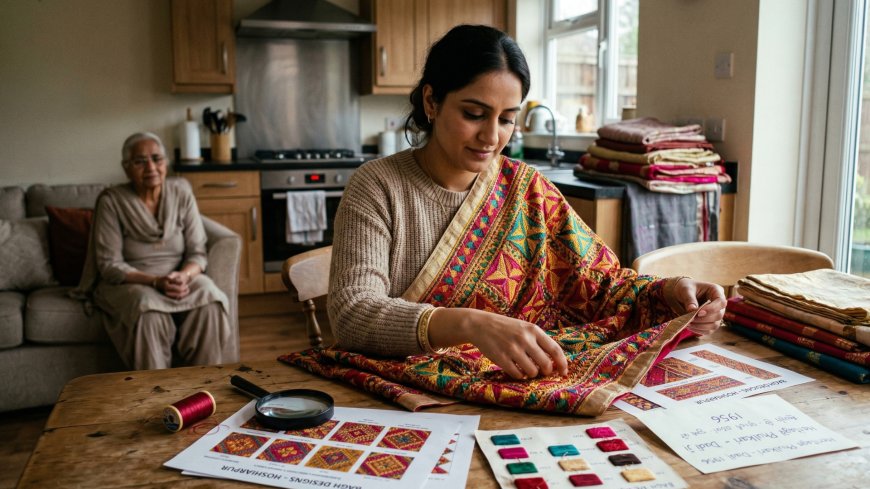
Jasleen had been allowed to look at the bagh twice — once as a child of nine, which had produced the vague, peripheral impression of something extraordinary that she carried without being able to fully articulate, and once as an adult of twenty-seven, the year before she got engaged, when she had asked to see it specifically and had spent forty minutes with it at the kitchen table in Wolverhampton, examining the geometric patterns with a magnifying glass her father used for model-making, photographing every section in the macro setting of her phone camera, turning it over to examine the reverse — the specific, orderly float stitches of the hand darning technique that distinguished genuine Phulkari from everything that imitated it.
The pattern she had been drawing in the margins was a translation. Not a copy of the bagh's patterns — those were her great-great-grandmother's designs, and copying them directly felt, to Jasleen, like something other than what she wanted to do with them. What she wanted to do with them was to carry them forward — to make something that was unmistakably from the same tradition, that spoke the same geometric visual language, that used the same logic of counted thread and repeated motif, but that was also specifically hers, made for her wedding, in her colours, in the year she was getting married.
The pattern in the margins was that translation. By the time she got engaged, it was detailed enough to be photographed and shared. By the time she had been engaged for six months, it existed in a clean, annotated digital version that she had made in a design app on her phone, with colour references and repeat specifications and the specific notes about proportion and spacing that three years of margin-drawing had produced.
The question — the question that drove the next six months of research, the WhatsApp conversations with her mother, the two calls to craft organisations in Jalandhar, the eventual discovery of the craftswomen who could make what she had drawn — was whether the pattern in the margin could become a piece of Phulkari.
The answer was yes. It required specific knowledge to get there.
This guide is for Jasleen, and for every NRI bride who has a design that exists somewhere — in a notebook margin, in a phone's camera roll, in the specific, inherited visual memory of a textile tradition that belongs to their family — and who wants to know exactly how to have it made.
What Phulkari Customisation Actually Means
The phrase Phulkari customisation is used in Jalandhar's craft market to describe a range of services that vary so significantly in what they actually provide that the phrase itself is almost meaningless without qualification. At one end of the spectrum, Phulkari customisation means choosing from a selection of existing patterns in a different colour than the standard. At the other end, it means working with a master embroiderer to develop an entirely original design, in a specific thread palette, in a specific coverage density, on a specific base fabric — a process that is genuinely creative and genuinely collaborative and that produces something that has never existed before.
The NRI bride who wants the latter and asks for the former will receive the former. The distinction between the two is not communicated by the commercial market — it is not in anyone's commercial interest to explain to a customer arriving with a colour preference that the service they are offering is not the service the customer actually needs. The NRI bride who understands the distinction before she arrives is the NRI bride who asks the right questions and finds the right maker.
The Three Levels of Customisation Available in Jalandhar
The first level is colour customisation. The embroiderer has a set of existing patterns — geometric, floral, figurative — and offers to execute them in thread colours specified by the customer rather than in the standard palette. This is the most common service offered under the name of customisation and is available from most commercial Phulkari retailers in Jalandhar with a lead time of four to eight weeks. It produces a genuine hand-embroidered piece in the customer's colours, but the design is not original — it is the embroiderer's existing pattern applied in different thread shades.
The second level is design selection with modification. The embroiderer has a library of patterns — typically developed over years of work and representing the tradition's established vocabulary — and offers to combine elements from different patterns, modify proportions, or adjust the density of coverage to create a piece that is distinct from any single existing design without being entirely original. This is a more sophisticated service, available from the more experienced ateliers in Jalandhar, and it produces a piece that is genuinely specific to the customer's brief without requiring the embroiderer to develop a completely new design from scratch.
The third level is fully original design development — the service that Jasleen needed and that this guide is primarily about. The customer provides an original design, or works collaboratively with the embroiderer to develop one, and the embroiderer translates that design into the specific technical language of the Phulkari tradition: the counted thread system, the specific stitch types, the thread palette, the coverage density, and the repeat logic that make a pattern executable in the hand darning technique on a specific fabric.
This third level is available in Jalandhar, but it is available from a small number of makers rather than from the commercial market generally, and finding those makers requires specific knowledge of where to look.
The Technical Language of Phulkari — What the Custom Brief Must Communicate
Before any customisation brief can be communicated to a Phulkari embroiderer, the NRI bride must understand enough of the tradition's technical language to translate her design intention into terms the embroiderer can work with. The embroiderer is a craftsperson, not a mind-reader, and the gap between a visual design concept and a technically executable Phulkari brief is a gap that the bride must be equipped to cross.
The Counted Thread Logic
Phulkari embroidery is not a freehand embroidery technique. It is a counted thread technique — the embroiderer works by counting the warp and weft threads of the base fabric and placing stitches at specific counted intervals, creating the pattern through the mathematical logic of the count rather than through the drawing of a pattern on the fabric surface. This means that every Phulkari design must be expressible as a counted thread chart — a grid in which each square represents a specific number of fabric threads and the stitch placement is indicated on the grid rather than drawn on the fabric.
The implication for the custom brief is significant. A design that looks possible in a digital sketch may not be executable in counted thread embroidery without modification. Curved lines, which are natural in drawing, must be approximated in the stepped geometry of a counted thread grid. Complex figurative elements must be translated into their geometric equivalent — the Phulkari tradition's birds and trees and human figures are not naturalistic; they are geometric abstractions that represent natural subjects through the logic of the grid. The custom brief that arrives as a naturalistic watercolour sketch requires translation into the counted thread language before it can be executed, and that translation is part of the collaborative work between the bride and the embroiderer.
The Thread Palette
Traditional Phulkari uses pat silk — the specific, lustrous silk thread with its characteristic directional sheen that has been discussed in the earlier guide to authentic Phulkari. The pat silk palette available from the thread suppliers who serve Jalandhar's embroidery community is extensive — dozens of shades across the warm and cool registers, the deep and pale intensities, the specific, undyed and naturally dyed colours that the tradition has historically used alongside the more recent synthetic dye range.
The custom brief should specify the thread palette as precisely as possible. Colour names are insufficient — "gold" and "deep rose" are imprecise to the point of meaninglessness in a tradition with dozens of shades in each colour family. The most reliable way to specify colour for a Phulkari commission is with physical thread samples — actual lengths of thread in the specific colours intended, purchased from a thread supplier before the commission begins and sent to the embroiderer as physical colour references. Digital colour references — screen images, hex codes — are unreliable because screen colour rendering is not standardised and the colour that appears on the bride's phone in Wolverhampton may not correspond to what the embroiderer sees on her phone in Jalandhar.
Coverage Density
The coverage density of the embroidery — the proportion of the base fabric that is covered by the thread work — is one of the most significant design decisions in a Phulkari commission and one that has the most direct effect on the timeline and the price. The bagh style, in which the thread covers the entire fabric surface, is the most time-intensive and most expensive coverage level. The open Phulkari style, in which the motifs are distributed across the fabric with deliberate negative space, requires less time and produces a different aesthetic. Intermediate coverage levels — dense borders with an open field, concentrated motif clusters with plain areas between — are available and represent the design range that most custom commissions explore.
The coverage density specification should be communicated as a percentage where possible — forty percent coverage, seventy percent coverage — or as a reference to an existing piece with a comparable density level. The embroiderer who understands the coverage density specification can give an accurate timeline and price estimate. The embroiderer who receives a vague brief and must guess at the coverage level will quote a price that may not reflect the actual work required.
The Base Fabric
The base fabric for the custom Phulkari commission is the material on which the embroidery is worked, and its choice affects every dimension of the finished piece — the visual character of the embroidery, the weight and drape of the finished piece, the durability of the work, and the relationship between the thread and the fabric that is the fundamental aesthetic character of the Phulkari tradition.
Traditional Phulkari uses khaddar — a handspun, handwoven cotton of specific texture and weight — as the base fabric. Khaddar has a surface structure that is ideally suited to the counted thread technique, with a clear, regular weave that makes the thread counting reliable and consistent. Contemporary Phulkari commissions use a range of base fabrics — georgette, chiffon, pure silk — that require adaptation of the traditional technique and that produce different visual results. The lighter base fabrics have a more contemporary aesthetic and are more appropriate for the modern bridal context. The khaddar base produces the most authentic expression of the tradition but may not suit the contemporary bridal brief.
The base fabric choice should be made in consultation with the embroiderer, who will have opinions about which fabrics work with the specific design being commissioned and which create technical challenges. The embroiderer who works primarily on khaddar may not have the same facility with silk georgette. The embroiderer who has adapted to contemporary base fabrics may produce different results on khaddar than on the fabrics she knows best.
Where to Find Genuine Phulkari Customisation in Jalandhar
The commercial market for Phulkari in Jalandhar — the GT Road boutiques, the Phulkari-labelled shops in the main market areas — is not the correct destination for a genuine custom commission. These establishments serve the colour customisation tier and, at their better end, the design modification tier. The fully original design development service is available from a different category of maker — the specialist ateliers and the craft community workshops that work at the upper end of the tradition's practice.
The Craft Community Workshops of Basti Sheikh and Surrounding Areas
As established in the earlier guide to authentic Phulkari in Jalandhar, the craft communities of the Basti Sheikh area and the villages surrounding Jalandhar in the Hoshiarpur and Kapurthala districts are where the Phulkari tradition is practised at its most genuine. Within these communities, there are embroiderers who have the skill and the willingness to execute fully custom designs — to receive an original brief, to translate it into the counted thread language of the tradition, and to produce a piece that has not existed before.
These embroiderers are not retailers. They do not have showrooms or Instagram accounts or the kind of digital presence that the NRI bride's standard research process reaches. They are found through the community network — through the boutiques that maintain direct sourcing relationships with the craft communities, through the cultural organisations that work with Phulkari artisans, through the family connections that are the most reliable navigation tool in Jalandhar's craft geography.
The customisation service offered by the craft community embroiderer is genuinely collaborative. She will look at the design, engage with it from the perspective of a lifetime of counted thread practice, and tell the bride what is executable and what requires modification. This conversation — the craftsperson's technical knowledge meeting the bride's design intention — is where the best custom Phulkari is born, and it is a conversation that cannot happen through a commercial intermediary without losing most of its value.
The Established Phulkari Ateliers
The established Phulkari ateliers described in the earlier guide — House of Phulkari, Phulkari by Paramjit, Nirmal Phulkari House — all offer custom design services at the upper end of their commission range, and all have experience working with NRI brides on original design briefs. These ateliers have the advantage of being accessible in the conventional sense — they have premises, they have communication infrastructure, they have experience managing NRI customer relationships across time zones — while also having genuine craft connections to the embroidery communities whose work they commission.
The custom design process at these ateliers typically works as follows: the bride shares her design brief, the atelier's design team translates it into a counted thread chart or a detailed embroidery specification, the specification is reviewed and approved by the bride, and the work is then commissioned from the embroiderers in the craft communities with whom the atelier has established relationships. The atelier manages the craft relationship, the quality control, and the delivery — the bride receives a finished piece without having to navigate the craft community directly.
The trade-off is the intermediary margin — the atelier's service charge, which adds to the price of the work — and the layer of translation between the bride's brief and the embroiderer's work that the intermediary introduces. For brides who want the genuine craft without the intermediary margin, and who have the local connections to navigate the craft community directly, the direct commission route produces better value. For brides who need the accessibility and the managed process, the established atelier route is the correct choice.
The Craft Organisations and Heritage Institutions
Jalandhar and the surrounding region have several organisations working specifically on the preservation and promotion of the Phulkari tradition — craft development bodies, NGOs working with artisan communities, heritage organisations that maintain contact with both the tradition's practitioners and its audience. These organisations are not retail outlets, but they are frequently the most reliable route to genuine custom Phulkari work because they have the deepest and most direct connections with the craft community.
The Punjab Lalit Kala Akademi, the craft development initiatives of the Punjab government, and the independent craft organisations working in the Jalandhar region can, in many cases, facilitate introductions to specific embroiderers working in the tradition at the level required for a fully custom brief. This route requires patience and a longer lead time than the commercial market, but it produces access to craftspeople whose skill level and whose relationship with the tradition are not available through any other channel.
Developing the Custom Brief — A Step-by-Step Process
The custom brief for a Phulkari commission is the most important document in the process, and its development is the work that determines whether the finished piece reflects the bride's design intention or diverges from it in ways that are discovered only when the embroidery is complete.
Step One — The Design Source
The brief begins with the design source — the origin of the visual idea that the custom Phulkari will translate into embroidery. The design source may be an original drawing, a pattern derived from a family heirloom piece, a combination of traditional motifs selected from the tradition's established vocabulary, or a concept that has not yet been given visual form. Whatever the source, it must be documented — photographed, sketched, or described in enough detail that the embroiderer can understand what is being requested without assuming.
For designs derived from family heirloom pieces, the documentation should include close photographs of the heirloom at multiple scales — the full piece, the individual motifs, the border patterns, the corner treatments, and the reverse — with annotations identifying the specific elements being referenced. The embroiderer who receives this documentation can assess the tradition's specific vocabulary that the heirloom represents and can advise on how to work within or extend it.
Step Two — The Technical Translation
The technical translation is the conversion of the design source into the counted thread language that the embroiderer works in. This step may be done by the bride, by the atelier's design team, or collaboratively between the bride and the embroiderer, depending on the maker's process and the complexity of the design.
For NRI brides working without an atelier intermediary, the technical translation requires learning enough about counted thread charting to produce a grid-based version of the design. Counted thread chart software — available as phone apps and web tools — can assist with this. The chart does not need to be production-ready; it needs to be detailed enough for the embroiderer to understand the intent and to produce a finalised chart from it.
Step Three — The Thread Palette Specification
The thread palette specification is the conversion of the design's colour intention into specific, physical thread references. Order sample thread cards from the pat silk thread suppliers used by Jalandhar's embroidery community — these are available through some of the Phulkari ateliers and through the wholesale thread suppliers in the Paragpur area — and select specific thread shades from the physical samples rather than from digital colour references.
If physical thread samples are not obtainable before the India trip, bring the most accurate colour references available — painted colour swatches, physical fabric swatches in the target colours, printed colour references — and make the final thread selection at the first appointment with the embroiderer, with the physical thread samples in hand.
Step Four — The Coverage and Placement Specification
The coverage and placement specification describes where on the fabric the embroidery will appear, at what density, and in what arrangement. For a dupatta commission, this means specifying the border width and pattern, the pallu treatment, the field coverage, and the corner design. For a lehenga border commission, it means specifying the border depth, the repeat length, the hem treatment, and the relationship between the embroidered border and the plain fabric above it.
This specification should be produced as a schematic — a simple drawing of the fabric piece with the embroidered areas shaded or indicated, with dimensions marked. It does not need to be technically precise; it needs to communicate the spatial intention clearly enough for the embroiderer to confirm understanding before work begins.
The Commission Process — From Brief to Finished Piece
The commission process for a fully custom Phulkari piece has specific stages that differ from the commercial purchase process in ways that the NRI bride must understand before committing to the timeline.
The Initial Consultation
The initial consultation is the meeting at which the brief is shared, the embroiderer's assessment is received, and the commission terms are agreed. This consultation should happen in person where possible — the nuance of a design discussion that involves physical fabric, physical thread samples, and the embroiderer's hands-on engagement with the brief cannot be fully replicated remotely. If the NRI bride is managing the commission remotely, the initial consultation by video call should be preceded by the delivery of physical samples and the brief document, so that both parties are looking at the same physical materials during the call.
The embroiderer's assessment at the initial consultation will include an evaluation of the design's executability, an identification of elements that require modification for the counted thread technique, a thread palette recommendation based on the bride's colour references, and a timeline and price quotation for the work as described. The bride should come to this consultation prepared to engage with the embroiderer's technical judgement — to listen to the modifications that the technique requires and to decide which modifications are acceptable and which represent departures from the design intention that cannot be accommodated.
The Design Finalisation
The design finalisation phase — the period between the initial consultation and the beginning of embroidery work — is the phase in which the counted thread chart is produced, the thread palette is confirmed with physical samples, and the base fabric is selected and prepared. This phase typically takes one to two weeks and requires active engagement from the bride, who must review and approve the counted thread chart before work begins.
The counted thread chart is the instruction from which the finished piece will be made. Errors in the chart become errors in the embroidery. Review the chart with the same attention you would give to a contract, because it is the contract — the specific, detailed agreement about what will be made.
The Embroidery Phase
The embroidery phase is the period of intensive hand work that constitutes the core of the commission. The timeline for this phase depends entirely on the coverage density and the size of the piece — a full bagh dupatta requires six to ten weeks of embroidery work by a single skilled embroiderer. A border panel for a lehenga hem, worked at moderate density, requires three to four weeks. A blouse back panel in open Phulkari requires two to three weeks.
The management of the embroidery phase from abroad requires the same discipline as the management of any craft commission from a distance: weekly check-ins with a specific question about progress, requests for photographs of the work in progress, and the ability to assess the photographs against the brief rather than simply accepting the embroiderer's assurance that everything is proceeding correctly.
Photographs of Phulkari work in progress — the partially embroidered surface of the piece — are a genuine quality control tool. The coverage density should be visible and comparable to the specification. The thread colours should be assessable against the approved palette. The pattern geometry should be recognisable as the counted thread chart that was approved. If the photographs do not match the brief, the discrepancy must be addressed immediately — not at collection, when the embroidery is complete and correction requires unpicking and re-embroidering.
The Collection and Assessment
The collection of a fully custom Phulkari piece is the appointment at which the finished work is assessed against every dimension of the brief — the design, the coverage, the thread palette, the base fabric, and the overall visual character of the piece. This assessment should be conducted in natural light, with the brief document in hand, and with the physical thread samples used for palette approval available for direct comparison.
The assessment standard for a fully custom commission is the brief itself. The question is not whether the piece is beautiful — it may be beautiful while also departing from the brief in ways that matter. The question is whether the piece is what was agreed. If the answer is yes, the commission is complete. If the answer is no, the specific departures must be identified, discussed, and either corrected or accepted with a negotiated adjustment to the final payment.
The Table: Phulkari Customisation Levels — Brief Requirements, Maker Types, Timelines and Prices
| Customisation Level | What It Produces | Brief Required | Maker Type | Lead Time | Price Range | NRI Suitability |
|---|---|---|---|---|---|---|
| Colour customisation | Existing pattern in specified colours | Thread palette only | Commercial GT Road retailers | 4–8 weeks | ₹5,000–₹25,000 | Good for secondary pieces |
| Design modification | Adapted existing pattern, combined elements | Visual reference, colour palette | Mid-tier ateliers, established boutiques | 6–10 weeks | ₹15,000–₹60,000 | Good for most NRI commissions |
| Fully original design | New counted thread design from bride's brief | Complete brief — drawing, chart, palette, coverage spec | Specialist ateliers, craft community workshops | 10–20 weeks | ₹35,000–₹1,50,000 | Best for signature pieces |
| Heirloom continuation | New piece derived from family piece's tradition | Heirloom documentation, design translation | Craft community, heritage ateliers | 12–24 weeks | ₹40,000–₹2,00,000 | Highest value for culturally rooted brief |
| Village artisan direct | Fully handmade, tradition-embedded commission | Facilitated through local contact | Craft community via introduction | 12–24 weeks | ₹30,000–₹1,50,000 | Highest authenticity, requires local access |
| Atelier-managed custom | Fully custom with intermediary quality management | Complete brief, remotely manageable | Established Phulkari ateliers | 10–16 weeks | ₹50,000–₹2,50,000 | Best for NRI without local contacts |
Common Mistakes NRI Brides Make When Commissioning Custom Phulkari
The first mistake is confusing design inspiration with a design brief. The NRI bride who arrives at the first consultation with a mood board of Phulkari images she admires and the instruction to make something like these has provided inspiration, not a brief. Inspiration tells the embroiderer what the bride finds beautiful in the tradition. A brief tells the embroiderer what to make. The transition from inspiration to brief — from images to a counted thread chart, a thread palette specification, a coverage density, a base fabric choice — is the work that the bride must do before the commission can begin. Ateliers that offer to develop the brief for the customer are offering a valuable service, but it is a service with a cost and a translation risk that the bride who has done the brief work herself does not incur.
The second mistake is specifying colour from digital references rather than physical thread samples. The colour that appears on a phone screen or a laptop — even a calibrated screen — is a rendered approximation of the actual thread colour, affected by the screen's specific colour profile, the ambient light in the room, and the display settings of the device. Thread colours are physical objects with specific, three-dimensional optical properties — they absorb and reflect light in specific ways that a screen cannot reproduce. The custom Phulkari commission that specifies colour from digital references will produce a piece whose colours are close to what was intended but not exactly what was intended, and in a tradition where the thread palette is one of the most important aesthetic decisions in the piece, close is not good enough.
The third mistake is not building sufficient lead time into the commission timeline. The fully custom Phulkari piece for a bridal commission requires a minimum of ten to twelve weeks from the finalisation of the brief to collection — longer for pieces with dense coverage, longer for pieces involving the craft community directly, and longer for any commission that encounters the delays in fabric sourcing, thread availability, or embroiderer workload that are normal features of the craft production calendar. The NRI bride who contacts an atelier twelve weeks before her wedding and expects a fully custom commission to be ready is working at the absolute minimum of the achievable timeline and has no margin for any delay. Commission six months before the wedding. Commission earlier if the design is complex.
The fourth mistake is not verifying the embroidery in progress through photograph review. The embroidery phase of a custom commission is the phase during which the most significant departures from the brief can occur — the thread colour that was substituted because the specified shade was unavailable, the coverage density that drifted below the specification because the work was taking longer than anticipated, the pattern that was modified by the embroiderer because the original chart had an executability problem that was not communicated. These departures are correctable if they are identified during the embroidery phase. They are uncorrectable if they are identified at collection. Request photographs at the completion of the first quarter of the embroidery work, the halfway point, and the three-quarter point. Assess each photograph against the brief. Address any discrepancy immediately.
The fifth mistake is treating the collection appointment as a formality rather than as an assessment. The custom Phulkari commission that has been in production for three months, that has been discussed and managed across time zones, that has been anticipated with the specific excitement of something that has never existed before — this is the commission that the bride is most likely to collect without conducting the full brief assessment, because the excitement of the moment and the emotional investment in the outcome make critical assessment feel like ingratitude. It is not ingratitude. It is the final quality control step in a process that has cost significant money and significant time, and it should be conducted with the same methodical attention as every other step. Assess the collection against the brief. If the piece is what was agreed, the assessment will confirm it and the excitement will be clean. If the piece departs from the brief, the assessment will catch it before the final payment is made.
What Jasleen Received in the Post
She had not been able to go back to Jalandhar for the collection.
The commission had been managed through the atelier — Phulkari by Paramjit in the Model Town area, chosen after two community recommendations and a video call in which Paramjit had looked at the counted thread chart Jasleen had produced and said, after a silence of approximately ten seconds, that the design was from the Hoshiarpur tradition — she could see it in the repeat logic, in the specific way the geometric forms related to each other at the corners.
Jasleen had not told her where the design was from. Paramjit had seen it in the pattern.
The piece had been in production for fourteen weeks. Jasleen had received photographs at the four-week, seven-week, and eleven-week marks — the partially embroidered surface showing the geometric forms emerging from the base fabric in the specific thread colours she had selected from physical samples sent to her in Wolverhampton eight weeks before the commission began. At the seven-week photograph, the thread colour in one section had drifted slightly from the specification — a marginal difference, but visible against the physical sample. She had mentioned it. It had been corrected before the eleven-week photograph.
The piece arrived by courier on a Tuesday morning in March, four weeks before the wedding. Muslin wrap. A handwritten note from Paramjit with the embroiderer's name and the village.
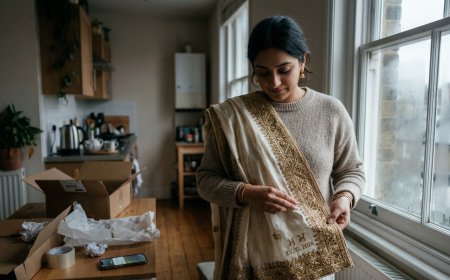
Jasleen opened it at the kitchen table in Wolverhampton — the same table at which she had been allowed to examine her great-great-grandmother's bagh, fourteen years earlier, with her father's magnifying glass. She unfolded it in the specific, deliberate way that the occasion required.
The pattern was right. Not right in the sense of matching the chart — matching the chart was the minimum, the baseline, the thing that had been agreed. Right in the sense that the three years of margin drawings had been building toward something that now existed in the world as a physical object, in pat silk thread on pure silk georgette, in the counted thread technique of a woman in a village outside Jalandhar whose name was written on the note.
She turned it over. The reverse showed the float stitches — long, orderly, the specific visual signature of hand darning that her great-great-grandmother's bagh also showed on its reverse.
The same language. The same hands, separated by a hundred years and four generations and the distance between a village in Hoshiarpur and a kitchen table in Wolverhampton.
She wore it at the wedding in April. Her grandmother, who is ninety-one and who had been at the Wolverhampton kitchen table for the unfolding on the Tuesday morning, sat in the front row of the Gurudwara.
During the Lavaan, when Jasleen walked with the dupatta over her head, her grandmother looked at the pattern from the front row for a long time without expression.
Afterward she said: your great-great-grandmother would have known that pattern.
She was right. She would have.
Begin with the design source — document it completely before any other step. Translate the design into counted thread language before the first consultation. Specify thread colours with physical samples, not digital references. Commission six months before the wedding, at minimum. Request progress photographs at the quarter, half, and three-quarter marks. Assess the collection against the brief before the final payment is made.
And if the design comes from a family piece — from the bagh in the back bedroom, from the chope in the tissue paper, from the memory of something seen once and never forgotten — take the time to understand what it is saying before you ask someone to translate it. The embroiderer in Jalandhar can execute the design. The meaning of the design is yours to carry.
Published by NRIWedding.com — The Premium Global Platform for Non-Resident Indians Planning Indian Weddings From Abroad.
What's Your Reaction?
 Like
0
Like
0
 Dislike
0
Dislike
0
 Love
0
Love
0
 Funny
0
Funny
0
 Angry
0
Angry
0
 Sad
0
Sad
0
 Wow
0
Wow
0