















































Getting Western-Fusion Bridal Outfits Made in Jalandhar — Which Tailors Get It and Which Don't
Jalandhar's tailoring community is extraordinary at traditional Punjabi bridal wear — but the NRI bride who arrives with a fusion brief, a Pinterest board, and a structured corset reference will quickly discover that traditional craft excellence does not automatically translate to Western tailoring capability. This complete guide covers why the gap exists, which Jalandhar boutiques genuinely bridge it, the precise questions to ask before commissioning, the technical brief every fusion commission requires, the red flags that signal a tailor cannot deliver, and the step-by-step process from the first conversation to the finished garment.

Getting Western-Fusion Bridal Outfits Made in Jalandhar — Which Tailors Get It and Which Don't
The honest guide to commissioning Indo-Western bridal wear in a city where traditional craftsmanship is extraordinary but fusion literacy is unevenly distributed
The Problem That Every Modern Bride in Jalandhar Eventually Hits
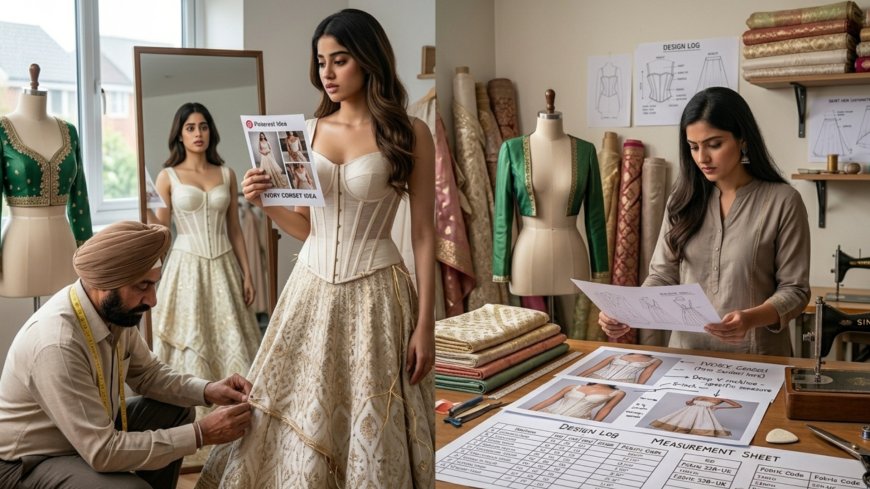
She has saved the reference images. She has a Pinterest board that took three months to curate. She knows exactly what she wants — a structured corset bodice in ivory brocade, a lehenga skirt with a subtle A-line silhouette and minimal embellishment, an asymmetric hemline, a cape overlay instead of a dupatta. She has seen the look on a Delhi-based designer's Instagram. She knows it is possible to make. She knows it will look extraordinary.
Then she sits across from a tailor in Jalandhar and watches the conversation go sideways.
The tailor nods at the reference images. He says yes, he can do this. Then he produces a sketch that looks nothing like what she described. Or he makes the corset without boning, so it collapses. Or he cuts the asymmetric hem in a way that is technically uneven rather than intentionally so. Or he adds embroidery where she specifically asked for restraint, because his instinct — shaped by decades of making heavy Punjabi bridal wear — tells him that more is more.
This experience is so common among Jalandhar brides seeking Western-fusion or Indo-Western bridal outfits that it has become a cliché of the city's wedding planning conversation. And it is not a failure of individual tailors. It is a structural reality of a craft ecosystem built around one aesthetic — magnificent, embellished, traditionally Punjabi — being asked to execute a fundamentally different vocabulary.
This article is about how to navigate that landscape: understanding why the gap exists, identifying who bridges it well, knowing the precise questions to ask before commissioning anything, and ensuring that the garment you eventually receive looks like what you envisioned and not like what the tailor's intuition defaulted to.
Part One: Why Jalandhar's Traditional Tailoring Strengths Don't Automatically Transfer to Fusion
The Craft That the City Excels At
Jalandhar is no less than a creative hub boasting talented designers across the city, where bridal lehenga designers offer bespoke services allowing Sikh brides to customise their lehengas according to their specific preferences. This is genuinely true, and it deserves to be stated plainly before the critique begins. The embroidery karigars, the lehenga cutters, the blouse stitchers of Jalandhar are extraordinary at what they do. The density of craft knowledge in this city — accumulated across generations of bridal wear production — is remarkable.
Jalandhar is famous for its praiseworthy craftsmanship in bridal wear. Sikh wedding lehengas are created with intricate embroidery, delicate embellishments, and traditional techniques.
That craft excellence is real and matters. A well-made traditional bridal lehenga from the right Jalandhar boutique can rival designer work from Delhi or Mumbai at a fraction of the price. The embroidery is precise, the fabric quality is high, the silhouette is understood in every detail by tailors who have spent their careers perfecting it.
The challenge arises at the intersection point: when a bride brings a brief that asks a fundamentally different set of skills from the same craftspeople.
What Fusion Tailoring Actually Demands
Indo-Western bridal wear seamlessly blends the intricate craftsmanship of traditional Indian attire with the contemporary flair of Western fashion. These ensembles typically feature a tailored jacket or blouse paired with cigarette pants, palazzos or a skirt, adorned with intricate embroidery, embellishments or statement prints.
The key word in that description is tailored. Western tailoring is a distinct discipline from Indian dress construction. A well-made blazer, a structured corset, a fitted trouser with a precise break at the ankle — these require a different technical vocabulary from a lehenga blouse or a salwar kameez. They require understanding of interfacing, boning, dart placement, shoulder shaping, and structured seam engineering that most Indian tailors — however skilled at their core craft — have simply never needed to develop.
Fusion bridal fashion is about personalization. Whether it is wearing a brocade lehenga with sneakers or a cape-style dupatta over a tailored gown, brides are styling their outfits to reflect both heritage and individuality.
This personalisation imperative is exactly where the tailor who "gets it" and the tailor who doesn't begin to diverge. The tailor who gets it treats the fusion brief as a design problem to be solved on its own terms. The tailor who doesn't treats it as a traditional outfit that has been described in unusual words — and quietly translates it back into the familiar categories they know how to execute.
The Three Most Common Fusion Fails in Jalandhar's Tailor Market
Fail One: The Uncorset. A bride commissions a structured corset bodice as the top for her fusion lehenga. The tailor makes a blouse that looks like a corset from the front but has no boning, no internal structure, and no actual engineering. It looks beautiful on the hanger and collapses on the body the moment the bride moves. The tailor has made a corset-shaped blouse, not a corset. The difference is entirely invisible at the fitting and completely visible in photographs.
Fail Two: The Embroidery Override. A bride specifies minimal embellishment — a clean, structured piece where the fabric and silhouette do the work, not the embroidery. The tailor, who has spent a career in which more embroidery always equals more value, quietly adds zardozi work "to make it nicer." The resulting garment looks like a traditional outfit with an unusual silhouette rather than a fusion piece with intentional restraint. The bride gets what the tailor thought she should want, not what she asked for.
Fail Three: The Asymmetry Accident. A bride requests an asymmetric hemline on a fusion jacket or gown — a deliberately styled design element that is one of the most recognisable features of contemporary Indo-Western fashion. The tailor, who has never cut an intentionally asymmetric garment, misinterprets the reference image as showing an uneven but otherwise standard hemline. The result looks like a mistake rather than a design choice. The difference between a fashion-forward asymmetric cut and a garment that looks like it was hemmed incorrectly is entirely in the execution — and the execution requires having made intentional asymmetric cuts before.
Part Two: How to Identify a Tailor Who Actually Gets It
The Instagram Portfolio Test
The most reliable pre-visit filter for identifying Jalandhar tailors and boutiques that can genuinely execute fusion bridalwear is their Instagram portfolio. Jalandhar has many designer boutiques that design ensembles according to the measurements and style preferences of their clients, offering finesse in cuts and absolutely snug fitting for completely chic looks.
But how a boutique describes itself and what its portfolio actually shows are two different things. Search for these specific elements in any boutique's Instagram before visiting:
Structured silhouettes. Does the portfolio show garments with clean, architectural lines — fitted bodices, structured shoulders, precisely engineered hems — or does everything have the softness and flow characteristic of traditional Indian construction? A boutique that has never posted an image of a well-structured garment probably cannot make one.
Western tailoring elements. Look specifically for blazers, trousers, corsets, fitted jackets, and tailored capes in the portfolio. Not on a rack, but worn by actual clients. A boutique that can show you three or four finished examples of these elements on real bodies is demonstrating genuine capability.
Restraint in embellishment. Does the portfolio include work where the design is clearly deliberate in its minimalism — where clean fabric surfaces and precise silhouettes are the aesthetic rather than a default for a less expensive piece? Fusion bridalwear at its best often uses embroidery selectively and architecturally. A boutique that cannot show examples of this approach will struggle to execute it.
Recent work. Fashion evolves quickly, and a portfolio full of pieces from five years ago tells you more about where a boutique was than where it is. Look for work posted within the last twelve months. Contemporary bridal wear embraces a blend of timeless tradition and modern aesthetics, with trends in 2025 focusing on fresh colour palettes, luxurious fabrics, and fusion silhouettes. A boutique keeping pace with these trends will have recent portfolio work that reflects them.
The Vocabulary Test
When you visit a boutique with your fusion brief, pay attention to how the conversation begins. The tailor or designer who gets it will engage with your reference images on their own terms — asking about silhouette, structure, fabric weight, and the specific design elements that matter to you. They will have opinions about what will work technically and what will not. They may push back on certain elements — but the pushback will be informed by technical knowledge, not discomfort with unfamiliar aesthetics.
The tailor who doesn't get it will say yes to everything while the reference images are visible. The session will feel easy. There will be no questions that reveal technical understanding — no discussion of interfacing options, no queries about your preference for boning material, no conversation about how asymmetric elements will be secured and finished. Everything will sound achievable. You will leave feeling optimistic and return to a garment that looks nothing like what you commissioned.
Ask the following questions directly:
"Have you made a structured corset or boned bodice before? Can I see photographs of the finished piece on a client?"
"What kind of interfacing do you use for structured jackets?"
"How do you finish an asymmetric hem so it reads as intentional rather than uneven?"
The answers — or the absence of meaningful answers — will tell you everything you need to know.
The Sample or Reference Piece Test
Before committing to a full commission, ask whether the boutique has a sample or reference piece in the style you are seeking — a finished fusion or Indo-Western garment that you can try on. This serves two purposes. First, it gives you an opportunity to see the quality of the boutique's western tailoring on your body before you invest in a full custom commission. Second, it reveals whether the boutique is actually working in this aesthetic regularly or whether it is claiming to offer something it has executed rarely or never.
A boutique that genuinely specialises in fusion bridalwear will have samples. A boutique that is stretching beyond its usual expertise will not.
Part Three: Who in Jalandhar Is Actually Doing This Well
Darzi Boutique: The Best Starting Point for Fusion Bridalwear
Darzi Boutique is a Jalandhar-based store full of inspired clothing with latest designs and styles. Among Jalandhar's bridal wear establishments, Darzi has built a specific reputation for willingness to engage with contemporary and fusion briefs — for taking the Instagram reference image seriously and working toward it rather than quietly translating it back into traditional territory.
The boutique's name itself is a statement: darzi is Urdu-Hindi for tailor, and by naming their establishment this, the founders have positioned craft — actual stitching, cutting, and construction — as their central proposition. This matters for fusion bridalwear, where execution quality is even more determinative of outcome than in traditional bridal work.
Fashion Libas: The Fusion-Forward Boutique
Fashion Libas is a Jalandhar-based women's wear boutique that offers a variety of designs for your special occasion. You can opt for traditional, classic, modern, or fusion styles. Its tailors use high quality products and elements to create a wedding dress that you'd be able to conserve and cherish.
The explicit inclusion of "fusion styles" in their offering is meaningful — and more importantly, it is borne out in their portfolio. Fashion Libas has consistently been among the city's more adventurous boutiques in terms of silhouette and design vocabulary, and its tailors have the exposure to Indo-Western aesthetics that many of their peers lack.
For brides seeking something that sits between fully traditional and fully Western — the embroidered gown, the structured jacket over a lehenga skirt, the saree-gown hybrid — Fashion Libas offers a practical and well-regarded starting point.
Turquoise Studio: Jalandhar's Most Design-Led Option
Turquoise Studio is a designer couture label based in Jalandhar that creates innovative fashion with a perfect balance of contemporary designs and Indian craftsmanship. Her collection includes a variety of one-of-a-kind designs that are ideal for the wedding season. Every piece of clothing contains a unique feature that makes the bride and bridesmaid feel and look their best on their special days. They work with various price points without compromising service quality to serve a diverse core audience.
What distinguishes Turquoise Studio from the broader Jalandhar boutique landscape is the designer's personal aesthetic — described by clients as rooted in Punjabi heritage but consistently modern in execution. The vision to keep the audience engaged with Punjab's inheritance of fabrics, weaving, textures and colours, relating to the rich history of Punjab and the core heritage of Jalandhar's fashion sense, combined with leading fresh ideas, is what distinguishes the studio.
For the bride seeking fusion bridalwear that has genuine design intelligence — that feels considered and original rather than derivative of designer work — Turquoise Studio is Jalandhar's most compelling option. The price tier is premium, and the process is engagement-intensive. But the results, when the studio is fully briefed and given adequate lead time, can match the best boutique work available anywhere in Punjab.
Ravishing Preet Boutique: The Celebrity Replica Advantage
For brides whose fusion brief is anchored in a specific reference — a look from a Bollywood actress, a Delhi designer's recent collection, a specific Instagram post — Ravishing Preet Boutique's celebrity replica model makes it uniquely useful. Ravishing Preet Boutique specialises in celebrity fashion replicas and can reproduce any look that the customer desires, with all designs handcrafted. If you email them an image of your design, they will replicate the design to fit your measurements.
The replica model carries an inherent risk — replication is not the same as original design, and a replica of a fusion look may not always capture what made the original work. But for a bride who is confident in her reference and wants skilled execution of that reference rather than interpretive design, the Ravishing Preet model is straightforward and has a strong track record.
Adaah Couture: The Multi-Designer Access Route
Adaah Couture is a multi-designer studio located in the city of Jalandhar, described as the region's biggest designer wear store having top names of Indian fashion in its family of designers, with a wide range of ethnic and western wear straight from India's leading fashion designers.
The multi-designer studio model offers a different route to fusion bridalwear — rather than commissioning bespoke from a local tailor, a bride can access ready-made or semi-custom pieces from national designers who are already working in the fusion aesthetic and whose execution quality has been validated at a national level. For brides who are uncomfortable with the uncertainty of full local commission, Adaah provides access to designer pieces that have been made to a consistent standard — and that can then be altered locally if needed.
Part Four: The Brief — How to Communicate What You Actually Want
Why the Reference Image Is Not Enough
Every fusion bride arrives with reference images. Every tailor sees reference images. The gap between them is rarely about what the images show — it is about whether the tailor and the bride are looking at the same things in those images.
A bride looking at a reference image of an embroidered blazer over a lehenga skirt sees the precise shoulder, the clean single-button closure, the way the blazer falls slightly away from the body, the deliberate restraint of the embroidery concentrated at the collar and cuffs. A tailor who has made thousands of traditional lehenga cholis looks at the same image and sees the fabric, the embroidery pattern, and the general shape — while the structural engineering that produces that specific, non-traditional silhouette may not register as a distinct technical requirement.
Closing this gap requires the bride to articulate what she sees in structural terms, not aesthetic terms. Not "I want it to look like this" but "I want the shoulder seam to sit exactly at the shoulder point, not dropped. I want the front closure to be a single hook-and-eye at the waist, nothing else. I want the hem length at exactly mid-thigh, finished with a clean single-turned hem rather than any facing or decorative border."
This level of specificity feels excessive to many brides. It is not excessive. It is the minimum that the construction of a technically precise fusion garment requires.
The Technical Brief — What It Needs to Include
A complete technical brief for a fusion or Indo-Western bridal commission in Jalandhar should address the following:
Silhouette and structure. What is the shape of the garment at every point? Where does it sit on the body? How structured is it — fully stiffened, lightly structured, or unstructured? What materials should be used for any internal structure (boning type, interfacing weight)?
Embellishment placement. Where exactly does embroidery or embellishment appear, and — critically — where does it not appear? Specify both. "Embroidery on the collar only, nothing elsewhere" is a complete instruction. "Minimal embroidery" is not — it leaves interpretation open in precisely the area where the tailor's instinct will override the brief.
Hem finishing. How is each hem finished? A clean, turned hem reads differently from a faced hem, which reads differently from a fringed or unfinished hem. For asymmetric hems particularly, the finishing method determines whether the result looks designed or accidental.
Closure details. What closures are used, where, and how visible should they be? Hidden hook-and-eyes? Exposed buttons? A lace-up back? Invisible zip? The closure is often the detail that most immediately signals whether a garment is Western-tailored or Indian-constructed.
Fit philosophy. Western tailoring typically fits close to the body through the torso. Traditional Indian bridal wear is often constructed with more ease. Specify your preference explicitly — "I want the bodice to fit like a tailored jacket, with no ease through the bust and waist" — rather than assuming the tailor will read this from the reference image.
The Mock-Up Demand
For any fusion commission above ₹25,000, insist on a mock-up — a version of the garment made in inexpensive cotton before the actual fabric is cut. This is standard practice in Western tailoring and in couture, but it is not universal in Jalandhar's bridal boutique context. A tailor who understands fusion construction will not object to this request. A tailor who is not confident in their execution may resist it — which is itself useful information.
The mock-up allows structural issues to be identified and corrected before expensive fabric is committed. A corset that collapses without adequate boning is far cheaper to fix in cotton muslin than in embroidered silk brocade.
Part Five: The Tailoring Landscape — A Practical Reference
The following table maps the key considerations for getting Western-fusion bridal outfits made in Jalandhar, from the specific garment types most commonly requested to the skill requirements and the risk profile of each commission type.
| Fusion Garment Type | Technical Requirement | Who Gets It | Who Doesn't | Risk Level | Lead Time | Mock-Up Needed? |
|---|---|---|---|---|---|---|
| Structured corset bodice | Boning, internal architecture, precise dart placement | Darzi Boutique, Turquoise Studio, Fashion Libas | General market tailors with no Western tailoring experience | High | 6–8 weeks | Yes, mandatory |
| Embroidered blazer / tailored jacket | Shoulder shaping, interfacing, clean single-button or zip closure | Ravishing Preet, Fashion Libas | Traditional blouse tailors | Medium–High | 5–7 weeks | Recommended |
| Lehenga-gown hybrid | Structured bodice + flared skirt, Western gown construction with Indian fabric | Turquoise Studio, Adaah Couture sourcing | Volume market boutiques | High | 8–10 weeks | Yes, mandatory |
| Cape overlay / dupatta replacement | Precise drape engineering, hidden weighting, invisible attachment | Darzi Boutique, Fashion Libas | Most traditional boutiques | Medium | 4–6 weeks | Optional but useful |
| Cigarette trousers or palazzo pants under lehenga blouse | Western trouser construction, precise break and hem finish | Ravishing Preet, Turquoise Studio | Traditional salwar tailors | Medium | 4–5 weeks | Recommended |
| Asymmetric hem garment | Intentional asymmetric cut, clean finish, deliberate drape | Turquoise Studio, Fashion Libas | Most tailors who lack asymmetric cutting experience | High | 5–6 weeks | Yes, mandatory |
| Embroidered gown (saree-gown or anarkali gown) | Floor-length gown with structured bodice, Indian embroidery | Darzi Boutique, Fashion Libas | Traditional anarkali tailors who default to ethnic silhouette | Medium | 6–8 weeks | Recommended |
| Fusion saree draping (pre-stitched or structured drape) | Structured or pre-stitched saree construction, clean seaming | Multi-designer studios (Adaah), specialist tailors | Traditional saree draping experts (different skill set) | Medium | 4–6 weeks | Optional |
Part Six: The Red Flags — How to Know Before You Commission
What a Tailor's Response Tells You
Beyond the specific test questions outlined earlier, there are behavioural signals that reliably indicate whether a tailor has genuine fusion capability or is accommodating an unfamiliar brief because they do not want to turn away business.
Immediate agreement. If a tailor says yes to every element of your brief without a single technical question, concern, or constructive pushback, be worried. Real expertise involves knowing where the challenges lie. The tailor who immediately confirms they can make everything you have described — the structured corset, the asymmetric hem, the minimal embroidery, the precise Western shoulder — without any discussion of how has not yet engaged with the technical reality of what you are asking.
Pivot to traditional alternatives. If, after you present your brief, the conversation moves toward showing you examples of traditional bridal wear that the tailor feels would "look similar" — this is the signal that they cannot execute what you described and are hoping to redirect you toward what they can. Politely acknowledge the alternatives and reiterate the brief. If the second attempt at a conversation produces the same pivot, move on.
No asking about fabric source. A tailor who genuinely understands Western tailoring will ask about fabric weight and structure before confirming they can produce the garment you have described. Structured corsets require different fabrics from flowing gowns. A tailor who does not ask about fabric is working from the assumption that they will use whatever they normally use — which may not be appropriate for the fusion piece you have described.
Inability to sketch the garment. Before commissioning, ask the tailor to sketch — even roughly — the garment from the reference images. A tailor who understands the brief will be able to produce a recognisable sketch that captures the structural elements. A tailor who does not understand it will produce a sketch that looks like a traditional garment with some unfamiliar features added.
When to Walk Away
Walk away when:
The portfolio contains no Western or fusion work, only traditional Indian bridal wear, and the tailor cannot produce any evidence of having made the garment type you are commissioning.
The tailor refuses the mock-up request for a commission over ₹25,000. Any legitimate fusion tailoring establishment will understand why a mock-up is appropriate. Resistance to this request is almost always a signal of limited confidence in the execution.
The tailor quotes a turnaround time that is significantly shorter than the complexity of the commission warrants. A structured corset bodice made properly takes time — time for pattern drafting, time for muslin, time for fitting, time for adjustment, time for finishing. A quoted turnaround of two weeks for a full fusion bridal outfit is a red flag, not a demonstration of efficiency.
The quoted price seems significantly lower than expected. Fusion construction requires more technical skill and more fitting cycles than traditional bridal stitching. It is inherently more expensive per garment hour. A price that is dramatically below what other capable boutiques are quoting is generally a signal that the tailor is planning to execute a simplified version of the brief rather than the technically demanding piece you described.
Part Seven: The Process from Brief to Garment
Managing the Commission Correctly
Having identified the right tailor, the following process maximises the likelihood of receiving the garment you envisioned.
Session one: Brief and technical discussion. Come with printed reference images, a written technical brief, and clear specifications for embellishment, closures, hem finishing, and fit philosophy. Take notes during the conversation. Confirm that the tailor has understood each element by asking them to explain it back to you.
Session two: Pattern and mock-up review. Before the actual fabric is cut, review the pattern and approve the mock-up. This fitting should be thorough and critical — check every structural element against the brief, including shoulder placement, bodice fit, hem height and finish, and silhouette. Changes at this stage are inexpensive. Changes after the fabric is cut are not.
Session three: Embellishment review. If the garment includes embroidery or embellishment, review the placement before the embroidery is applied. A photograph or tracing showing exactly where the embellishment will appear — and confirming the boundaries of the unembellished areas — prevents the embroidery override failure described earlier.
Session four: First fitting in actual fabric. This fitting checks that the translation from mock-up to final fabric has not introduced any new issues, and that the garment moves correctly on the body. Test movement range — can you walk, sit, and dance comfortably? Fusion garments often have tighter fit tolerances than traditional Indian bridal wear, and movement testing is essential.
Session five: Final fitting and collection. Final review before collection. Check every seam, every closure, every hem, every embellishment placement against the original brief. Do not collect the garment until you are satisfied that it matches what you commissioned.
Conclusion: The Right Tailor Makes It Possible
The fusion bridal brief in Jalandhar is achievable. The city has craft talent, design intelligence, and the technical infrastructure to produce Indo-Western bridal outfits that are genuinely excellent — outfits that honour the richness of Punjab's textile traditions while speaking the language of contemporary bridal fashion.
Jalandhar is a creative hub boasting talented designers across the city, and many boutiques offer bespoke services allowing brides to customise outfits according to their specific preferences, with shops allowing brides to have consultations with designers and tailors to discuss their vision, try on different lehengas, and receive expert advice.
The challenge is not finding talent. The challenge is finding the specific subset of that talent that has genuinely developed Western tailoring capability alongside its traditional Indian craft skills — and then communicating with that talent in sufficiently precise technical terms to ensure the brief is executed rather than interpreted.
The tailors who get it are out there. They have Instagram portfolios that show structured shoulders and clean asymmetric hems. They ask technical questions before they say yes. They welcome the mock-up request. They push back on elements where their experience tells them the execution will not work. They understand that when you say minimal embellishment, you mean it.
Finding them takes effort. Briefing them correctly takes discipline. The result — a fusion bridal outfit made in Jalandhar, by a craftsperson who understands both the Indian textile tradition and the Western tailoring vocabulary — is worth every hour of preparation.
Practical checklist before commissioning any fusion bridal outfit in Jalandhar: Audit the boutique's portfolio for Western or fusion work. Ask the three technical test questions. Request a previous example of the same garment type. Insist on a written brief with embellishment placement specified. Budget for a mock-up fitting for any commission over ₹25,000. Allow minimum eight weeks lead time for complex fusion pieces. Bring your reference images printed, not just on your phone — it changes how seriously the conversation is taken.
What's Your Reaction?
 Like
0
Like
0
 Dislike
0
Dislike
0
 Love
0
Love
0
 Funny
0
Funny
0
 Angry
0
Angry
0
 Sad
0
Sad
0
 Wow
0
Wow
0