







































































How to Communicate Your Vision to a Jalandhar Tailor — Photos, References and What They Actually Need
For the NRI bride who has spent months building a folder of reference photographs and still cannot answer a skilled tailor's most fundamental question — what do you want — the problem is never the vision. It is the brief. This comprehensive guide by NRIWedding.com delivers the complete framework for translating visual inspiration into a communicable garment brief that a Jalandhar tailor can actually work from. Covers why photographs alone are not a brief and what they structurally cannot convey, the five essential components of a communicable brief including the measurement document, annotated reference photographs, fabric specification, priority hierarchy, and approval protocol, the remote communication practices that protect commission quality across time zones, the specific reference types and what each communicates to a craftsperson, and the linguistic resilience strategies that prevent information loss through translation. Includes a complete reference type guide table and the five most costly mistakes NRI brides make when briefing Jalandhar tailors.

How to Communicate Your Vision to a Jalandhar Tailor — Photos, References and What They Actually Need
The folder on Preethi's phone had two hundred and forty-seven photographs in it.
She had been building it for eight months — screenshots from Instagram, saved images from Pinterest boards, photographs taken at her cousin's wedding in Chennai two years earlier where a blouse construction had caught her eye in a way she had not forgotten, close-up images of embroidery she had seen on a mannequin in a shop in Wembley that she had photographed without buying because the price was wrong but the detail was exactly right. There were photographs of necklines and photographs of sleeves and photographs of back constructions and photographs of embellishment placement and photographs of the specific way a particular dupatta fell across a particular shoulder in a particular quality of afternoon light that she had been trying to articulate to herself, across eight months of looking, as a feeling about what she wanted.
The folder was organised into subfolders. Necklines. Backs. Sleeves. Embellishment. Colour reference. Overall silhouette. Feeling. That last subfolder — Feeling — had thirty-one photographs in it and was the one she most often opened and the one she would have found most difficult to explain to anyone who had not spent eight months building a folder like this.
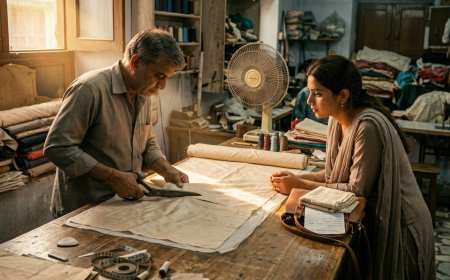
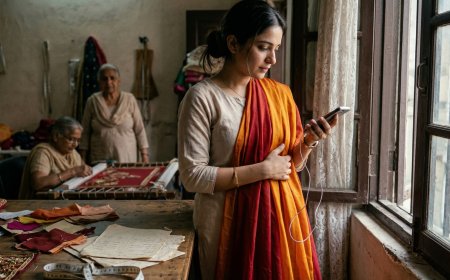
She had sent forty-three of the photographs to her aunt in Jalandhar the previous week, in three separate WhatsApp messages, with captions that said: something like this for the neckline, and: the sleeve in this one but maybe slightly shorter, and: not this exactly but this kind of feeling for the embellishment. Her aunt had forwarded the photographs to the tailor. The tailor — a man named Sukhdev who worked from a first-floor workroom in a building off the Guru Nanak Mission Chowk area and who had been making occasion wear in Jalandhar for twenty-two years — had looked at the forty-three photographs and sent back, through Preethi's aunt, a single question.
The question was: What does she want?
Preethi had read the question three times. She had looked at her folder. She had felt, with the specific clarity that arrives sometimes when the thing you have been avoiding becomes unavoidable, that the forty-three photographs were not a brief. They were evidence of a brief that had not yet been written. Sukhdev had not asked the wrong question. He had asked the only question that mattered, and the answer required something that two hundred and forty-seven photographs, organised into subfolders including one called Feeling, could not provide.
She closed the folder. She opened a new document. She typed, at the top: What do I actually want.
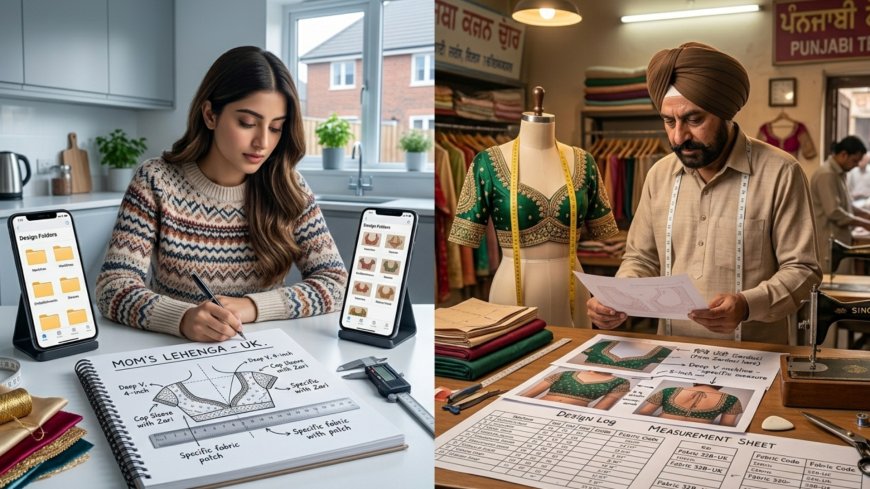
It took her four hours to answer the question properly. The answer was not forty-three photographs. It was two pages of specific, numbered, measured, referenced instructions that she had never written down before because she had assumed, for eight months, that showing was the same as telling.
It is not. And understanding why it is not — and what telling actually requires — is the knowledge that transforms a commission that produces something close to what you imagined into a commission that produces exactly what you imagined. The distance between close and exactly is not talent. It is not the tailor's skill level or your aesthetic judgment or the quality of the fabric. It is the brief. It is always the brief.
This guide is for Preethi, and for every NRI bride or family member who has spent months collecting visual references and still cannot answer a skilled tailor's most fundamental question: what do you want. It is the complete framework for translating visual inspiration into a communicable brief — what photographs can and cannot convey, what measurements must accompany every visual reference, how to structure the brief document, how to manage the communication protocol across time zones, and the specific discipline that converts eight months of looking into two pages of telling.
Why Photographs Alone Are Not a Brief
The photograph is the most natural communication tool for a visual decision. When something is difficult to describe in words — a neckline angle, a sleeve edge curve, a quality of embellishment density — the photograph appears to solve the problem by bypassing language entirely. Look, you say. Like this. The image speaks for itself.
In a tailor's workroom, the image does not speak for itself. It speaks in a language that is filtered through the tailor's experience, the tailor's aesthetic defaults, the tailor's understanding of what is achievable in the specific fabric being used, and the tailor's interpretation of which element of the photograph the client is pointing at. The neckline photograph sent as a reference may contain six separate design decisions — the depth, the width, the edge finish, the internal structure, the relationship to the shoulder seam, the way it interacts with the embellishment at the front panel. The tailor, looking at the same photograph, sees one reference: a neckline of approximately this character. The six decisions are resolved by the tailor's judgment, not the client's specification, and the tailor's judgment is not wrong — it is simply not the client's.
This is not a failure of the tailor's intelligence or attention. It is the structural limitation of the photograph as a communication tool for a craft process that operates on precise measurements and specific construction decisions. The photograph shows an outcome. The tailor needs a process — the sequence of specific decisions that produces the outcome. The brief is the document that converts the outcome shown in the photograph into the process the tailor can follow.
The NRI managing a commission from London or Toronto or Melbourne is more vulnerable to this limitation than the client who is present in the workroom, because presence provides a form of real-time correction that remote communication cannot replicate. The client in the workroom who looks at the pattern being drawn and says that is too shallow can catch the interpretation error before it is cut into fabric. The client in Leicester who sees the finished blouse for the first time on a video call, when the neckline is already stitched and the embellishment is set, is looking at a decision that was made in her absence by a tailor working from an ambiguous reference. The brief that prevents this outcome is not a supplementary document. It is the primary act of the commission.
What the Tailor Actually Needs From You
The experienced Jalandhar tailor — the craftsperson who has been making occasion wear for fifteen or twenty or thirty years — comes to every commission with a developed vocabulary of defaults. A sweetheart neckline, in the tailor's default, sits at a specific depth and width calibrated by years of making sweetheart necklines for the Punjabi wedding market. A cap sleeve, in the tailor's default, extends a specific distance from the shoulder seam with a specific edge curve. These defaults are not arbitrary — they represent the accumulated aesthetic judgment of a skilled craftsperson who has made thousands of garments for thousands of clients in a specific cultural context and developed a refined sense of what works.
The problem is that your vision is not the tailor's default. Your vision is the specific, particular outcome of eight months of looking at photographs and developing a visual sensibility that is yours and nobody else's. The brief is the document that replaces the tailor's default with your specific intention — that says, in effect: I know you have a default, and here is how mine differs, and here is exactly how it differs, expressed in numbers and annotated images and the specific language of construction rather than the language of feeling.
The tailor who receives this brief is not being told that their judgment is wrong. They are being given the information they need to produce your garment rather than their version of your garment. Every skilled tailor in Jalandhar understands this distinction intuitively. The brief that provides this information is not an insult to the tailor's expertise. It is a sign of respect for the precision that expertise requires. The tailor who has been given a complete brief can work with full confidence. The tailor who has been given an incomplete brief is guessing, and however educated the guess, it remains a guess.
The Anatomy of a Communicable Brief
The communicable brief has five components, and all five must be present for the brief to function as a complete specification. The absence of any one component creates a gap that the tailor fills with their own judgment, which may or may not align with the client's intention. Understanding each component — what it contains, why it is necessary, and how to produce it — is the framework that converts the folder of two hundred and forty-seven photographs into a two-page document that a tailor can work from.
Component One: The Measurement Document
The measurement document is the foundation of everything else. It contains every dimension relevant to the garment being made, expressed as numbers in centimetres, with no descriptive language substituting for measurement where measurement is possible. The distinction between these two things — descriptive language and measurement — is the most important distinction in the entire brief-writing process. Deep is a description. Fourteen centimetres is a measurement. Three-quarter length is a description. Thirty-eight centimetres from the shoulder seam is a measurement. The tailor works from the second kind. The first kind produces garments that are the tailor's interpretation of the description.
Body measurements come first — bust, waist, hip, shoulder width, arm length from shoulder seam to wrist, arm circumference at bicep and at wrist, torso length from shoulder to natural waist, back length from nape to waist. These are the standard measurements that every tailor takes at the first appointment, and if the commission is being managed remotely, they must be taken in India by a designated person — ideally someone who has experience taking garment measurements — communicated by video if necessary to ensure the measuring technique is correct. A bust measurement taken with the tape too loose by two centimetres produces a blouse that is two centimetres too large across the chest. The error is invisible in the measurement and immediately legible in the garment.
Design measurements come second — the specific dimensions of every design decision being made. The neckline depth as a distance from the natural neckline to the lowest point of the cut. The neckline width as the distance between the two shoulder points at which the neckline curve begins. The back neck V depth as a distance from the nape to the base of the V. The sleeve length as a distance from the shoulder seam to the sleeve edge. The sleeve opening circumference. The button diameter. The button spacing as a centre-to-centre measurement. The boning extent as the distance from one side seam to the other. The blouse hem length from the natural shoulder point to the lower edge of the blouse. Every element of the design that has a measurable dimension must be expressed as a measurement. Everything that cannot be expressed as a measurement — the edge curve of a sleeve, the finish on a neckline, the texture of an embellishment — must be expressed in the annotated photograph component.
The measurement document should be formatted as a clean table with three columns: the measurement name, the value in centimetres, and any relevant note about method or tolerance. It should be sent as a document or a screenshot, not read aloud in a voice note. The tailor who can see the measurement table can refer to it throughout the construction. The tailor who heard it once on a voice note three days ago is reconstructing it from memory.
Component Two: The Annotated Reference Photographs
The reference photograph on its own is ambiguous. The annotated reference photograph — the same image with arrows, labels, and notes added directly onto the image — is specific. The annotation does what the photograph cannot do alone: it identifies which element of the image is the reference, what specifically about that element is being referenced, and what the reference is instructing. The same photograph of a blouse can be a reference for the neckline, the sleeve, the embellishment placement, the fabric texture, or the overall silhouette. Without annotation, the tailor must guess which of these five things the client is pointing at. With annotation, the photograph carries a single, specific instruction.
Annotation tools available on any smartphone — the markup feature in the iOS Photos app, the drawing tools in Google Slides, the annotation function in most Android photo editors — allow the addition of arrows and text directly onto a photograph in under two minutes. The annotation should be specific and minimal: an arrow pointing to the neckline edge with the label this neckline depth only — not the fabric or embellishment. An arrow to the sleeve edge with this inward curve. An arrow to the embellishment section with this density of placement, not this motif style. Each annotation identifies one design element and names it precisely. Multiple annotations on the same photograph are acceptable if they refer to different elements, but each annotation must be independently legible.
Three to five annotated reference photographs are sufficient for most blouse commissions. More than five introduces the same problem as Preethi's original forty-three — the tailor must decide which elements to prioritise when references conflict or overlap, which is the tailor making brief decisions rather than the client. Select the photographs that, together, cover every major design decision in the brief. Annotate each one precisely. Send those and only those. The remaining photographs in the Feeling subfolder are for the client's own reference during the brief-writing process. They have served their purpose. They do not go to the tailor.
Component Three: The Fabric and Material Specification
The fabric specification tells the tailor what they are working with, and every construction decision in a garment — the seam finish, the interfacing weight, the lining choice, the embellishment technique — is affected by the fabric's properties. A brief written without fabric specification is a brief written in a vacuum, because the construction technique correct for raw silk is different from the technique for georgette, which differs again from the technique for a heavy brocade or a tissue fabric. The tailor who is not told what fabric they are working with defaults to the construction techniques appropriate for the most common fabric in their experience, which may not be the fabric you have chosen.
The fabric specification should include the fabric type and common name, the weight in grams per metre if known, the fabric width as purchased, any handling characteristics the tailor should be aware of — a fabric prone to fraying requires a specific seam finish; a fabric with a nap or directional weave requires a specific cutting orientation; a fabric that marks easily requires specific pressing techniques — and the total quantity of fabric available for the commission. The quantity matters because the tailor who knows they have exactly one and a half metres to work with makes different cutting decisions from the tailor who assumes two metres are available.
If the fabric is being sourced in Jalandhar by the tailor rather than provided by the client, the fabric specification becomes a sourcing brief — the type and quality required, expressed in terms the fabric market uses, with a reference photograph of a comparable fabric where possible and a maximum budget for the fabric purchase. The tailor who is sourcing the fabric is making a significant additional decision on the client's behalf, and that decision requires the same specificity as the construction itself.
Component Four: The Priority Hierarchy
The priority hierarchy is the component most consistently absent from NRI commission briefs, and its absence is the source of most of the decisions that the tailor makes unilaterally in the course of a complex garment construction. In any garment where multiple design elements interact — where the neckline depth affects the embellishment placement, where the sleeve construction affects the shoulder line, where the fabric quantity constrains the pattern piece — there will be points at which two specified elements cannot both be achieved exactly as described. One must be adjusted. The priority hierarchy tells the tailor which one.
Without the priority hierarchy, the tailor makes the prioritisation call based on their experience and their interpretation of what the client most cares about. The tailor who has been making occasion wear for twenty-two years will make a reasonable call. It is not the client's call. It is a call made by someone who has never seen the folder of two hundred and forty-seven photographs and does not have access to the eight months of looking that produced it.
The priority hierarchy is a simple, ranked list: these elements are fixed and must be achieved exactly as specified. These elements are flexible and may be adjusted if the fixed elements require it. Within the flexible elements, this is the order in which adjustment is acceptable. It takes ten minutes to write and it protects every fixed decision in the brief from being overridden by a tailor's reasonable but unilateral judgment.
Component Five: The Approval Protocol
The approval protocol establishes the checkpoints at which the client will review the work and the specific nature of the review at each checkpoint. For a remote commission, the approval protocol is the quality control structure that prevents the finished garment from being the first moment at which a significant error is discovered — which is the worst possible moment, because it is the moment at which correction is most expensive, most time-consuming, and most emotionally fraught.
The minimum approval protocol for a remote commission has three checkpoints. The pattern stage: the paper pattern is photographed against a measured grid or with a measuring tape visible in the frame and sent to the client for approval before any fabric is cut. The toile stage: the rough version of the garment made in an inexpensive fabric is assessed on a dress form or a body, photographed from every relevant angle, and sent for approval before the final fabric is touched. The finishing stage: the completed garment is photographed in natural light from front, back, and both sides, with close-ups of every design detail, before collection or dispatch.
Each checkpoint requires a specific, measurement-based response from the client. The response that says it looks fine is not a checkpoint response. It is a formality that provides no quality assurance. The response that says the V depth in the pattern photograph appears to measure eleven centimetres rather than the specified fourteen — please confirm the measurement and correct before cutting is a checkpoint response. It engages with the specific information in the photograph. It references the brief. It provides an instruction rather than an impression.
The Remote Communication Protocol
The NRI commissioning a garment in Jalandhar from abroad faces a communication challenge that is structural — built into the conditions of the commission rather than produced by any individual's failure. The distance compresses decision windows. The time zone difference means the tailor's question in the morning arrives in the client's evening and the response arrives in the tailor's next morning, with a full working day of potential interim decisions in between. The linguistic relay through a family member introduces a translation layer at which information can change. The absence of physical presence removes the real-time correction that presence provides.
The remote communication protocol is the set of practices that minimises the degradation of information across these structural conditions. The first and most important practice is the single point of contact. All communication about the commission flows through one designated person in Jalandhar — typically a trusted family member who lives near enough to the tailor to visit if needed and who has the specific brief document and the authority to relay it accurately. The brief that is also sent directly to the tailor, and also discussed with the grandmother on a family call, and also commented on by the cousin who visited the workroom out of curiosity, exists in multiple versions simultaneously, and the tailor who has received conflicting signals from four people will resolve the conflict with their own judgment. One contact. All communication through that contact. No exceptions.
The second practice is written communication for all measurements and specifications. Voice notes are the natural medium of the Indian family WhatsApp group, and they are warm and immediate and excellent for conveying context and emotion. They are not reliable vehicles for measurements. A measurement spoken in a voice note must be heard, retained, and later recalled — and numbers change at each of these steps in ways that words do not. Write the measurements. Send them as text that the tailor and the contact can read, verify, and refer back to without reconstruction. Reserve voice notes for the relationship aspects of the communication — the appreciation, the context, the personal details that make the commission feel like a collaboration rather than a transaction.
The third practice is photograph requests at every significant construction decision, not only at the formal checkpoints. The tailor who is asked to photograph whenever a significant decision is being made will send photographs that provide an ongoing view of the commission. These photographs are not formal checkpoint reviews — they are visibility into a process that is otherwise invisible until the checkpoint reveals it. The tailor who makes a decision about the embellishment placement at the point where the bodice is being prepared, photographs it, and sends it, gives the client the opportunity to confirm or correct before the decision is fixed. The tailor who makes the decision and proceeds without photographing it has made an irrevocable choice in the client's absence.
What Different Reference Sources Actually Convey
The reference photographs in the brief are not all equivalent, and understanding what different types of references can and cannot communicate to a tailor changes how the brief is assembled and which photographs earn their place in it.
The editorial or magazine photograph shows the garment in optimised conditions — professional lighting, a model whose proportions are specifically suited to the piece, styling that enhances the garment's strongest qualities and conceals its weaker ones. What this type of reference communicates well is the overall silhouette, the broad character of the design, and the relationship between embellishment and fabric at the level of visual impression. What it does not communicate is the actual construction — the internal structure that produces the silhouette, the seam placement that creates the fit, the interfacing that maintains the neckline's shape. The editorial reference establishes aesthetic direction. It does not provide construction specifications, and the tailor who uses an editorial reference as a construction guide is making assumptions about the internal engineering that the photograph does not show.
The real wedding photograph — the kind found on Indian wedding photography blogs and studio portfolios — shows the garment in actual conditions: on a real body, in available light, during the physical activity of a wedding day. These photographs communicate how a design performs in practice — how the neckline holds its shape during the ceremony, how the sleeve falls when the arms are raised, how the embellishment reads at a distance rather than in a studio close-up. They are more reliable construction references than editorial images precisely because they are unidealised. The neckline that holds its shape in a real wedding photograph was constructed to hold its shape, and the construction that achieved it is legible in a way that the studio image's perfected result is not.
The detail photograph — the close-up of a neckline finish, a sleeve edge, an embellishment placement, a closure mechanism — is the most useful reference type in the brief because it removes all contextual ambiguity and focuses the reference on one specific design element. A detail photograph that shows exactly the edge finish required, at a scale where the specific stitching is visible, communicates more construction information than ten full-garment silhouette references. The brief built around detail photographs is the most precise brief achievable from photographic references. Build from detail outward, not from silhouette inward.
The schematic drawing — the flat technical illustration of the garment with proportions indicated and dimensions marked — is the most precise reference type of all and the one that most NRI brides feel they cannot produce because they are not trained illustrators. They do not need to be. A rough schematic drawn in the Notes app on a phone, with approximate proportions indicated by outline and dimensions written as numbers, communicates construction intent that no photograph can match. The tailor who receives a front schematic showing the neckline curve with the depth and width marked in centimetres, a back schematic showing the V depth and the button placement, and a side schematic showing the sleeve length — even if these drawings are crude — has more precise information than the tailor who receives forty-three unannotated photographs from a folder called Feeling.
The Language Gap and How the Brief Bridges It
The Jalandhar tailor works in Punjabi. The NRI in Leicester or Brampton or Sydney may speak Punjabi fluently, partially, or not at all. The commission may be conducted in Hindi, or in English through a family member who translates, or in some combination of all three that shifts throughout the process depending on who is in the room. Each layer of this linguistic arrangement is a point at which information can change — not through dishonesty or carelessness, but through the specific way that language works across translation. A nuanced instruction in English becomes a summarised instruction in Punjabi, and the summary omits the nuance that was the point.
The brief designed for linguistic resilience is the brief that relies on numbers and images rather than language wherever possible. The number fourteen centimetres survives translation from English to Punjabi to the tailor's understanding unchanged, because numbers do not have synonyms and fourteen centimetres means the same thing in every language. The phrase elegant but not too open does not survive translation, because elegant and open are words that carry different resonances for different people in different languages and the brief that depends on them is a brief that depends on a shared sensibility that may not exist.
When the brief must pass through a family member who is relaying it in Punjabi, the brief should be prepared in its most number-dense form — the measurement table, the annotated images, the schematic — and the family member should be asked to relay the numbers exactly as written rather than paraphrase them. The family member who says approximately fourteen centimetres has introduced an error. The family member who says fourteen centimetres, reads it from the document, and shows the tailor where the measurement is marked on the schematic, has not. The difference is preparation — briefing the family member as carefully as the tailor.
The Table: Reference Types, What They Communicate, and How to Use Them
Understanding each reference type's specific strengths and limitations determines which references earn a place in the brief and which should remain in the inspiration folder.
| Reference Type | What It Communicates Well | What It Cannot Communicate | How to Use in Brief | Annotation Required |
|---|---|---|---|---|
| Editorial / magazine photograph | Overall silhouette, aesthetic direction, embellishment character | Internal structure, construction technique, actual fit behaviour | Aesthetic reference only — never as construction guide | Yes — identify the specific element |
| Real wedding photograph | In-wear performance, how design holds across a day | Studio-quality finish, idealised proportions | Construction reference for specific design elements | Yes — annotate the element being referenced |
| Detail close-up photograph | Specific finish, edge treatment, embellishment density, closure style | Proportions relative to full garment | Primary construction reference — build brief around these | Yes — name the element precisely |
| Schematic drawing | Proportions, dimensions, spatial relationships between elements | Texture, finish quality, embellishment character | Most precise reference — use alongside measurements | Numbers must be marked directly on drawing |
| Physical fabric swatch | Colour, texture, weight, drape | None — physical samples are complete references | Send with fabric specification | Not applicable |
| Colour reference on screen | Approximate colour direction | Accurate colour — screens vary | Supplementary only — always accompany with physical swatch | Describe colour family in words |
Common Mistakes NRI Brides Make When Briefing Jalandhar Tailors
The first mistake is treating the reference folder as the brief. The folder of photographs — however extensive, however well-organised, however carefully curated across eight months of looking — is raw material for a brief, not a brief itself. The brief is the document produced from the folder: the two pages of numbered, measured, referenced instructions that answer the tailor's question. The folder is the process. The brief is the product. Sending the folder is sending the process. The tailor needs the product.
The second mistake is using descriptive language where measurement is possible. Every instance of deep, slightly, medium, modest, dramatic, subtle, delicate in a garment brief is a decision handed to the tailor. Every instance of fourteen centimetres, three centimetres, nine millimetres is a decision retained by the client. The brief that contains descriptive language where measurement is possible is incomplete in exact proportion to the number of descriptions it contains. Count the descriptions in the brief. Replace each one with a measurement. What cannot be replaced with a measurement is expressed in an annotated photograph.
The third mistake is sending the brief through multiple channels simultaneously. The mother who has been asked to handle the commission, the cousin who mentions something to the tailor during a social visit, the client who sends one clarifying message directly to the tailor because the question seemed simple — these are three briefs in circulation simultaneously, and they will conflict at the edges in ways that are invisible until the garment reveals them. Nominate one contact. Brief that contact on the importance of being the single channel. Tell every other family member that the contact is the channel and that anything they want to communicate about the commission goes through the contact, not directly to the tailor.
The fourth mistake is not attending the toile review with the measurement document open. The video call at which the toile is shown to the client is the most valuable checkpoint in the remote commission, and it is routinely conducted as a visual impression rather than a measurement-based assessment. The client who looks at the toile on screen and says it looks about right has used the checkpoint as a formality. The client who looks at the toile with the measurement document open, asks the contact to measure the neckline depth while both parties watch, and either confirms the measurement or corrects it, has used the checkpoint as intended. The toile is not a preview. It is a measurement verification opportunity, and the client who treats it as a preview receives the garment that the tailor made rather than the garment the brief specified.
The fifth mistake is responding to tailor questions slowly. The tailor's question arrives in the morning in Jalandhar and in the late evening in the NRI's time zone. The question that receives a response twelve hours later — the following morning for the client, the following afternoon for the tailor — has produced a full working day in which the tailor either waited, losing a day from the timeline, or proceeded, making the decision independently. Neither outcome is optimal. The tailor's questions deserve same-day responses. The commission's timeline and quality both depend on it, and the question that feels minor — a clarification about a button position, a query about the hem length — is often the question that determines whether the finished garment is correct.
What Happened to Preethi
The two-page document she wrote on that evening, after Sukhdev's question arrived through her aunt, did not feel like a breakthrough while she was writing it. It felt like the specific, grinding work of converting a feeling into a specification — the patience of sitting with the folder of two hundred and forty-seven photographs and asking, for each element she cared about, not what does this look like but what exactly does this require.
The neckline depth was fourteen centimetres from the shoulder seam to the centre front. Not deep. Not medium-deep. Fourteen centimetres, because that was the measurement she had taken from the reference photograph she had returned to most often across eight months, the one she had been calling a feeling without knowing it was a number. The sleeve was a cap sleeve, three centimetres from the shoulder seam, with an inward curve at the edge rather than an outward one — not because inward or outward was a term she had previously used, but because when she had held the two options against each other during the brief-writing, she had understood for the first time that the curve direction was the thing she had been looking at in the photographs, the thing the photographs had been showing her and that she had been naming as something she could not name.
She sent the document with five annotated photographs and a rough schematic she had drawn in the Notes app with her finger. Her aunt sent it to Sukhdev. Sukhdev read it and sent back, through the aunt, not a question but a confirmation: he had understood the brief and the toile would be ready in ten days.
It was ready in eleven days. The toile photographs showed a neckline of fourteen centimetres — she measured it on the screen with a ruler held against the image and then asked the contact to confirm the measurement in person, which she did, which confirmed it. The sleeve was three centimetres from the seam with an inward curve. The blouse length was correct. There was one adjustment: the covered buttons were ten millimetres rather than the specified nine, which she asked to have corrected, and which were remade before the final fabric was cut.
The finished blouse arrived in Leicester by courier six weeks before the wedding, packed in tissue paper in a rigid box that Sukhdev had sourced specifically for the shipment. She opened it at the kitchen table on a Sunday morning. The neckline was fourteen centimetres. The inward curve of the sleeve edge was the specific thing she had been looking at for eight months. The covered buttons were nine millimetres in blouse fabric at two centimetre spacing, which in the actual garment — not the reference photograph, not the measurement document, not the folder with its subfolders — was the thing she had been trying to describe as delicate for eight months and which turned out, in the physical object, to be simply correct.
She wore it at her wedding in the autumn. Sukhdev's workroom number is in her phone. She has already sent him the brief for the reception blouse. It is one page and seven annotated photographs and the measurements are in a table with three columns.
Write the measurements before you select the photographs. Annotate every reference image before it leaves your phone. Establish one contact and confirm that all communication flows through them alone. Confirm every verbal agreement in writing before the pattern is cut. Treat the toile review as a measurement verification, not a visual impression. Respond to tailor questions the same day.
The folder of two hundred and forty-seven photographs is eight months of developing your vision. The two-page document is how you give it to someone else. The tailor needs the second one.
Published by NRIWedding.com — The Premium Global Platform for Non-Resident Indians Planning Indian Weddings From Abroad.
What's Your Reaction?
 Like
0
Like
0
 Dislike
0
Dislike
0
 Love
0
Love
0
 Funny
0
Funny
0
 Angry
0
Angry
0
 Sad
0
Sad
0
 Wow
0
Wow
0