












































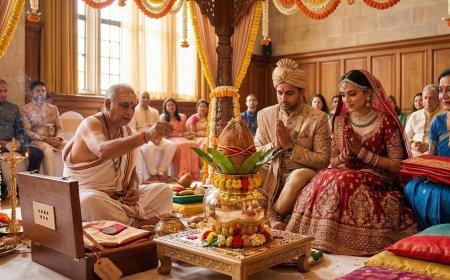

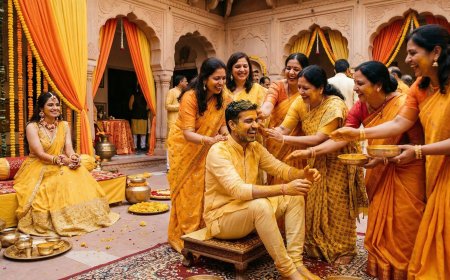
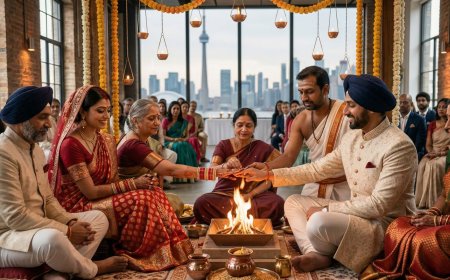



Embroidery Customisation in Jalandhar — Adding Initials, Wedding Dates and Personal Motifs
Personalised embroidery — initials worked into a bridal dupatta border, a wedding date integrated into a sherwani hem, a lotus motif commissioned from a craftsperson who has practised the technique for decades — is one of the most meaningful and most underutilised customisation opportunities available to NRI couples planning a Jalandhar wedding. This guide covers the full range of what Jalandhar's embroidery tradition makes possible: the specific techniques from zardozi to aari to phulkari, the items that can be personalised beyond the bridal dupatta, and the complete framework for commissioning custom embroidery work remotely — the specification document, the sample protocol, the timeline built backward from the wedding date, and the script decisions that deserve more deliberation than they typically receive. Built specifically for the NRI couple managing a craft commission across time zones, with a craftsperson they may never meet in person.

Embroidery Customisation in Jalandhar — Adding Initials, Wedding Dates and Personal Motifs
The idea came to Ananya on a Tuesday evening in April, on the District line somewhere between Earl's Court and Wimbledon, reading a wedding blog on her phone with the particular focus of someone who has been reading wedding blogs for six months and has developed the ability to filter out the generic advice in the first three sentences and find, occasionally, the specific detail that changes something.
The detail was a photograph. A close-up of a bridal dupatta — ivory silk, heavy with gold zardozi — in the corner of which, worked into the embroidery in a script so integrated with the surrounding pattern that you had to look twice to find it, were two letters and a date. The initials of the bride and groom. The wedding date in Roman numerals. Not appliquéd. Not printed. Embroidered — the same thread, the same tension, the same hand that had made the rest of the piece, worked into the border as if it had always been there, as if the dupatta had been waiting for those specific letters since the moment the thread was first put to the fabric.
She screenshot the photograph. She sent it to her mother in Jalandhar with no message attached.
Her mother called back in eleven minutes. This was the fastest her mother had ever responded to anything she had sent, including the message announcing her engagement. Her mother said, in the specific Punjabi-inflected Hindi they used when the conversation was important: Beta, this is something we can do. There is a man in Jalandhar. I know his shop.
Ananya had heard this before — there is a man, there is a shop, there is a cousin who knows someone who knows someone. But she had also learned, over the course of planning a wedding from London while her family lived in Jalandhar, that her mother's network was not the vague social fabric it sometimes sounded like. It was specific. It was reliable. And it had produced, consistently, the names and locations of craftspeople whose work she would not have found any other way.
She typed back: Tell me everything.
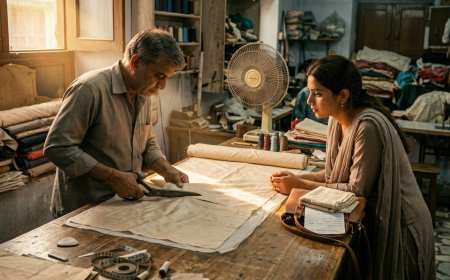
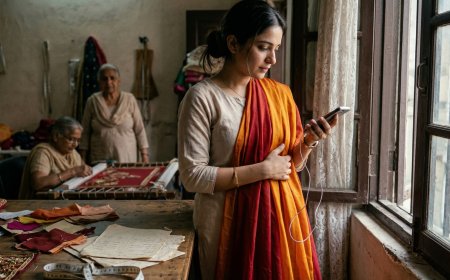
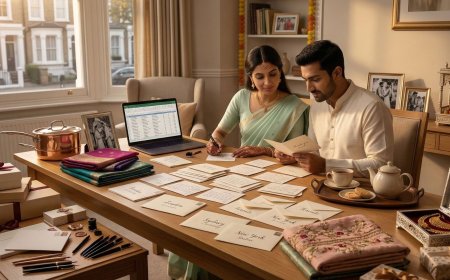
What followed was a three-week education — delivered in voice notes, WhatsApp photographs, and one forty-minute video call in which her mother sat in an embroidery workshop in a lane off the Guru Nanak Mission Chowk area while the embroiderer — a man in his mid-fifties named Harjinder, with the particular stillness of someone who has spent decades doing precise work with his hands — showed the camera the process of transferring a design onto fabric before the needle goes in. Ananya watched on her laptop in Wimbledon, leaning toward the screen, asking questions that Harjinder answered through her mother, who relayed them in Punjabi and translated the answers back in Hindi, and the whole thing had the quality of a conversation happening across not just distance but time — the London flat, the Jalandhar workshop, the craft that had been practised in that city for generations.
She asked about initials. She asked about dates. She asked about a specific motif — a lotus, which was both the flower of her wedding's visual theme and a symbol that carried personal meaning she did not need to explain because the embroiderer did not ask for explanations, only specifications. She asked about the thread colours and the placement and the size and whether the integration with the existing pattern was technically possible on a dupatta that had already been partially worked.
Harjinder answered each question through her mother. The answers were precise and honest — yes to this, not advisable for that, possible but expensive for the third thing, straightforward and cheap for the fourth. By the end of the call Ananya had not placed an order. She had something more valuable: a genuine understanding of what embroidery customisation in Jalandhar could and could not do, how to specify it correctly, and what the process required from her side of the arrangement.
She opened a new document. She titled it: Embroidery — What is actually possible.
This guide is for Ananya, and for every NRI bride or groom who has seen a personalised embroidery detail and wondered whether it is possible to achieve in Jalandhar — the complete framework for commissioning custom embroidery work, specifying it correctly across time zones, understanding the craft traditions that make it possible, and managing a process that begins in a London flat and ends in the hands of a craftsman who may not speak your language but who understands, with complete precision, what the needle can and cannot do.
The Craft Tradition Behind Jalandhar's Embroidery Work
Jalandhar's embroidery industry is not widely understood outside the people who use it, which is part of why it consistently surprises the NRI who encounters it for the first time with specific requirements. The city sits within a region — Punjab broadly, and the Doaba sub-region specifically — that has a long and layered embroidery heritage, most visibly expressed in phulkari, the counted-thread surface embroidery on coarse cotton that is among the most recognisable textile traditions in North India. But phulkari is the public face of a craft culture that extends much further — into the zardozi and zari work that is central to bridal wear, into the aari embroidery that produces the chain-stitch surface decoration on occasion wear, into the gota patti and mirror work and the hand-appliqué traditions that dress the Punjabi wedding across its multiple functions.
The craftspeople who practise these techniques in Jalandhar exist at several levels. At the top end are the master embroiderers — men and women who have trained for years, who work with premium materials, and whose output is the kind of work that appears on garments sold through premium boutiques in Delhi and through the Indian fashion export market. Below them are the skilled workshop embroiderers who produce consistent, high-quality commercial work for the mid-range garment trade. And below them are the home-based craftspeople who do piece-rate work for the wholesale market — consistent in their specific technique but without the design flexibility or the material knowledge of the upper tiers.
For the NRI commissioning personalised embroidery — the initials, the wedding date, the personal motif worked into a bridal dupatta or a sherwani hem or a set of ceremonial cushion covers — the correct tier to engage is the first or the second. The master embroiderer has the design ability to integrate a personalised element into an existing pattern seamlessly. The skilled commercial workshop has the organisational capacity to manage a remote commission — to communicate by photograph and video, to produce samples, to meet a deadline that has been specified weeks in advance by someone who cannot be there to supervise in person.
The Specific Techniques and What They Enable
Understanding the embroidery techniques available in Jalandhar is the first step to understanding what kind of personalisation is achievable and at what cost and timeline.
Zardozi is the heavy goldwork embroidery — using metallic threads, sometimes combined with sequins, beads, and semi-precious stones — that is the dominant technique in bridal occasion wear. It is worked on a frame, by hand, with a needle or a hook depending on the specific stitch. Personalisation in zardozi is possible and, when done by a skilled craftsperson, spectacular — the initials or date worked in the same metallic thread as the surrounding embroidery, integrated into the design so naturally that the personalisation reads as intentional design element rather than addition. The timeline for zardozi personalisation on an existing garment is two to four weeks depending on the complexity and placement. The cost is variable but typically between three and eight thousand rupees for a single personalised element on a dupatta or border.
Aari work — the hook-based chain stitch that produces the dense, continuous surface coverage seen on many Punjabi bridal dupattas and sarees — is more technically demanding to personalise because the chain stitch has a specific visual rhythm that must be maintained across the entire surface, including the personalised section. Done well, aari-based personalisation is virtually indistinguishable from the surrounding work. Done poorly, the lettering sits on the surface like an interruption rather than an integration. The craftsperson's skill level matters enormously for this technique, more than for zardozi where the three-dimensional quality of the metalwork can absorb minor inconsistencies.
Phulkari, as a technique for personalisation, offers a different aesthetic — the counted-thread geometric quality of phulkari does not lend itself naturally to cursive script or organic motifs, but it can accommodate initials and dates rendered in a geometric, cross-stitch-adjacent style that is visually consistent with the tradition. This is a less common form of personalisation but one that carries a specific authenticity when the garment is itself phulkari — the personalisation in the language of the textile rather than imposed on it.
Hand-embroidery in silk thread — the softer, more painterly surface embroidery used on lighter occasion wear and on the decorative textile elements of the wedding — is the most flexible technique for personalisation. Silk thread in a range of colours allows for script, motifs, and pictorial elements that would not be achievable in the heavier metalwork traditions. A lotus, a peacock, a pair of birds facing each other — these translate well into silk thread embroidery and can be integrated into dupatta borders, cushion covers, and the decorative textile elements that a wedding ceremony uses and that the couple keeps afterward.
What Can Be Personalised: The Full Range
The NRI couple who thinks of embroidery personalisation only in terms of the bridal dupatta is missing a significant proportion of what is possible. The range of items that can be customised with initials, dates, and personal motifs in Jalandhar is broader than most people realise, and some of the most meaningful personalisation opportunities are in the supporting textile elements of the wedding rather than the primary garments.
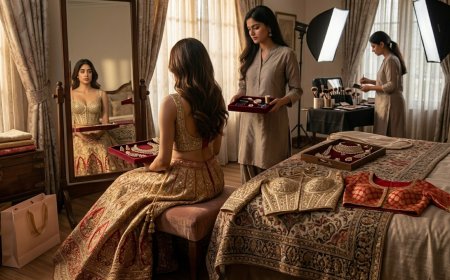
The bridal dupatta is the most common starting point — the corner embroidery or the border integration of initials and wedding date is the personalisation that the blog photograph showed Ananya, and it is genuinely achievable and genuinely beautiful when executed well. But the dupatta is only the beginning.
The groom's sherwani can be personalised at the hem, the cuffs, or the inner lining — a detail visible to the groom himself and to those who look closely, which is its own kind of meaningfulness. The inner lining personalisation — the bride's initial worked into the interior of the sherwani in a colour that matches the bridal palette — is a detail that appears in photographs only if the groom opens the jacket, but that carries a private significance that the couple carries through the day.
The ceremonial cushions used during the phera — the seat cushions, the cushion on which the pandit places the holy book — can be embroidered with the couple's initials and wedding date in a way that converts a functional object into a keepsake. These cushions are often made new for the wedding from raw fabric, which means they can be designed from scratch with the personalisation built in from the beginning rather than added to an existing piece.
The jutti — the embroidered footwear that is central to the Punjabi wedding aesthetic — can be personalised at the Jalandhar craftspeople who specialise in this category. The toe piece and the upper strap of a hand-embroidered jutti can carry initials, dates, or small motifs in the same thread as the surrounding embroidery, and the jutti category has the additional advantage of being purchased new and worked from the beginning, which gives the craftsperson more design freedom than personalising an existing garment.
The sehra — the floral or thread curtain that covers the groom's face during the procession — is a textile element that is often made new for the wedding and is a natural candidate for personalisation in its construction, with the couple's initials or a specific motif woven into the thread or ribbon elements that make up the hanging strands.
The wedding dupatta presented to the bride by the groom's family — the traditional odhni or chunri — can be personalised as a commission piece made from scratch, designed specifically for the family's colour scheme and carrying the personal elements that make it specific to this wedding rather than a generic ceremonial gift.
The Remote Commission: How to Specify Personalised Embroidery From Abroad
This is where the NRI context becomes specifically challenging, and specifically consequential. Embroidery is a visual and tactile craft. Specifying it correctly requires communicating visual information — the exact script of the initials, the size of the lettering relative to the surrounding pattern, the thread colour, the placement on the garment — across a medium that reduces everything to photographs and words. The craftsperson and the client are not in the same room. They cannot point to the border and say: here, this size, this thread, this angle of integration.
The specification document is the solution. It is not a description of what you want in general terms. It is a precise brief that contains every piece of information the craftsperson needs to proceed without ambiguity, because ambiguity in a remote commission is resolved by the craftsperson's judgment, and the craftsperson's judgment, however skilled, may not align with the client's unspoken vision.
The specification document for a personalised embroidery commission should contain: the exact text or motif to be embroidered, rendered as an image or a typed string with no ambiguity about font or script style; the placement on the garment, described in terms of distance from specific edges and reference points; the size of the personalised element relative to the garment and to the surrounding embroidery; the thread colour, specified with a reference the craftsperson can match — the name of a specific thread colour in the Indian embroidery thread system, or a physical swatch if the commission is being coordinated through a family member who can visit the workshop; the technique — zardozi, aari, silk thread — if it is not the craftsperson's default; the timeline — the date by which the piece must be completed, the date by which any sample or progress photograph must be sent; and the approval protocol — whether the client must approve a sample before the full work proceeds, which for a bridal dupatta or any high-value piece is non-negotiable.
The Script Question
The script in which initials are rendered is a decision that carries more consequence than it might initially appear. Indian embroidery craftspeople work naturally in Devanagari script and in the regional scripts of their own language tradition — for a Jalandhar craftsperson, this typically means Gurmukhi and Devanagari, with Roman script being less natural but well within the competence of any experienced workshop that has worked with the export market.
The choice between Devanagari initials, Gurmukhi initials, and Roman script initials is not purely aesthetic — it is a statement about the couple's relationship with their own linguistic and cultural heritage, and it is a decision that deserves genuine consideration rather than a default to Roman because it is the script of the country of residence. A bride whose name in Punjabi produces a Gurmukhi initial that is visually beautiful integrated into the border of a traditional dupatta has made a different and arguably more resonant choice than the bride whose Roman initials sit in the same position. Both are valid. Neither should be assumed.
If the couple wants the wedding date, the rendering of numerals is similarly a decision — Roman numerals have a specific aesthetic that works beautifully in metalwork embroidery, Devanagari numerals have a different visual weight and curve, and the choice between them should be deliberate.
The Timeline: What the Process Actually Requires
The timeline for a personalised embroidery commission is the variable that NRI couples most consistently underestimate, and the underestimation is expensive in the specific way that running out of time is always expensive — rushed work, compromised specifications, or the pain of abandoning the commission entirely because the wedding date arrived before the piece was finished.
The timeline depends on three factors: the complexity of the personalised element, the technique required, and the craftsperson's current workload. A simple initial in zardozi on an existing dupatta, commissioned from a skilled craftsperson with a manageable current workload, can be completed in ten to fourteen days. A complex integration of initials and motif into a new piece being worked from scratch, in aari technique on a heavily embroidered dupatta, from a master craftsperson who is managing other commissions simultaneously, requires six to eight weeks from brief to completion.
The NRI couple should build their embroidery commission timeline backward from the wedding date, not forward from the moment they decide they want it. The piece needs to be finished a minimum of two weeks before the wedding, to allow time for collection from the craftsperson, any final alteration or finishing, transport to the wedding location, and the quality review that should happen before the garment is packed for the ceremony. Two weeks before the wedding is therefore the completion deadline. Count backward from there — six to eight weeks for a complex commission, two to four weeks for a simpler one — and that is the latest date by which the commission can be placed. Not the date by which you would ideally like to have placed it. The latest date. Everything before that is buffer.
Managing Quality Across Distance: The Sample Protocol
The single most important quality control mechanism for a remote embroidery commission is the sample — a small section of the personalised embroidery worked on a piece of the actual fabric before the full commission proceeds, photographed and sent to the client for approval before the craftsperson continues. This sample serves multiple functions simultaneously: it confirms the thread colour, the script style, the size, the integration with any surrounding embroidery, and the craftsperson's interpretation of the brief. It identifies any misunderstanding between the specification document and the craftsperson's execution before the misunderstanding is worked into an irreversible thirty-centimetre border.
The sample requirement should be stated explicitly in the commission agreement. Not implied. Not assumed. The craftsperson should be told clearly: before proceeding with the full work, a sample of approximately five centimetres square must be sent as a photograph, and the full work will not begin until written approval is received. A craftsperson who resists this requirement — who says the sample is unnecessary, that they understand the brief completely, that the client should trust the process — is a craftsperson whose commission carries higher risk than one who accepts the sample protocol as reasonable and standard.
The photograph of the sample should be taken in natural light, against a neutral background, with the garment laid flat. The client should assess the photograph against the specification document and against any reference images used in the brief. If the sample is correct, approval is given and work proceeds. If the sample requires adjustment — the script is too large, the thread colour reads differently in the photograph than expected, the placement is slightly off — the adjustment is made to the sample before the full commission begins. This iteration costs one to three additional days. It is worth every hour.
Common Mistakes NRI Couples Make With Embroidery Customisation
The first mistake is commissioning without a specification document. The NRI who describes the personalisation in a WhatsApp message — a few sentences, a reference photograph, a verbal description of the placement — has given the craftsperson enough information to begin but not enough to finish correctly. The gap between the verbal description and the finished piece is filled by the craftsperson's interpretation, which may be skilled and beautiful and entirely different from what the client had in mind. The specification document is not bureaucracy. It is the difference between receiving the piece you imagined and receiving a piece that the craftsperson imagined on your behalf.
The second mistake is commissioning too close to the wedding date. The NRI who decides in the final six weeks before the wedding that they want a personalised dupatta is not in the same position as the NRI who commissioned the same piece four months earlier. The craftsperson who is booked has no availability. The craftsperson who has availability at six weeks' notice either has a light workload for a reason, or will rush the commission to accommodate the timeline, and rushed embroidery is legible as rushed embroidery in the photographs. Commission early. The personalised element is not an afterthought. Treat it as a primary decision made early in the planning process.
The third mistake is relying on a single family member to manage the commission without establishing a clear communication protocol. The NRI who says to their mother: sort out the embroidery commission, I trust you — and then does not establish how photographs will be shared, how approval will be communicated, how disputes or adjustments will be handled — is creating a situation where the commission's success depends entirely on the mother's interpretation of an unspoken brief. The mother will do her best. Her best may not be what the NRI had in mind. The communication protocol — the WhatsApp group, the shared folder of reference images, the explicit approval steps — is the structure that makes remote collaboration reliable rather than hopeful.
The fourth mistake is not asking about the craftsperson's experience with the specific technique required. Jalandhar has many embroiderers. Not all of them are skilled at all techniques, and not all of them have experience with personalisation work specifically. A craftsperson who is excellent at the repetitive pattern work of commercial wedding embroidery may not have the design flexibility to integrate an initial or a motif into an existing pattern seamlessly. Ask specifically: have you done this kind of work before? Can I see an example? The craftsperson who answers with photographs of previous personalisation commissions is the craftsperson to engage. The craftsperson who says yes without evidence should be pressed for it.
The fifth mistake is not accounting for the garment's existing condition when commissioning personalisation on a piece already purchased. A bridal dupatta that has been bought from a boutique and is being sent to an embroiderer for personalisation needs to arrive at the workshop in perfect condition — clean, pressed, with the existing embroidery undamaged. A dupatta that arrives with a loose thread, a small stain, or embroidery that has shifted during transport creates complications that add time and cost to the commission. The garment should be inspected before it is sent, wrapped carefully in tissue paper, and transported in a rigid container rather than folded in a bag. This is an obvious thing that is frequently not done.
The Complete Personalisation Reference Table
| Technique | Best Personalisation Use | Timeline | Cost Range (INR) | Remote Commission Suitability | Sample Required |
|---|---|---|---|---|---|
| Zardozi | Initials and dates on bridal dupatta borders, sherwani cuffs | 2–4 weeks | 3,000–8,000 per element | High — metalwork photographs clearly | Yes — mandatory |
| Aari (Chain Stitch) | Full surface integration on dupattas and sarees | 3–6 weeks | 4,000–10,000 per element | Medium — texture difficult to assess remotely | Yes — mandatory |
| Phulkari | Geometric initials and dates on phulkari garments | 2–3 weeks | 2,000–5,000 per element | High — counted thread photographs well | Yes — recommended |
| Silk Thread | Motifs, floral elements, pictorial personalisation | 2–5 weeks | 2,500–7,000 per element | Medium — colour accuracy critical | Yes — mandatory |
| Gota Patti | Border personalisation, geometric initial integration | 1–3 weeks | 1,500–4,000 per element | High — structural work photographs clearly | Recommended |
| Jutti Embroidery | Full initial and motif personalisation on footwear | 2–3 weeks | 2,000–5,000 per pair | Medium — scale difficult to assess remotely | Yes — recommended |
What Happened to Ananya
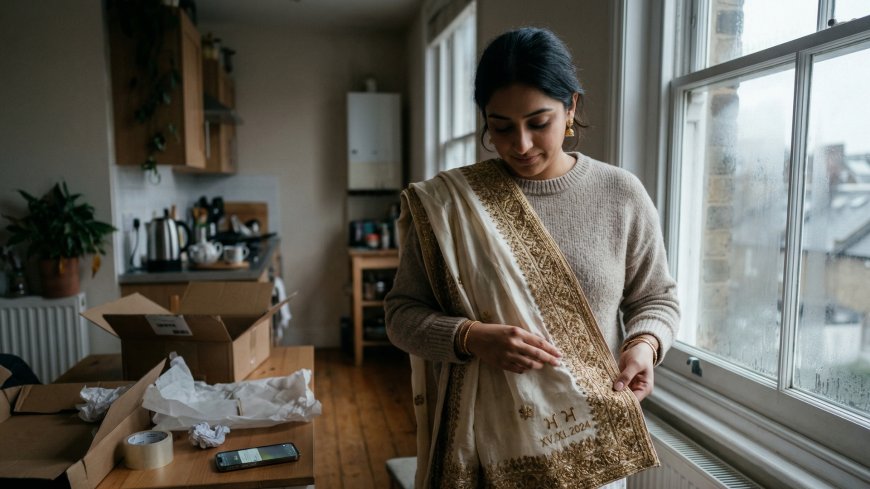
The dupatta arrived at her flat in Wimbledon six weeks before the wedding, sent by her mother through a courier service that her mother's neighbour had used for documents and that turned out to be entirely reliable for a carefully packed textile, which surprised Ananya slightly and did not surprise her mother at all.
She opened the package at the kitchen table on a Sunday morning in November, with the particular care of someone handling something they have been anticipating for two months. The dupatta was ivory silk, heavy with gold zardozi in the border pattern she had seen in the photograph on the District line that April evening. In the lower left corner of the border, worked in the same gold metallic thread as the surrounding pattern, integrated into the existing motif as if it had been designed that way from the beginning, were two Gurmukhi letters and a date in Roman numerals.
She had chosen Gurmukhi after three weeks of deliberation. Her own name in Gurmukhi, and his. The script her grandparents had used, the script she had learned to read as a child and half-forgotten and remembered again during the planning of this wedding. In the corner of a dupatta made in Jalandhar by a man named Harjinder, on ivory silk with gold thread, on a Sunday morning in Wimbledon.
She photographed it in the window light. She sent the photograph to her mother before she sent it anywhere else.
Her mother replied in forty-seven seconds. One word, in Punjabi. It meant: beautiful.
Commission early — at least six weeks before the wedding for complex work, eight weeks for master craftsperson commissions. Write a specification document before you send a single WhatsApp message. Require a sample before the full work begins. Choose the script deliberately — Gurmukhi and Devanagari are not defaults, they are decisions. Inspect the garment before it goes to the workshop and after it comes back.
The thread is old. The craft is patient. The personalisation is permanent.
Published by NRIWedding.com — The Premium Global Platform for Non-Resident Indians Planning Indian Weddings From Abroad.
What's Your Reaction?
 Like
0
Like
0
 Dislike
0
Dislike
0
 Love
0
Love
0
 Funny
0
Funny
0
 Angry
0
Angry
0
 Sad
0
Sad
0
 Wow
0
Wow
0