


































































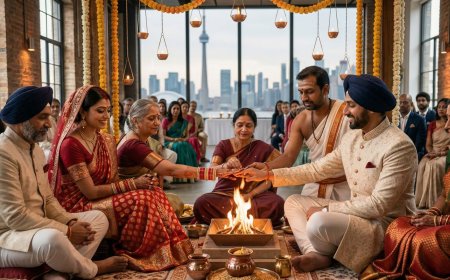



The NRI Groom's Complete Shopping and Styling Guide: Every Outfit, Every Occasion and Every Decision Done Right
The groom's wedding outfit rarely gets the planning attention it deserves — and NRI grooms who leave their shopping to the last India visit consistently arrive underprepared for one of the most photographed weekends of their lives. This guide delivers a complete event-by-event outfit framework covering sherwani selection, fabric and color strategy, turban styling, accessories, footwear, grooming, and the realistic fitting timeline that custom garments actually require. From the mehendi kurta to the reception suit, plan every look with the intention and clarity that your wedding photographs will reflect for the rest of your life.


Groom's Complete Shopping and Styling Checklist
The NRI groom's practical guide to every outfit, every occasion, and every decision — so you arrive at your own wedding dressed with intention rather than whatever survived the last-minute shopping panic
Nobody Told You the Groom's Shopping Was Also This Complicated
The narrative around Indian wedding fashion is, with very few exceptions, a narrative about the bride. The months of research, the designer appointments, the trousseau planning, the fitting anxiety — all of it centers on the bride's outfit with the implicit assumption that the groom's styling will sort itself out in a shorter timeframe with considerably less drama.
It does not sort itself out.
The NRI groom who leaves his outfit planning to the final India visit — who assumes he will find what he needs in a day or two of shopping, that tailoring can happen in forty-eight hours, that the sherwani his cousin recommends will work for all four events — consistently arrives at his wedding with an outfit situation that is some combination of ill-fitting, rushed, and insufficiently considered.
The groom's outfit at an Indian wedding is not a supporting element to the bride's look. It is photographed in every image, remembered by every guest, and experienced by the groom himself through every hour of every event across the wedding weekend. A groom who is dressed with genuine intention — whose outfit fits correctly, whose fabric and embroidery are appropriate to the occasion, whose overall look has been thought through with the same care as everything else about the wedding — is a groom who carries himself differently. Who is more confident. Who is more present. Whose photographs are better.
This guide is the preparation that makes that outcome possible.
The Multi-Event Reality: How Many Outfits Do You Actually Need
Before the shopping begins, clarity on the number of events requiring distinct outfits. NRI Indian weddings typically involve a sequence of events across two to four days, each with different aesthetic requirements, different formality levels, and different expectations for the groom's attire.
The standard multi-event NRI wedding typically requires: an outfit for the mehendi, an outfit for the haldi, an outfit for the sangeet, the main wedding ceremony outfit, and a reception outfit if this is a separate event from the ceremony. Some wedding weekends include additional events — a welcome dinner, a morning-after brunch — that may or may not require a distinct outfit depending on the formality of the occasion.
The practical minimum for a three-day NRI wedding with mehendi, sangeet, wedding ceremony, and reception is four distinct outfits. The haldi is typically the one occasion where a dedicated expensive outfit is the wrong choice — the turmeric and water that define the haldi ceremony are extraordinarily difficult to remove from fine fabric, and most grooms wear something comfortable and sacrificeable that they do not expect to keep.
Map your specific events before any shopping begins and assign each a formality level — low, medium, high — that will guide the outfit brief for each occasion.
Event by Event: The Outfit Guide
The Mehendi
The mehendi is typically a daytime, outdoor or semi-outdoor event with a relaxed, festive atmosphere. The groom's outfit for the mehendi should reflect this — festive without being formal, colorful without being costume-like, comfortable enough to sit on the ground or move around freely for several hours.
The most common and most practical groom mehendi outfit is a well-fitted kurta-pajama in a fabric and color that complements the bride's mehendi outfit. The level of embroidery and embellishment should be moderate — visible enough to read as an intentional celebration outfit but not heavy enough to compete with the aesthetic register of the event. Cotton, cotton-silk blends, or lightweight linen are the most practical fabric choices for a daytime outdoor event, particularly if the wedding is in a warm month or a warm climate.
Color is the most interesting decision point for the mehendi outfit. The NRI groom's mehendi palette has evolved significantly from the traditional white kurta toward a broader range of considered color choices — mustard yellow, olive green, terracotta, dusty blue, sage — that feel intentional and contemporary without abandoning the cultural context of the occasion.
Coordinate with the bride. Not match — coordinate. A groom in terracotta who knows his bride is wearing rust and orange is making an intentional color decision that reads in photographs as considered and connected. A groom in a color chosen independently of the bride's palette is making a decision that may or may not work visually, with consequences visible in every photograph from the event.
The Haldi
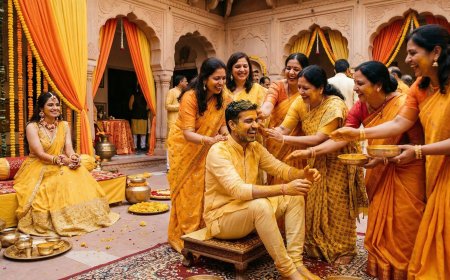
The haldi is functionally a no-outfit occasion in the sense that whatever is worn will be destroyed. The practical approach is a simple, comfortable white or off-white kurta that accepts the turmeric staining graciously — white turns a beautiful golden yellow under haldi application, which photographs well and provides a visual record of the ceremony without requiring the groom to mourn an expensive outfit.
Some grooms wear clothes that belong to the family's tradition for this occasion — an old dhoti or a simple cotton kurta that has no expensive associations. Others wear deliberately cheerful, disposable options. The one consistent principle: do not wear anything to the haldi that you are not comfortable losing.
The Sangeet
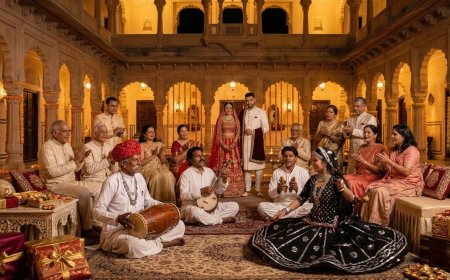
The sangeet is typically the highest-energy event of the wedding weekend and the one where the groom's outfit can most comfortably lean toward a contemporary, fashion-forward interpretation of Indian festive wear. The atmosphere — performances, dancing, a younger demographic at the center of the celebration — calls for something that moves well, photographs under stage and party lighting, and feels celebratory without the ceremonial weight of the wedding day outfit.
Indo-Western options work particularly well for the sangeet. A well-tailored bandhgala jacket in a statement fabric — brocade, velvet, richly textured silk — worn over tailored trousers or churidar provides the cultural context of Indian festive wear with the silhouette ease of Western tailoring. A statement kurta in a bold print or embroidered fabric with well-cut churidar is equally appropriate and often more comfortable for dancing.
The sangeet is the occasion on which accessory choices can be bolder and more experimental — a statement brooch on a bandhgala lapel, a distinctive pocket square, footwear with more personality than the wedding day choices. The formality constraint is lower here than at the ceremony, which creates room for personal expression that the main wedding outfit may not permit.
The Wedding Ceremony
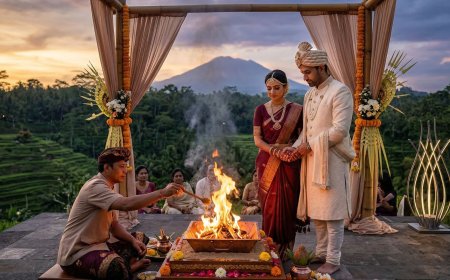
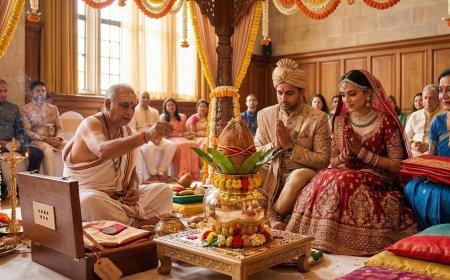
The main wedding ceremony is the occasion for which the groom's outfit investment should be highest and the styling consideration deepest. This is the outfit that appears in every key wedding photograph, that is worn during the most emotionally significant moments of the entire wedding, and that guests will reference when they describe the wedding for years.
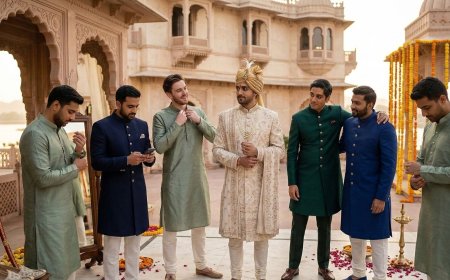
The sherwani remains the predominant choice for Indian groom wedding ceremony wear — and for good reason. The silhouette is specifically ceremonial, deeply culturally rooted, and produces an unmistakably wedding-specific visual impact that no other garment achieves in the same way. A well-made sherwani in the right fabric and color, fitted correctly for the specific groom's body, is one of the most distinguished garments that Indian fashion produces.
The alternatives to the sherwani for the ceremony outfit include: a Nehru jacket worn over a kurta with well-tailored churidar, a traditional dhoti-kurta for grooms whose family background and personal aesthetic places them in this tradition, and for some contemporary NRI grooms, a bandhgala suit that sits at the precise intersection of Indian and Western formal wear.
Whatever the specific garment, the wedding ceremony outfit should be: fitted to the specific groom's body rather than a standard size, appropriate in fabric and embellishment level to the formality of the ceremony, coordinated with the bride's bridal look in color and embellishment register, and tested by wearing it for at least an hour before the wedding day to confirm comfort across the full duration of the ceremony.
The Reception
The reception outfit — for grooms whose wedding has a separate reception event — is the occasion for the greatest departure from the ceremony look. Where the ceremony outfit carries ceremonial gravity, the reception can lean toward elegance and sophistication. A well-tailored suit in a festive fabric — a deep jewel-toned velvet, a textured brocade, a navy with subtle sheen — with Indian accessories can be as appropriate as a more traditional sherwani alternative, depending on the overall aesthetic of the reception.
For NRI grooms whose reception is attended primarily by international guests and colleagues, the reception outfit often benefits from sitting closer to the Western formal tradition — a beautifully tailored suit with Indian accessories that signal cultural identity without demanding cultural knowledge from guests who may not have it.
The Sherwani Deep Dive: Getting the Most Important Garment Right
Fabric Selection
The fabric choice for the wedding sherwani determines everything else — the drape, the weight, the way it responds to embroidery, how it photographs in different light conditions, and how comfortable it is to wear for six to eight hours.
The most commonly used fabrics for groom sherwanis and their characteristics:
Silk — the default choice for high-end wedding sherwanis, available in multiple weights and weaves. Pure silk drapes beautifully, photographs with a rich lustre, and accepts embroidery with the precision that this level of garment requires. The weight of the silk affects the drape — heavier silks produce a more structured silhouette, lighter silks produce a softer one. Confirm the silk content — blends sold as pure silk are common and produce a noticeably different garment.
Brocade — a woven fabric in which the pattern is created during the weaving process rather than embroidered afterward. Brocade sherwanis have a distinctive visual texture that reads as intrinsically luxurious without requiring additional embroidery. A brocade sherwani in a deep color — midnight blue, forest green, burgundy — with minimal additional embellishment is a sophisticated choice that photographs extraordinarily well.
Velvet — rich, tactile, and deeply photogenic in the right light conditions. Velvet sherwanis are specifically suitable for winter weddings where the fabric's warmth is practical as well as aesthetic. The visual weight of velvet means embellishment should be minimal — the fabric itself is the statement. Silk velvet is significantly more luxurious than synthetic velvet and worth the price difference for this garment.
Raw silk and dupion — textured silks that produce a more casual, slightly rustic visual character. These are more appropriate for mehendi and sangeet outfits than for the main wedding ceremony, where the more refined drape of pure silk or the visual richness of brocade or velvet reads more appropriately at the ceremonial register.
Color Selection
The groom's sherwani color is the most individually significant styling decision he makes — and the one most influenced by trends, family opinions, and the specific combination of the couple's outfits.
The traditional palette — ivory, cream, gold, and the deep jewel tones of burgundy, navy, and forest green — remains the most reliable foundation for a wedding ceremony sherwani because these colors read as inherently ceremonial, photograph beautifully across a range of lighting conditions, and do not carry the risk of appearing fashion-specific in a way that dates the photographs.
The contemporary expansion of this palette has brought in dusty rose, sage, slate blue, and various muted, desaturated versions of traditional colors that respond to the broader bridal fashion shift toward non-traditional color choices. These work well for NRI grooms whose aesthetic is contemporary and whose wedding has a specific color story that these choices serve.
The coordination principle: the groom's sherwani color should be chosen in conversation with the bride's lehenga rather than independently. This does not mean the colors should match — a bride in red and a groom in red is a specific aesthetic choice that some couples make deliberately and others arrive at accidentally. It means the colors should be chosen in relationship to each other — complementary, harmonious, or deliberately contrasting in a way that reads as intentional rather than accidental.
Embroidery and Embellishment
The embellishment level of the groom's sherwani should be calibrated to the embellishment level of the bride's lehenga rather than considered independently. A heavily embroidered bride next to a minimal groom creates a visual imbalance that reads oddly in photographs. A heavily embroidered groom next to a minimally embroidered bride creates a different imbalance. The goal is visual balance — not identical embellishment level but proportional embellishment that reads as part of the same aesthetic conversation.
Embroidery placement on a sherwani typically concentrates on the chest panel, the collar, the cuffs, and sometimes a vertical front panel. The thread work techniques most common for groom sherwanis include zardozi, dabka, and tilla — metallic thread embroidery techniques that produce the richly textured surface typical of high-end groom wear. Kundan embellishment — small stone settings within embroidered panels — adds a jewel-like quality that photographs particularly well.
The Accessories: Where the Details Live
The groom's accessory selection at an Indian wedding is the element most consistently underplanned and most visibly impactful when done well.
The Safa or Turban
The groom's turban — or safa — is the single most visually distinctive element of the Indian groom's wedding look and the element that most consistently differentiates a thoughtfully styled groom from a generically outfitted one. A well-tied, appropriately decorated safa adds visual height, creates ceremonial gravitas, and produces photographs with a distinctly majestic quality that no other accessory achieves.
The turban style varies by regional tradition — the Rajasthani safa with its structured shape and fan-back differs from the Punjabi dastar, which differs from the styles of other regions. An NRI groom whose family does not have a strong turban tradition has the freedom to choose the style that best suits his face shape and the overall aesthetic of his outfit.
The tying of the turban is a specific skill — do not attempt to learn it from a YouTube tutorial on the morning of the wedding. Engage a professional turban tier for the wedding ceremony and, if the turban is worn at other events, for those occasions too. The difference between a professionally tied turban and a self-tied one is immediately visible and significantly affects the overall visual impact of the groom's look.
Turban accessories — the kalgi, the jeweled brooch or aigrette that is pinned to the front of the turban — are a meaningful additional detail. A family kalgi, if one exists, carries sentimental significance beyond its aesthetic function. A purchased kalgi should be chosen in proportion to the turban style and in metal and stone that coordinates with the rest of the groom's jewelry.
Jewelry
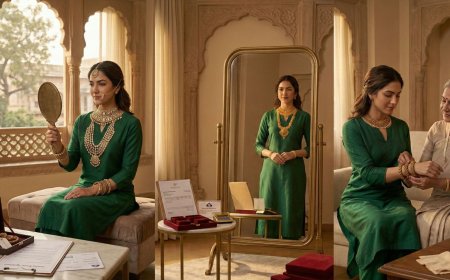
Indian groom jewelry at a wedding ceremony typically includes: a mala or garland as part of the ceremony itself, a ring or rings, a brooch on the sherwani if appropriate, and for some grooms in specific regional traditions, additional jewelry including a haar, a bracelet, or other pieces specific to the family's wedding customs.
For NRI grooms who do not regularly wear jewelry, the wedding ceremony is an occasion where the groom's jewelry should be simple, high quality, and specifically appropriate to the outfit rather than elaborate. A beautifully made gold or platinum ring, a high-quality sherwani button set, and a well-chosen brooch or pocket square are sufficient to produce a polished and complete look without overwhelming the outfit or creating discomfort for a groom unaccustomed to jewelry.
Footwear
The traditional mojari or juti — the hand-embroidered flat shoes of North Indian tradition — is the footwear choice most consistent with a sherwani wedding look and the choice that most Indian grooms make for the ceremony. The specific embroidery, color, and embellishment level of the footwear should coordinate with the overall outfit — a heavily embroidered sherwani in gold is best complemented by mojaris in a coordinating color rather than competing with additional embroidery.
The practical challenge of mojaris for NRI grooms: the fit of traditional mojaris does not always translate easily to feet accustomed to Western footwear. Try mojaris in advance and walk in them for at least thirty minutes before committing to wearing them for six or eight hours at the wedding. The toe profile of traditional mojaris is pointed in a way that can be uncomfortable for feet shaped by years of round-toe Western shoes. Break them in before the wedding day.
For grooms who cannot manage the comfort of traditional mojaris across the duration of the ceremony, high-quality leather dress shoes in tan, brown, or deep burgundy can complement a sherwani without compromising the overall aesthetic significantly.
The Dupatta or Stole
Not all groom outfits include a dupatta or stole, but for those that do — particularly at the main wedding ceremony — the choice of this element deserves care. The groom's dupatta is typically worn over the left shoulder and should coordinate with the sherwani in color and embellishment level. A heavily embroidered sherwani typically calls for a less embellished dupatta and vice versa.
The Fitting Reality: Why This Is Not a Two-Day Job
The consistent mistake NRI grooms make in their wedding outfit planning is assuming that the fitting process can be compressed into a short India visit. It cannot — not for a custom or semi-custom garment that is expected to fit correctly and look distinguished.
The realistic timeline for a custom sherwani: six to eight weeks minimum from the first fitting to the final garment for a mid-tier designer or skilled tailor, three to four months for a high-end designer with a significant order book. This timeline exists because the garment is built in stages — the initial cut, the basting fitting, the embroidery application, the final fitting and adjustment — and each stage requires time that cannot be meaningfully compressed without affecting the quality of the outcome.
For NRI grooms whose India visits do not accommodate this timeline, the practical alternatives are:
Order well in advance of the final India visit, with measurements taken on a preliminary visit or sent in advance, and plan the final visit to include a fitting and any final alterations.
Work with a designer who has established protocols for NRI clients — who can do the initial consultation remotely, ship a muslin trial garment for fit confirmation, and have the final garment ready for a single fitting on the India visit.
Consider semi-custom options from established bridal wear retailers who carry a range of sizes and offer on-site alteration services, reducing the lead time to a few days rather than weeks.
The Complete Shopping Checklist by Occasion
To ensure nothing is missed across the complete wedding outfit planning process, this checklist covers every garment, accessory, and styling element required across the full wedding weekend.
Mehendi Outfit: Kurta in festive fabric and color, coordinating churidar or pajama, simple footwear, minimal accessories.
Haldi Outfit: Comfortable, sacrificeable white or off-white kurta and pajama, footwear that can be removed easily.
Sangeet Outfit: Bandhgala jacket or statement kurta, coordinating churidar or tailored trousers, footwear that accommodates dancing, considered accessories including brooch or pocket square.
Wedding Ceremony Outfit: Sherwani or equivalent ceremonial garment, matching churidar, dupatta if applicable, safa or turban with kalgi, mojari or formal footwear, complete jewelry including ring, brooch, and any family pieces, inner garments appropriate to the sherwani's weight and construction.
Reception Outfit: Reception suit or sherwani alternative, coordinating shirt and trousers or churidar, formal footwear, reception-appropriate accessories.
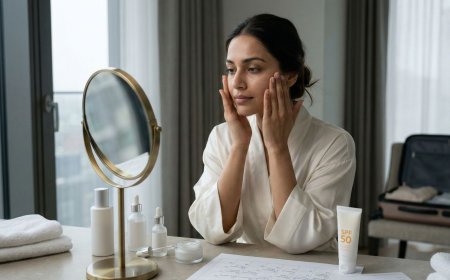
Grooming: Haircut timed for three to five days before the wedding, not the morning of; facial treatment or grooming routine established in advance; hand and nail care for the ring ceremony photographs; any specific grooming treatments required — threading, waxing, skin treatment — completed at least a week before the wedding to allow any reaction time.
The Groom's Styling Conversation Nobody Has
At the center of the NRI groom's shopping experience is a conversation that most grooms do not have because the cultural framework around Indian wedding fashion does not encourage them to: what do you actually want to look like?
Not what the designer recommends. Not what the family expects. Not what was worn at the last wedding you attended where the groom looked good. What is your specific vision for how you want to present yourself on the most photographed days of your life?
This question is worth sitting with. The groom who has answered it — who knows that he wants something contemporary rather than traditional, who has a specific color in mind that is personal to him rather than conventionally appropriate, who wants to wear something that feels like himself rather than a costume — will make better shopping decisions, have better conversations with designers and tailors, and ultimately feel more genuinely himself in the photographs that will exist for the rest of his life.
The groom's outfit matters. Your comfort in it matters more. Your confidence wearing it, across eight hours of one of the most emotionally charged days you will ever experience, is the thing that makes the photographs extraordinary.
Plan accordingly.
NRIWedding.com — Expert guidance for Indian weddings planned across borders.
What's Your Reaction?
 Like
0
Like
0
 Dislike
0
Dislike
0
 Love
0
Love
0
 Funny
0
Funny
0
 Angry
0
Angry
0
 Sad
0
Sad
0
 Wow
0
Wow
0