


















































Managing Language Barriers at Your Indian Wedding — The Complete NRI Couple's Guide
The NRI wedding brings together guests from multiple linguistic worlds simultaneously — the regional Indian languages of the older generation, the English of the diaspora and international guests, the sacred languages of the ceremony, and the inter-community gaps between different Indian linguistic traditions — creating a language landscape of genuine complexity that without deliberate management produces missed connections, peripheral participation, and the specific sadness of guests who were present but not fully included. This complete guide gives NRI couples the framework to manage every language gap at their wedding with the specific tools that actually work — covering the three distinct language gaps at the NRI wedding and their different management strategies, the sacred language as shared exclusion and how to reframe it, the ceremony programme as translation, the bilingual MC and how to find the right one, Hindi as inter-community lingua franca, the multi-generational language gap specific to NRI families, the English assumption and its limits for genuinely multilingual international guest lists, translation apps as social tools and their limitations, the seating plan as the most powerful language management tool, the mixing versus comfort principle tension, the informal translation network of bilingual family members and how to brief them, the multilingual welcome speech, video messages as language bridges, the ceremony officiant's role, multilingual venue signage thresholds, and the five common mistakes that leave guests linguistically isolated at weddings where the gaps were entirely predictable and manageable.


Managing Language Barriers at Your Indian Wedding
The Conversation That Almost Did Not Happen
The moment that the bride's grandmother remembered most vividly from the wedding — the moment she described to anyone who would listen for the following three years — was not the ceremony. It was not the photographs. It was not the Saptapadi or the flowers or the specific quality of light on the Udaipur lake at sunset.
It was the conversation she had at the reception dinner with the groom's colleague from Stockholm.
She spoke no English. He spoke no Hindi, no Marathi, no Gujarati — none of the languages that constituted her entire communicative world. What they shared was a table, a plate of food, and the specific human willingness to find a way through.
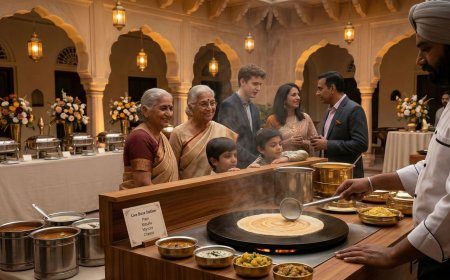
It began with the food. She pointed to a dish and said its name in Marathi. He repeated it badly and she laughed — not unkindly but with the specific delight of someone hearing their language attempted with genuine goodwill and spectacular incompetence. He pointed to his own plate and said something in Swedish that she could not understand but whose tone she understood completely — the tone of someone saying this is delicious in whatever language they have available.
They spent forty minutes at that table communicating almost entirely without shared language. She showed him photographs of her grandchildren on the phone her granddaughter had taught her to use. He showed her photographs of the Stockholm winter on his phone. She offered him more food with the specific maternal insistence that requires no translation. He accepted with the specific gratitude that also requires none.
The bride's cousin, who spoke both Marathi and English, translated intermittently — not every sentence, just the ones that needed translation, the ones where the gesture and the expression and the tone were not sufficient on their own.
At the end of dinner, the grandmother told her granddaughter that the Swedish man had a good heart.
He told the bride, through the cousin, that her grandmother was the most magnificent person he had ever met at a wedding.
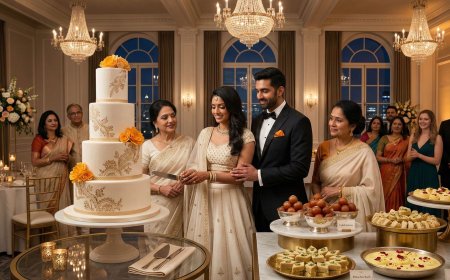
Neither of them had needed a common language to reach this conclusion. But they had needed the specific conditions that made the conversation possible — the table arrangement, the cousin's intermittent translation, the food that gave them a shared starting point, the wedding's overall atmosphere of warmth and welcome that made the attempt feel safe rather than awkward.
Those conditions were not accidental. They were the product of planning.
The Core Reality: The Language Landscape of the NRI Wedding
The Specific Complexity
The language landscape of the NRI wedding is among the most complex of any social occasion in the world — a gathering in which a single event may bring together people communicating in ten or fifteen different languages, with varying degrees of overlap between those languages, and with the specific additional layer of the ceremony's sacred languages — Sanskrit, Arabic, Gurmukhi — that are not the daily languages of anyone present.
The typical large NRI wedding might include: the bride's parents' generation communicating primarily in their regional Indian language — Gujarati, Tamil, Punjabi, Bengali, Marathi — with varying English fluency. The groom's extended family from a different regional linguistic community — creating an inter-Indian language gap as well as an Indian-international one. The couple's friends from university and work in the UK, Australia, Canada, or the USA — native English speakers with no Indian language. The non-Indian guests — colleagues, neighbors, friends — communicating in English and occasionally in other European or international languages. The ceremony officiant conducting rituals in Sanskrit or Arabic or Gurmukhi. The venue and catering staff communicating primarily in Hindi or the local language of the wedding destination.
This is not a language challenge. It is a language ecosystem — one that requires deliberate management not to resolve every linguistic difference but to ensure that the differences do not become barriers to the specific human connections that the wedding is creating the conditions for.
The Three Language Gaps
The language landscape of the NRI wedding contains three distinct gaps, each requiring different management strategies.
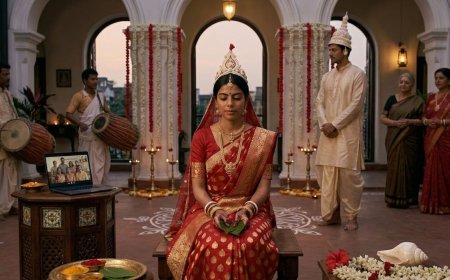
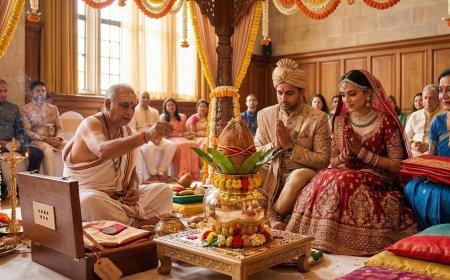
The ceremonial language gap: The gap between the language of the ceremony — Sanskrit, Arabic, Gurmukhi, or the regional language in which the rituals are conducted — and the language of the assembled guests. This gap applies to virtually every guest at the ceremony, including Indian guests, because the ceremony's sacred languages are rarely the daily languages of the people participating in them.
The inter-community Indian language gap: The gap between different Indian linguistic communities represented in the guest list — between the Tamil-speaking guests from the bride's family and the Punjabi-speaking guests from the groom's family, mediated by Hindi where it exists and by English where it does not.
The international language gap: The gap between the Indian-language world of the ceremony and the extended family, and the English-speaking world of the international guests — and occasionally between English and other international languages where non-English international guests are present.
Each gap requires specific management. The ceremonial language gap is addressed through explanation and ceremony programmes. The inter-community gap is addressed through Hindi as a lingua franca and through deliberate social mixing. The international gap is addressed through the comprehensive cultural and practical briefing that this guide series has addressed, and through the specific human infrastructure of translation and facilitation that this guide covers.
Managing the Ceremonial Language Gap
The Sacred Language as Shared Exclusion
There is a specific and underappreciated dynamic in the ceremonial language gap — the fact that the Sanskrit of the Hindu wedding ceremony, the Arabic of the Nikah, or the Gurmukhi of the Anand Karaj is not the daily language of virtually any guest present creates a form of shared exclusion that is, paradoxically, the condition for shared inclusion.
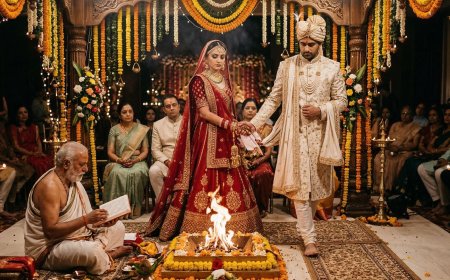
The Tamil grandmother who has attended forty Hindu weddings does not understand the specific Sanskrit mantras being chanted any more than the Swedish colleague attending his first Indian wedding. Both are participating in a ceremony conducted in a language that is not theirs. Both are experiencing the ceremony through something other than linguistic comprehension — through the visual, the musical, the sensory, the emotional, the transmitted meaning that does not require precise lexical understanding to convey.
This shared condition is worth acknowledging in the ceremony programme and in the officiant's explanations — not as an apology for the sacred language's inaccessibility but as an invitation into the specific mode of participation that the ceremony's language requires. The Sanskrit mantra does not need to be understood word by word to be participated in with genuine presence. It needs to be understood in its essential meaning — what is being committed to, what is being invoked, what the specific act being performed is doing — and this essential meaning is entirely communicable in English.
The Ceremony Programme as Translation
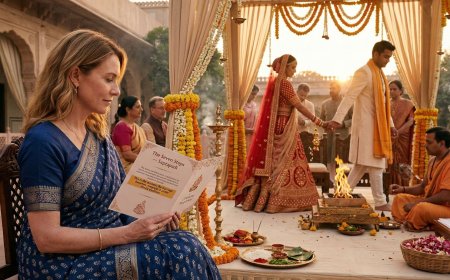
The ceremony programme — addressed in detail in the cultural explanation guide — is the primary tool for managing the ceremonial language gap for all guests simultaneously. A well-produced ceremony programme that explains each ritual's meaning in English, that translates the essential content of the key mantras or prayers, and that flags the ceremony's most significant moments for specific attention serves every guest at the ceremony regardless of their linguistic background.
The specific translation decisions in the ceremony programme:
The mantras and prayers do not need to be reproduced in their original language in the programme — the transliteration of Sanskrit or Arabic in a ceremony programme is typically not useful for guests who cannot read the script. What is useful is the English meaning of what is being said — not a word-for-word translation but the essential content expressed in natural English.
The Saptapadi's seven vows do not need to be rendered as precise Sanskrit translations in the programme. They need to be expressed in English in a way that conveys what the couple is committing to — with the specific warmth and the specific depth that makes the ceremony's meaning genuinely accessible rather than academically correct.
The Bilingual MC
For ceremonies that include a live programme element — particularly the sangeet and the reception — a bilingual MC who can operate fluently in both English and the primary Indian language of the family is among the most practically impactful additions to the event management.
The bilingual MC's role extends beyond translation — they are the specific human infrastructure that bridges the linguistic worlds of the two communities assembled at the wedding, making the specific jokes that land in both registers, managing the specific tone that serves both audiences, and creating the conditions in which a room full of people who do not all share a language feel like a single community rather than two communities in the same space.
Finding the right bilingual MC:
The bilingual MC must be genuinely fluent in both languages — not conversationally competent but fully fluent, capable of spontaneous improvisation, capable of managing the specific social dynamics of a large wedding gathering, and capable of the specific tonal judgment that distinguishes the moment that needs a joke from the moment that needs a sincere acknowledgment.
The bilingual family member who is charming and fluent and willing is a better MC than the professional MC who is polished but not fluent. The specific fluency and the specific family connection are more important than the professional performance experience.
Managing the Inter-Community Indian Language Gap
Hindi as the Lingua Franca
In contexts where the Indian language communities at the wedding do not share a regional language — where the Tamil-speaking and the Punjabi-speaking guests do not have a common Indian language — Hindi serves as the lingua franca that mediates between them, at least for guests whose Hindi is functional.
The Hindi proficiency of the guest list varies enormously by generation, region, and individual linguistic history. The older generation from Tamil Nadu or Kerala may have limited Hindi — the Dravidian language communities' relationship to Hindi is historically complex and Hindi fluency cannot be assumed. The younger generation from any Indian regional community who has been educated in a Hindi-medium or mixed-medium environment may have functional Hindi even without it being their home language.
The practical management: Seating arrangements that place guests with a shared language together, combined with the deliberate seating of bilingual guests at tables where the language bridge is needed, is the most practical tool for managing the inter-community Indian language gap at the reception.
The Multi-Generational Language Gap
A specific language gap that the NRI wedding almost always contains is the multi-generational gap — the gap between the older generation from India whose primary language is a regional Indian language and whose English may be limited, and the younger NRI generation whose primary language is English and whose regional Indian language may be limited.
This gap is not simply linguistic. It is the specific expression of the NRI experience — the generation that built a life in India and carries the full cultural and linguistic heritage, and the generation that was born or raised abroad and carries the heritage in a different form, with different linguistic access.
The management of this gap in the wedding context:
The deliberate placement of bilingual family members — the cousins who speak both the regional language and English fluently — as informal bridges at tables where the gap is most significant. The ceremony programme and the event communications in both languages — English and the primary Indian language of the family — where the family has the resource to produce both. The MC's bilingual operation. The specific acknowledgment of the older generation — in the languages they speak — that creates the feeling of inclusion rather than peripheral attendance.
Managing the International Language Gap
The English Assumption and Its Limits
The NRI wedding's default assumption is that English is the shared language of international communication — and for most NRI weddings, this assumption is accurate. The international guests from the UK, Australia, Canada, and the USA are native or fluent English speakers. The couple and their generation are fluent in English. English functions as the bridge language between the Indian and international worlds.
But the international guest list at some NRI weddings is genuinely multilingual — the groom's colleagues from the Frankfurt office who speak German, the bride's university friend who moved to Paris and whose English has been limited by a decade of daily French, the Japanese family member of the groom's colleague whose English is functional but limited. For weddings with a genuinely multilingual international guest list, the English-only assumption creates a specific exclusion that the couple may or may not be in a position to address.
The practical management:
For the ceremony programme and the event communications — providing translations into the specific non-English languages represented in the guest list is a significant practical undertaking and is appropriate only when the proportion of non-English international guests is large enough to justify the effort.
For the social dimension — seating non-English international guests with guests who share their language, or with guests who are multilingual, is the most practical social management of the multilingual international guest experience.
The Translation App as a Social Tool
The proliferation of mobile translation apps — Google Translate being the most widely used and the most consistently functional — has created a specific new tool for managing language barriers at social occasions that the wedding's guest brief should acknowledge.
Google Translate's real-time conversation feature — which can translate spoken language in real time and display it on the phone screen — is genuinely functional for the kind of basic social communication that wedding conversations involve. It is not a substitute for fluent bilingual communication. It is a starting point for the conversation that might not happen without it.
The specific suggestion for the guest brief:
International guests who want to communicate with guests from Indian linguistic communities — or Indian guests who want to communicate with non-English international guests — should have Google Translate downloaded and should know that using it is not rude or awkward but is a warm signal of the desire to communicate across the language barrier. The conversation that starts with a phone screen between two people who do not share a language is more valuable than the silence that replaces it.
The technology limitation that should be acknowledged:
Translation apps are significantly less functional for the specific linguistic patterns of the older generation's regional Indian languages — the specific dialect variations, the specific idioms, the specific register of the elderly grandmother's Marathi or the elderly grandfather's Tamil — than they are for standard modern Hindi or English. The app is a useful tool for basic communication and a limited tool for genuine nuanced exchange.
The Seating Plan as Language Management
The Strategic Seating Principle
The seating plan for the reception dinner is the most powerful single tool available for managing the language landscape of the wedding gathering — more powerful than any communication programme, more powerful than any technology, because it determines the specific human conversations that are structurally possible across the wedding evening.
The language-conscious seating plan:
Every table at the reception should have at least one fluently bilingual guest — someone who can bridge the primary language gap at that table. The bilingual guest at a table of Tamil-speaking older family members and English-speaking international guests is not there to be a formal translator — they are there to be the human bridge that makes the conversation possible, the person who hears something said in Tamil that the international guest would benefit from knowing, and who passes it across without making the translation feel like a service.
The Mixing Principle Versus the Comfort Principle
There is a genuine tension in seating plan design for multilingual weddings between two valid principles.
The mixing principle: Place guests from different linguistic and cultural communities together — create tables that are genuinely mixed, that require the conversation to cross the language gap, and that produce the specific human connections across cultural difference that are the wedding's most extraordinary social achievement.
The comfort principle: Place guests in groups where they share a language and can communicate naturally — where the Tamil grandmother is at a table with Tamil speakers, where the German colleague is at a table with someone who speaks German, where no one is managing the anxiety of not understanding or not being understood for an entire evening.
The resolution: Apply the mixing principle to the younger and more socially confident guests who have the linguistic flexibility and the social ease to navigate mixed-language tables without discomfort. Apply the comfort principle to older guests, to guests who are already managing significant unfamiliarity — the non-Indian international guest at their first Indian wedding — and to guests whose limited language is already requiring significant management effort. Reserve the bridge guests for the tables where the gap is largest and the social stakes of bridging it are highest.
The Family Member as Language Infrastructure
The Informal Translation Network
The most effective language management at an Indian wedding is not a formal translation service or a professional interpreter. It is the informal network of bilingual family members who move through the gathering, create the conditions for cross-language connection, and make the specific conversations possible that would not otherwise happen.
Identifying the informal translators:
Every extended Indian family has its bilingual members — the cousins who grew up in India and studied in the USA and speak both Tamil and English fluently, the aunt who married into a Punjabi family from a Bengali background and now navigates both communities with the ease of someone who has been doing it for thirty years, the young cousin who grew up in London and speaks both Gujarati and English at a native level because the family insisted on both.
These people are the language infrastructure of the wedding gathering. The seating plan and the event management that deploys them deliberately — places them at the tables and in the social situations where the language bridge is most needed — is extracting the maximum value from a resource that the family already possesses.
The Briefing of the Informal Translators
The informal translation network works better with a brief conversation before the wedding than without one. The specific request — "could you keep an eye on the table where the Swedish guests are sitting with Grandmother and make sure they have someone to talk to" — is more effective than the general assumption that the bilingual cousins will naturally serve this function.
The briefing does not need to be formal. It is the specific request from the couple to specific people who are well-positioned to help, made before the wedding day rather than in the moment when the gap has already become apparent.
The Welcome Speech: Setting the Linguistic Tone
The Multilingual Welcome
The welcome speech at the reception — delivered by the couple, by the parents, or by the MC — is the moment at which the wedding's linguistic character is publicly established. The welcome speech that is delivered only in English establishes English as the wedding's language and implicitly positions every non-English speaker as a peripheral participant. The welcome speech that includes a greeting, an acknowledgment, or a specific word in each of the significant languages represented in the room establishes the wedding as a genuinely multilingual occasion in which every community is acknowledged.
The multilingual welcome does not need to be a full speech in multiple languages — this is impractical and would extend the welcome to an unreasonable length. What it needs is the specific acknowledgment — the grandmother's language spoken back to her in the welcome, even briefly, even imperfectly — that makes her feel that she is at the centre of the occasion rather than at its periphery.
The practical form:
The welcome speech that opens in English, includes a greeting in Hindi or the primary Indian language of the family, includes a brief acknowledgment of the international guests in English that specifically names the countries they have traveled from, and closes with a word or phrase in any additional significant language represented in the room — the Swedish "välkommen," the German "herzlich willkommen" — produces a specific emotional effect in the guests who hear their language reflected back that no amount of logistical planning can replicate.
The effect is not about the linguistic content of the word. It is about what the word communicates — that the couple knew their guests were there and thought about them specifically enough to learn their language's word for welcome.
The Video Message as Language Bridge
For weddings where significant family members could not attend in person — the grandmother in Chennai who could not travel, the uncle in New York whose visa did not arrive in time — a video message played during the reception creates the specific inclusion of the absent person in a form that the language infrastructure can manage.
The video message in the absent person's language — with subtitles in English and the other significant languages of the gathering — is fully inclusive. The family member who appears on screen speaking Tamil is not excluding the Swedish guest who cannot understand Tamil, because the subtitles are providing the meaning. The Swedish guest is watching someone's grandmother express her love for her granddaughter at her wedding — and this does not require linguistic comprehension to be genuinely moving.
The Children's Experience
The Child's Language Landscape
Children at multilingual weddings face a specific version of the language challenge — they are typically less equipped than adults to manage communication across language barriers, and their experience of the language gap is more immediately affecting because they have fewer compensatory social strategies.
The NRI child who speaks English and some Hindi and has been brought to India for the family wedding is navigating an environment where the older generation speaks primarily a regional Indian language the child may not know, where the ceremony is in Sanskrit, and where the social conventions of the extended family gathering are unfamiliar.
The specific management:
Ensuring that every child guest has at least one adult in their proximity who speaks their language — their parents, a bilingual cousin, a family friend — removes the specific anxiety of the language-isolated child. The children's gathering — if the wedding programme includes one — should be managed by a bilingual adult who can bridge whatever language gaps are present in the children's group.
The Ceremony Officiant's Role in Language Management
The Explanation That Changes Everything
The pandit, Qazi, Granthi, or other ceremony officiant is the most important single contributor to the management of the ceremonial language gap — because their decision about whether and how to explain the ceremony in English determines whether the assembled guests of all linguistic backgrounds experience the ceremony as meaningful or as beautiful and opaque.
The guidance for working with the officiant on language:
The pre-ceremony meeting — addressed in the ceremony guides for each tradition — should specifically include the question of how the ceremony will be made accessible to guests who do not understand the ceremonial language. The officiant who is willing and able to provide English explanations before each ritual, or to pause at key moments for a brief English summary, is the officiant who is most effectively managing the ceremonial language gap.
The officiant who cannot or will not provide English explanations should be supplemented by the ceremony programme and, where appropriate, by a family member who provides quiet commentary to the non-understanding guests.
Signage and Written Communication
The Multilingual Venue
For weddings with a significant proportion of non-English or non-Hindi speaking guests, the venue signage and the written communication at the wedding — menus, table cards, directional signage — can be produced in multiple languages as a specific act of linguistic inclusion.
The practical threshold:
Multilingual signage is worth producing when the proportion of guests who would benefit from it is significant enough to justify the effort — typically when more than fifteen to twenty percent of the guest list does not read English fluently. For smaller proportions, the investment in full multilingual signage may be disproportionate to the benefit, and other management tools are more cost-effective.
The minimum multilingual provision:
Even for weddings where full multilingual signage is not practical, the menu — the document that guests interact with most directly during the reception dinner — is worth producing with at minimum the dish names in both English and the primary Indian language of the family, with brief ingredient descriptions that allow guests with dietary requirements to manage their choices without requiring translation assistance.
Common Mistakes NRI Couples Make With Language Management
The first mistake is treating the language barrier as the guests' problem rather than the couple's planning challenge. The Swedish guest who cannot communicate with the Tamil grandmother is not failing at social participation — they are in a situation that the seating plan could have managed more effectively. The language gap that was predictable in the planning stage and was not addressed becomes the specific missed connection at the reception that the couple notices in the photographs — the table where the two communities sat side by side and did not speak.
The second mistake is relying on English as the universal solution. For the older Indian generation at the wedding — the grandparents, the parents' generation from smaller cities, the extended family whose daily lives are conducted in a regional Indian language — English is not a comfortable communicative medium. The wedding that operates entirely in English has made a specific choice about whose comfort is prioritised, and that choice is visible to the people it disadvantages.
The third mistake is not briefing the bilingual family members on their informal translation role. The bilingual cousin who does not know they are needed at a specific table spends the evening at a table where their language skills are not required, while the table where they are needed manages the gap without them. The thirty-second briefing conversation before the wedding changes this outcome.
The fourth mistake is not including any explanation of the ceremonial language in the ceremony programme. The ceremony programme that lists ritual names without explaining what they mean in English is marginally better than no programme — it tells the guest what is happening but not why it matters. The ceremony programme that explains the essential meaning of each ritual in warm, accessible English is the tool that transforms the ceremonial language gap from a barrier into an invitation.
The fifth mistake is over-engineering the language management. The wedding that attempts to provide full professional translation across every language gap at every event — professional interpreters, multilingual signage throughout, ceremonial translation earpieces — is attempting something that is both practically overwhelming and socially counterproductive. The most powerful language management at a wedding is human rather than technical — the bilingual cousin, the warm MC, the seating plan that places the bridge guest at the right table. The technology and the formal infrastructure support the human infrastructure. They do not replace it.
The Conversation That Does Not Require a Common Language
The grandmother remembered the conversation with the Swedish man for three years because it had surprised her — the specific surprise of genuine human connection across what should have been an impassable barrier. She had not expected to find in a person with whom she shared no words, no cultural reference, and no common history, the specific quality of warmth and genuine interest that she had recognised immediately and that had made the forty minutes at the dinner table among the most memorable of the entire wedding.
He remembered it because it had changed something in his understanding — the specific revision of the assumption that communication requires shared language, replaced by the understanding that communication requires only the shared willingness to attempt it in whatever medium is available.
Both of them had arrived at this understanding because the conditions for the attempt had been created. The table arrangement. The cousin's intermittent translation. The food that gave them a shared starting point. The overall atmosphere that made the attempt feel safe.
These conditions were planning decisions. They were the specific, considered choices that the couple had made about how to create the gathering that their wedding would be — a gathering where the different linguistic worlds of the assembled guests were not obstacles to connection but the specific texture of the extraordinary human occasion the wedding created.
The language barrier at an Indian wedding is real. It is also, with thoughtful management, permeable.
The conversation that almost does not happen is the one worth planning for.
Build the conditions for it. Trust that the people will find the way through.
Published by NRIWedding.com — The Premium Global Platform for Non-Resident Indians Planning Indian Weddings From Abroad.
What's Your Reaction?
 Like
0
Like
0
 Dislike
0
Dislike
0
 Love
0
Love
0
 Funny
0
Funny
0
 Angry
0
Angry
0
 Sad
0
Sad
0
 Wow
0
Wow
0