







































































Paithani Saree Buying in Mumbai — Where to Find Authentic Weaves Without Going to Pune
For the NRI bride who cannot make the trip to Yeola or Pune, Mumbai's Paithani market is more capable than most guides admit — if you know exactly where to look and what to examine. From Dadar West's Ranade Road to Matunga's quieter dealers and Kala Ghoda's premium studios, this guide covers every genuine buying location in Mumbai, the physical tests that separate handloom from machine-made, provenance questions every dealer must answer, and the complete NRI buying framework for one day, two days, or a trusted buyer on the ground.

Paithani Saree Buying in Mumbai — Where to Find Authentic Weaves Without Going to Pune
She had exactly four days in Mumbai and a list that ran to eleven items. The Paithani was at the top — had been at the top since she had written the list on the flight from Singapore, somewhere over the Bay of Bengal, with a plastic cup of orange juice balanced on the tray table and her wedding binder open on her lap. Everything else on the list felt manageable, the kind of manageable that comes from having a phone and a credit card and a mother who has already done the reconnaissance. The Paithani felt different. The Paithani felt like the thing that could go wrong in ways she had not yet fully imagined.
Her mother had told her, in the way mothers tell you things that contain entire histories compressed into a single sentence: go to Pune, go to Yeola, go to the source. Her aunt had said the same. Her future mother-in-law, who was Maharashtrian to the bone and whose opinion on Paithani authenticity was delivered with the confidence of someone who had been buying them since before Singapore existed as a financial centre, had said it a third time: there is no substitute for Yeola. The weaver's hands. The loom. The real thing.
She understood this. She also had four days, eleven items on the list, and a return flight on Sunday evening that was not negotiable because Monday was a board presentation that the entire quarter depended on. Pune was two hours each way on a good day. Yeola was three hours beyond Pune. The mathematics of the trip did not work, and the mathematics of the trip were not going to work, and this was a fact she had accepted somewhere over Sri Lanka while finishing the orange juice.
What she needed — and what she could not find in any of the sources she had consulted before boarding the flight — was a genuine answer to a question that everyone seemed to be avoiding: where in Mumbai, specifically, could she find a real Paithani? Not a Paithani-style saree. Not a Paithani-inspired piece produced in Surat on a power loom and sold in a glass-fronted showroom by a salesperson who had memorised a script about Yeola heritage. A real one. Handwoven. Genuine zari. The kind of thing her future mother-in-law would hold up to the light and not find wanting.
She called her cousin Meera, who lives in Mulund and who has been buying sarees in Mumbai since she was twenty-two. Meera said, without hesitation: Dadar first, then Matunga, then if you have time, one specific shop in Kala Ghoda that nobody talks about. She said: I will send you a list. The list arrived at midnight, Mumbai time, with specific shop names, specific streets, specific instructions about what to ask for and what to refuse. Meera had added at the bottom, in a postscript that carried the weight of hard experience: do not buy a Paithani from anyone who cannot tell you the name of the weaver or the village. If they hesitate, leave.
She landed the next morning. She went to Dadar first.
This guide is for that bride — and for every NRI who needs the real Paithani and cannot make the trip to Pune, and who deserves a complete, honest account of where Mumbai's genuine Paithani market actually lives.
Why the Question of Mumbai Versus Pune Matters
The received wisdom about Paithani buying — go to Yeola, go to Paithan, go to the source — is not wrong. It is simply incomplete in a way that does not serve the NRI bride whose India trip is measured in days rather than weeks. Yeola, in Nashik district, is where the majority of genuine handwoven Paithanis are produced, and Paithan, the ancient town in Aurangabad district from which the saree takes its name, is where the tradition originated. Both are extraordinary places to buy, if you have the time, the transport, and the Marathi-language negotiation skills that make the sourcing trip productive rather than merely atmospheric.
Mumbai is not the source. Mumbai is the market. But it is a market with a history of Paithani trade that stretches back generations, and within that market there are dealers who have relationships with Yeola weavers that are as old as the dealers' own businesses. The Paithani sold in the right Mumbai shop is not a second-best option. It is the same weave, from the same hands, purchased through a supply chain that the best dealers have spent decades making reliable.
The problem is that Mumbai's Paithani market is not uniform. Alongside the genuine dealers with genuine weaver relationships, there is a large and growing parallel market in machine-woven imitations, power-loom approximations, and Surat-produced synthetics labelled with sufficient confidence to fool a buyer who does not know what she is looking at. Understanding which market you are in — the genuine one or the imitation one — is the entire skill that this guide is designed to transmit.
The GI Tag and What It Actually Means
The Paithani saree received its Geographical Indication tag in 2009, which means that technically only sarees produced in Yeola and the surrounding region of Nashik district can be sold as genuine Paithani. The GI tag is an intellectual property protection, similar in principle to the designation that protects Champagne or Darjeeling tea. In practice, its enforcement in the retail market is inconsistent at best, and the NRI bride who assumes that a GI tag sticker on a saree is a reliable guarantee of authenticity is placing faith in a system that the market has not fully implemented.
The GI tag is a starting point, not a conclusion. A saree with a GI tag from a reputable dealer who can explain the provenance is a good sign. A saree with a GI tag from a shop that cannot answer specific questions about the weave is a tag that has been applied to a product it may not accurately describe. Use the tag as one data point among several, never as the only one.
Where in Mumbai to Buy a Genuine Paithani
Dadar West: The Primary Market
Dadar West, and specifically the concentration of saree shops along Ranade Road and the lanes immediately surrounding it, is the most important single location in Mumbai for Paithani buying. This is not a recent development or a discovery — it has been the primary Mumbai Paithani market for decades, and the reason it has maintained that position is the same reason any market maintains its position: the dealers there have the relationships, the knowledge, and the accumulated credibility that buyers return to.
The Dadar Paithani market is not a single shop or a single arcade. It is a dense, overlapping collection of businesses that range from large family-run establishments occupying entire floors of commercial buildings to small single-room shops whose frontage is barely wide enough for two people to stand side by side. The quality range within this market is enormous — which is both its greatest asset and its primary challenge for the uninitiated buyer.
The larger, more established shops on Ranade Road — the ones whose signage has been there long enough to be faded, whose interiors have the particular organised depth of a business that has been accumulating stock for thirty years — are the places to begin. These are the shops where the owner, if asked directly about provenance, will either give a specific answer or decline to make the claim at all. The specific answer is what you are looking for. A dealer who says "this comes from Rama Vitthal's workshop in Yeola, they use only silver-core zari, my father has been buying from them since 1978" is telling you something verifiable and meaningful. A dealer who says "yes, yes, genuine Paithani, Yeola only" while simultaneously avoiding eye contact is telling you something else entirely.
The best time to visit Ranade Road is a Tuesday or Wednesday morning, between ten and noon, when the market is active but not at its weekend peak and the dealers have time for the kind of conversation that genuine buying requires. Saturday afternoons are to be avoided — the market is at its most crowded, the dealers are at their most transactional, and the conditions for careful examination and honest conversation are at their worst.
Matunga: The Less-Known Alternative
Matunga, specifically the area around King's Circle and the lanes running off Telang Road, contains a smaller but significant concentration of Paithani dealers who serve primarily the Maharashtrian residential community of the neighbourhood. These shops are less well-known to the tourist or out-of-town buyer than the Dadar establishments, which means they operate with slightly less performance pressure and slightly more willingness to have an honest conversation about what they are actually selling.
The Matunga dealers tend to carry a narrower range than the Dadar shops — fewer pieces at any one time, a more focused edit of qualities and price points. For the NRI bride who knows approximately what she wants and needs to make a decision efficiently, this can be an advantage rather than a limitation. The decision space is smaller, the conversation is easier, and the dealers — who know their regular customers by name and by wedding anniversary — are accustomed to treating buyers as people rather than as revenue opportunities.
The price points in Matunga are often marginally lower than in Dadar for comparable quality, which reflects lower overheads rather than lower quality, and the buying experience is generally calmer. The trade-off is range: if you need to see twenty Paithanis to find the right one, Dadar is where you go. If you already know you want a peacock-motif pallu in a specific colour range and you trust the dealer's curation, Matunga can be faster and less exhausting.
Kala Ghoda and the Fort Area: Curated and Expensive
The heritage precinct of Kala Ghoda and the surrounding Fort area in South Mumbai contains a small number of saree dealers who operate at the premium end of the market and whose Paithani offerings are genuinely different in character from the Dadar and Matunga stock. These are typically dealers who have established direct relationships with specific master weavers — not the general Yeola wholesale market but individual craftspeople whose work is known by name — and who carry limited quantities of correspondingly high-quality pieces.
The price points in Kala Ghoda are the highest in the Mumbai Paithani market. A handwoven Paithani from a reputable Kala Ghoda dealer will typically start at sixty to seventy thousand rupees and can reach several lakhs for a piece with complex pallu work or pure gold zari. What the buyer receives at this price level is not simply a better saree — it is a saree whose specific origin can be documented, whose weaver's name is known, and whose zari composition is verifiable rather than merely claimed. For the NRI bride who is buying the principal wedding ceremony saree and for whom authenticity is a non-negotiable rather than a preference, the Kala Ghoda premium is justified.
Mulund and Thane: The Eastern Suburb Dealers
The eastern suburbs — Mulund, Bhandup, and extending into Thane — contain a distribution of Paithani dealers that serves the large Maharashtrian residential population of that corridor. These shops are not destinations in the sense that Dadar is a destination, but they are functional and, in certain cases, excellent. The NRI bride staying with family in the eastern suburbs, or whose visit to Mumbai centres on that part of the city, should not assume she must travel to Dadar for a genuine purchase.
The eastern suburb dealers vary considerably in quality and in the specificity of their Paithani knowledge, and the due diligence required here is if anything more rigorous than in Dadar, where the density of competition creates a certain natural discipline. The questions about provenance, weaver relationships, and zari composition are the same questions — they simply need to be asked with more patience and more willingness to leave if the answers are not satisfactory.
Reading a Paithani: The Physical Examination Every NRI Buyer Must Know
The ability to examine a Paithani and determine whether it is what it claims to be is not an expert skill available only to people who have been buying these sarees for decades. It is a specific, learnable set of observations that any buyer can perform in ten minutes with adequate light and adequate determination. The observations described below apply to any Paithani under consideration, regardless of the shop, the dealer, or the price being asked.
The Zari Examination
The zari — the metallic thread that forms the borders, the pallu motifs, and the characteristic gold-work of a Paithani — is the single most important quality indicator and the single most commonly misrepresented element. Genuine Paithani zari uses a silver wire core that is wound with gold-plated thread. The resulting yarn has a weight, a drape, and a surface quality that synthetic metallic thread — polyester wound with metallic film — cannot replicate.
The examination begins with the border. Hold the border of the saree with both hands and let it drape. Genuine zari border has a weight that pulls the fabric downward with authority. Synthetic zari is lighter and produces a drape that is softer and less structured. This is a tactile assessment that becomes reliable with a small amount of practice — if you can, handle two or three Paithanis at different price points before making your assessment, so you understand the range.
The burn test — pulling a single thread of zari from an inconspicuous section of the border and burning it with a lighter — is the most definitive non-laboratory test available. Genuine silver-core zari burns and leaves a residue that holds its shape. Synthetic zari melts and produces a plastic smell. No reputable dealer will object to this test on a saree being seriously considered for purchase, and a dealer who objects is providing important information about what the saree contains.
The Interlocking Thread Join
The defining structural characteristic of a handwoven Paithani is the way the coloured motif threads are joined to the ground weave. In a genuine handloom Paithani, the coloured threads of the body pattern — the characteristic checks, the floral motifs, the peacock figures — are interlocked with the ground threads using a tapestry-weaving technique that creates an almost imperceptible ridge on the surface of the fabric when held to a raking light. This interlocking is what makes the Paithani reversible — both sides of a genuine handwoven Paithani are clean and finished, with no floating threads on the reverse.
Turn the saree over. Look at the underside. On a genuine handloom piece, the reverse is as clean as the face, with the same pattern visible in a slightly different way. On a power-loom or machine-woven piece, there will be floating threads on the reverse where the pattern was produced by a mechanical process that does not interloc the way a handloom does. This examination takes thirty seconds and is entirely definitive.
The Selvedge Test
The selvedge — the finished longitudinal edge of the saree — on a handwoven Paithani is slightly irregular. Not badly made. Not unravelling. Slightly irregular, in the way that any edge produced by human hands on a handloom is slightly irregular, because the tension applied by a human weaver varies fractionally from row to row in a way that a machine does not. This irregularity is the mark of the hand, and it is present in every genuine handloom Paithani regardless of the quality level.
Machine-woven and power-loom Paithanis have perfectly regular selvedges. The evenness is mechanical. If you run your finger along the selvedge of a saree and feel complete, metronomic regularity, you are almost certainly holding a machine-woven piece. This is not always a problem — machine-woven Paithanis are legitimate products at their correct price point — but it becomes a problem when a machine-woven piece is being sold as a handloom one.
The Silk Body Test
The body of a genuine Paithani is pure mulberry silk — dense, cool to the touch, with a specific weight and drape that synthetic or blended alternatives do not replicate. The simplest test for genuine silk is the ring test: pass the saree through a ring. Pure silk passes through a small ring with ease because of the fineness and natural compressibility of the fibre. Synthetic or heavily blended fabric resists. The burn test on a thread from the body — not the zari border — should produce the smell of burned hair and a crushable ash, not the smell of plastic and a hard, melted bead.
The Mumbai Paithani Market: A Reference Guide
The table below provides a structured comparison of Mumbai's primary Paithani buying locations, with indicative price ranges, quality characteristics, and practical guidance for the NRI buyer. Price ranges reflect 2024-2025 market conditions for genuine handwoven pieces and are indicative rather than definitive — actual prices will vary by specific piece, dealer, and negotiation.
| Location | Primary Area | Indicative Price Range (Genuine Handloom) | Stock Range | Best For | Practical Notes |
|---|---|---|---|---|---|
| Dadar West — Ranade Road | Western suburbs, central Mumbai | ₹25,000 – ₹1,50,000 | Widest in Mumbai — multiple qualities, colours, pallu styles | First-time buyers wanting maximum choice; buyers who need to compare quality levels | Tuesday-Wednesday mornings best; avoid Saturday afternoons; parking difficult — arrive by auto or taxi |
| Dadar West — Side Lanes | Off Ranade Road, Dadar West | ₹15,000 – ₹80,000 | Moderate — smaller shops, more focused edits | Buyers with specific requirements; those comfortable negotiating in smaller, less formal settings | Requires more navigation; some excellent shops not visible from main road; local knowledge helpful |
| Matunga — King's Circle area | Central Mumbai, eastern side | ₹20,000 – ₹90,000 | Moderate — curated, community-focused | Buyers staying in central or eastern Mumbai; those who prefer calmer buying environment | Dealers know regular customers well; honest conversation easier here; range smaller than Dadar |
| Kala Ghoda — Fort area | South Mumbai | ₹60,000 – ₹5,00,000+ | Narrow — premium, selected pieces only | Buyers seeking principal wedding ceremony saree with verified provenance; heirloom quality | Appointment often preferred; highest prices in Mumbai market; documented weaver relationships standard |
| Mulund — Eastern suburbs | Eastern suburbs | ₹18,000 – ₹75,000 | Moderate — variable by shop | Buyers based in eastern suburbs with limited travel time | Quality varies significantly between shops; due diligence especially important; ask provenance questions rigorously |
| Thane — Extended market | Thane district | ₹15,000 – ₹70,000 | Moderate to narrow | Buyers based in Thane or visiting family there | Several reputable dealers alongside less reliable ones; referral from local Maharashtrian contacts essential |
| Online — Mumbai-based dealers | Ships from Mumbai nationwide | ₹12,000 – ₹2,00,000 | Variable — depends on dealer | NRI buyers who cannot visit in person; follow-up purchases after initial relationship established | Physical swatch request essential before purchase; video call examination strongly recommended; Silk Mark and GI documentation required |
The NRI Buyer's Mumbai Paithani Strategy: A Specific Framework
If You Have One Day
One day in Mumbai for Paithani buying means Dadar West and nothing else. The Ranade Road concentration gives you the maximum number of genuine options in the minimum geographical area, and a focused morning — starting at ten, finishing by one — can cover four to six shops with enough time at each for a genuine examination and a genuine conversation. The afternoon can be kept for the decision, which should not be made under time pressure inside the shop but after a short break, a meal, and the opportunity to compare notes on what you have seen.
The one-day buyer must arrive with a complete brief: the specific function, the colour range with reference photographs saved on the phone, the maximum budget, and the non-negotiable quality requirements. Without this brief, one day is not enough time to develop the clarity that good buying requires. With it, one day is sufficient to find a genuine Paithani at the right quality level, provided you are willing to leave without buying if nothing meets the standard.
If You Have Two Days
Two days allows a Dadar morning and a Matunga afternoon on day one, and a return visit to the one or two pieces that were closest to correct on day two. The return visit is the most underrated tool in the NRI buyer's arsenal — the ability to go back to a specific piece having slept on it, having looked at the photographs again, having consulted your brief and your future mother-in-law by WhatsApp, is worth more than any amount of same-day deliberation conducted under shop lighting with a dealer waiting.
Two days also allows for the Kala Ghoda option — an afternoon in South Mumbai visiting the premium dealers, which functions as a calibration exercise even if the price points are beyond the budget. Seeing what a sixty-thousand-rupee handloom Paithani with pure gold zari actually looks like and feels like gives you a reference point against which every other piece you see will be measured.
If You Are Buying Through a Trusted Buyer
The trusted buyer framework — sending a knowledgeable Mumbai-based family member or friend to Dadar on your behalf, connected to you via video call — is fully viable for Paithani buying in Mumbai, provided the brief is complete and the communication protocol is established in advance. The video call must happen in natural light or under good directional light, never under flat fluorescent overhead. The trusted buyer must perform the physical tests described in this guide — the zari drape, the selvedge examination, the reverse-side inspection — and report the results before any decision is made.
The trusted buyer must also be specifically instructed that her role is examination and reporting, not decision-making. The decision of which Paithani to buy is the bride's decision, and the trusted buyer's job is to give the bride enough accurate, specific information to make that decision from a distance. A trusted buyer who makes the decision herself — who buys the Paithani she likes rather than the Paithani that matches the brief — is a trusted buyer who has exceeded her mandate, however kindly.
The single most important instruction for the trusted buyer is this: describe what you are holding, not what you think she will want to hear.
Pricing, Negotiation, and the NRI Premium
The NRI buyer in Mumbai faces a specific pricing challenge that the local buyer does not face in the same form. The NRI buyer is, in the perception of some dealers, a person who is wealthy by Indian standards, unfamiliar with local prices, time-pressured, and emotionally invested in a purchase she has been planning for months. All of these perceptions, taken together, create the conditions for a price premium that has nothing to do with the quality of the saree and everything to do with the dynamics of the transaction.
The defence against this premium is the same in every market in every country: know the price before you go. The research required is not complex. A genuine handwoven Paithani with silver-core zari and a standard peacock pallu design costs between twenty-five and fifty thousand rupees at 2024-2025 market rates from a reputable Dadar dealer. A piece with more complex pallu work, a larger design field, or a higher proportion of zari coverage will cost more. A piece with pure gold zari and a master weaver attribution will cost significantly more. These are the reference points. Any price significantly above these reference points for a piece at the stated quality level is a price that warrants a direct question about what is being charged for.
Negotiation in the Dadar market is standard practice and expected. A dealer who quotes a price and refuses any discussion is either pricing at the absolute bottom of their margin — which is unusual — or operating on an assumption about the buyer's lack of market knowledge. A polite, informed counter-offer, made without aggression and with the implicit signal that you know the market, produces a reasonable result in most cases.
Common Mistakes NRI Buyers Make When Buying Paithani in Mumbai
Buying From the First Shop
The first mistake is buying from the first shop that shows a convincing Paithani. The Dadar market is dense enough that the first convincing piece you see is almost certainly not the best available piece in your price range. The correct approach is to visit a minimum of three shops, examine the relevant pieces at each, and return for the purchase after comparison. The bride who buys from the first shop because she is afraid of missing the piece — because the dealer has said, with carefully calibrated urgency, that this particular Paithani is the last one and someone else is coming to look at it this afternoon — has allowed time pressure that was manufactured by the dealer to substitute for judgment that should have been her own.
Ignoring the Reverse Side
The second mistake is examining only the face of the saree without turning it over to inspect the reverse. The reverse side of a Paithani is the most reliable indicator of whether the weave is genuinely handloom or machine-produced, and it takes five seconds to check. Buyers who feel awkward turning a saree over in a shop are allowing social discomfort to override practical necessity. No legitimate dealer will object to a buyer examining a saree's reverse side. An objection, if it comes, is itself information.
Accepting Verbal Provenance Claims Without Questions
The third mistake is accepting a dealer's verbal statement — "genuine Yeola Paithani, hundred percent authentic" — without following it with specific questions. The specific questions are: who is the weaver, which village, how long have you been buying from them, and can I see the GI documentation for this specific piece. A dealer with genuine provenance knowledge will answer these questions specifically and without irritation. A dealer who responds to these questions with repetition of the original claim — "yes, yes, genuine, Yeola only, very good quality" — is answering a different question from the one that was asked.
Underestimating the Cost of Genuine Quality
The fourth mistake is arriving at the Dadar market with a budget calibrated to online prices for machine-woven pieces and expecting to find genuine handloom quality at that price point. A genuine handwoven Paithani with silver-core zari costs what it costs because of the labour it contains — a complex pallu design can take a skilled weaver several weeks to complete on a handloom. The buyer who finds a "Paithani" at eight thousand rupees and believes she has found a bargain has almost certainly found a machine-woven piece at its accurate price. The correct response is not disappointment but recalibration: either adjust the budget or adjust the expectations, but do not adjust the definition of genuine.
Shipping Without Documentation
The fifth mistake is completing the purchase and arranging shipping without a written invoice that specifies the saree's description, the declared value, the composition of the fabric and the zari, and the seller's complete business details. This documentation is required for customs purposes in virtually every country to which an NRI bride might be shipping a saree, and it is additionally required for any insurance claim if the saree is damaged or lost in transit. A dealer who cannot or will not provide a proper invoice is a dealer whose transaction is not fully above board, and the NRI buyer who accepts an informal arrangement — a WhatsApp receipt, a handwritten note, a promise that "it will be fine" — has no recourse in either Indian or international law if something goes wrong.
What Happened at the End of Four Days
She went to Dadar on the first morning, as Meera had instructed. She spent three hours on Ranade Road, in four shops, examining eleven Paithanis with the specific attention that this guide describes. She turned each one over. She tested the zari weight by draping the border across her hand. She asked each dealer the specific questions. Two of the dealers answered specifically. Two gave her the repetition response, and she left those shops without buying.
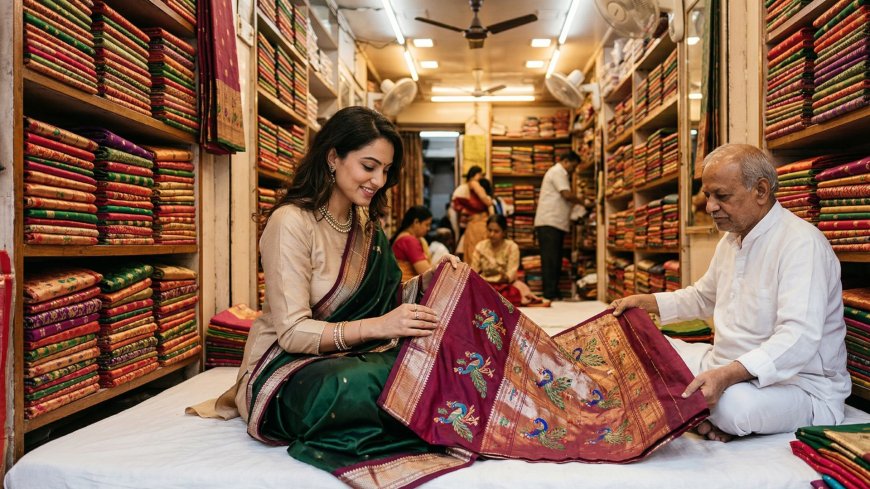
She went to Matunga on the second afternoon, because one of the pieces she had seen in Dadar was close but not right and she wanted to compare. In Matunga, in a shop whose owner had been buying from the same Yeola family for twenty-two years and who produced, without being asked, a folder of photographs of the loom and the weaver, she found the one. It was a deep forest green with a wine-coloured pallu, and the peacock motifs in the pallu had been worked in a blue-green silk thread that caught the light differently from every angle. She tested the zari. She examined the reverse. She looked at the selvedge. Everything was correct.
She bought it. She paid the price that was asked, which was within the range she had researched, and she did not feel the need to negotiate aggressively because the price was fair and the piece was right. She got a proper invoice. She arranged shipping with insurance. The saree arrived in Singapore twelve days later, undamaged, exactly as described.
Her future mother-in-law held it up to the light in the living room of the Pune apartment, in the particular silence of a woman who knows exactly what she is looking at. Then she said: this is a real one. You did well.
Go to Dadar first, with a brief and a reference price in your head. Turn every saree over before you make a judgment about it. Ask the specific provenance questions and treat the evasive answers as answers. Build at least two days into your Mumbai trip for this purchase, not one. Get the invoice, arrange the insurance, and do not ship without documentation.
The genuine Paithani exists in Mumbai. It is not as easy to find as it should be, and it requires more knowledge and more patience than the saree market always makes comfortable. But it is there, in the right shops, held by dealers who know the weavers by name and who are as proud of the provenance as you will be of the saree.
Published by NRIWedding.com — The Premium Global Platform for Non-Resident Indians Planning Indian Weddings From Abroad.
What's Your Reaction?
 Like
0
Like
0
 Dislike
0
Dislike
0
 Love
0
Love
0
 Funny
0
Funny
0
 Angry
0
Angry
0
 Sad
0
Sad
0
 Wow
0
Wow
0